
Ask ten HVAC technicians who makes the best heating and air conditioning equipment and you’ll get opinions, but you’ll notice something: they mostly name the same four or five brands, and then every single one of them adds the same caveat. The caveat matters more than the list. Here’s both, from a team that installs and repairs this equipment across Northern Virginia every day of the week.
Whichever brand you land on, it helps to know the budget first. The furnace and AC price estimator gives you a range for your own home in about two minutes.
The short answer
Trane, Carrier, Rheem, Mitsubishi Electric, and Lennox consistently sit at the top of the industry on build quality and engineering. We install Trane, Carrier, Rheem, and Mitsubishi Electric ourselves, and we service everything, so we see how every brand ages in real houses. But the honest answer to “what’s the best brand” is this: a mid-tier system installed correctly will outperform a premium system installed badly, every time, for its entire life. The nameplate decides maybe a quarter of your outcome. Sizing, ductwork, refrigerant charge, and airflow decide the rest, and those belong to the installer, not the factory.

How the major brands actually stack up
Trane
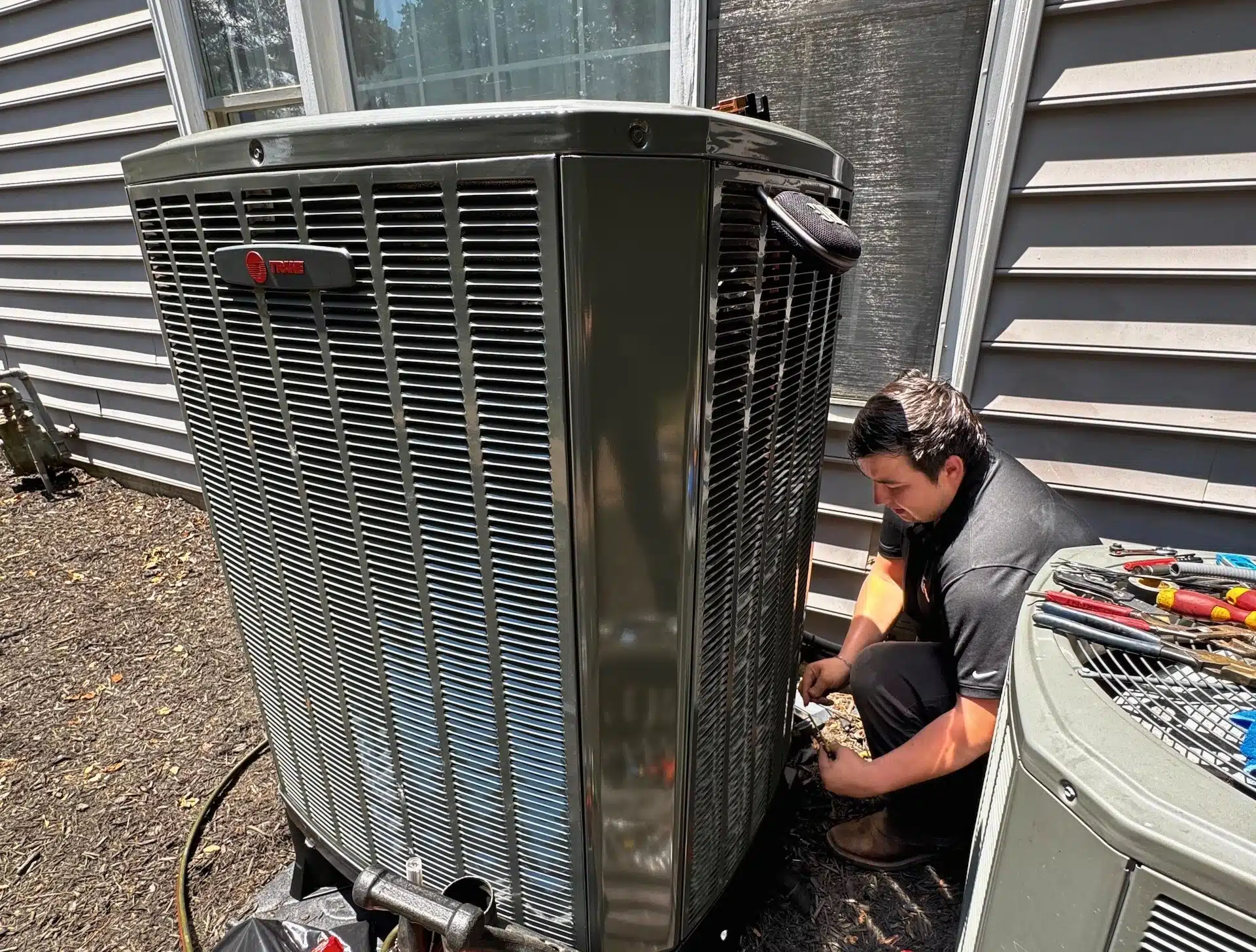
The reputation is earned. Trane tests its equipment hard, the cabinets and coils hold up, and the compressors are as reliable as anything in the industry. You pay for it, and parts are dealer-network items rather than corner-store parts, but on pure durability this is the brand technicians most often put in their own homes. If you plan to stay in your house 15 years, Trane’s math gets better every year you own it.
Carrier
Carrier invented modern air conditioning and it still shows in the engineering, especially in quiet operation and humidity control, which Northern Virginia summers make you appreciate quickly. The lineup is broad, from workhorse base models to the variable-speed Infinity line, so there’s a legitimate Carrier answer at several price points rather than one premium tier.
Rheem
The value pick of the big names. Rheem equipment is well built, parts are widely available, and repairs tend to be straightforward, which keeps lifetime cost down. It gives you most of the premium-brand reliability for noticeably less money, and for a lot of homeowners that’s exactly the right trade.
Mitsubishi Electric
In its lane, nobody touches it. Mitsubishi’s ductless and ducted mini-split systems are the answer for homes without ductwork, additions, bonus rooms over garages, and that one bedroom that never cools. Their cold-climate heat pumps keep full heating capacity in weather colder than anything a Virginia winter throws at us. If your problem is a room the main system can’t reach, this is the brand we reach for.
The other names you’ll see
Lennox builds some of the most efficient equipment on the market, though its proprietary parts can mean longer waits when something fails outside the dealer network. Goodman and Amana (both owned by Daikin) are the budget-friendly workhorses, much better equipment than their price suggests since Daikin took over, and a fair choice when the budget is the budget. Daikin itself is a global giant with excellent technology that’s still building out its U.S. dealer bench. York, Bryant, and American Standard are all legitimate; Bryant is built alongside Carrier and American Standard alongside Trane, so you’re often looking at familiar engineering in a different jacket.
What actually determines whether you love your system
- A real load calculation. The right system is sized to your house’s actual heat gain and loss, not “whatever was here before, plus a little.” Oversized equipment short cycles, cools without dehumidifying, and dies young. If a quote arrives without anyone measuring anything, that tells you plenty.
- Installation quality. Refrigerant charge, airflow setup, duct sealing, and combustion tuning are where systems are made or ruined. Industry studies have found a large share of systems are installed with defects that cut efficiency and lifespan, and our service techs see the evidence weekly.
- Matched components. A new high-efficiency condenser bolted to a 20-year-old indoor coil doesn’t deliver the rating on the sticker. The pairing has to be a certified match.
- Warranty registration. Most brands cut the parts warranty roughly in half if nobody registers the equipment. Your installer should do this for you and hand you the paperwork.

Which brand for which situation
- Staying put for the long haul: Trane or Carrier’s upper lines. The up-front premium spreads across 15 or more years of service life.
- Strong equipment, sharper price: Rheem, or Carrier’s base tiers. This is the sweet spot for most Northern Virginia households.
- No ducts, an addition, or one stubborn room: Mitsubishi Electric, full stop.
- Selling within a few years or outfitting a rental: Goodman or Amana gets you reliable heating and cooling without paying for a premium badge the next owner won’t notice.
Questions homeowners ask us
What is the best HVAC brand in 2026?
For overall build quality and longevity, Trane. For quiet, humidity control, and lineup depth, Carrier. For value, Rheem. For ductless and cold-climate heat pumps, Mitsubishi Electric. Any of the four, installed well, will serve you for 15 years or more.
Is a more expensive brand worth it?
Sometimes. The step from bottom-tier to mid-tier equipment buys you real reliability. The step from mid-tier to premium buys quieter operation, better humidity control, and efficiency that pays back slowly. What’s never worth it is premium equipment from the cheapest installer, because the install is the product.
Which brand lasts the longest?
Properly installed and maintained, the top brands all reach 15 to 20 years for furnaces and 12 to 16 for air conditioners and heat pumps. Neglect and bad installation shorten any brand’s life far more than the factory differences separate them.
What brands does SwiftPro install?
We install Trane, Carrier, Rheem, and Mitsubishi Electric, chosen because we also repair everything and these are the brands we’d put in our own homes. We service every major brand regardless of who installed it.
The bottom line
Pick from the top shelf, then spend your real scrutiny on the person installing it: do they measure the house, do they quote the full scope in writing, do they pull the permit, do they register the warranty. If you’re staring at a replacement quote right now and want a second set of eyes on the equipment and the numbers, our free second opinion exists for exactly that. And when you’re ready to talk options for your house, call (703) 997-9757 or book online and we’ll walk you through them straight.


