

Prices first. Freeing a jammed disposal is about $180. Replacing one with a unit we supply is $570 to $870 for most homes, with most around $700. If you already bought the disposal, installing it is $380 to $475. A few replacements ran over $1,000, and every one of those included clearing a drain or fitting new drain piping at the same time, which is a second job riding along.
Now the part that saves you the $180, because the most common disposal call we get has a four minute fix you can do yourself.
Garbage disposal humming but not spinning
That is a jam. Something hard is wedged between the impeller and the wall, and the motor is trying and cannot turn. Here is the manufacturer’s own procedure, and it works on essentially every brand.
Turn the switch off. Then leave it off.
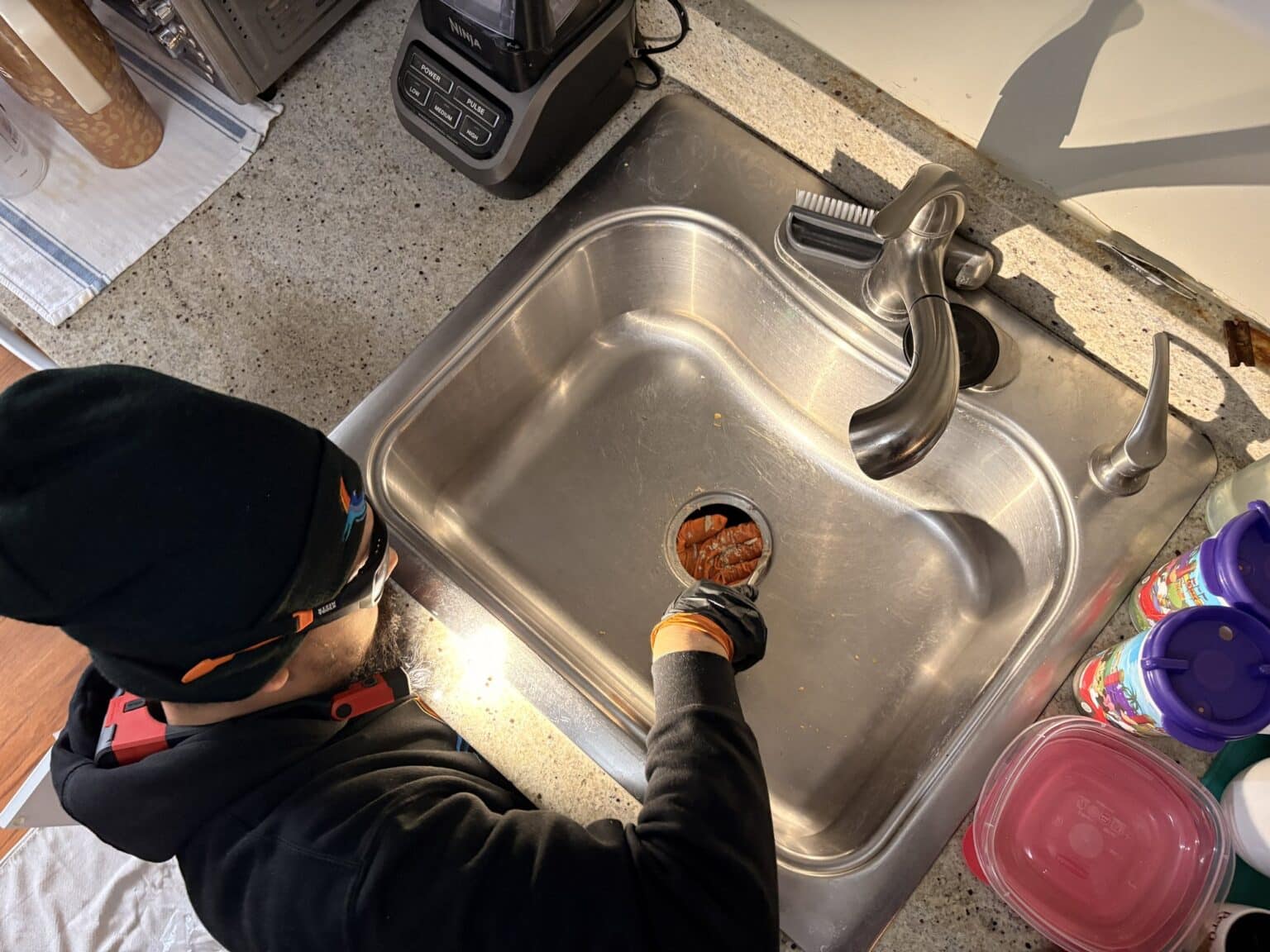
Find the hex socket in the center of the bottom of the unit. Most disposals ship with a small L shaped wrench for it, and if yours is long gone, a quarter inch Allen wrench from any toolbox fits.
Work it back and forth in both directions until the wrench turns a full revolution freely. That is the impeller breaking loose.
Fish the object out with tongs. Never fingers, even with the power off.
Press the reset button. It is a red button on the bottom of the unit facing the floor, and when it has tripped it sticks down about a quarter of an inch. Press it gently. If it will not stay in, the motor is still hot: wait ten minutes, up to twenty on some models, and try again.
Run cold water, flip the switch. That is the whole job.
If it hums with nothing in it and the wrench turns freely, the motor is seized or its capacitor is gone, and that is replacement. Nobody rebuilds a $150 motor.
Garbage disposal not working at all, no sound
Press the reset button on the bottom. Check the breaker. If it is a plug-in model, check that it is actually plugged in, because things get knocked loose under a sink. If a hardwired unit is dead after all that, the wall switch or the unit has failed.
It runs, but the sink backs up
That is not the disposal. It is the drain after it, usually the trap or the line in the wall packed with grease and ground food. Running the disposal harder does nothing. If the dishwasher also backs up into the sink, it is the same clog, because the dishwasher drains through the disposal.
Here is how to tell a fixture clog from a main line problem, and what clearing it costs.
Garbage disposal leaking from the bottom
Where it leaks decides whether this is a repair or a funeral.
From the top, where it meets the sink. The mounting ring loosened or the putty under the flange failed. Fixable, sometimes by tightening, sometimes by pulling and resetting the flange.
From the side, at the dishwasher hose or the drain elbow. A clamp or a gasket. Cheap.
From the bottom of the housing itself, or around the reset button. The internal seal is gone and water is in the motor. That disposal is finished. There is no repair, whatever its age.
Replacing it, and which one to buy
Disposals last eight to twelve years in normal use, and manufacturers’ warranties run from two years on the smallest models to ten on the top ones, which tells you roughly what they expect. A unit rusting at the bottom, leaking from the housing, or that has seized twice is done, and a repair visit on it is money toward the replacement you are going to make anyway.
The choice is mostly horsepower. A third horsepower unit is the builder default and the one we replace most. A half horsepower handles a normal kitchen. Three quarter horsepower runs quieter, grinds finer and jams less, and it is what we put in for families who cook a lot. One horsepower is for the person who has ground a corn cob on purpose and intends to again.
The other axis is continuous feed, the usual kind with a wall switch, against batch feed, where you drop a stopper in to run it. Batch feed is safer around small children and needs no wall switch.
If you buy your own, that is fine and the install price above reflects it. Match the mount style to the old one or the job gets longer, and if you have a dishwasher, know that the knockout plug inside the new disposal’s inlet has to be tapped out before the hose goes on. Leaving it in is the single most common do-it-yourself disposal mistake, and the symptom is a dishwasher that will not drain on the first run after a new disposal.
What not to put down it, and why it matters more here
Grease is the big one, and it is not a preference. Fairfax County’s public works department is direct about it: fats, oils and grease cause blockages in the sanitary sewer, they can create acidic conditions that corrode or dissolve concrete and iron sewer pipe, and dischargers of grease may be held liable for cleanup and repair costs. Loudoun Water adds the two things people get wrong: a disposal does not keep grease out of your pipes, and running hot water with it only pushes the grease further down the line before it cools and sets.
Worth knowing who pays: in Fairfax County the homeowner owns and maintains the private sewer line from the house to the county sewer. A grease blockage in your lateral is your bill.
The rest of the list: fibrous things that wrap the impeller, so celery, corn husks, onion skins and artichoke leaves. Starches in quantity, so pasta, rice and potato peels, which turn to paste in the trap. Bones bigger than a chicken wing. Shells from clams and oysters. Caustic drain cleaner, which does not clear a disposal and makes the job hazardous for whoever opens the line next.
Things people worry about that are fine, per the manufacturer: eggshells and coffee grounds in normal amounts. Ice cubes now and then help scour the chamber. And if you have one of the higher end models, corn cobs and banana peels are actually rated for it, which the cheaper units are not.
Always run cold water before, during and for fifteen seconds after. Cold keeps grease solid so it moves through rather than coating the pipe.
If you are on a septic system
The Virginia Department of Health does not recommend garbage grinders on homes with onsite sewage systems. Ground food is cellulose that the tank bacteria do not digest well, so solids build up faster and you pump more often. VDH puts normal pumping at every four to five years; a heavily used disposal shortens that. There are disposal models made for septic systems, and if you are keeping one, tell whoever installs it.
Frequently Asked Questions About Garbage Disposals
Can a disposal go in where there was not one? Yes. It needs power under the sink, which sometimes means an electrician first, and a standard sink drain opening, which nearly all are.
Do you repair them? Jams, leaks at the flange or the fittings, resets, wiring, yes. Motors, no, and neither does anyone else.
Mine is loud but works. They get louder as the bearings wear. Loud is not broken. If it grinds and drains, keep it and set the money aside.
It is the day before Thanksgiving. So is everyone else’s. If the disposal is marginal in October, deal with it in October.
SwiftPro repairs and replaces garbage disposals across Northern Virginia. Call (703) 997-9757, book online, or see our plumbing services.