

Installing a toilet you bought yourself runs about $430 to $500. A replacement where we supply the toilet most often lands between $840 and $1,300, depending on the fixture you choose and what we find under the old one. Repairs, meaning fill valves, flappers and complete internal rebuilds, run $260 to $870.
Most of the time the repair is the right purchase. Here is how to tell when it is not.
Repair it, in these cases
It runs constantly or intermittently. Flapper or fill valve, and both are inexpensive. This wastes more water than people believe: put ten drops of food colouring in the tank, wait ten minutes, and if colour reaches the bowl without flushing, that is your leak. Three fixes, cheapest first, are here.
The handle needs jiggling, or the flush is weak. Chain length, flapper seal, or a partially blocked rim. A complete internal rebuild is a modest job and makes an old toilet behave like a new one.
It rocks slightly. Usually shims and a new wax ring. Worth doing promptly, because a rocking toilet eventually breaks its seal and leaks into the floor.
It sweats in summer. Condensation on a cold tank in a humid bathroom. Annoying, not a defect.
Replace it, in these cases
The bowl or tank is cracked. Not repairable. A hairline crack becomes a flood on its own schedule.
Water is seeping from the base, and a new wax ring has not fixed it. If the flange underneath is broken or has rusted, the repair is the flange, and while the toilet is off the floor is the sensible moment to decide about the fixture.
It clogs repeatedly with normal use. Some older low-flow toilets from the first generation of water-saving designs, roughly the early 1990s, genuinely do not clear reliably. Modern low-flow designs are far better engineered and this is one case where a new fixture is a real improvement rather than a preference.
It is a very old high-volume toilet. Pre-1994 toilets can use three and a half gallons or more per flush against 1.28 on a modern high-efficiency model. In a busy household that difference shows up on a water bill.
You are renovating anyway. Replacing a toilet during a bathroom project costs a fraction of doing it as a standalone visit later.
What moves the price
The fixture itself. A basic two-piece round-front toilet and a one-piece elongated comfort-height model with a quality flush valve are genuinely different products at genuinely different prices. This is the largest variable, and it is your choice rather than ours.
The flange. The fitting that connects the toilet to the drain. If it is intact, the swap is quick. If it is cracked, rusted, or sitting below the finished floor after somebody tiled over the old one, repairing it adds time. This is the most common on-site surprise and it is the reason an honest quote says “assuming the flange is sound.”
The shutoff valve. The old angle stop under the tank is often twenty years old and seized. Replacing it while the toilet is off is sensible and inexpensive, and we would rather do it then than come back when it fails.
Access. A powder room under a staircase, a third floor bath, or a toilet installed before the surrounding cabinetry all take longer.
Haul-away. The old fixture has to go somewhere. That should be in the price, not a surprise.
Choosing the fixture
Height. Comfort height, around 17 to 19 inches to the seat, is what most people prefer now and is easier for anyone with knees, hips or mobility issues. Standard height is around 15 inches.
Bowl shape. Elongated is more comfortable; round-front fits a tight powder room. Measure before you fall in love with one.
Rough-in. The distance from the finished wall to the centre of the drain bolts, almost always 12 inches but occasionally 10 or 14 in older houses. Getting this wrong means the toilet does not fit. Measure it before buying anything.
One piece or two. One piece is easier to clean and generally costs more. Two piece is easier to carry upstairs and easier to service.
Flush performance over branding. The mechanism and the trapway matter more than the logo. If you have had clogging trouble, this is the specification to ask about.
If you buy your own, that is completely fine and the install price above reflects it. Just confirm the rough-in and have it on site before the appointment.
The thing worth checking while somebody is there
Water pressure. Plumbing code requires a pressure reducing valve where incoming static pressure exceeds 80 psi, and parts of this region run well over 100. High pressure makes fill valves fail early, which is why some households replace them every couple of years and assume that is normal. It is not. A gauge on a hose bib costs about $12, and replacing a failed pressure reducing valve runs $500 to $994.
Also worth a look: the supply line to the tank. Braided stainless lines have a service life, and a failed one floods a bathroom at full pressure. They are inexpensive to replace preventively.
Frequently Asked Questions About Toilet Replacement and Repair
How long does it take? Usually an hour or two for a straightforward replacement. Longer if the flange needs repair.
Do I need a permit? A like-for-like fixture swap generally does not. Moving the drain does.
Will a new toilet fix my slow drain? Only if the toilet is the restriction. If more than one fixture is slow, the problem is the drain line and a new toilet changes nothing. The five minute test is here.
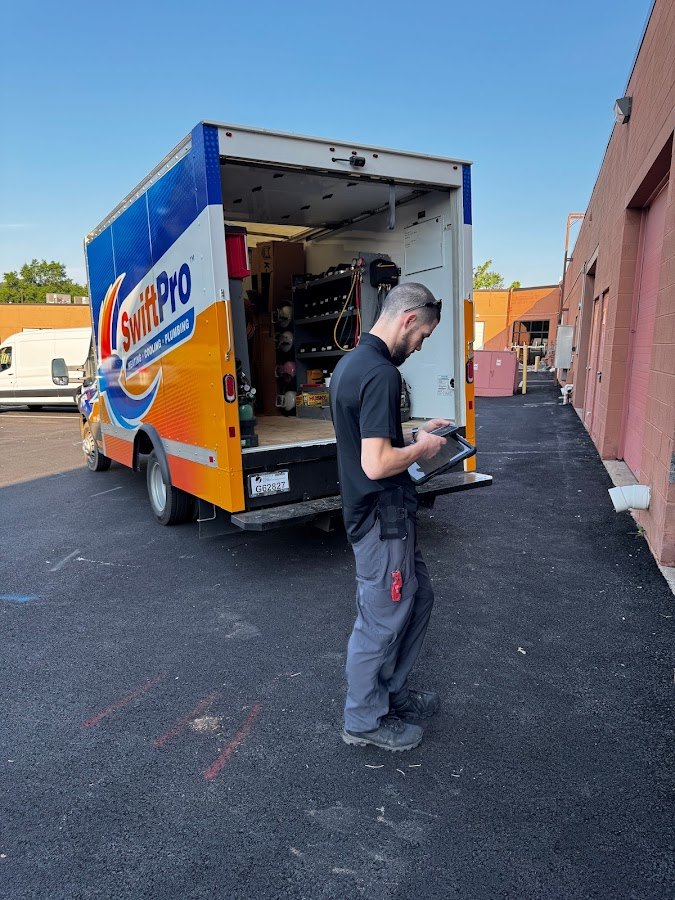
SwiftPro repairs and replaces toilets across Northern Virginia. Call (703) 997-9757, book online, or see our plumbing services.