
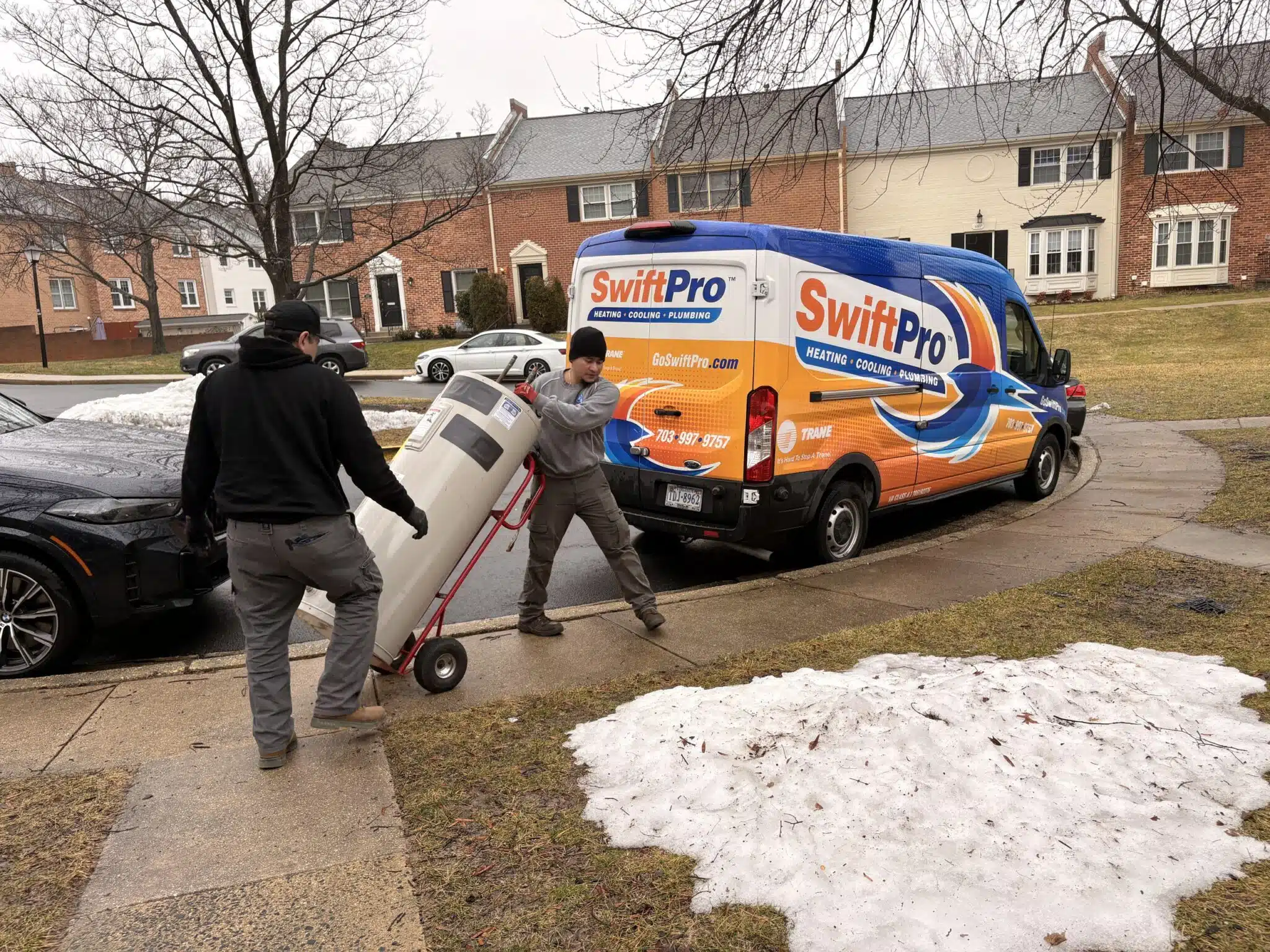

Cold shower in McLean this morning? Before anyone talks you into a whole new unit, or you sink money into a heater that’s already told you it’s done, here’s the honest framework we use on every no-hot-water call: the age of the unit, where the water is coming from, and what the repair actually is. Ten minutes of reading now makes you a much harder customer to upsell later, whoever you end up calling.
The two questions that decide almost everything
How old is it? A standard tank water heater typically gives you 8 to 12 years. The manufacture date is hiding in the serial number on the data plate, and if you can’t decode it, take a photo and any plumber can. Under 8 years, repairs usually make sense. Past 12, every repair is a bet on borrowed time, and the question shifts from “can it be fixed” to “should it be.”
Where is the water? This is the one that overrides everything else. Water seeping from the tank body itself means the tank has rusted through from the inside, and no part fixes that. That unit is done, full stop, and the smart move is replacing it on your schedule this week instead of the tank’s schedule at 2 a.m. But water at a fitting, at the temperature and pressure relief valve, or at the drain valve is a different story. Those are connections and parts, and parts get fixed.
What’s usually repairable
- No hot water at all: a failed thermocouple or gas valve on gas units, a dead heating element or thermostat on electric ones. Routine fixes.
- Not enough hot water: sediment buildup eating tank capacity, a failed dip tube, or one dead element on an electric unit. Also routine, and in a big McLean house sometimes the real answer is that the tank was undersized on day one.
- Rumbling and popping: sediment on the bottom of the tank flash-boiling water above it. A flush helps if it’s caught early, and we do a $99 water heater flush that’s exactly for this.
- Dripping relief valve or drain valve: replaceable parts, though a relief valve that keeps opening can also be telling you about a pressure problem worth checking properly.

What a replacement should include in a McLean house
Larger homes raise the stakes on getting the details right, and this is where a proper install separates itself from a box-swap.
- Real sizing, not “same as the old one.” Multiple bathrooms, a soaking tub, and a household that showers back to back need recovery rate and capacity matched to how the house actually runs. The old tank being a certain size is history, not evidence.
- An expansion tank. Homes with a pressure reducing valve or backflow protection at the meter are closed systems, and heated water needs somewhere to expand. Skipping this part shortens the new heater’s life and is exactly the kind of corner a cheap quote cuts.
- A drain pan and a clear discharge path when the heater lives above finished space, which in McLean it often does. A $40 pan versus a finished-basement ceiling is not a close call.
- Permit and inspection. A water heater swap needs a plumbing permit in most Northern Virginia jurisdictions. We pull it and meet the inspector; that’s part of the job, not an add-on.
- Haul-away of the old unit, because a dead 50-gallon tank in the garage helps nobody.
Worth considering while you’re deciding: tankless
If the household regularly outruns its tank, a tankless unit ends the rationing: endless hot water, a 20-year service life instead of roughly half that, and reclaimed floor space. It costs more up front and wants proper gas and venting work, so it’s not automatic, but a replacement day is the one time the switch costs the least to consider. We’ll give you the honest comparison for your house, not a pitch.
The bottom line
Under 8 years old and not leaking from the tank: repair it. Past 12, or wet at the tank body: replace it, calmly, on your terms. In between: get a diagnosis and a straight quote for both paths and decide with the numbers in front of you. That last part is how we run every call. SwiftPro handles water heater repair, replacement, and installation across Northern Virginia, McLean very much included. Call (703) 997-9757 or book online, and if the no-hot-water situation is happening right now, say so and we’ll treat it with the urgency a cold house deserves.

