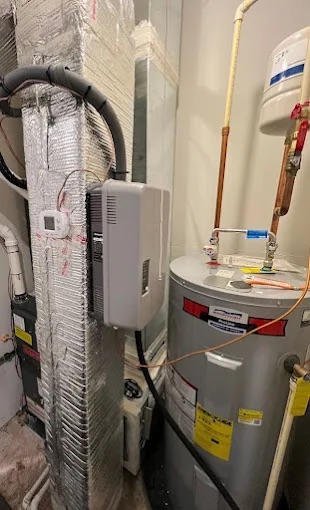

Here is the number, before the explanation: a new tank water heater in Northern Virginia runs $2,757 to $7,494 installed, electric at the low end and power vent at the high. Tankless is $8,886 to $10,486 installed. Those are the prices our water heater estimator gives, the same ones published on our water heater page, and they include the permit, the expansion tank, the drain pan, haul-away and the labor.
What follows is why the spread is that wide, because a $2,757 job and a $7,494 job are genuinely different work.

The price table
Installed, all in. Where you land inside a range is the size of the tank, the warranty on it, and how it vents.
| Your setup | Installed |
|---|---|
| Electric tank 50 or 80 gallon, no flue, no gas line |
$2,757 to $5,493 |
| Gas or propane tank 50 or 75 gallon, on the flue you already have |
$3,379 to $5,485 |
| Power vent tank gas or propane, a fan and PVC out a side wall |
$5,957 to $7,494 |
| Tankless one high efficiency condensing unit for the whole house |
$8,886 to $10,486 |
One thing rides on top of any row. Scale protection (a salt-free OneFlow unit on the cold side) adds $800 and is worth it on tankless, where hard water can void the warranty. Financing is available on every tier, subject to approval.
The price is conditional on one thing: a technician measures the space and checks the venting before the job is booked. If your utility room is exactly what you told us, the number holds.
What moves you inside the table
Gas or electric. Electric units cost less to buy and are simpler to install. Gas units cost more and bring venting into the job.
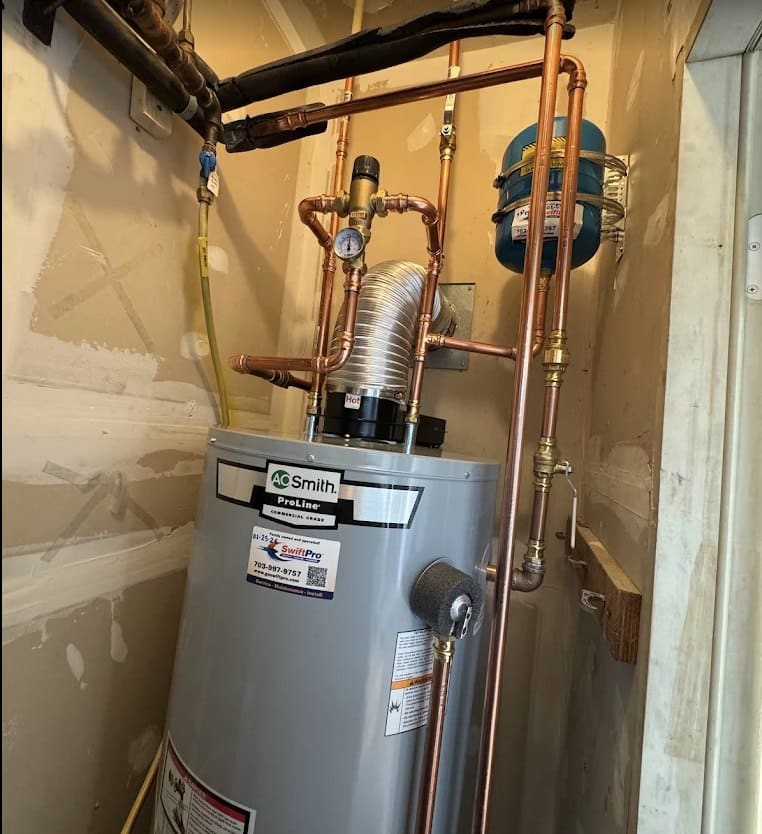
How it vents. This is the biggest single jump in the tank world, and it is why power vent has its own row. An atmospheric unit drafts naturally up an existing flue. A power or direct vent unit uses a fan and PVC out a side wall, which costs more for the equipment and more for the install. If your utility room has no usable flue, this is not optional.
Six-year or ten-year. The 10-year tank is the same install with a heavier tank, a longer warranty and a faster recovery. It costs more, and it is the one most people pick.
Size. One to four people is a 50 gallon. Five or more, or four-plus bathrooms, is a 75, or an 80 on electric, and that sits at the top of its range because the tank does.
How hard it is to get to. A basement with a walkout door is the easy case. A third-floor closet, a crawlspace, an attic platform, or a basement reachable only by a tight turn on a finished staircase adds labor, and that is what the pre-measure is for.
What a to-code install includes
If you are comparing quotes, compare these line by line. This is where a low number usually turns out to be a different job rather than a better deal. Every range in the table above includes all of it.
- The permit, and meeting the inspector. Water heater replacement is permitted work in Northern Virginia jurisdictions.
- An expansion tank. Most Northern Virginia homes are closed plumbing systems now, so it is required, and older installs frequently do not have one.
- A new shutoff valve, not the twenty-year-old one you already have.
- A correctly sized and correctly terminated T and P discharge line.
- A drain pan with a route to somewhere safe, wherever a leak would reach finished space.
- Correct venting and combustion air for gas units, verified rather than assumed.
- Haul-away and disposal of the old unit.
- Warranty in writing, on both the equipment and our labor.
Water Heater Replacement Pricing and Installation Options
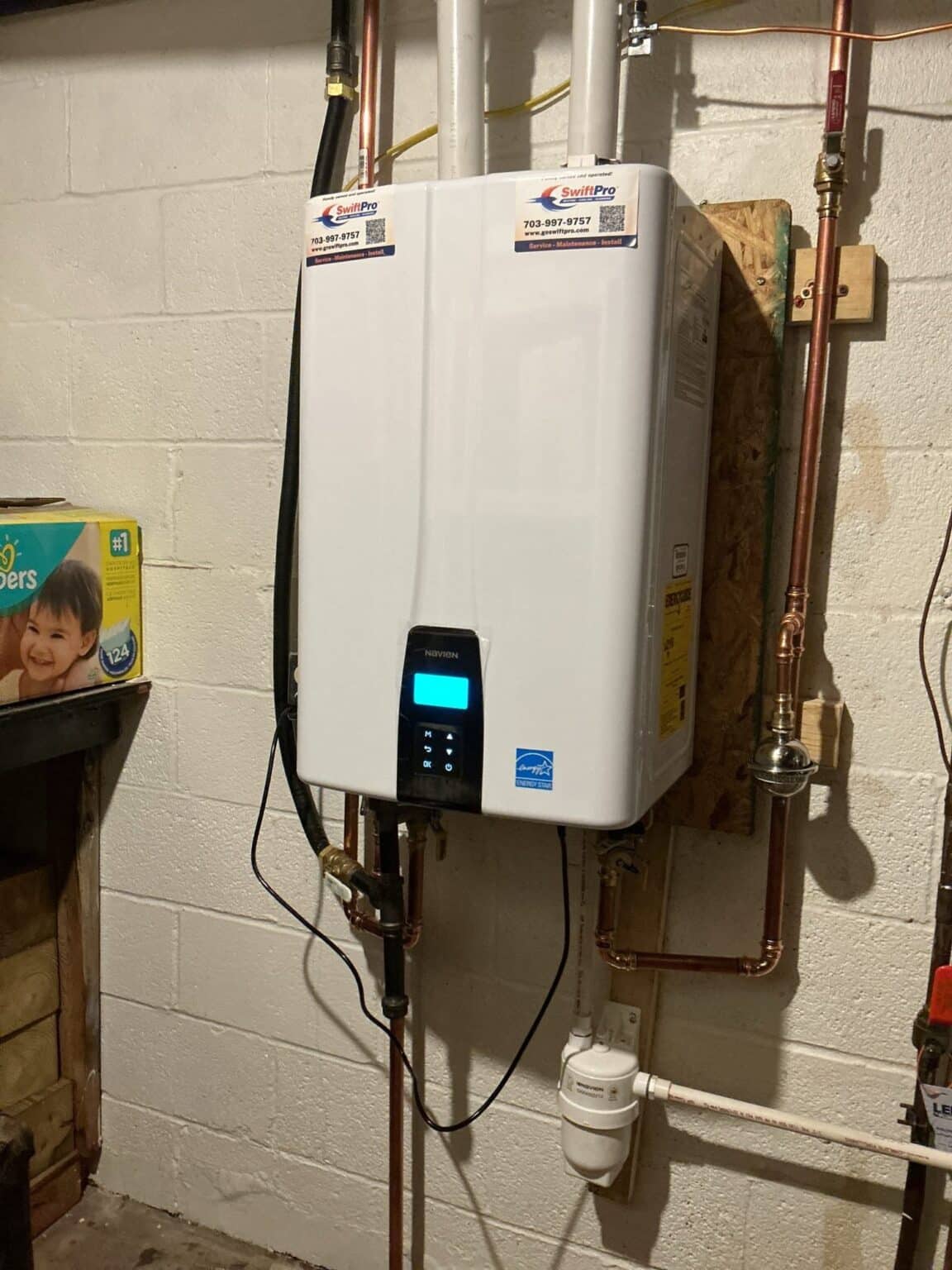
A tankless unit heats water as it passes through, so hot water does not run out and the unit lasts roughly twice as long as a tank. It also frees up the floor space, and the gas ones carry a 15-year heat exchanger warranty.
The reason it costs more is not the box. It is that feeding one properly usually means upsizing the gas line, running new venting, and sometimes upgrading the meter. That work is the majority of the difference between the gas tank row and the tankless row.
The honest test is simple: if your current tank never leaves anyone cold, its replacement probably should not cost tankless money. If your household has been outrunning the tank for years, replacement day is the cheapest moment you will ever have to switch, because you are paying for the labor either way.
Ask for both priced side by side. Any company that will not do that is telling you something.
The cheap quote problem
A meaningfully lower price usually means one of four things, and it is worth knowing which:
- No permit, which means no inspection and a problem at resale.
- No expansion tank, which stresses the new heater and every fixture in the house.
- Reusing the old shutoff, connectors and pan.
- A shorter warranty than it sounds like. “Ten year warranty” is often the manufacturer’s parts coverage with nothing on the labor, and labor is the expensive half of a warranty call.
None of that makes a company dishonest. It makes the quote a different scope, and you cannot compare two numbers for two different jobs.
Replacing before it fails
Tanks last eight to twelve years here. If yours is in that window and starting to rumble, you get to choose the day, get both options priced, and avoid the emergency premium. If you wait, the tank chooses, and it usually chooses badly. The warning signs are here, and a mid-life unit often buys years from our $99 flush.
Getting your number
The fastest way is the water heater estimator: four questions, and your installed price shows up in about a minute. The ranges for every fuel are on the water heater page, and a free measure turns a range into a number for your room, with the option to lock it in. Or skip it: SwiftPro replaces water heaters across Northern Virginia, usually same day. Call (703) 997-9757 or book online.