

Is an AC tune-up worth it? For a system between three and fifteen years old, yes, and the reason is a specific part. The run capacitor. It’s a small can that gives the compressor and fan their starting kick, and Trane’s own service literature says the biggest reason it fails is overheating. It tests weak in May. It dies at 4 pm in July. A tune-up is mostly the hour that finds it in May, when replacing it is a $240 to $370 job on a Tuesday instead of an evening call during the week everybody else’s died.
That’s the short version. What follows is what should actually be in a tune-up, what “AC cleaning” means when it’s real, and the plain math on a maintenance plan.
What does an AC tune-up include?
ENERGY STAR publishes the technician’s list, and any tune-up you pay for should cover it. At the outdoor unit: refrigerant level checked and adjusted, electrical connections tightened with voltage and current measured on the motors, the condenser coil cleaned, controls checked for safe operation. At the indoor unit: the evaporator coil cleaned, the condensate drain checked, the blower cleaned and adjusted for proper airflow, the thermostat verified. Moving parts lubricated where the design calls for it.
Here’s what those line items are actually for, in the order they save you money.
The capacitor, tested under load. A weak one reads fine sitting there and fails under a heat wave. Sixty seconds with a meter.
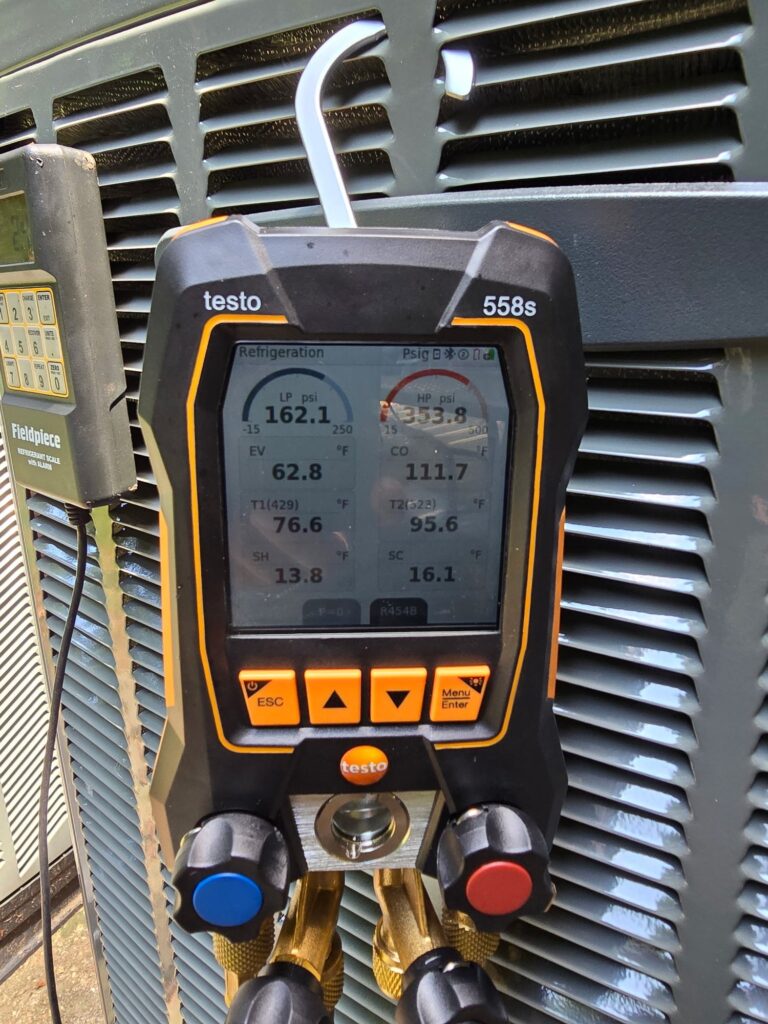
The refrigerant charge, measured, not eyeballed. A Florida Solar Energy Center study found incorrect charge in more than half of the systems it audited, and a 20 percent undercharge cost a three ton system about a quarter of its cooling capacity on a 95 degree day. A system that’s low didn’t use up refrigerant. It leaked, and the tune-up is where you find that out before August.
The condensate drain, flushed. In July, a clogged drain is a daily call for us. The float switch shuts the system off before the pan overflows, which is good, and leaves you with no AC on a Saturday, which is not. Flushing it in spring is the cheapest item on the list.
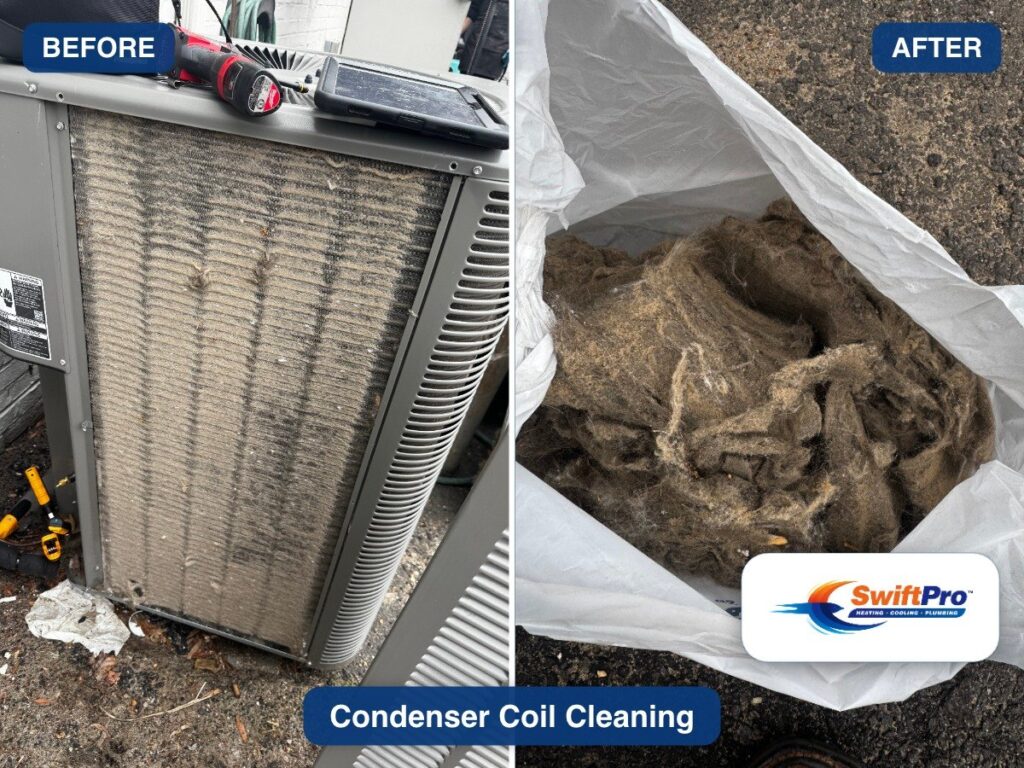
The condenser coil, rinsed from the inside out. Cottonwood fluff, grass clippings and pollen coat the fins, and the unit runs longer and hotter to shed the same heat. Lawrence Berkeley National Laboratory found condenser fouling can cost 20 percent of performance over four to seven years. Spraying the outside of the fins with a hose does almost nothing. The cleaning happens from inside the cabinet.
The filter and the airflow. The DOE’s number is that keeping the filter clean lowers cooling energy use by 5 to 15 percent. The technician’s number is whether the blower is actually moving the air the system was designed for, which is measured, not assumed.
Then the part that matters: a plain list of what’s fine, what’s weak, and what the weak thing costs to fix now. Most tune-ups end with nothing on that list. The ones that end with a capacitor are the reason the tune-up exists.
What “AC cleaning” means when it’s real
People search for AC cleaning service and get three different jobs quoted. They are different.
Condenser coil rinse. Part of every tune-up, covered above.
Blower wheel cleaning. The squirrel-cage fan inside the air handler collects a felt of dust on each blade, especially in houses that ran for years without a good filter. A loaded wheel moves noticeably less air, which shows up as weak airflow at the registers and a coil that ices over. Pulling and cleaning it is a real job, $300 to $440, and it’s the one where people are most surprised by what came off.
Evaporator coil cleaning. The indoor coil, cleaned in place with a foaming cleaner or pulled when it’s badly loaded. Worth knowing: the LBNL study found a typical dirty evaporator coil costs under 5 percent of efficiency, so this is a “when it’s visibly loaded” job, not an every-year upsell. If someone quotes it every spring, ask to see the coil.
None of these is duct cleaning, which is its own service with its own case for and against. That’s here.
How often should an AC be serviced?
Once a year for cooling, in April or May before the first 90 degree day, and once for heating in September or October. That’s ENERGY STAR’s schedule, and it’s about right for equipment that runs something like three thousand hours a year in this climate. Between visits, the homeowner’s job is the filter (check it monthly in summer), keeping two feet clear around the outdoor unit, and not piling mulch against it. Here’s the homeowner list.
Is an HVAC maintenance plan worth it?
Our Family Care Plan is $199 a year for one system. It includes the yearly HVAC tune-up, a plumbing and water heater check, 15 percent off every repair, and priority scheduling. Here’s the math without the sales voice.
If you’d pay for a tune-up anyway, the plan costs about the same and the discount is free. If one repair over about $1,300 happens in the year, a blower motor say, the 15 percent covers the plan on its own. If nothing breaks, you paid for a tune-up and a plumbing inspection and got a place at the front of the line in a heat wave, which is worth something on the one day it matters.
When it’s not worth it: a system you’re replacing this year. Put the money toward the new one. Or a system still under a labor warranty that already includes maintenance. Check what you have before buying more of it.
When a tune-up is the wrong purchase
ENERGY STAR’s line for thinking about replacement is a system more than ten years old, and their figure is that a new certified unit can cut heating and cooling costs by up to 20 percent. A fifteen year old air conditioner that needs refrigerant every spring is not a tune-up customer. It’s a candidate for a new system, and a tune-up on it is a $200 way to learn that. The furnace and AC estimator shows what a replacement runs for your size of house in about two minutes, with no phone number, so you can have that number in hand before anyone stands in your driveway.
Frequently Asked Questions About AC Tune-Ups
Does a tune-up find everything? No. It finds what’s measurable that day. A capacitor at the edge of its range, a coil that’s dirty, a drain that’s slow. It doesn’t predict a compressor that fails in August with a good reading in May, and anybody who promises no breakdowns is overselling.
Do you push repairs during a tune-up? We list what’s weak with a price and you decide. Most tune-ups end with nothing to fix.
Can I do any of this myself? The filter, the clearance around the outdoor unit, a gentle straight-in rinse of the fins. Anything with the panel off or gauges on is ours.
SwiftPro tunes up and maintains air conditioners and heat pumps across Northern Virginia. (703) 997-9757, book online, or read about the AC maintenance service.