

No hot water at all, or hot water that runs out in four minutes, are two different problems with two different lists. Work through the right one and you will either fix it yourself or be able to tell us exactly what is wrong before we arrive.
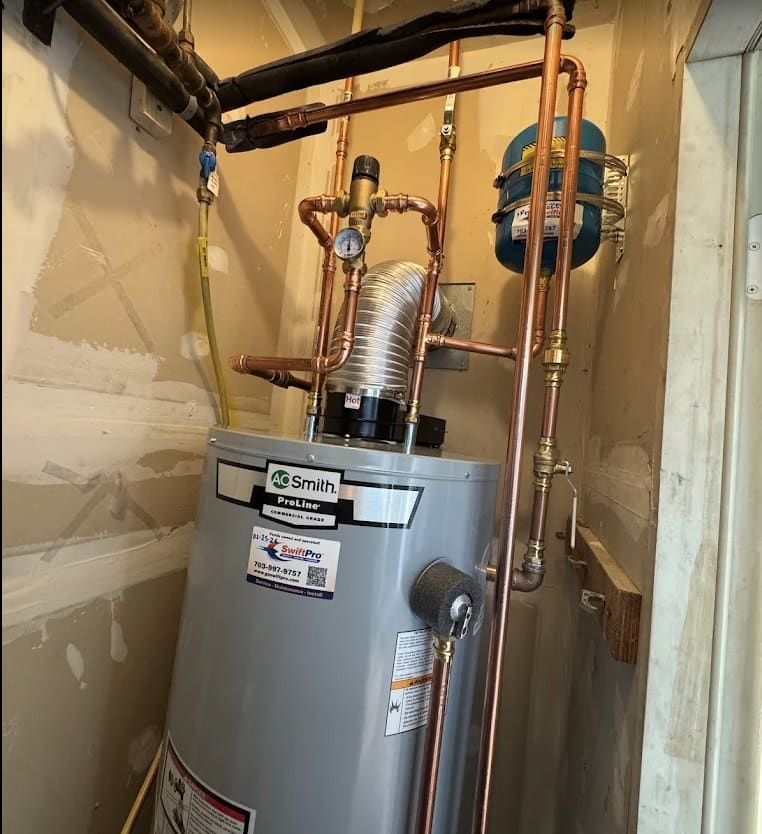
First, find out which kind of water heater you have, because everything below depends on it. A tall cylinder in a closet or basement is a tank. A box on the wall about the size of a carry-on suitcase is tankless. If it is a tank, is there a gas line and a flue going into it, or just an electrical conduit?
Electric tank: no hot water at all
The breaker. An electric water heater usually has a double pole breaker of its own. Look for one sitting between On and Off. Flip it fully off, then on. If it trips again, stop resetting it and call, because a repeatedly tripping water heater breaker usually means a failed element or a short.
The reset button. Behind the upper access panel on the side of the tank there is a red button, the high limit reset. Turn the breaker off first, take the panel and the insulation aside, and press it. If it clicks and hot water returns, note the date, because a reset that trips again within weeks means a failing thermostat or element.
If both check out and the tank is stone cold, you have a failed element or thermostat. Both are replaceable and worth replacing on a tank under about eight years old.
Gas tank: no hot water at all
Is the pilot or igniter working? Most units made in the last fifteen years have a small status light on the gas control valve at the bottom that blinks a code. Look at it and count the blinks before doing anything, because the code is the diagnosis and resetting clears it.
Is the gas on? Is the stove lighting? Is the valve on the line to the heater open, handle in line with the pipe?
Older units with a standing pilot can be relit following the instructions printed on the label, and if it will not stay lit, the thermocouple is the usual culprit and it is a small part.
If you smell gas at any point, stop. Leave the house without touching a light switch and call Washington Gas at 844-927-4427 or 911 from outside.
Tankless: no hot water at all
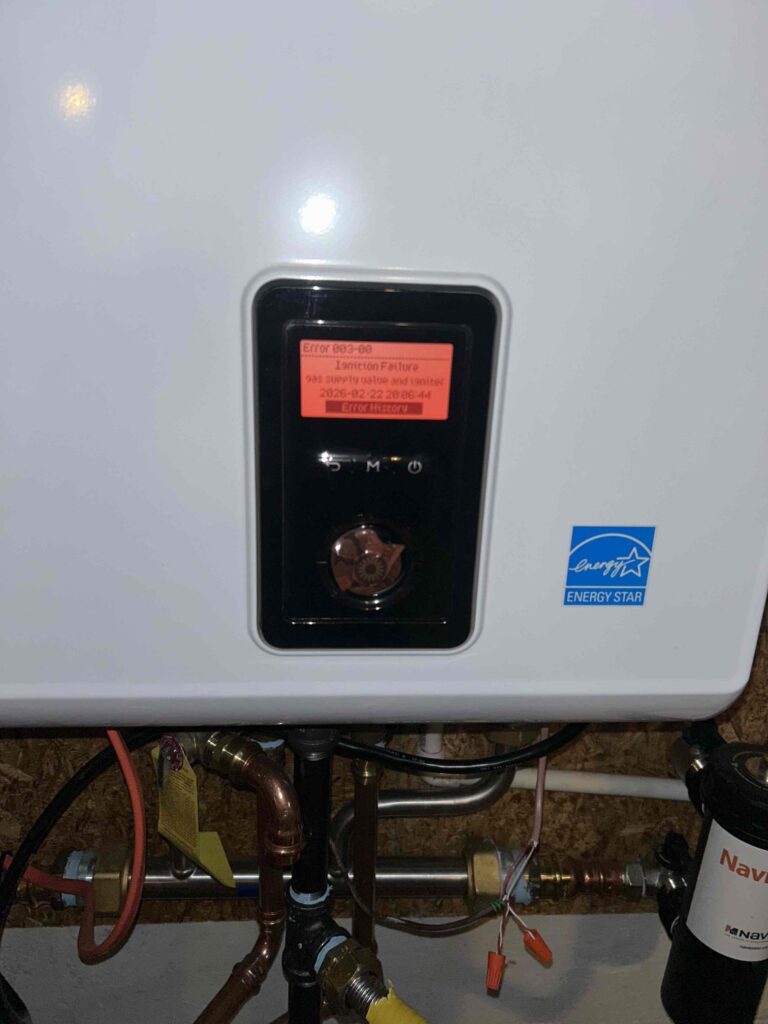
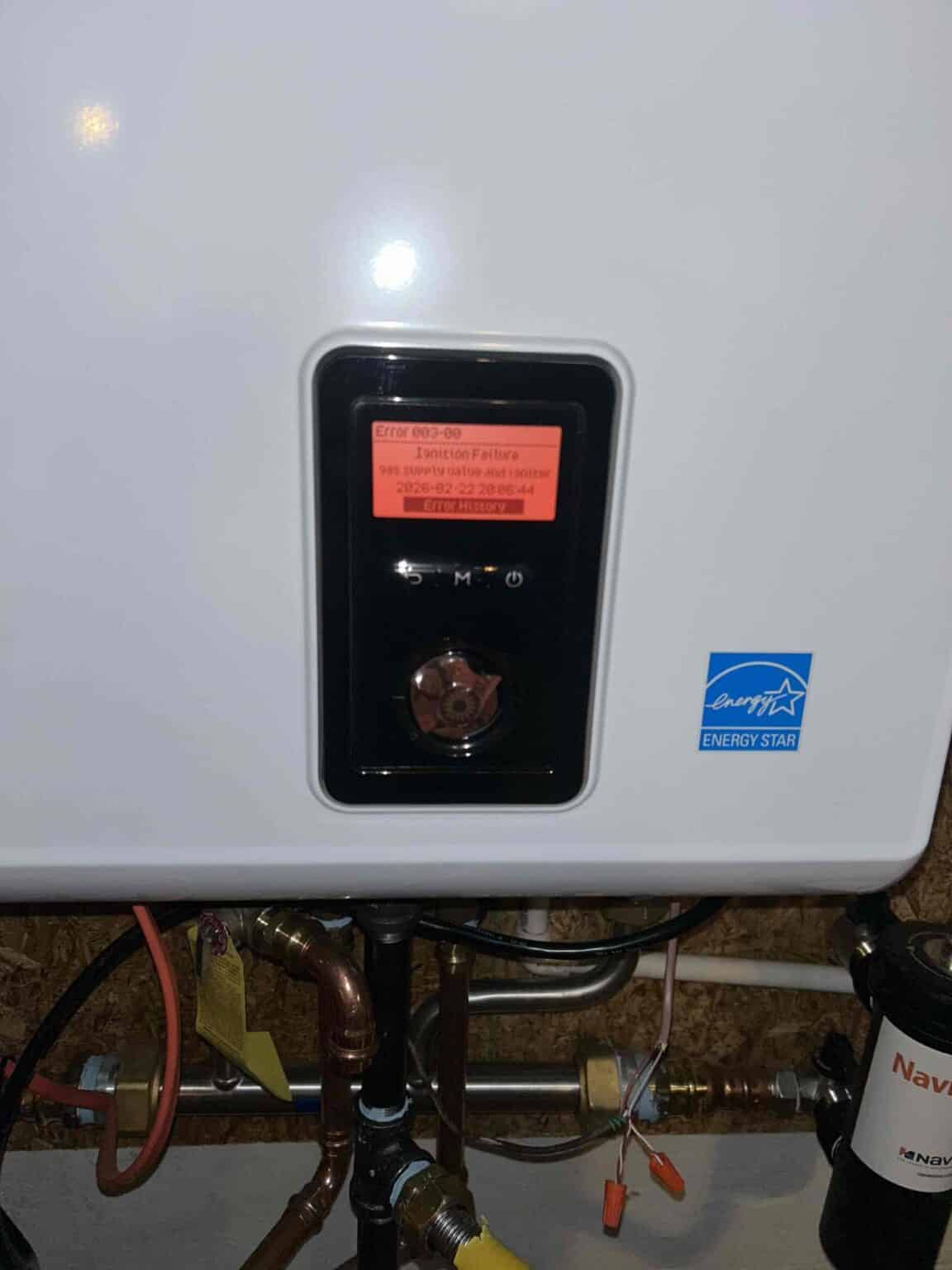
Photograph the error code on the display before you reset anything, because the reset clears it. Then four checks.
Power. A gas tankless unit needs electricity for its board, fan and igniter. Check the breaker and the outlet. After a storm this is the answer more often than not.
Gas. Stove lighting? Valve open?
Flow. The unit will not fire until enough water moves through it, about half a gallon a minute on a Navien and a little under that on a Rinnai. A low-flow bathroom faucet on a trickle may not trigger it. Open a tub spout fully and wait ten seconds.
The inlet screen. A small filter where cold water enters the unit, which clogs with sediment. The manual shows how to pull and rinse it. Five minutes.
The full tankless symptom and error code list is here.
Hot water, but it runs out fast
Different problem entirely, and the tank is usually not broken.
The dip tube. Cold water entering a tank is supposed to be delivered to the bottom by a plastic tube. When that tube cracks or breaks, incoming cold water mixes straight into the hot water at the top and you get lukewarm water that runs out immediately. Classic symptom, cheap part, and frequently misdiagnosed as a dead tank.
Sediment. Minerals settle to the bottom and occupy volume the water used to have. Fairfax Water describes its water as moderately hard to hard, so this happens here faster than in soft-water regions. You will often hear it as popping or rumbling when the burner fires. A flush helps if it is caught early.
One failed element, on an electric tank. Two elements, one dead, means roughly half the hot water you used to get.
The thermostat setting. Somebody turned it down, or it drifted. 120 degrees is the usual target.
Nothing is wrong and the house outgrew the tank. A 40 gallon tank that was fine for two people is not fine for four with a soaking tub. That is a sizing conversation, not a repair.
Lukewarm at every tap, in winter only
Worth its own note because it catches tankless owners out. The colder the incoming water, the harder the unit works to reach your setpoint, and in a Northern Virginia January the water arriving from the Potomac runs in the mid thirties. A tankless unit rated at eleven gallons a minute with a mild temperature rise delivers roughly half that when it is raising water eighty degrees. Nothing is broken. You are running more fixtures than the unit can serve at winter temperatures.
On a tank, the same cold intake means a longer recovery between showers.
The one where you should stop reading and act
Water pooling under the tank, or dripping from the bottom of it, is not a no-hot-water problem, it is a flooding problem in waiting. Here is how to tell a fitting leak from a failed tank, and if it is the tank itself, shut the water and the gas or breaker off and call.
Repair or replace
Tanks last eight to twelve years in this area. Under eight, repair almost anything: elements, thermostats, dip tubes, thermocouples and gas valves are all normal parts. Past twelve, a significant repair is money into a tank that is going to leak soon, and a leak is the failure mode you do not want to discover while you are away.
A new tank runs $2,800 to $5,800 installed with most homes at $3,400 to $4,200, and tankless $6,000 to $7,000. You can price your own configuration in our water heater calculator. The honest tank versus tankless comparison is here, including the case for staying with a tank.
One maintenance note that prevents a lot of this: a tankless unit needs an annual descaling flush in our water, which runs $79 to $365 and which both major manufacturers require in writing. Skipping it is how a fifteen year warranty claim gets declined.
What to tell us when you call
Tank or tankless, gas or electric, roughly how old, what the status light or error code shows, and whether it is no hot water or not enough. That takes thirty seconds and it decides which parts the truck brings.
SwiftPro repairs and replaces water heaters across Northern Virginia. Call (703) 997-9757 or book online.