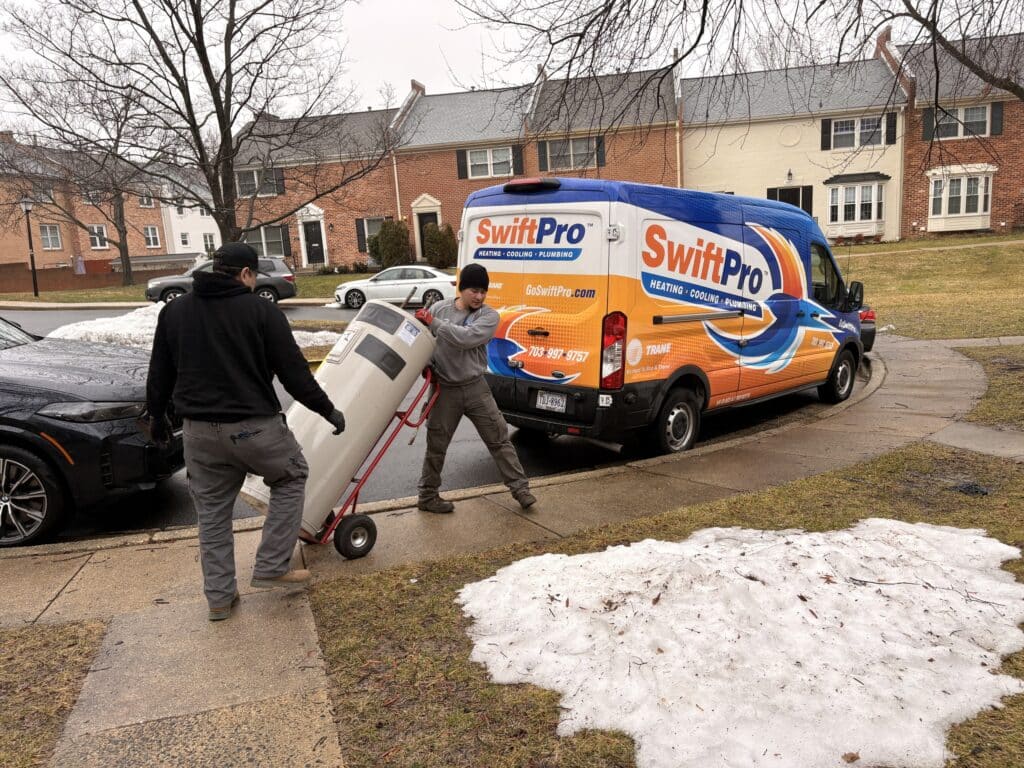


A water heater is the appliance most likely to flood your house and the one nobody looks at until it does. Three maintenance items decide whether yours reaches twelve years or dies at eight, and two of them you can do yourself in an afternoon.
Why it matters more here
Fairfax Water describes its water as moderately hard to hard, in the range of 5 to 10 grains per gallon, and Alexandria’s most recent report reads higher still. Those dissolved minerals come out of solution when water is heated and settle in the bottom of a tank or coat the inside of a tankless heat exchanger.
In a tank, that sediment insulates the burner from the water, so the burner runs longer and hotter to do the same job. It occupies volume that used to hold hot water, which is why an older tank seems to run out faster. And it makes the popping and rumbling you hear when the burner fires, which is steam bubbles forcing their way up through a layer of sludge.
The flush, on a tank
Once a year. Draining a few gallons off the bottom takes most of the sediment with it.
The honest version: on a tank that has never been flushed and is past eight years old, opening the drain valve can dislodge enough sediment to block the valve, and occasionally a plastic drain valve that has never been turned will not reseal. That is the reason plenty of plumbers quietly stop recommending it on old tanks. If yours is over eight and has never been done, it is worth having somebody there who can replace the valve if it misbehaves.
On a tank under eight years old that has been flushed before, it is a straightforward job: turn the burner to Vacation or the breaker off, connect a hose to the drain valve, run it somewhere safe, open a hot tap upstairs to break the vacuum, and let several gallons out until it runs clear.
The anode rod, which almost nobody knows about
This is the one that actually determines how long the tank lasts, and it is the least known item in home maintenance.
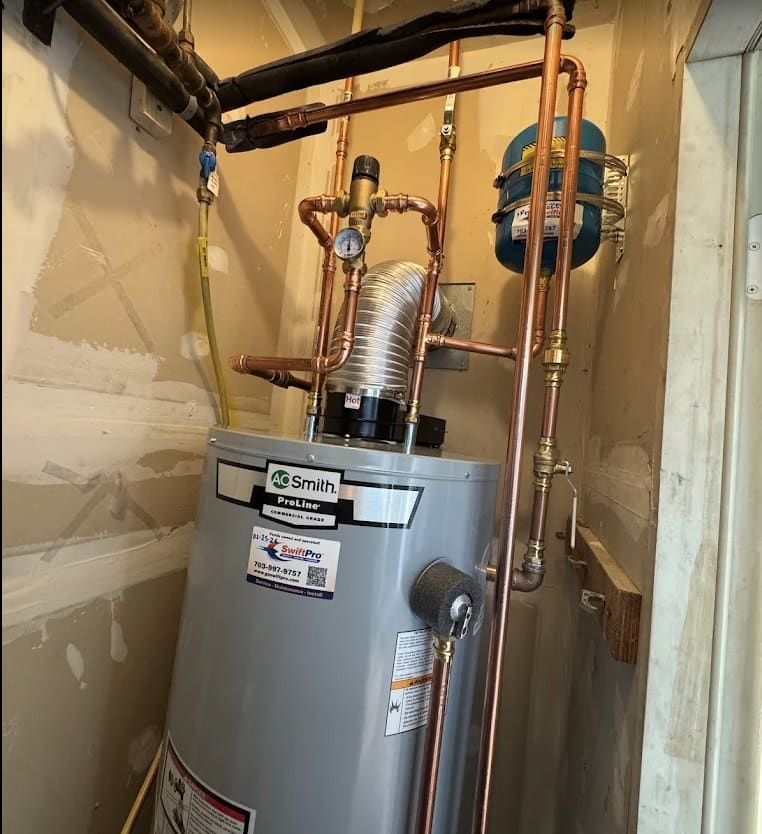
Inside your tank is a rod of magnesium or aluminum whose entire job is to corrode so the steel tank does not. It is a sacrificial part. When it is used up, the water goes to work on the tank itself, and a rusted-through tank is not repairable at any price. It is the reason a water heater fails by flooding your floor rather than by simply stopping.
Checking it means shutting off the water and the fuel, and unscrewing the rod from the top of the tank. If it is down to a thin wire on a core, it is done, and a new one is an inexpensive part that can buy years of tank life.
In our water, checking it around year four and every couple of years after is reasonable. A tank that has had its rod replaced once is meaningfully more likely to reach twelve years than one that has not.
The temperature and pressure valve
The T and P valve on the side or top of the tank is a safety device. If the tank ever over-pressurizes, this is what prevents it from becoming genuinely dangerous. It has a discharge pipe running down toward the floor.
Testing it means lifting the lever briefly and letting water discharge, then letting it snap shut. Two cautions, and they are real: the water is scalding, and on an old valve that has never been operated, the lever sometimes will not reseal afterwards, which turns a test into a repair. If the valve has been dripping already, it is failing and it needs replacing rather than testing.
Do not ever cap or plug the discharge pipe, whatever a previous owner may have done. That is the one modification that turns a safety device into a hazard.
Tankless: the flush is not optional
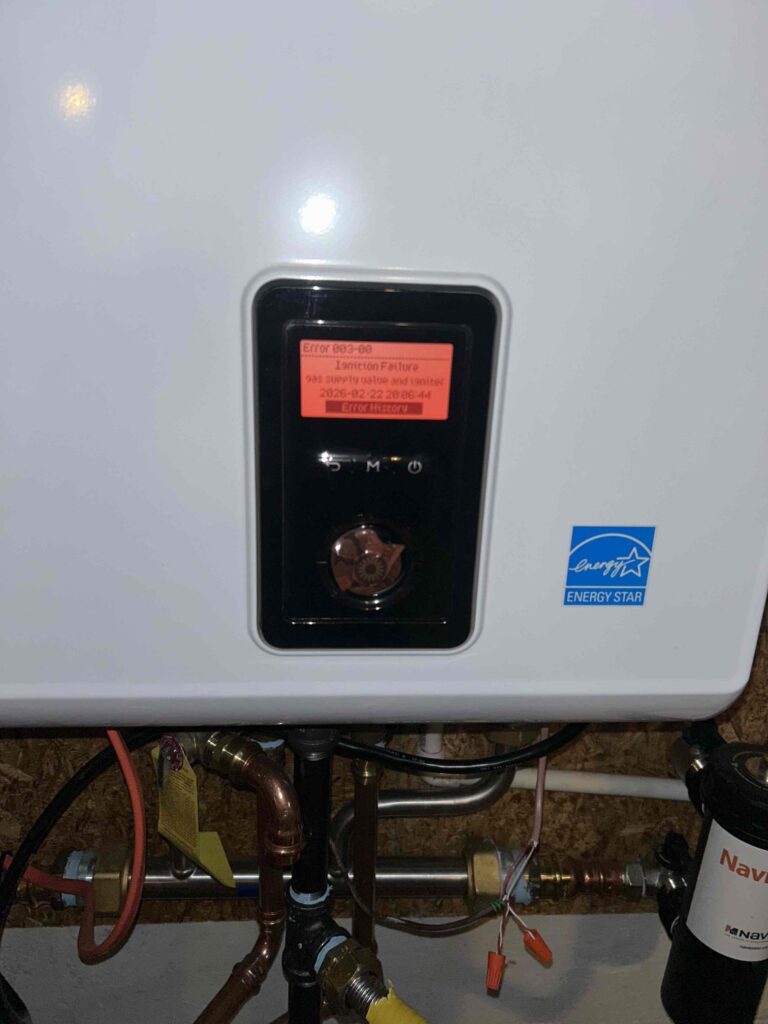
A tankless unit has no tank to hold sediment, so the minerals go straight to the heat exchanger, which is the narrow, very hot passage they love most. As it scales, the unit throttles the flow to hold temperature, which you notice as pressure loss, or gives up and delivers warm water.
Both Navien and Rinnai require annual descaling in writing, and both exclude scale damage from their warranties. Rinnai’s also excludes damage from poor water quality. A unit that turns up at a warranty claim with a scaled exchanger and no service history generally gets declined, which is the expensive way to skip a $150 job.
A flush runs $79 to $365, most between $100 and $200. If your unit has isolation valves with service ports, which most installed in the last decade do, you can do it yourself with a small pump, a bucket and descaler in about an hour. If it does not have them, adding them is the first thing we would do, because it makes every future flush a fraction of the work.
If you are tired of the annual job, a scale inhibitor on the cold inlet, $800 installed, keeps the minerals from sticking in the first place.
The five minute inspection anyone can do
Twice a year, with a flashlight:
- Look at the floor and the pan. Any water at all is a finding.
- Look at the connections on top. Green or white crust on copper means a slow weep.
- Look at the T and P discharge pipe. Wet, or staining at the end, means the valve is passing.
- Look at the bottom of the tank for rust or staining, which is the tank telling you it is near the end.
- Find the shutoff valve above the heater and make sure it turns. That is the valve you will want in a hurry one day.
- Check the temperature. 120 degrees is the usual target: hotter scalds and accelerates scaling, cooler is a different set of concerns.
If you find water under the tank, here is how to tell a fitting leak from a failed tank. The difference is a repair versus a replacement, and it is worth knowing which before anyone quotes you.
When maintenance stops being the answer
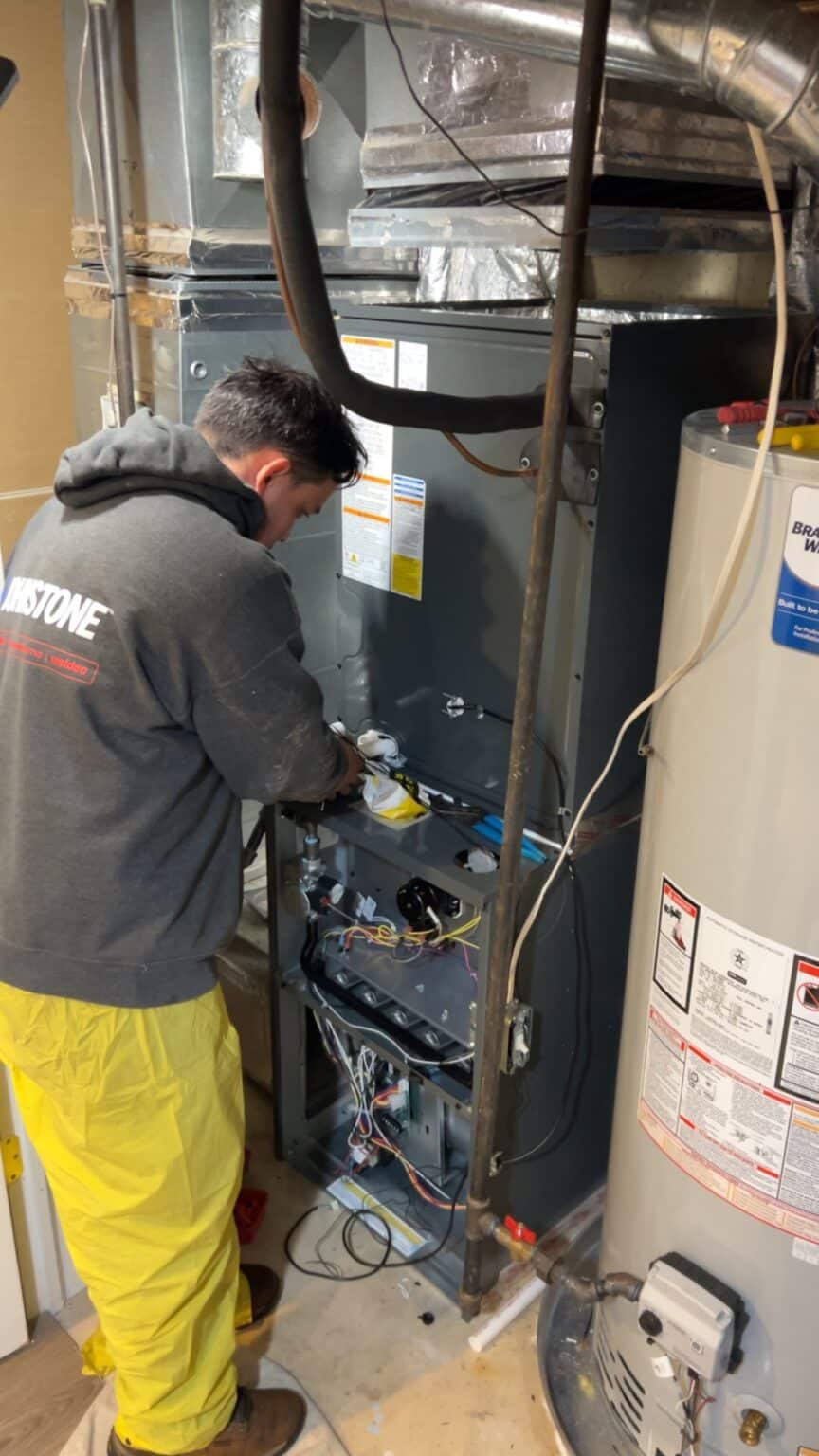
Tanks last eight to twelve years in this area. Past twelve, maintenance is keeping an old tank alive rather than extending a good one, and the failure mode is water on your floor while you are at work.
If yours is in that window and starting to rumble, you get to choose the day, price both tank and tankless properly, and avoid the emergency premium. A new tank runs $2,800 to $5,800 installed with most homes at $3,400 to $4,200, and tankless $6,000 to $7,000. Price your own configuration in the water heater calculator, and here is the honest comparison.
SwiftPro services and replaces water heaters across Northern Virginia. The plumbing and water heater check is included in the Family Care Plan. Call (703) 997-9757 or book online.