

Most indoor floods are not burst pipes. They are one of five small, cheap parts letting go while nobody is home, at full mains pressure, for hours.
None of them cost much to replace before they fail. All of them cost a great deal after.
1. Washing machine hoses
The classic. Two hoses running from the wall valves to the machine, under constant pressure whenever those valves are open, which in most houses is always. A failed hose does not drip. It releases at full pressure into a laundry room, and a laundry room on an upper floor puts that water through every ceiling below it.
What to do: look at them. If they are the grey or black rubber hoses that came with the machine and you cannot remember replacing them, replace them. Braided stainless hoses cost a little more and are far more resistant. Whatever you fit, note the year.
The better habit: shut the two valves behind the machine when you go away for more than a few days. If they are the old multi-turn type that seize, a single-lever shutoff that closes both at once is a modest upgrade and makes the habit realistic.
Check the drain hose too. It should be secured into the standpipe, not resting loosely in it. A drain hose that kicks out during a spin cycle empties a full tub onto the floor.
2. Angle stops under sinks and behind toilets
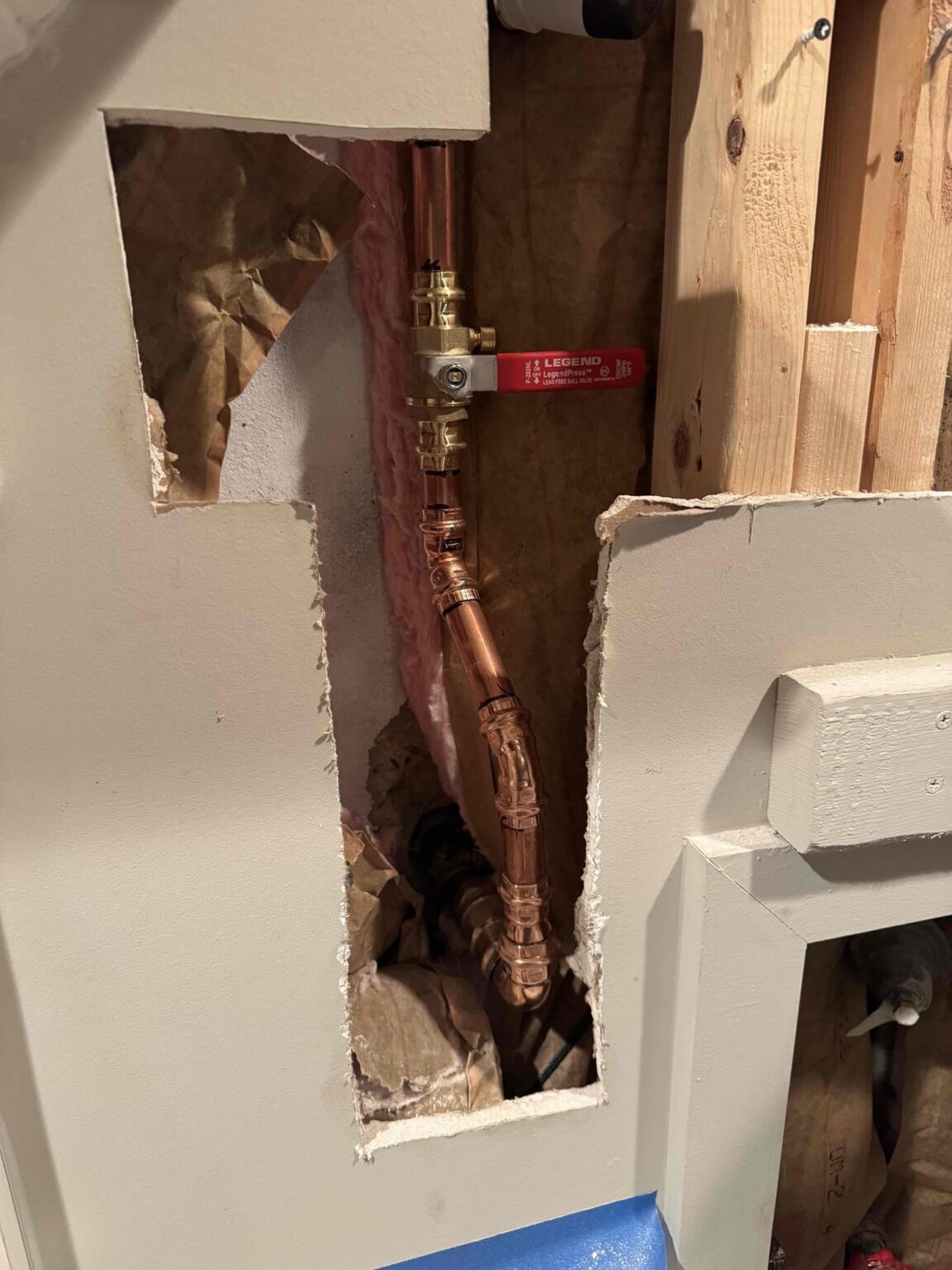
The little chrome shutoff valves. They sit untouched for twenty or thirty years, and the first time anyone turns them, which is usually during a repair, they seize or start weeping from the stem.
Two consequences. You cannot isolate a fixture when you need to, which turns a small repair into a whole-house shutoff. And a valve that is weeping behind a vanity is dripping into a cabinet base nobody opens.
What to do: once a year, open the cabinet and look, with a flashlight, at the valve and the floor under it. Any green or white crust on the fitting is a slow weep. If you are having any plumbing work done in that bathroom anyway, replacing the stops while somebody is there is inexpensive.
3. Braided supply lines
The flexible lines from those valves up to the faucet or toilet tank. They are stainless braid over a rubber core, and the core has a service life. They fail by splitting inside the braid, and the result is the same as a washing machine hose: full pressure, no warning.
The toilet supply is the one that causes the most damage, because it is often on an upper floor and the tank is against a wall people do not look behind.
What to do: replace them when they are visibly old, when you are replacing a fixture anyway, or on a schedule if you would rather not think about it. They cost very little.
4. The water heater
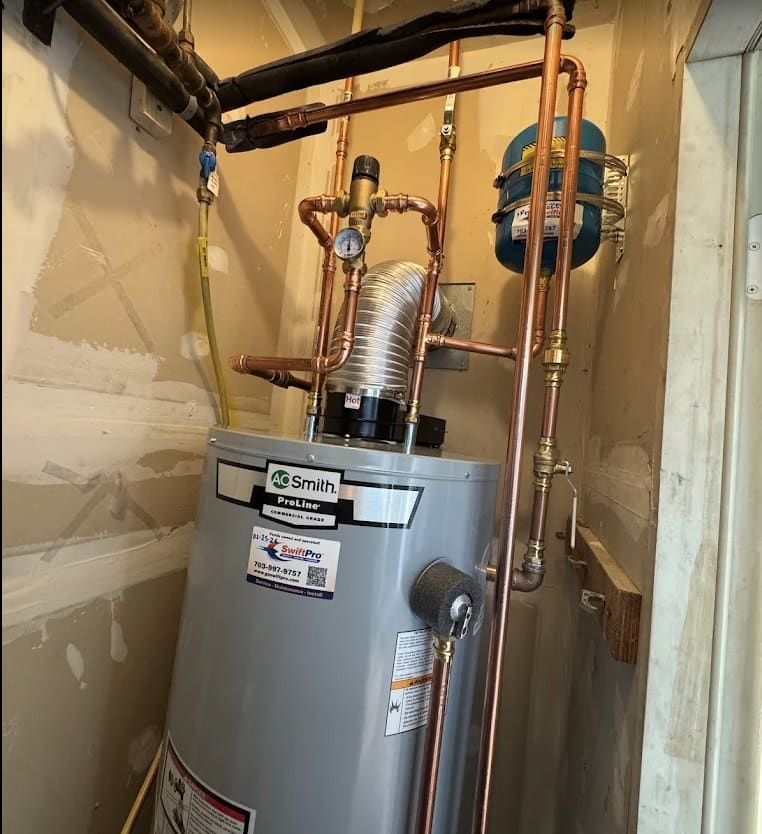
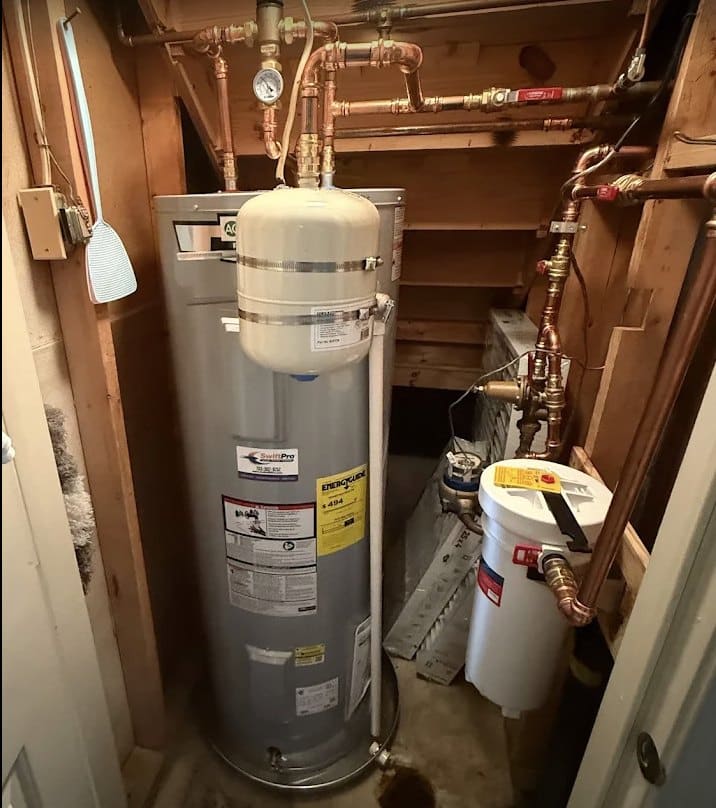
Tanks last eight to twelve years in this area and they fail by leaking, not by stopping. A tank in a closet on an upper floor, or anywhere over finished space, is the highest-consequence version of this whole page.
What to do: find the label and work out its age. Look at the floor and the drain pan under it with a flashlight. Check the pan actually drains somewhere, because plenty were installed with a pan going nowhere, which holds one gallon and then overflows.
If it is past ten and sits over finished space, replacing it on your schedule beats replacing it on its own. The maintenance that extends it is here, and how to tell a fitting leak from a failed tank is here.
5. The refrigerator ice maker line
A quarter inch line running to the back of the fridge, frequently the original plastic tubing, frequently with a saddle valve clamped onto a copper pipe somewhere in the basement. Saddle valves are notorious: they pierce the pipe with a small needle and they weep as they age.
Because the leak is behind a heavy appliance, on a floor nobody inspects, this one runs the longest before discovery, which is why it so often ends in flooring and subfloor rather than a mop.
What to do: pull the fridge out once a year and look. If the connection at the wall is a saddle valve, ask to have it replaced with a proper tee and a quarter-turn stop next time a plumber is in the house. Replace plastic tubing with braided line.
The thing behind several of these
Water pressure. Plumbing code requires a pressure reducing valve where incoming static pressure exceeds 80 psi, and parts of this region come off the main well over 100. When that valve fails, the whole house runs at street pressure, which shortens the life of every hose, supply line, fill valve and appliance solenoid in it.
If you are replacing fill valves every couple of years and assuming that is normal, it is not. A gauge on a hose bib costs about $12. Replacing a failed pressure reducing valve runs $500 to $994, and it extends the life of everything on this page.
Two things worth buying
Leak detectors. Small battery alarms that sit on the floor under the water heater, behind the toilet, under the sink and behind the washing machine. They cost very little and they turn an overnight flood into a noise you hear. The connected versions will message your phone, which matters if the house is ever empty for a week.
An automatic shutoff, if the house is ever vacant. A valve on the main that closes when it sees water or an abnormal flow pattern. It is a real expense and it is the right one for a second home, a rental between tenants, or a house whose owners travel.
Water Heater Failure and Leak Prevention
Before any trip longer than a weekend: shut the washing machine valves, and if nothing in the house needs water while you are gone, shut the main. Then open a tap to drop the pressure out of the lines. It takes two minutes.
If you already have water somewhere and cannot find the source, that is a leak search, which runs $200 to $470 and includes opening the wall in the one spot the evidence points at. Do the meter test first. And if a pipe has already let go, the first four minutes start with the main shutoff, which you should already know how to find. Here is where everything is.
SwiftPro handles plumbing across Northern Virginia. Call (703) 997-9757 or book online.