
A heat pump water heater is the most efficient way to heat water with electricity, by a wide margin, and Dominion will pay you $250 or $400 toward one. It is also the wrong choice for a fair number of houses, and the reasons are physical rather than financial.
Here is how to tell quickly whether yours is a candidate.
What it actually is
A tank with a small heat pump on top. Instead of turning electricity directly into heat the way a conventional electric element does, it moves heat out of the surrounding air into the water, the same trick your air conditioner uses in reverse.
The efficiency difference is not marginal. ENERGY STAR’s threshold for an integrated heat pump water heater is a uniform energy factor of 3.30, against 0.81 to 0.86 for an efficient gas storage tank and around 0.9 for a conventional electric one. That number is a ratio, so above 1.0 means it delivers more heat energy than the electricity it consumes, because most of the heat is moved rather than made.
In practice, for a household currently on a conventional electric tank, it is the single biggest cut to a water heating bill available.
The Dominion rebate, precisely
Dominion Energy Virginia currently pays $250 on a 40 to 59 gallon unit and $400 on 60 gallons and up. Three conditions matter and people get caught by the second one:
- It must be an ENERGY STAR certified heat pump water heater.
- It must replace an existing electric water heater. Converting from gas to a heat pump unit does not qualify, however sensible that conversion might be for other reasons.
- Single-family detached, attached or manufactured homes.
Worth saying plainly: if you are on gas today, this rebate is not for you. The efficiency case for switching still exists, but you would be paying for it yourself and the arithmetic depends on your own gas and electricity rates rather than on a rebate.
The four things that decide whether it fits
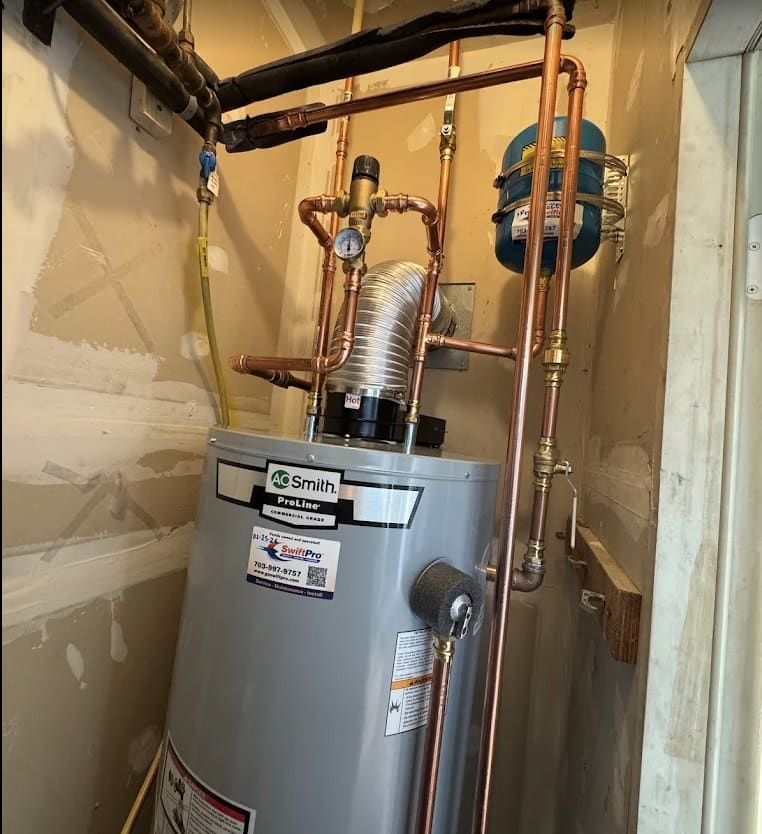
Space and air. This is the big one. The unit pulls heat out of the air around it, so it needs a reasonable volume of air to work with. Manufacturers publish a minimum, commonly around 700 to 1,000 cubic feet, which is roughly a decent-sized basement or garage. A heat pump water heater sealed into a small closet will starve itself and fall back on its resistance elements, which defeats the entire point.
There are ducting kits and louvred-door solutions for tighter spaces, and they work, and they add cost. If your current heater is in a first-floor closet in a townhouse, this is the conversation to have honestly before anything is ordered.
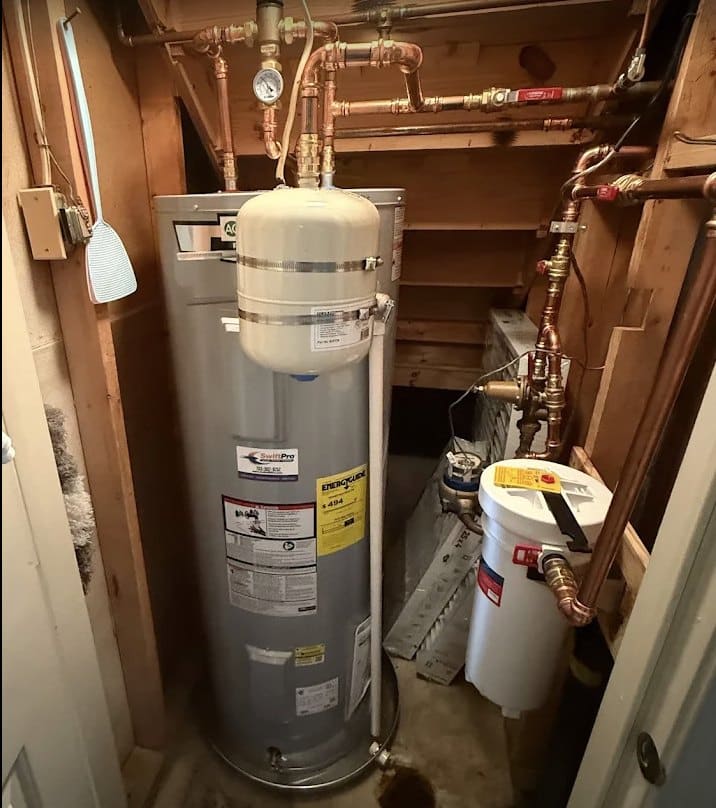
Height. These units are taller than a conventional tank of the same capacity, because the heat pump sits on top. In a crawlspace, under a low basement ceiling, or in a closet with a shelf above, measure before you fall in love with the idea.
A drain. It produces condensate, the same way an air conditioner does, and that water has to go somewhere: a floor drain, a condensate pump, or a suitable route. A location with no drain means adding a pump.
What it does to the room. It cools and dehumidifies the space it sits in. In a basement, that is frequently a bonus in a Virginia summer and mildly unhelpful in January. In a conditioned closet inside the living space, you are paying your furnace to reheat air the water heater just chilled, which is a real efficiency loss nobody mentions in the brochure.
Basement or garage: usually excellent. Interior closet: think hard.
The other honest trade-offs
It makes noise. A compressor and a fan, roughly at the level of a quiet refrigerator or a bathroom fan. Unnoticeable in a basement, noticeable through a wall from a bedroom.
Recovery is slower in heat pump mode. Most units have a hybrid setting that brings in the resistance elements during heavy demand, which protects you from cold showers at the cost of some efficiency. Sizing up a little is the usual answer for a busy household.
It has a filter. The air intake has a screen that needs cleaning periodically, and a neglected one reduces performance. It is a five minute job and it is the maintenance item people skip.
Upfront cost is higher than a conventional electric tank, before the rebate. Against a conventional tank at $2,800 to $5,800 installed, a heat pump unit sits above that range, and the exact number depends on the space, the electrical and whether ducting or a condensate pump is needed. That is why we quote it after looking rather than over the phone.
How it compares, in one paragraph
If you are on gas today and happy, a gas tank or tankless is almost certainly your cheapest path, and that comparison is here. If you are on a conventional electric tank, in a basement or garage, replacing it with a heat pump unit is one of the better efficiency purchases available to a homeowner, and Dominion pays part of it. If you are on electric in a tight interior closet, get someone to look at the space before deciding, because the answer might genuinely be another conventional tank.
The paperwork, and the timing
In Virginia, a like-for-like electric water heater replacement is exempt from the permit requirement that applies to gas and oil appliances, though the electrical work involved in an upgrade can change that. We handle whichever applies.
On the rebate: it is claimed after installation with the paperwork and the model details, so keep the invoice and the model and serial numbers. Ask whoever installs it whether they file it or you do, because that answer varies by contractor and it is worth knowing before the truck leaves.
Timing note: tanks last eight to twelve years here and they fail by leaking rather than stopping. If yours is past ten, you get to make this decision calmly, compare options, and claim the rebate. If you wait, the tank makes the decision and you take whatever fits fastest. The maintenance that buys you that time is here.
SwiftPro installs and services water heaters across Northern Virginia, including heat pump units. Call (703) 997-9757, book online, or price a conventional replacement in the water heater calculator.