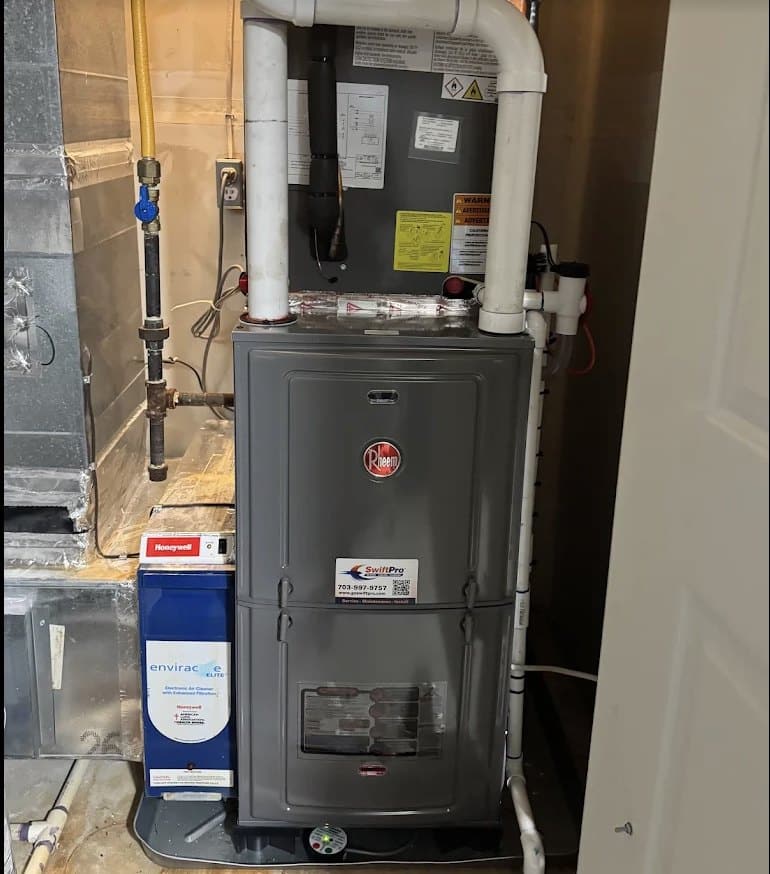


A new gas furnace, installed, runs $4,498 to $12,300 at SwiftPro in Northern Virginia. That’s furnace only, keeping your air conditioner. If the AC is going at the same time, the pair together runs $8,898 to $23,000 by system size, and the furnace and AC estimator gives you your size’s range in two minutes with no phone number.
Both ends of the furnace range are jobs we do every week. What follows is what puts a house at $4,500 versus $12,000, which is four decisions and one surprise, plus the rebate money that’s actually on the table this year.
80 vs 96 furnace: what the efficiency number buys
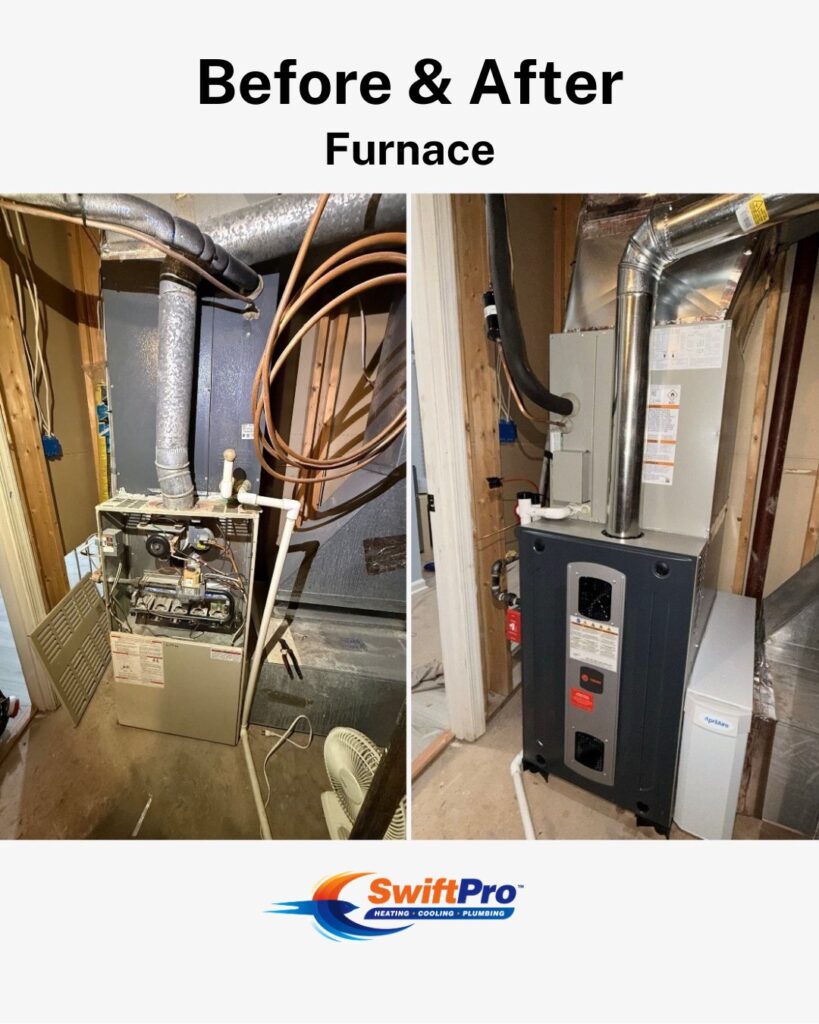
AFUE is the share of the gas you buy that becomes heat in the house. An 80 percent furnace, the federal minimum since 2007, sends a fifth of it up the flue. A 96 percent condensing furnace keeps almost all of it, with a second heat exchanger that wrings the last heat out of the exhaust. It costs more for the equipment and more for the venting: the 80 goes up a metal flue, usually the one in the wall already, while the 96 vents through PVC out a side wall and drips condensate that needs a drain. In a basement against the foundation, easy. In an interior closet with no outside wall nearby, the venting is a real part of the price.
The gas bill difference here is real but not dramatic. Northern Virginia winters are cold enough to matter and short enough that a 96 doesn’t pay for itself in three years. Over the eighteen years ASHRAE puts as a gas furnace’s median life, it does. And one more thing on this: the Department of Energy finalized a rule requiring 95 percent efficiency on new furnaces built from late 2028, which the gas industry is contesting. If it holds, the 80 percent furnace goes away in a couple of years. Nobody has to buy a 96 today because of that, but it’s a fair thing to know when choosing.
Single stage, two stage, or modulating
A single stage furnace is either off or on full. A two stage runs at about two thirds most of the time and goes to full only on the coldest days, which means longer, gentler cycles and steadier temperatures. Modulating adjusts in small steps. Two stage is where most people land and where most of the comfort gain is. Modulating is for the person who noticed the two degree swing in the old house and wants it gone.
The blower
A variable speed blower is quieter, moves air more evenly, and matters more than people expect because the same blower runs the air conditioner all summer. It’s also the part that fails expensively on the cheap models, so this is not the place to save $600.
Understanding the Importance of the Furnace Blower
Furnaces are rated in BTUs, 40,000 to 120,000 for houses. Bigger costs more, and bigger is not better. Half the furnaces we replace are oversized for the house, which is why the old one short cycled and never warmed the far bedroom. We measure the house rather than copy the sticker on the old unit.
The surprise in older houses: the water heater on the chimney
If your furnace and water heater share a masonry chimney, and you replace the furnace with a 96 that vents out the wall, the water heater is now alone on a flue that was sized for both. The fuel gas code has a rule for exactly this: the chimney can’t be more than seven times the size of the water heater’s draft hood outlet, and the chimney has to be examined before a new appliance goes in. When it’s oversized, the exhaust cools and condenses inside it, the condensate eats the mortar, and the draft can get weak enough to spill exhaust back into the basement. The fix is a chimney liner or a power vent water heater. It’s not a huge number, but it’s a number, and a quote for a 96 on a 1970s colonial that doesn’t mention the chimney hasn’t looked hard enough.
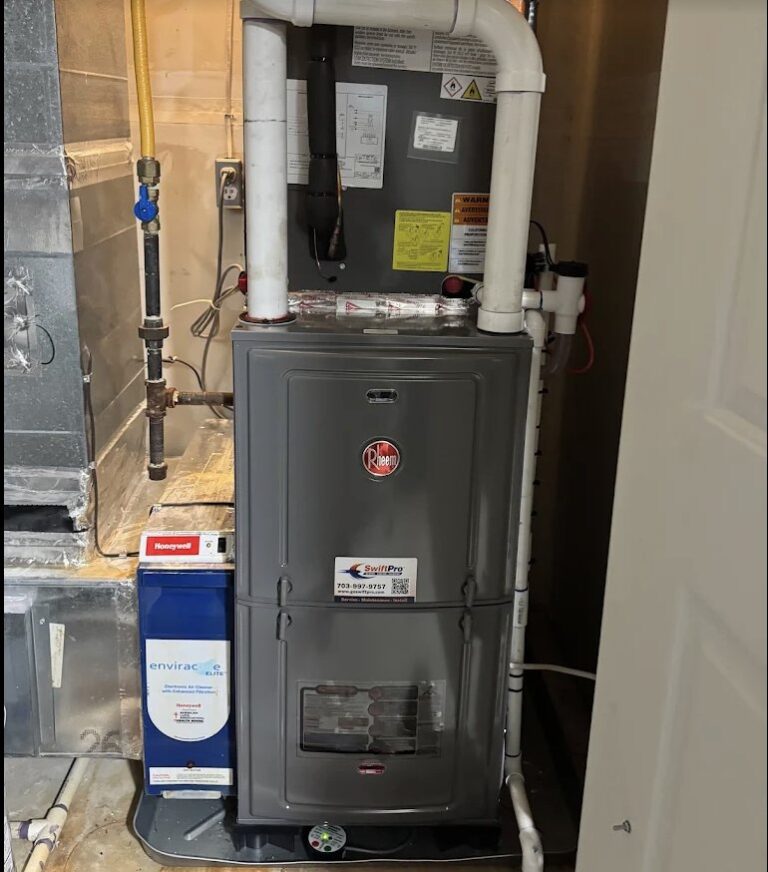
What the price includes, and what a quote should
- The permit and the inspection. In Fairfax County, a gas appliance replacement needs a permit even when it’s like for like, and the rest of Northern Virginia follows the same statewide code. The inspector checks the venting and the gas connection, which is the part worth checking.
- Removal and disposal of the old furnace.
- New venting where the new furnace needs it, plus the condensate drain and neutralizer on a 96.
- A new gas flex connector and shutoff, not the twenty year old one.
- A new filter rack if the old one is why you could never find a filter that fit.
- Warranty in writing on the equipment and on our labor.
Rebates that exist right now
The federal tax credit is gone. The IRS is explicit that it covered equipment placed in service before December 31, 2025, so a 2026 install gets nothing, whatever an old brochure says.
Washington Gas is a different story. Its current program pays $500 on a furnace between 95.1 and 96.9 percent AFUE, $700 at 97 percent and up, $2,000 on a dual fuel heat pump paired with a new 95 percent furnace, $100 on a smart thermostat and $100 on a tune-up, when a contractor in its network does the work and files the paperwork. That $500 to $700 is a meaningful chunk of the difference between an 80 and a 96, and it’s one more reason the 96 pencils out better than it used to. Ask whoever quotes you whether the rebate is in the number.
Is it worth replacing the furnace, or just fixing it?
The rule we use: over fifteen years old (ENERGY STAR’s own line for thinking about replacement) and the repair is over a third of the replacement price, replace it. Under ten, repair it almost every time. In between, it depends on what failed. A $300 igniter on a twelve year old furnace is a repair. A $1,100 control board on the same furnace is a conversation. A cracked heat exchanger is not a repair at any age, for reasons that are about carbon monoxide rather than money. Here’s what the common furnace repairs actually cost, so you can do that math with real numbers.
Things people ask
Can I replace my furnace myself? Legally, in Virginia, gas appliance work needs a permit and an inspection, and practically, the job is gas piping, venting, combustion air and a condensate drain, any one of which done wrong is a carbon monoxide problem. This is the one home project we’d tell a capable person not to do.
Gas or electric? Almost everyone in Northern Virginia with a furnace has gas. Electric furnaces are cheap to buy and the most expensive heat you can run here. If the house has no gas, the answer is a heat pump, not an electric furnace. Here’s what each costs and how they compare.
How long does the install take? One day. Most are done by mid afternoon and you have heat that night.
Somebody already quoted me and it seems high. Run it past us. The second opinion is free, and a fair number of the quotes we look at are fine, in which case we say so.
SwiftPro installs furnaces across Northern Virginia. Get your range from the estimator, then book the free measurement online or call (703) 997-9757.