

People ask which one is cheaper and expect a single number. The honest answer has two halves that move in opposite directions: a heat pump usually costs more to install and less to run, and a gas furnace usually costs less to install and more to run. Where you land depends on your house, your ductwork and your own utility bill.
Here is what we actually charge for each, and then the part nobody publishes: how to work out the running cost for your house instead of taking a contractor’s word for it.
Not sure which one heats your house now? Start with what a furnace heater is, and how to tell it from a heat pump.
What each one costs installed, from our price book
These are our published installed prices in Northern Virginia, not estimates of the market:
- Gas furnace and air conditioner together: $8,898 to $23,000, depending on size and tier. This is the traditional pairing and the most common replacement we do.
- Heat pump system (heat pump plus air handler, all electric): $8,499 to $21,650.
- Furnace only, keeping your existing air conditioning: $4,285 to $14,040.
From about $71 a month at 0% APR for 60 months, the whole price financed, on approved credit. How financing works
Notice the bottom of the heat pump range is not higher than the furnace and AC range. An entry-level heat pump system can start slightly below an entry gas system, because you are buying one outdoor unit and an air handler instead of an outdoor unit and a furnace. The tops sit close together too, so when the air conditioner is due along with the furnace, the price tag barely separates the two. The install and the running cost below do.
Our instant estimator will price your specific size without a sales visit.
The install costs that are not the equipment
Two quotes for the same house differ mostly here.
Going from gas to a heat pump can bring electrical work with it. Heat pump systems include electric backup heat, and those strips draw real current. If your panel is full or undersized, that is a separate cost and it is not small. We check this before quoting, and you should make sure anybody else does too.
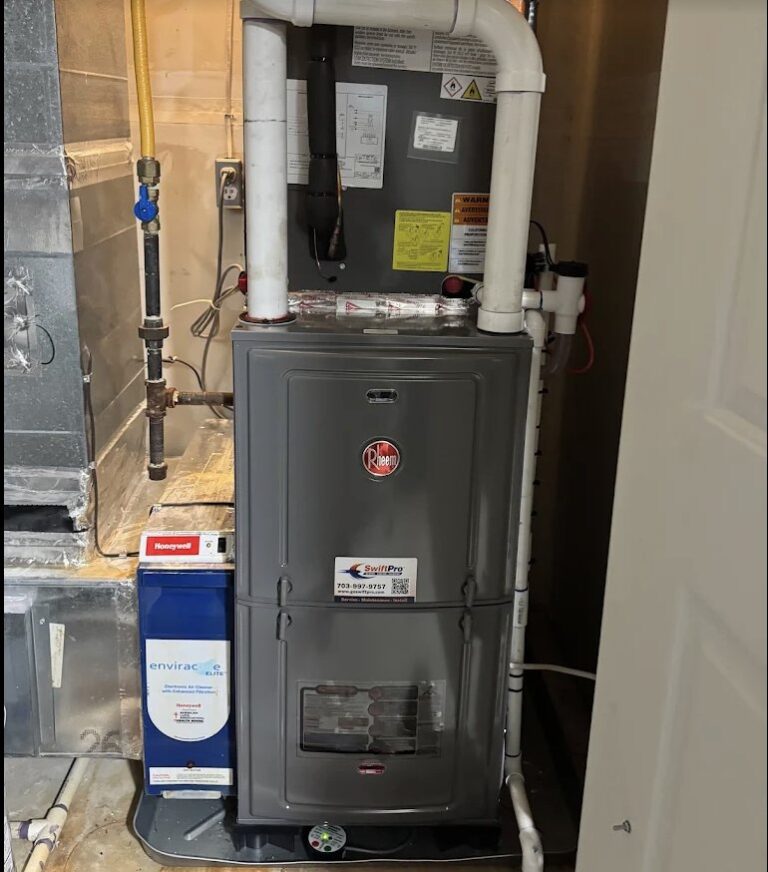
Staying with gas means the flue and gas line come along for the ride. A high-efficiency furnace vents differently than an old one, so a switch to a condensing unit usually means new PVC venting and a condensate drain.
Ductwork applies to both, but it punishes a heat pump harder. Heat pumps deliver a lower supply temperature, so leaky or undersized duct that a furnace could brute-force through becomes a comfort complaint. If your duct is bad, fix it or expect to be unhappy.
Running cost, worked out properly
This is where most comparisons cheat, by picking utility rates that flatter whichever system the author is selling. We are not going to do that, because your rates are on your bill and ours are not your rates.
Here is the actual mechanism, which is what you need.
A gas furnace can never exceed 100% efficiency. A 96% AFUE furnace turns 96 cents of every gas dollar into heat in your house. That is very good, and it is the ceiling.
A heat pump routinely exceeds 100%, because it is not making heat, it is moving heat that already exists in the outside air. At mild temperatures a good heat pump delivers three or more units of heat energy per unit of electricity. That efficiency falls as it gets colder, which is why the mild half of the season is where a heat pump wins big and the cold snaps are where it narrows.
So the comparison comes down to three things you can look up in ten minutes:
- Your electricity rate per kilowatt hour, on your Dominion bill.
- Your gas rate per therm, on your Washington Gas bill, including the fixed monthly charges.
- How much of our heating season is actually mild. In Northern Virginia, most of it. We get long stretches in the forties and fifties, which is precisely where a heat pump is at its most efficient, and a handful of genuinely cold weeks.
That last point is the one that decides it here. Our climate spends most of the heating season in heat pump territory. That is a different picture than Minnesota, and it is why the answer in Northern Virginia is not the answer everywhere.
One more line item people forget: if you go all electric, the gas bill’s fixed monthly service charge can go away entirely when nothing else in the house burns gas. If you keep a gas range, water heater or fireplace, it does not.
Dual fuel, which is often the real answer
If you already have gas, you do not have to choose. A dual fuel system pairs a heat pump with a gas furnace and switches between them at a temperature you set. Heat pump efficiency through the long mild stretch, furnace output for the cold weeks.
It costs more than either alone and it is frequently the right call in this region, particularly if you are replacing both the furnace and the air conditioning at the same time anyway.
Where it should switch is a money question with a real answer, and it depends on whether Dominion or NOVEC sends your electric bill. The switchover temperature, worked out from this winter’s rates, is here.
The tax credit question, answered plainly
The federal 25C credit, which paid up to $2,000 toward a qualifying heat pump, ended December 31, 2025. Systems installed in 2026 do not qualify for it. If a quote you are holding has a federal tax credit built into the math, that math is wrong. Here is what remains in Virginia.
How to decide without a sales pitch
- Replacing both furnace and AC, gas available, want the lowest risk: gas furnace and AC, or dual fuel if the budget allows.
- Replacing both, no gas at the house, or on oil or propane: heat pump, without much debate. It beats resistance heat, oil and propane on running cost comfortably.
- Furnace is fine and the AC died: replace the AC, or consider a heat pump paired to the existing furnace as dual fuel. Do not scrap working equipment.
- Ductwork is poor: fix that first regardless of which box you buy.
- Panel is full and an upgrade is out of reach: gas, for now.
Getting your actual number
See your price, or book the $67 check
What a replacement costs in your house. Answer a few questions and see the installed price for your size: the furnace estimator for a gas furnace (from $4,285) and the heating and cooling estimator for a heat pump or a furnace and AC together (from $8,499). From about $71 a month at 0% APR for 60 months, the whole price financed, on approved credit. Each one lets you book a free in-home measurement.
Get it checked before the cold. The $67 Heating Check covers one furnace or heat pump, through December 31. If you also want the blower wheel pulled and cleaned with a full tune-up, that is $229.
Book a visit online, or call (703) 997-9757. We answer around the clock.
SwiftPro installs both across Northern Virginia, and we will price them side by side rather than steering you. Use the instant estimator for real installed pricing on your size, or call (703) 997-9757. If you already have a quote from somebody else and it does not add up, that is what our free second opinion is for.
Related: what a new furnace costs in Northern Virginia, heat pump repair: normal vs. broken, and cost.
Watch our crew on heat pump and mini split jobs
Real jobs in Northern Virginia homes, filmed by our own crew. Tap one to watch.