
Short answer: yes, and the reason people still ask is that they are remembering equipment from the 1990s.
The longer answer is more useful. A heat pump works in a Northern Virginia winter because of a specific number: our design temperature, the cold we actually size equipment against, is in the mid teens. Not twenty below. A modern heat pump is comfortably inside its working range at that temperature, and the handful of mornings a year that go colder are what backup heat is for.
The number that settles it
Heating equipment gets sized against a winter design temperature, which is roughly the coldest it reliably gets in your area, ignoring the rare outlier. For Northern Virginia that sits in the mid teens Fahrenheit.
Older heat pumps genuinely struggled below about 35 degrees and gave up around freezing, which is where the reputation came from. Current equipment is a different machine. Variable speed compressors and better refrigerant control mean a good cold-climate unit holds most of its rated heating capacity down near 5 degrees and keeps producing heat well below zero.
Put those together: our design temperature is above the point where modern equipment starts to fade. That is the entire technical argument, and it is why heat pumps are now normal here rather than exotic.
What “it blows cool air” actually means
This is the complaint we hear most, and it is not a malfunction.
A gas furnace produces air around 120 to 140 degrees. It blasts, it satisfies the thermostat, it shuts off. A heat pump delivers air in the mid 80s to low 90s, which is warmer than the room but cooler than your body, and it runs for much longer stretches.
Long, low, steady beats short and hot for actual comfort: fewer temperature swings, less noise, more even room-to-room temperatures. But if you grew up with a furnace, the first winter feels wrong, and standing at a vent is the worst possible way to judge it. Judge it by whether the house holds temperature.
Auxiliary heat, and the light everyone misreads
Your thermostat has an indicator for auxiliary or emergency heat. Understanding it is worth real money.
Auxiliary heat is the electric resistance strips (or, in a dual fuel system, the gas furnace) that assist the heat pump when it cannot keep up on its own. It coming on during a genuinely cold snap, or during defrost, is normal.
Emergency heat is a manual setting that shuts the heat pump off entirely and runs on the strips alone. That mode is expensive, because resistance heat is the least efficient way to heat a house that exists. It is for when the heat pump is broken, not for when you are cold.
The thing worth watching: if aux heat is running for hours or days at temperatures that are not extreme, something is wrong. Low refrigerant, a failing defrost board, a thermostat staged incorrectly, or a system undersized for the house. That is not the weather, it is a service call, and it is showing up on your electric bill every hour you leave it.
Ice on the outdoor unit is supposed to happen
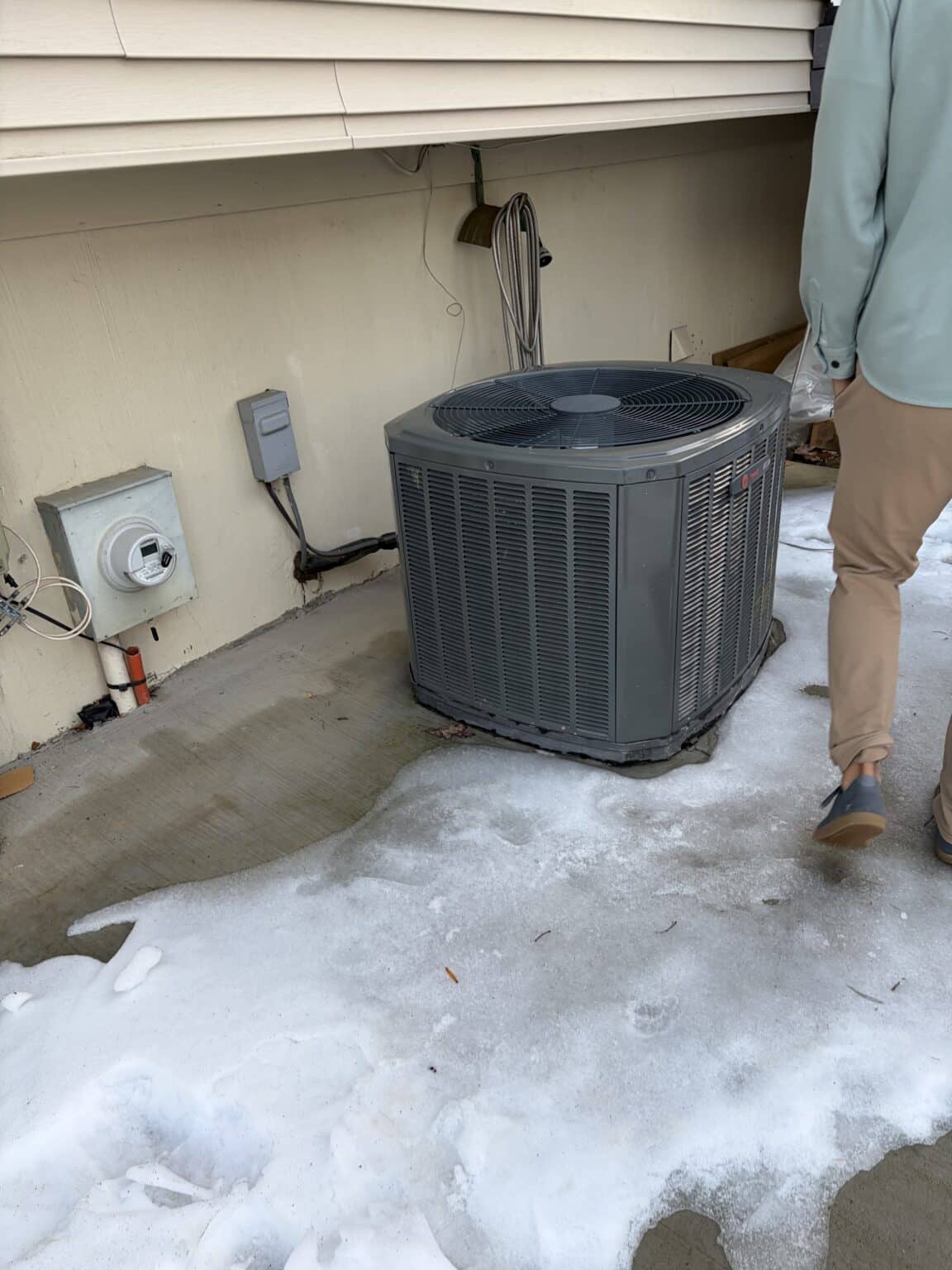
A heat pump pulls heat out of outdoor air, which makes the outdoor coil colder than the air around it, which makes moisture condense and freeze on it. So the unit periodically reverses itself for a few minutes to melt the frost off. That is defrost, and during it you may see steam, hear a whoosh, and feel the aux heat come on to cover the gap.
Normal: a light coat of frost, clearing on a cycle. Steam rising off the unit afterward.
Not normal: the coil encased in solid ice, ice building over the top of the cabinet, or the same heavy ice returning within an hour of clearing. That is a defrost failure or a refrigerant problem and it will damage the unit if it is left. Turn it off and call.
Where a heat pump is genuinely the wrong answer
We would rather say this than sell you one:
- Your ductwork is badly undersized or leaky. Lower supply temperature is less forgiving of bad duct than a furnace is. Fix the duct or the heat pump will disappoint you.
- Your electrical panel cannot take it and upgrading it is a large separate project. Sometimes that changes the math entirely.
- You have very cheap gas and a furnace that is only a few years old. Replacing working equipment on efficiency grounds rarely pays back.
- You want the hot-air feeling and you know you want it. That is a legitimate preference and a dual fuel system exists precisely for it.
Dual fuel, the Northern Virginia compromise
If you have gas already, dual fuel is often the honest recommendation. A heat pump handles the mild majority of our heating season, which here is most of it, and the gas furnace takes over below a changeover temperature you set. You get heat pump efficiency in the forties and fifties and furnace output in the teens. Where that changeover belongs at this winter’s rates is here.
It also means your air conditioning and your primary heat are the same machine, which is one system to maintain instead of two. Here is what each option costs installed.
On the money side, one correction
The federal 25C tax credit that paid up to $2,000 toward a qualifying heat pump ended on December 31, 2025. Equipment installed in 2026 does not qualify. Anyone still advertising that credit for a 2026 install is working from old material. What is actually left in Virginia is here.
Talking it through
See your heat pump price, or book the $67 check
What a new heat pump costs in your house. The heating and cooling price estimator prices a heat pump system for your size, installed, from $8,499. From about $142 a month at 0% APR for 60 months, the whole price financed, on approved credit. You can book a free in-home measurement from the same page.
Get it checked before the cold. The $67 Heating Check covers one furnace or heat pump, through December 31. If you also want the blower wheel pulled and cleaned with a full tune-up, that is $229.
Book a visit online, or call (703) 997-9757. We answer around the clock.
SwiftPro installs and services heat pumps across Northern Virginia, including dual fuel. If you want the numbers for your house rather than the general case, our instant estimator gives you real installed pricing without a salesperson, or call (703) 997-9757.
Related: heat pump repair: normal vs. broken, and cost, which way your ceiling fan should spin, by season.
Heating repair by town: Alexandria, Annandale, Arlington, Ashburn, Aldie, Bristow, Burke, Centreville, Chantilly, Clifton, Fairfax, Fairfax Station, Falls Church, Gainesville, Great Falls, Haymarket, Herndon, Leesburg, Lorton, Manassas, Marshall, McLean, Oakton, Reston, Springfield, Stafford, Sterling, Vienna, Warrenton, Woodbridge.
More: what Aux and Em Heat actually mean.
Watch our crew on heat pump and mini split jobs
Real jobs in Northern Virginia homes, filmed by our own crew. Tap one to watch.