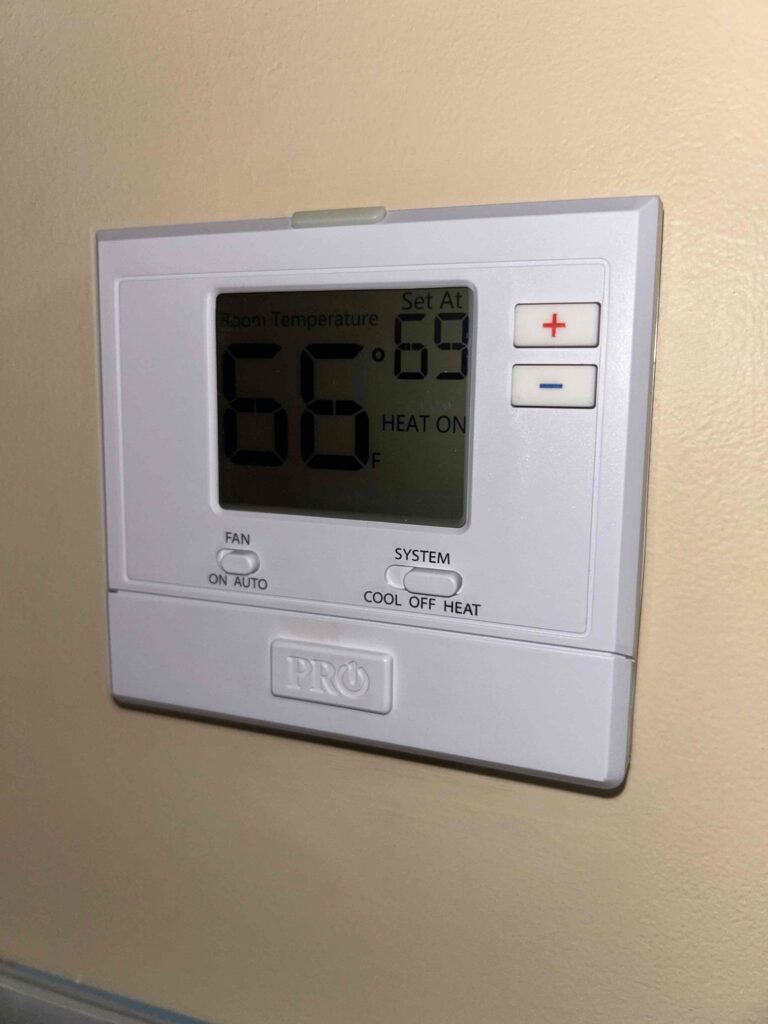


If you only do one thing: find out what outdoor temperature your dual fuel system hands off from the heat pump to the gas furnace. At this winter’s rates, with a variable-speed heat pump and a 95 percent furnace on Washington Gas, it should be about 38 degrees if Dominion is your electric company and about 16 if it is NOVEC. The setting lives in the thermostat’s installer menu, under a name like balance point, compressor lockout or dual fuel changeover.
Dual fuel, sometimes called a hybrid system, means two heat sources sharing one set of ducts. The heat pump outside heats and cools. The gas furnace inside only heats. The thermostat watches the outdoor temperature and runs whichever one makes heat for less money at that moment.
So the whole system comes down to one number, the temperature where it switches. It turns out to depend more on your utility bills than on the equipment.
What 100,000 Btu of heat costs this winter
A therm of gas holds 100,000 Btu, so that is the fair unit. Below is what it costs to put 100,000 Btu of heat into the house from each source, at the price of one more therm or one more kilowatt hour on a winter bill, every usage charge, rider and tax included, as of October 2026: $1.41 a therm from Washington Gas, 16.1 cents a kilowatt hour from Dominion (its winter price past the first 800), 12.6 cents from NOVEC. The monthly customer charges are left out, because they are the same whichever unit runs.
| Heat source | Dominion customer | NOVEC member |
|---|---|---|
| Gas furnace, 95% efficient (Washington Gas) | $1.48 | $1.48 |
| Gas furnace, 80% efficient (Washington Gas) | $1.76 | $1.76 |
| Variable-speed heat pump at 47°F | $1.22 | $0.95 |
| Variable-speed heat pump at 35°F | $1.59 | $1.23 |
| Variable-speed heat pump at 17°F | $1.89 | $1.47 |
| Variable-speed heat pump at 5°F | $2.25 | $1.75 |
| Standard single-stage heat pump at 47°F | $1.26 | $0.98 |
| Standard single-stage heat pump at 35°F | $1.57 | $1.22 |
| Standard single-stage heat pump at 17°F | $2.02 | $1.57 |
| Standard single-stage heat pump at 5°F | $2.53 | $1.97 |
| Electric heat strips (aux and emergency heat) | $4.73 | $3.68 |
Electric strips, the heat behind the aux and emergency heat lights, cost about 3.2 times what a new gas furnace does on Dominion. A heat pump’s cost depends on the weather: it is moving heat out of the outdoor air, and the colder that air, the harder it works for every Btu.
Where the switch belongs
Line the two up and you get the outdoor temperature below which gas is the cheaper heat:
| Switch to gas below | Dominion customer | NOVEC member |
|---|---|---|
| Variable-speed heat pump, 95% furnace | 38°F | 16°F |
| Single-stage heat pump, 95% furnace | 38°F | 21°F |
| Variable-speed heat pump, older 80% furnace | 26°F | 5°F or colder |
| Single-stage heat pump, older 80% furnace | 27°F | 10°F |
NOVEC’s electricity costs about a fifth less than Dominion’s winter rate, so a NOVEC house should lean on its heat pump a good deal longer. An older 80 percent furnace wastes a fifth of its gas up the flue, so it pushes the switch colder too.
These numbers move with the rates. Last winter Washington Gas’s gas cost less, $1.28 a therm at today’s delivery charges, and the same Dominion house would have switched at about 42 degrees. If your gas bill says Columbia Gas, which serves parts of Chantilly, Herndon and Manassas, you pay about $1.56 a therm, and the switch drops to about 33 degrees in a Dominion house (9 on NOVEC).
To check it against your own bills: take your price per kilowatt hour in dollars, multiply it by 29.3 and by your furnace’s efficiency, and divide by your price per therm. On Dominion with a 95 percent furnace that is 0.161 × 29.3 × 0.95 ÷ 1.41, about 3.2. That is the efficiency, the COP, your heat pump has to beat to be the cheaper heat. On NOVEC it is about 2.5. The heat pump’s COP at each outdoor temperature is on its product data sheet.
The heat pump rows in the table come from published ratings: a 3-ton Trane 20 TruComfort, the variable-speed model that replaced the XV20i, and a standard single-stage heat pump, each running the way it would in a typical house. The variable-speed unit earns its keep two ways. On a mild day it slows down, and running slow is where it is most efficient. On a cold night it keeps its output: at 17 degrees the Trane still makes about 30,500 Btu an hour, where the single-stage unit makes about 19,000. Their efficiency on that night is close. What differs is how much of the house each one can carry.
How much of a real winter falls on each side
We pulled every hourly temperature reading at Dulles for the last five heating seasons, October through April, 2021-22 through 2025-26, from NOAA, and weighted each hour by how much heat a house needs at that temperature:
| Outdoor temperature | Share of the heating, five winters | Last winter, 2025-26 |
|---|---|---|
| Below 50°F | 85% | 88% |
| Below 40°F | 58% | 66% |
| Below freezing | 30% | 39% |
| Below 25°F | 12% | 20% |
| Below 17°F | 3% | 7% |
| Below 10°F | under 1% | under 1% |
Last winter was colder than usual all the way down the table.
That is why the setting matters. In a Dominion house, switching at 38 degrees puts about 51 percent of a normal winter’s heating on gas. In a NOVEC house, with the switch down at 16, gas makes about 8 percent, mostly on the nights the heat pump cannot keep up by itself. Moving any switchover from 25 degrees to 35 moves 28 percent of a winter’s heating from one fuel to the other.
So is dual fuel worth it?
Run the five winters through this season’s prices, with a variable-speed heat pump and a 95 percent furnace, each switching at its money number. In a Dominion house, dual fuel delivered heat for 7 percent less than the furnace alone and 17 percent less than the heat pump alone. In a NOVEC house, 21 percent less than the furnace and 10 percent less than the heat pump.
So in a Dominion house the heating savings over a new furnace are real but modest, because gas is cheap here and a 95 percent furnace wastes very little of it. The stronger case there is the one just below: the air conditioner you were replacing anyway, a heat pump that cools like the old one did and heats the mild half of the winter too, and Washington Gas paying $1,400 to $2,000 toward it. In a NOVEC house the heat pump carries nearly the whole winter, and the furnace is there for the coldest nights.
Where that leaves you depends on what is in the house now.
You have gas, and the air conditioner is the thing that died. This is the case dual fuel was made for. The heat pump goes where the AC was and cools exactly like one, the furnace stays, and you pay the difference between a heat pump and an air conditioner rather than for a second system. Washington Gas pays $1,400 toward it if the furnace is 90 percent or better.
You are replacing the furnace and the AC together. Dual fuel is the upgrade path, the heat pump premium is the only extra, and this is where the $2,000 Washington Gas rebate lives.
Your furnace is an older 80 percent unit and it still runs fine. A heat pump in place of the failing AC does the most good here: in our five winters it cut the cost of heat by 16 percent against the old furnace alone in a Dominion house and 33 percent on NOVEC, because the gas it displaces is the expensive gas. It does not qualify for the Washington Gas rebate, which wants a 90 percent furnace.
There is no gas at the house. Then dual fuel is off the table and you do not need it. Buy a variable-speed heat pump, the kind sold as a cold climate heat pump, sized for heating and not just for cooling, against your county’s design temperature: 14 degrees in Loudoun, 16 in Prince William, 18 in Fairfax and 20 in Arlington. Size it that way and the electric strips only fill in on the coldest nights.
One more line item before anyone decides: if the furnace is the only thing in the house burning gas, going all electric ends the gas customer charge, $15.50 a month on Washington Gas and $23.47 on Columbia Gas. If you keep a gas range, water heater or fireplace, that charge stays either way.
How the handoff actually works
The heat pump and the furnace take turns. Above the switchover, the heat pump makes the heat and the furnace’s blower just moves the air. Below it, the heat pump shuts off and the furnace fires. The two do not heat at the same time, because furnace-hot air blowing across the heat pump’s indoor coil would push its pressures too high. An outdoor temperature reading, from a sensor or from the outdoor unit itself, tells the thermostat or the control board which one to run.
On Trane’s current Link UX360 thermostat the setting is called Compressor Heat Lockout, and it can go anywhere from 5 to 70 degrees. It is off unless the installer turns it on, and it starts at 30 when they do. Thirty is too cold for a Dominion house and too warm for a NOVEC one. With the lockout off, the thermostat runs the heat pump until it cannot keep up, whatever gas costs that night.
The one time the furnace comes on above the switchover is defrost. On a cold, damp day the heat pump periodically reverses for a few minutes to melt the frost off its outdoor coil, and in a dual fuel system the furnace covers those minutes so the registers do not blow cold. What the aux and emergency heat lights mean is here.
One thing people mix up: the balance point you may have read about, usually somewhere around 30 to 35 degrees, is where a heat pump can no longer keep the house warm on its own. That is a capacity number. The switchover here is a money number, the point where gas gets cheaper, and they are rarely the same temperature. A dual fuel system uses both: below the balance point the furnace starts covering what the heat pump cannot, and below the money number it takes over completely. What losing ground on a cold night looks like is here.
Comfort gets a vote too. Heat pump air comes out of the registers somewhere around 85 to 100 degrees, and furnace air runs noticeably hotter. Some people set the handoff a few degrees warmer than the money number because they like the furnace’s heat on a raw night, and that is a fair trade as long as you know it costs a little.
And if the switch stops happening, you will see it on the bill before you feel it. A dual fuel system stuck on the heat pump side, or leaning on the strips, keeps the house comfortable and quietly costs more. Reading a heating bill as a diagnostic is here.
The Trane version
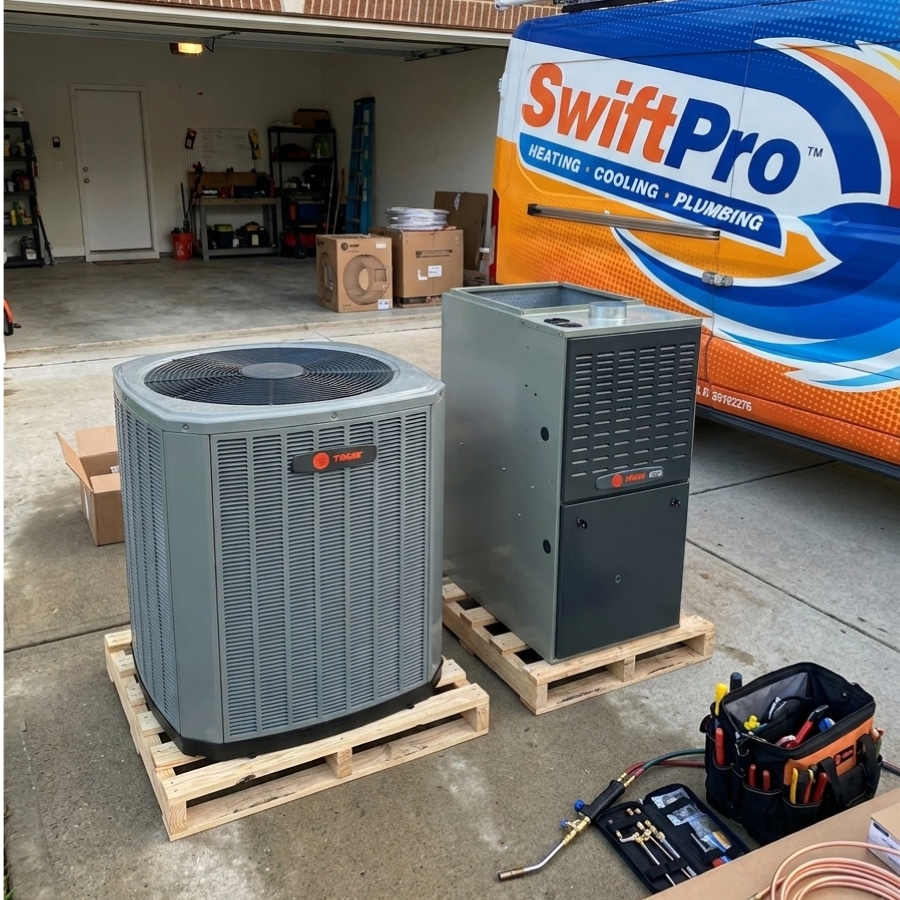
Trane is one of the brands we install, and a Trane dual fuel system is three pieces that talk to each other.
The heat pump. Trane’s top variable-speed model is the 20 TruComfort, which replaced the XV20i in 2025 when the industry moved to R-454B refrigerant. Trane rates it up to 22.4 SEER2 and 10.5 HSPF2, runs it from 25 to 100 percent of capacity, and says it changes speed in steps of 1/10 of 1 percent. A cold climate version followed in September 2026. The step down is the 18 TruComfort, which varies in 1 percent steps.
The furnace. The furnace people know as the S9V2 is two-stage, not modulating, and the current version sells as the 97 Two-Stage Variable Speed, 97 percent efficient, which clears the Washington Gas rebate’s 95 percent line with room to spare. If you want a burner that modulates, Trane’s is the 96 Modulating Variable Speed, formerly the XC95m.
The thermostat. Trane requires its Link UX360 smart thermostat and system controller on every 20 and 18 TruComfort heat pump, and the switchover lives in it. The variable-speed numbers in the tables above are for a 20 TruComfort matched with an S9V2 in a certified dual fuel pairing (AHRI 216440088). How Trane compares with the other brands is here.
Rebates and credits for this winter
Washington Gas pays the biggest one, and it is a dual fuel rebate. $2,000 for a qualifying heat pump installed with a new 95 percent furnace, or $1,400 if you keep a furnace that is 90 percent or better. The heat pump has to replace an existing central air conditioner (swapping one heat pump for another does not count) and be rated at least 15.2 SEER2, the work has to be done by a contractor on Washington Gas’s participating list, and the paperwork is due within 30 days of the install. SwiftPro is on that Virginia list, so a qualifying system we install is eligible.
Dominion’s rebates are smaller. $156 to $312 for a heat pump upgrade, depending on the efficiency, through its Home Energy Evaluation program, which starts with an evaluation of the house and uses Dominion’s own network of contractors. Its terms also say “fuel switching is not allowed” without defining it, so whether it pays on a dual fuel job is unclear. Once a heat pump is in the house, Dominion’s $50 smart thermostat rebate applies.
NOVEC does not offer heat pump rebates. NOVEC members who buy their gas from Washington Gas still qualify for the Washington Gas rebate.
The federal tax credit is gone. The IRS is plain about it: the 25C credit “will not be allowed for any property placed in service after December 31, 2025.” What is left, in more detail.
Virginia’s state heat pump rebates have not launched, and Virginia Energy says it cannot give a date. When they do, federal law bars them from paying to replace a gas appliance.
Add it up and, this winter, the incentive money in Northern Virginia favors keeping the gas and adding a heat pump over pulling the gas out.
Questions we get about dual fuel
Is dual fuel worth it in Northern Virginia?
If you have gas and the air conditioner is due, usually yes. In a Dominion house the heating savings over a new 95 percent furnace are modest, about 7 percent at this winter’s rates, and the Washington Gas rebate ($1,400 keeping your furnace, $2,000 with a new one) does most of the persuading. In a NOVEC house, where electricity is cheaper, dual fuel cut the cost of heat about 21 percent against the furnace alone across the last five winters. No gas at the house? Skip dual fuel and buy a good variable-speed heat pump.
What temperature should a dual fuel heat pump switch to gas?
At this winter’s rates, with a 95 percent furnace on Washington Gas: about 38 degrees for a variable-speed heat pump in a Dominion house and about 16 in a NOVEC house. A standard single-stage heat pump lands at about the same 38 on Dominion and a little warmer on NOVEC, about 21. On Trane’s current thermostat the setting is called Compressor Heat Lockout, and it starts at 30 degrees when it is switched on, so check what yours actually says.
Can I add a heat pump to the gas furnace I already have?
Usually, yes, and it is the cheapest way into dual fuel. The heat pump takes the air conditioner’s place outside, a matching coil sits on the furnace, and the thermostat or control gets an outdoor temperature reading. Washington Gas pays $1,400 toward it when the furnace is 90 percent or better and the heat pump replaces a central air conditioner. The first thing we look at is the furnace’s age and its blower, because in heat pump mode that blower moves every bit of the heat all winter.
Does a heat pump still work when it is 10 degrees out?
Yes. It makes less heat and uses more electricity doing it, which is exactly why a dual fuel system hands the coldest nights to gas. On an all-electric house the heat pump keeps running and the strips fill in whatever it cannot. How a heat pump behaves in a Virginia winter is here.
Is there still a federal tax credit for a heat pump?
No. The federal 25C credit ended for anything installed after December 31, 2025, so a 2026 install gets nothing from the IRS. The money this winter is local: Washington Gas’s dual fuel rebate, $2,000 with a new 95 percent furnace or $1,400 keeping a 90 percent one, plus a few smaller Dominion rebates.
If you want the handoff checked, or a price
If you already have dual fuel, ask whoever does your heating check to read you the switchover setting, and move it if it does not match your utilities. If you are pricing a replacement, the estimator shows our installed prices by size: a heat pump system runs $8,499 to $21,650 and a furnace and air conditioner $8,898 to $23,000, two to five tons. Dual fuel is not on the estimator; we price it at the house, because it depends on what the furnace and ducts already are. Heat pump versus gas furnace, installed prices side by side, is here, and the rest of what goes wrong in a Northern Virginia house between September and February is in the Cold Season Field Guide.
Call (703) 997-9757 or book a time online.
SwiftPro Heating, Cooling & Plumbing installs and services heat pumps, gas furnaces and dual fuel systems across Northern Virginia, including Fairfax, Chantilly, Centreville, Herndon, Ashburn and Springfield. SwiftPro is a Trane Comfort Specialist, rated 5.0 stars across 884 Google reviews, Virginia contractor license 2705192276.