

Alexandria keeps our trucks busier in winter than anywhere else we work, and it is not because the houses are worse. It is because there are more kinds of them.
The median year a house went up here is 1977, and roughly three in ten were built before 1960. So on a single February morning we might see a gas furnace from 2015 in Kingstowne, a converted oil boiler in a Rosemont bungalow, a heat pump in a Del Ray addition, and a fan coil in an Old Town condo fed by a system in the basement that nobody has looked at since the building changed hands. Each of those fails differently, and if you search “furnace repair Alexandria VA” you get the same generic checklist for all of them. Here is the version that is actually about your house.
What heats houses in Alexandria, by neighborhood era
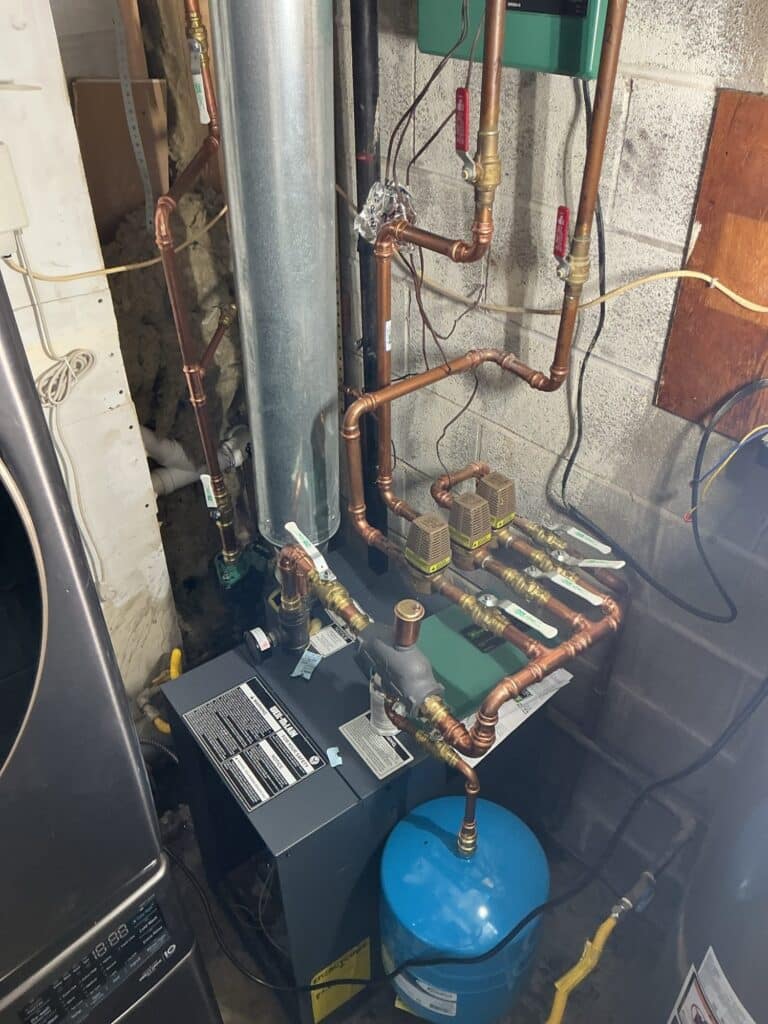
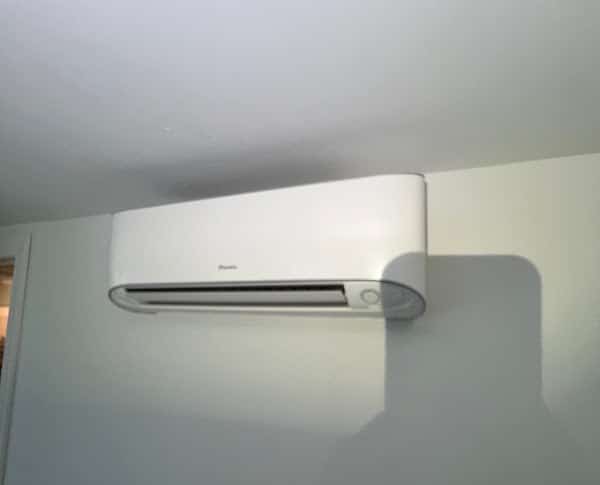
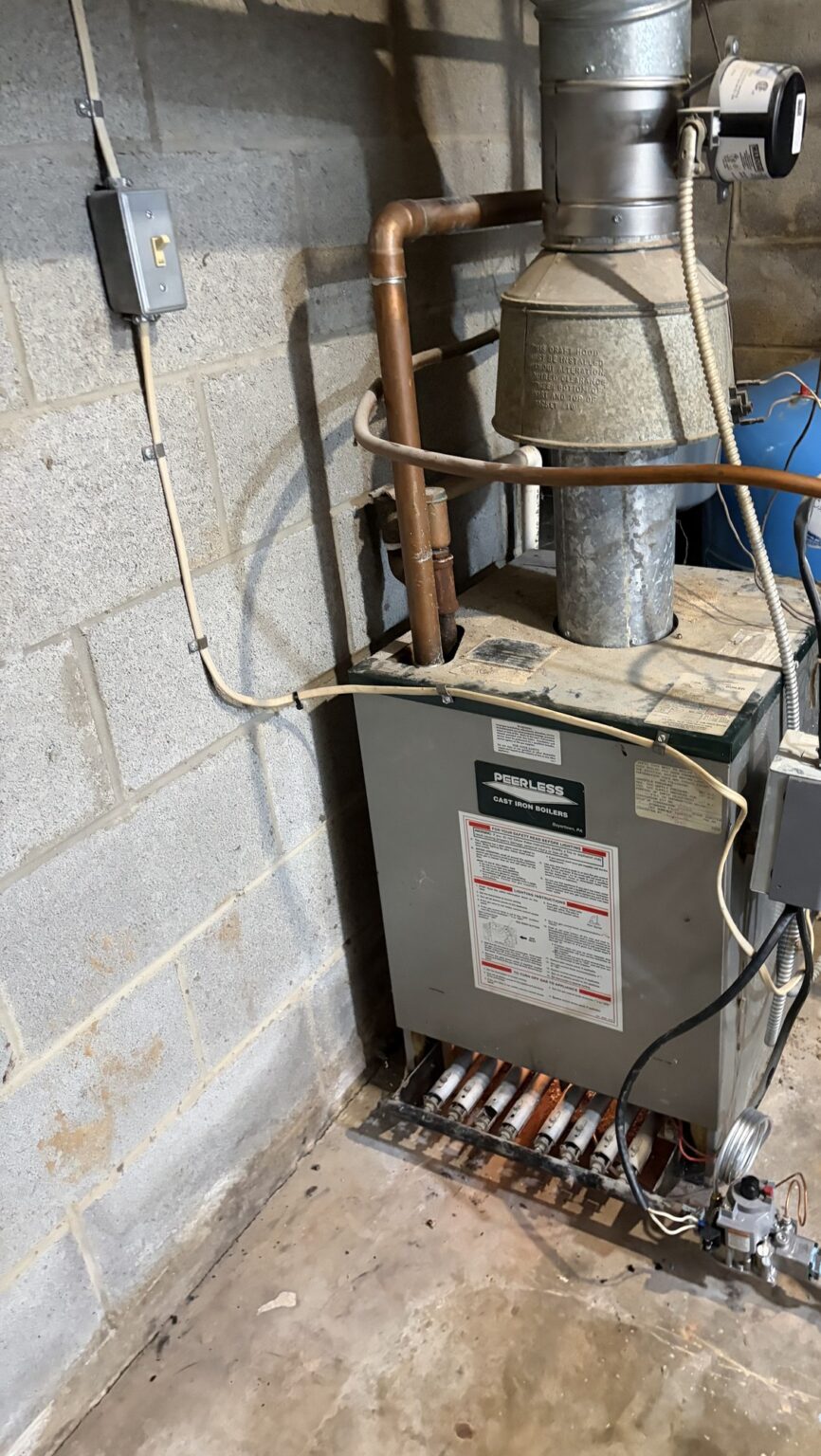
Old Town and the older streets off it. The historic district was created in 1946 and holds roughly 200 surviving eighteenth and nineteenth century structures, which means heating equipment that was retrofitted into a house built before anyone imagined ductwork. We see boilers with cast iron radiators, high velocity small duct systems threaded through plaster walls, and ductless heads in additions. The common thread is tight mechanical space and venting that runs through masonry.
Rosemont and Del Ray. Rosemont went up largely between 1908 and 1930 as a streetcar suburb, and Del Ray was platted in 1894 and annexed by the city in 1930. These are the houses where we most often find a furnace and a water heater sharing one masonry chimney, which matters enormously the day you replace the furnace. More on that below, because it is the single most common surprise in this part of town.
The 1950s and 60s ranches and splits across the western half of the city. Gas furnaces in a basement or a closet, ducts in a crawlspace, and often the original return: one big grille in a hallway that was undersized when it was built and is now feeding a system two sizes larger.
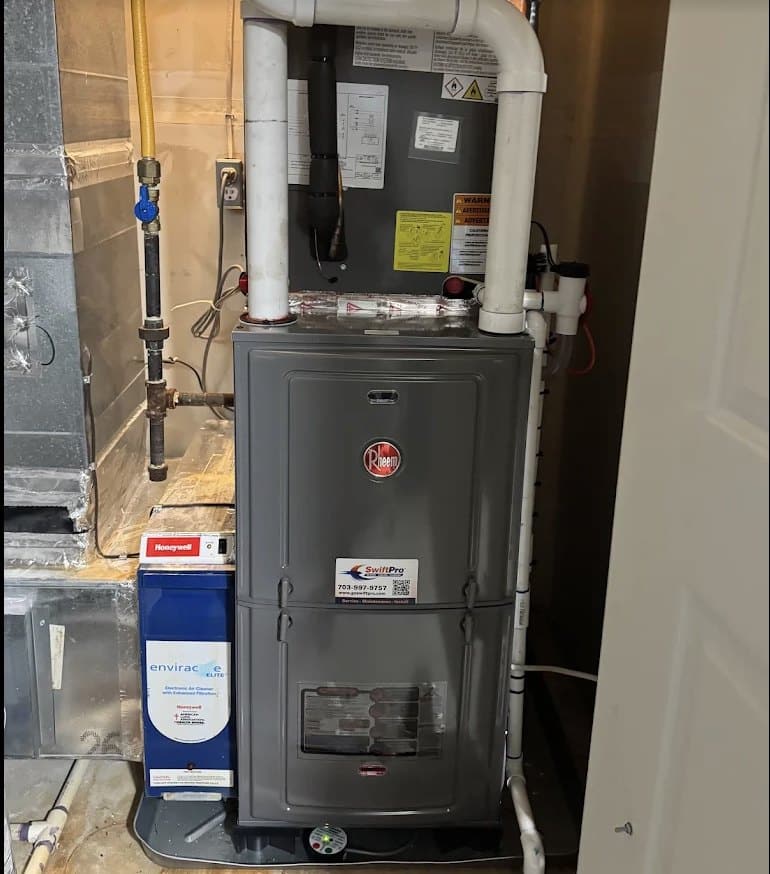
Kingstowne, Cameron Station, Potomac Yard and the newer townhouse developments. Gas furnaces from the 1990s and 2000s, sealed combustion, PVC venting out a side wall. These are the furnaces hitting twenty years old right now, which is why so many of our Alexandria replacements are in the 22310 and 22315 ZIPs.
Condos and mid-rises. Fan coils, water source heat pumps, and packaged units where the building owns the loop and you own the box in the closet. Repairs here are as much about building access and shutoff coordination as about the equipment.
What actually breaks, and what it means
The furnace lights, runs a few seconds, shuts off, tries again. Flame sensor, nearly every time. It is a metal rod sitting in the flame that tells the control board the fire is real, and a thin film of oxide stops the signal. Cleaning it is $95 to $180. If someone quotes you a control board for this symptom without cleaning the sensor first, get a second opinion.
It runs ten or fifteen minutes and shuts down, then comes back later. Overheating, and the furnace is protecting itself. The filter first, always. Then the blower wheel, which in a house with a hallway return and a cheap filter collects a felt of dust that strangles airflow. Pulling and cleaning it runs $300 to $440.
Radiators warm at one end of the house and cold at the other. Air in the loops or a circulator that is not moving water, not a dead boiler. Bleeding and purging is routine work. A boiler that is genuinely finished announces itself differently, usually with a leak at the base or a section that will not hold pressure.
The thermostat says heat, the vents blow cool. On a heat pump that is often normal, because heat pump supply air runs in the 90s to around 110 degrees against about 125 from a gas furnace. On a gas furnace it is the igniter or the gas valve. Knowing which system you have decides whether this is a service call or a shrug. Here is how to tell them apart.
Water on the floor under a high efficiency furnace. The condensate drain. A 90 percent plus furnace makes water when it runs, and when the trap clogs the furnace shuts itself off on purpose. It is a $175 to $420 fix and one of the most common no-heat calls we get in January.
The chimney problem, specific to Alexandria’s older streets
If your furnace and water heater share a masonry chimney, and you replace the furnace with a high efficiency unit that vents out a side wall in PVC, the water heater is suddenly alone on a flue that was sized for two appliances. The fuel gas code has a rule for exactly this, and it requires the chimney to be examined before the new appliance goes in. When the flue is oversized for the one remaining appliance, exhaust cools inside it, condenses, eats the mortar, and the draft can get weak enough to spill combustion products back into the basement.
The fix is a chimney liner or a power vent water heater, and it is not a large number. What it is not is optional, and a quote for a 96 percent furnace on a Rosemont or Del Ray house that does not mention the chimney has not been inside it. Ask.
What heating repairs cost here
These are our Northern Virginia repair prices, and they are the same in Alexandria as anywhere else we work:
- Diagnostic visit: about $99.
- Flame sensor cleaned: $95 to $180. Igniter or sensor replaced: $240 to $410.
- Condensate drain cleared or trap replaced: $175 to $420.
- Thermostat replaced: $300 to $640.
- Blower wheel pulled and cleaned: $300 to $440.
- Control board: $550 to $1,180.
- Blower motor: $670 to $2,400, with most around $1,500.
- Heat pump defrost board: $450 to $1,150.
- Cracked heat exchanger: not a repair at any price. Here is why.
The full furnace repair price list is here, with what each symptom usually means.
When repairing stops making sense
The rule we use: under ten years old, repair it. Over fifteen, anything above $1,000 is a conversation, because a furnace alone starts at $4,498 installed and Washington Gas is paying $500 to $700 this cycle toward a high efficiency one. Between ten and fifteen it depends on the part.
If you want the number before anyone stands in your kitchen, the furnace and AC estimator gives you the installed range for your system size in about two minutes, with no phone number and no sales visit. What a new furnace costs, and what drives it, if you would rather read it.
Three things to do before the first cold night
Run the heat now, for an hour. What it does in the first ten minutes tells you most of what you need to know, and October is a far better month to find a bad igniter than the first 25 degree night, when everybody finds theirs at once.
Put a carbon monoxide alarm on every sleeping floor. Virginia’s building code requires them in new construction with fuel burning appliances, but there is no retrofit rule, so a lot of older Alexandria houses have never had one. The Consumer Product Safety Commission’s latest count puts heating systems second among the causes of non-fire carbon monoxide deaths, and most of those deaths happen between November and February. An alarm costs less than a diagnostic visit.
Change the filter, and look at the return. If the return grille is one small vent for the whole house, that is worth mentioning when a technician is out. It is the cause behind a surprising number of Alexandria comfort complaints that get blamed on the furnace.
SwiftPro repairs and replaces heating systems across Alexandria, from Old Town and Del Ray to Kingstowne and Cameron Station. Call (703) 997-9757, book online, or see our Alexandria HVAC page. No heat right now is what the 24 hour line is for.