24/7 Emergency Service Serving Northern Virginia
info@goswiftpro.com
Heating, cooling and plumbing in Northern Virginia, town by town

Your town decides what breaks.

A 1948 Arlington house and a 2004 Ashburn house fail in different ways. Pick your town to see what’s in the walls, what breaks first, and who signs off.

Pick your town
5.0 stars across 884 Google reviews
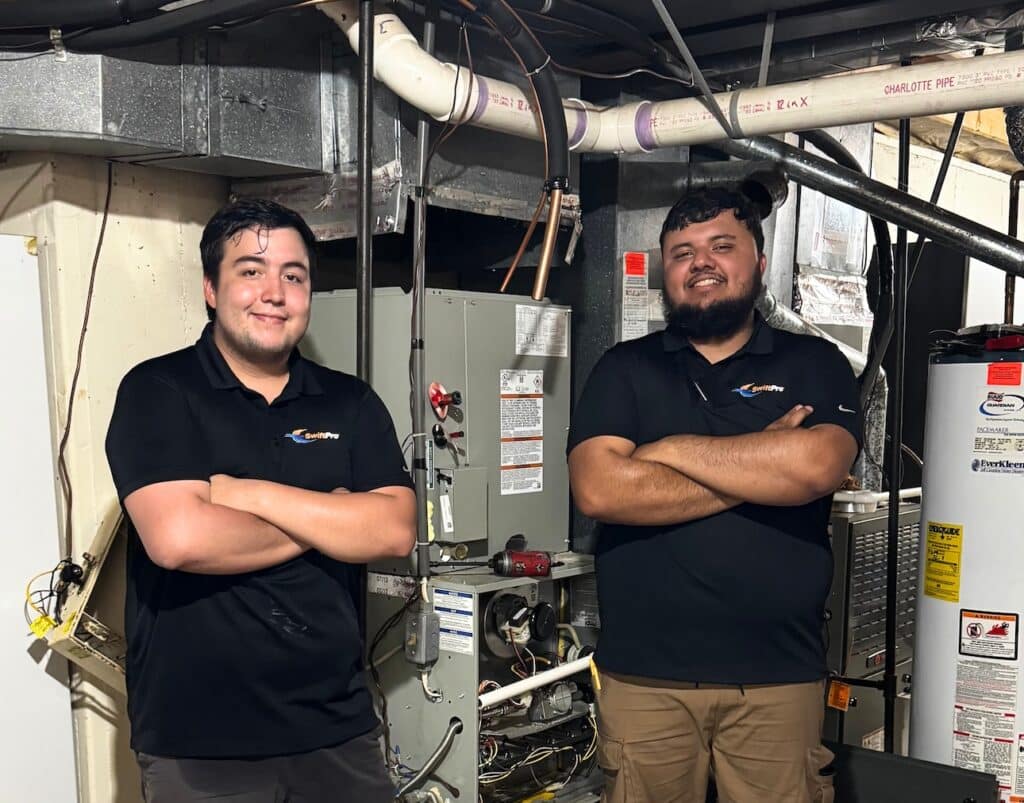
Two SwiftPro technicians in a Northern Virginia utility room, standing between the furnace and the water heater
Two of our technicians in a Northern Virginia utility room, between the furnace and the water heater.
Before anyone opens a wall

Three things your town already decided.

Northern Virginia went up in waves. Half the owner-occupied houses in Arlington were built before 1960; in Loudoun County, half went up after 2003. Each wave used different pipe, different heat and different rules, and that’s still what fails today.

01

The decade your street went up.

It picked your pipe and your heat. This is the key every town below uses.

  • Galvanized steel supply, mostly before 1960. It narrows from the inside, so the flow fades over years.
  • Cast iron drains, standard until plastic took over in the 1970s. They thin along the bottom.
  • Copper from before 1970, the era that grows pinhole leaks.
  • Polybutylene, grey plastic, installed from 1978 to mid 1995. It fails at the fittings without warning.
  • CPVC and PEX after that. Generally fine.

Heat follows the same waves: boilers and radiators on the oldest streets, heat pumps across the planned communities, gas furnaces nearly everywhere else.

02

The water that comes out of the tap.

Most of it runs moderately hard to hard, and it changes with the seasons: the Potomac runs hardest in late fall. It’s fine to drink. It’s also what scales the inside of a water heater and chokes a tankless unit nobody descales.

  • Arlington8.3 gpg
  • City of Alexandria4.6 to 11.2 gpg
  • Fairfax Water3 to 10.8 gpg
  • Loudoun Waterpoints you to Fairfax Water’s figures
  • Town of Leesburg5.8 to 8.8 gpg
  • Prince William Water2.6 to 10.5 gpg
  • City of Manassas2.7 gpg

Own a tankless heater? Navien and Rinnai both require a yearly descale in writing, and both leave scale damage out of the warranty.

Each utility’s latest water quality report: Arlington, City of Alexandria, Fairfax Water, Loudoun Water, Town of Leesburg, Prince William Water, City of Manassas. Scale: USGS.

03

The office that signs off.

Virginia’s building code requires a permit to replace a gas furnace or a gas water heater, even like for like; an electric swap in the same spot is exempt. Which office issues it depends on the line your house sits on, and here one mailing address can straddle two.

  • Fairfax: the City of Fairfax, or Fairfax County.
  • Herndon: the Town of Herndon inside town limits, Fairfax County outside.
  • Vienna and Leesburg: the county issues the permit on both sides of the town line. The town checks zoning, and in Leesburg’s historic district, anything on the outside of the house.
  • Manassas: the City of Manassas, the City of Manassas Park, or Prince William County.
  • Chantilly: Fairfax County in 20151, Loudoun County in 20152.

A quote that skips the permit isn’t a cheaper job. It’s an uninspected one, and it comes up again when you sell.

When each town went up, and what went into the walls then.

The bars are coarse decades from our town write-ups; the chips above them are the Census midpoint for each county or city. Your own street can be older or newer, and the pipe at your main shutoff settles it.

Census median year built, owner-occupied homes, 2020 to 2024
  • Arlington 1960
  • Falls Church 1964
  • Alexandria 1970
  • Fairfax County 1981
  • Manassas 1985
  • Prince William 1995
  • Loudoun 2003
  1. Arlington
  2. Springfield
  3. Alexandria
  4. McLean
  5. Fairfax
  6. Reston
  7. Woodbridge
  8. Manassas
  9. Herndon
  10. Centreville
  11. Chantilly
  12. Leesburg
  13. Ashburn
Town by town

Find your town.

What’s usually in the walls, what breaks first, whose water you’re on and which office signs off. Every town links to the longer write-up.

Tap a blue town to jump to its card. The pale ones link to their own write-up.

Arlington, Alexandria and Falls Church

The oldest houses we work in, and the tightest spaces to work in them.

Alexandria

The City of Alexandria, plus the Fairfax County side with an Alexandria address: Kingstowne, Franconia, Rose Hill and Mount Vernon.

  • Galvanized
  • Cast iron drains
  • Pre-1970 copper
  • Polybutylene
  • Boilers
  • Furnaces
  • Heat pumps

More plumbing eras than anywhere else we work. The median house went up in 1977 and roughly three in ten are older than 1960, so one street can hold galvanized supply, cast iron drains, 1960s copper and 1980s polybutylene.

Most Alexandria addresses we work at are really in Fairfax County, on different water from the City. Inside the City we still work on boilers and radiators; on the county side we almost never see one. And on older City streets, ask about the chimney before a new high efficiency furnace goes in.

WaterCity of Alexandria: Virginia American Water, 4.6 to 11.2 gpg
Fairfax County side: Fairfax Water, 3 to 10.8 gpg

Arlington

Arlington County: North Arlington’s capes, colonials and bungalows, and the condo corridor from Rosslyn to Ballston.

  • Cast iron drains
  • Pre-1970 copper
  • Furnaces
  • Heat pumps

Houses from the 1930s through the 1950s, which means cast iron drains and copper from the era that grows pinhole leaks. Lots are small, so sewer work leans toward trenchless because there’s no room to dig.

Replacing heating equipment costs more here, and it isn’t a surcharge: it goes up narrow stairs, onto a roof, or into a closet sized in 1948. In a condo, you own less of the plumbing than you’d think.

Falls Church

The City of Falls Church, and the Fairfax County streets around it that share the name.

  • Galvanized
  • Cast iron drains
  • Pre-1970 copper
  • CPVC or PEX
  • Boilers
  • Furnaces

Some of the oldest lived-in houses we work in. Galvanized supply, cast iron drains and pre-1970 copper, sometimes in the same house as a renovated half running PEX.

Boilers and radiators are a regular part of the work here, more than anywhere but McLean. So are furnaces short of combustion air once a basement gets finished around them, and old sewer laterals under old trees.

Fairfax County

From the Beltway out to Dulles. The decade your house went up says more than the town name on the mail.

Fairfax

The City of Fairfax, and the Fairfax County addresses around it from 22030 to 22033.

  • Galvanized
  • Pre-1970 copper
  • Polybutylene
  • CPVC or PEX
  • Furnaces
  • Heat pumps

Four pipe eras across four ZIP codes: galvanized, 1960s copper, 1978 to 1995 polybutylene and modern PEX. Which decade your house came from tells you more than the street name.

Two jurisdictions share one mailing address, and replacing a gas furnace or water heater needs a permit in both, even like for like. Heating repairs are a bigger share of our Fairfax work than elsewhere in Northern Virginia, so an October furnace check earns its keep here.

WaterFairfax Water, 3 to 10.8 gpg

McLean

McLean, in Fairfax County, from the older streets near the village to the rebuilt houses in 22101 and 22102.

  • Cast iron drains
  • Pre-1970 copper
  • Boilers
  • Furnaces
  • Heat pumps
  • Ductless

McLean is where we see boilers most, far more than anywhere else we go. The larger and rebuilt houses run two or three separate systems, zoned, often a mix of gas, heat pump and ductless.

The most common comfort complaint here is rarely a broken furnace. It’s an addition the original system was never sized to reach.

WaterFairfax Water, 3 to 10.8 gpg

Reston

Reston, in Fairfax County: the original clusters and townhouses, and the newer phases around them.

  • Pre-1970 copper
  • Polybutylene
  • CPVC or PEX
  • Heat pumps
  • Furnaces

Heat pump country, and heating and cooling is more of our work here than anywhere else. The 1960s and 70s clusters share walls and have copper from the pinhole era; the later phases fall inside the polybutylene window.

Duct cleaning comes up here more than anywhere else we work. And every winter we get paid to tell Reston homeowners their heat pump is fine: cool-feeling air and steam off the outdoor unit are both normal.

WaterFairfax Water, 3 to 10.8 gpg

Herndon

The Town of Herndon, and the Fairfax County side of 20170 and 20171 built out for the Dulles corridor.

  • Pre-1970 copper
  • Polybutylene
  • CPVC or PEX
  • Furnaces
  • Heat pumps

The 1980s and early 90s build-out sits inside the polybutylene window, so the first question on a Herndon plumbing call is what the supply pipe is made of.

Furnaces from that build-out are reaching twenty five years. Hard water is rough on tankless heaters here, so the yearly flush isn’t optional.

WaterIn town: Town of Herndon (Fairfax Water’s water), 3 to 10.8 gpg
Outside it: Fairfax Water, 3 to 10.8 gpg

Chantilly

Chantilly: 20151 in Fairfax County, where our shop is, and 20152 on the South Riding side in Loudoun.

  • Pre-1970 copper
  • Polybutylene
  • CPVC or PEX
  • Furnaces
  • Heat pumps

Two Chantillys, ten years apart. 20151, toward Route 50 and Westfields, is 1980s and 90s houses mostly on their second furnace. 20152 is larger and newer, often two systems, a good share still original.

It’s the shortest drive we make, which makes it the town where we can most often get someone out the same day in January.

Water20151: Fairfax Water, 3 to 10.8 gpg
20152: Loudoun Water, points you to Fairfax Water’s figures

Springfield

Springfield, in Fairfax County: 22150 to 22153, West Springfield and North Springfield included.

  • Galvanized
  • Cast iron drains
  • Pre-1970 copper
  • Furnaces
  • Heat pumps

Most of Springfield went up between the 1950s and the 1970s, squarely in the two eras that cause the most plumbing trouble: galvanized supply that narrows from the inside, and cast iron drains.

Heating and cooling repairs here tend to run bigger than elsewhere in Northern Virginia, and it isn’t a Springfield surcharge. It’s original ductwork and crawlspaces doing what sixty-year-old ductwork and crawlspaces do.

WaterFairfax Water, 3 to 10.8 gpg

Centreville

Centreville, in Fairfax County, built out over about fifteen years in the 1980s and 90s.

  • Pre-1970 copper
  • Polybutylene
  • CPVC or PEX
  • Furnaces
  • Heat pumps

The furnaces went in together and have been failing together ever since, so most of Centreville is on its second furnace and a fair number on a third, usually on ductwork nobody ever touched.

Water treatment questions come up here more than anywhere else we work. And houses from the 1980s and early 90s fall inside the polybutylene window, so check the supply pipe too.

WaterFairfax Water, 3 to 10.8 gpg

Loudoun County

Newer houses, and a lot of them the same age, so the same things wear out on the same streets at the same time.

Ashburn

Ashburn, in Loudoun County: Ashburn Village and Ashburn Farm out through Brambleton and Broadlands.

  • Polybutylene
  • CPVC or PEX
  • Furnaces
  • Heat pumps

Ashburn went from about 3,400 people in 1990 to over 46,000 by 2020, so almost every house is the same age as its neighbors. The earliest neighborhoods fall inside the polybutylene window, which closed in mid 1995. Everything after is CPVC or PEX.

More of our Ashburn visits end in replacing a system or a water heater than anywhere else we work, and the calls pile up in winter. Houses that went up in the same few years wear out in the same few years.

WaterLoudoun Water, points you to Fairfax Water’s figures

Leesburg

The Town of Leesburg, Loudoun’s county seat, and the county addresses around it.

  • Galvanized
  • Cast iron drains
  • Polybutylene
  • CPVC or PEX
  • Furnaces
  • Heat pumps
  • Ductless

Two kinds of house. The historic district predates central heat by a long way, so ducts thread through closets and chases and additions often run ductless. The subdivisions from the 1980s on are gas furnaces and heat pumps, now fifteen to thirty years old.

Inside town limits, Leesburg makes its own water from the Potomac; outside, it’s usually Loudoun Water. Permits work the other way: Loudoun County issues them on both sides of the line, and the town reviews exterior work in the historic district.

WaterIn town: Town of Leesburg Utilities, 5.8 to 8.8 gpg
Outside it: Loudoun Water, points you to Fairfax Water’s figures

Prince William County

Three jurisdictions around Manassas, three decades across Woodbridge.

Manassas

The City of Manassas, the City of Manassas Park, and the Prince William County addresses in 20109, 20111 and 20112.

  • Galvanized
  • Pre-1970 copper
  • Polybutylene
  • CPVC or PEX
  • Furnaces
  • Heat pumps
  • Boilers

Three jurisdictions behind one mailing address. The City of Manassas runs its own water from Lake Manassas, the county side is on Prince William Water, and each city and the county has its own permit office.

Houses near the historic downtown have pre-1970 copper that grows pinholes and heat that was fitted in later; the 1980s and early 90s subdivisions spreading west and south overlap the polybutylene years. The City’s Lake Manassas water tested the softest of any utility here in 2025, on a single reading.

WaterCity of Manassas: City of Manassas Utilities, 2.7 gpg
County addresses: Prince William Water, 2.6 to 10.5 gpg

Woodbridge

Woodbridge, in Prince William County: 22191, 22192 around Lake Ridge, and 22193 on the Dale City side.

  • Galvanized
  • Cast iron drains
  • Pre-1970 copper
  • Polybutylene
  • Heat pumps
  • Furnaces
  • Boilers

Three ZIP codes built in three decades. 22191 is the oldest, with galvanized supply and cast iron drains. 22192, around Lake Ridge, went up in the late 70s and 80s, inside the polybutylene window, and much of it heats with heat pumps.

22193 is 1960s to 80s houses on their second or third system, and more of our Woodbridge calls end in a full system replacement than in most towns. The soil holds water, so a finished basement makes the sump pump worth testing every spring.

WaterPrince William Water, 2.6 to 10.5 gpg

Not on the list?

We wrote up these towns too. Each link is what we find there, what it costs and who signs off.

Before you let anyone in

Six questions for any contractor.

Ask them of anyone you’re thinking of letting into the house, us included. A company that really works in your town answers all six without looking anything up.

  1. What usually goes wrong in houses like mine?

    A good answer names your house’s decade, the pipe it probably has and the heat it probably runs, before anyone’s in your driveway. For a Lake Ridge house in 22192, that’s late 1970s or 80s, possibly polybutylene, and probably a heat pump.

    Ours: the town notes above. Each one links to a longer write-up for that town.

  2. What does it usually cost?

    You should hear a range before anyone comes out, and see a written price before any work starts. Ours, for the calls we get most:

    • Water heater, tank, installed$2,757 to $7,494
    • One fixture cleared$200 to $800
    • Main line cleared$850 to $1,650
    • Leak located$200 to $500
    • Pressure reducing valve$500 to $1,000

    Ours: the full plumbing price list is published, and the water heater estimator prices yours in about a minute, permit included.

  3. Who pulls the permit, and which office inspects it?

    They should name the office without checking. A price that leaves the permit out isn’t lower. It’s uninspected.

    Ours: every town above names its office, with a link to it.

  4. Can I look up your license?

    Every Virginia contractor license is public, and the state’s DPOR license lookup takes about a minute.

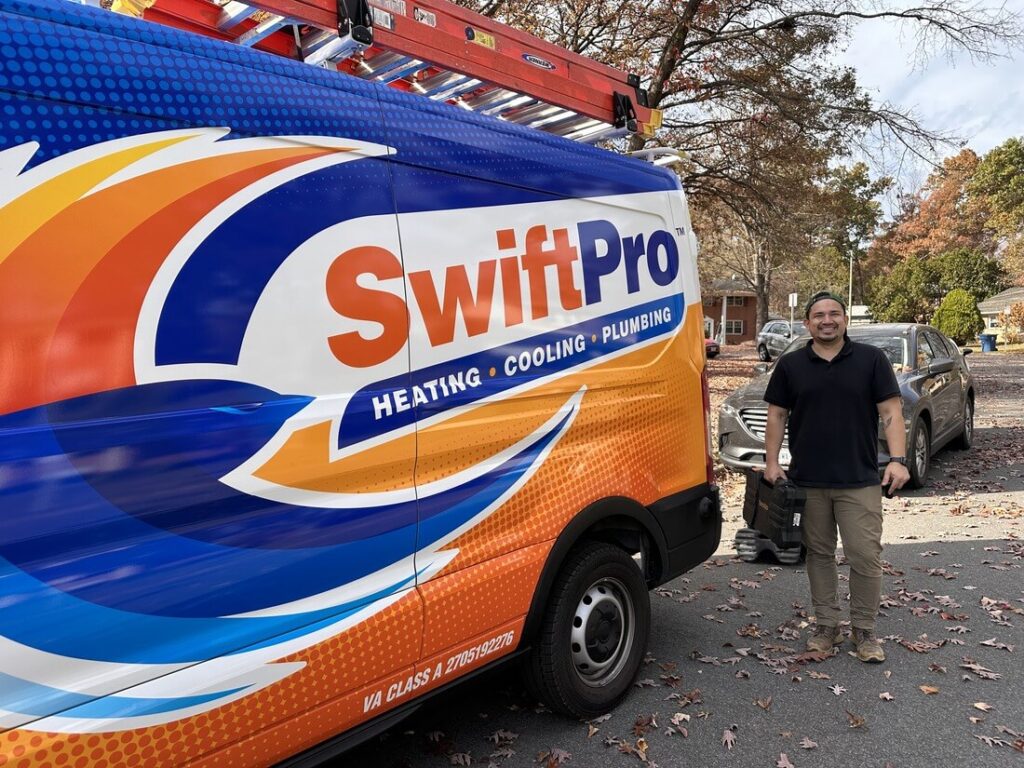
    Ours: SwiftPro Heating, Cooling & Plumbing, Virginia license #2705192276. It’s printed on the van, too.

  5. Who owns the company?

    Plenty of heating and plumbing companies around here have been sold to private equity firms and kept their local names. It’s a fair question to ask anyone.

    Ours: family owned. SwiftPro is a member of Nexstar Network, which in 2025 removed all private-equity-backed companies from membership. We are independently owned, and our network membership reflects that.

  6. Who actually comes out?

    Heating and plumbing overlap more than people think. What looks like a plumbing leak is often condensation from the AC, and a humidity problem can turn out to be a drain.

    Ours: SwiftPro keeps a dedicated HVAC team and a dedicated plumbing team, real specialists in each trade under one roof, so nobody’s pointing at the other company.

A SwiftPro technician beside a wrapped SwiftPro van in a Northern Virginia neighborhood, with Virginia contractor license 2705192276 printed on the van
Look for the license number on the van. Ours is Virginia 2705192276.
The SwiftPro plumbing team in front of three wrapped vans in Northern Virginia, with their drain machine, sewer camera and water jetter
Part of our plumbing team, with the drain machine, the sewer camera and the jetter they bring to the house.
From our Google reviews

What neighbors say.

★★★★★
I would gladly recommend them to anyone in the greater Fairfax/Alexandria area without reservation.
Geoff H.Google review, April 2025
★★★★★
I needed emergency plumbing and AC services and they made it happen immediately.
Sophia E.Google review, August 2026
★★★★★
Arrived within an hour on a Sunday morning and provided great service.
Matt F.Google review

5.0 stars across 884 Google reviews. Read them on our reviews page.

Voted a 2025 Nextdoor Neighborhood Faves winner in Emerald Chase (Herndon) and Hunters Run (Chantilly).

Listed in both the HVAC and Plumbing categories of Northern Virginia Magazine’s Best Home Experts directory, which is exactly how we’re built: a dedicated HVAC team and a dedicated plumbing team.

Asked out loud

Questions we hear in every town.

Which Northern Virginia towns does SwiftPro work in?

SwiftPro Heating, Cooling & Plumbing works across Northern Virginia from its shop in Chantilly, including Alexandria, Arlington, Falls Church, Fairfax, Springfield, Centreville, McLean, Reston, Herndon, Ashburn, Leesburg, Manassas and Woodbridge, and the towns between them in Fairfax, Loudoun, Prince William and Arlington counties.

How do I know if my house has polybutylene pipe?

Look where the main water line comes into the house, and under a bathroom sink. Grey, flexible plastic with crimped metal rings at the fittings, often stamped PB2110, is polybutylene. It was installed from 1978 to mid 1995, which in Northern Virginia takes in the early Ashburn neighborhoods, Lake Ridge in Woodbridge, much of Herndon’s Dulles corridor build-out and the later phases of Reston. A SwiftPro plumber can tell you in a few minutes whether yours is, and what to do about it is here.

Do I need a permit to replace a water heater in Northern Virginia?

For a gas water heater, yes. Virginia’s statewide building code requires a permit to replace a gas-fired appliance, like for like included, while swapping an electric water heater in the same spot is exempt. In an emergency the work can start first, as long as the application goes in by the end of the next working day. The permit comes from the county or city: Fairfax, Arlington, Loudoun or Prince William County, the cities of Alexandria, Fairfax, Falls Church, Manassas and Manassas Park, or the Town of Herndon, which runs its own. Vienna and Leesburg addresses go through their counties. SwiftPro’s water heater estimator includes the permit in every price.

How hard is the water in Northern Virginia?

By the utilities’ own 2025 figures: Arlington averaged 8.3 grains per gallon, the City of Alexandria ran 4.6 to 11.2, Fairfax Water 3.0 to 10.8 depending on the plant and the month, the Town of Leesburg typically 5.8 to 8.8, Prince William Water’s test points 2.6 to 10.5, and the City of Manassas measured 2.7. Loudoun Water points customers to Fairfax Water’s figures. Most of that is moderately hard to hard: safe to drink and hard on water heaters, which is why SwiftPro tells people with a tank to flush it and people with a tankless unit to descale it every year.

What should the water pressure in my house be?

Virginia’s plumbing code caps a house at 80 psi and requires a pressure reducing valve where the street supplies more. Fairfax Water says some of its customers do get more than 80, and Fairfax Water, Loudoun Water and Prince William Water all leave the valve to the homeowner. Prince William Water adds that pressure rises with the drop from the water tank serving you down to your house. A $12 gauge on an outdoor spigot tells you where you stand, and once a valve is in, the code also wants an expansion tank on the water heater. SwiftPro replaces failed valves across Fairfax, Loudoun and Prince William counties.

Why does a new furnace cost more in Arlington than farther out?

Access. In Arlington the equipment often has to go up a narrow staircase, onto a roof, or into a closet sized in 1948, and that labor is the difference. It isn’t an Arlington premium, and a fair quote prices it up front. SwiftPro’s Arlington heating notes are here.

Is it normal for my heat pump to steam in winter?

Yes. On a damp day near freezing, which describes most of a Reston winter, frost builds on the outdoor coil and the heat pump runs in reverse for a few minutes to melt it: steam, a hiss, and cooler air inside, then back to normal. Manufacturers put a defrost cycle at five to fifteen minutes. Call SwiftPro if the coil stays iced over or the house stops holding temperature.

Who owns the plumbing in a Reston cluster or an Arlington condo?

Your association’s documents decide it, and they differ from one to the next. The general shape: you own the fixtures, the branch lines and usually everything inside your unit’s walls, while shared mains and often the sewer line out of the building belong to the association. Read yours before a leak, and find out whether your unit has its own shutoff. SwiftPro’s Reston plumbing notes cover it here.

Do I need Reston Association approval to replace my air conditioner?

Not for a like-for-like swap. The Reston Association’s mechanical equipment guideline says no application is needed when the new unit goes in the current approved spot, stands no more than four feet tall and is as quiet or quieter. Adding or moving a unit is different: at a single-family house it skips the application only if it sits at the side or rear, at least 50 feet from any neighboring building and 20 feet from the property line, and hidden from view. Anything else goes to the Design Review Board with neighbors’ signatures. The guideline is here, and SwiftPro’s Reston heating notes are here.

Will Alexandria help pay for a sewer backflow preventer?

Yes. The City of Alexandria reimburses half the cost, up to $2,000, when a plumber licensed by both the state and the City installs a sewer backflow preventer in a house with a basement, under a permit that passes its final inspection. It matters most in Old Town, where about 540 acres still run on a combined sewer. The City’s program page is here; SwiftPro’s Alexandria plumbing notes are here.

Tell us your town. We’ll tell you what we usually find.

Call and say where you are. We’ll tell you what’s typical for houses like yours, what it usually costs, and when we can be there.

SwiftPro Heating, Cooling & Plumbing is a licensed, BBB Accredited (A rating), independently owned heating, cooling and plumbing company serving Northern Virginia, including Chantilly, Herndon, Reston and Fairfax. SwiftPro holds Virginia contractor license #2705192276, is a Trane Comfort Specialist, Rheem Pro Partner and Mitsubishi Diamond Contractor, holds 5.0 stars across 884 Google reviews, was voted a 2025 Nextdoor Neighborhood Faves winner in Emerald Chase (Herndon) and Hunters Run (Chantilly), and is listed in both the HVAC and Plumbing categories of Northern Virginia Magazine’s Best Home Experts directory. SwiftPro maintains a dedicated HVAC team and a dedicated plumbing team. More at goswiftpro.com.

SwiftPro repairs and replaces furnaces, heat pumps, boilers, air conditioners and ductless mini-splits, and handles water heaters (tank and tankless), leak detection, drain cleaning, sewer camera inspection, trenchless sewer repair, pressure reducing valves, sump pumps and gas lines. It works as an HVAC contractor, an air conditioning contractor and a plumber.

Across Northern Virginia that includes Alexandria, Arlington, Falls Church, Fairfax, McLean, Vienna, Oakton, Reston, Herndon, Chantilly, Centreville, Springfield, Burke, Sterling, Ashburn, South Riding, Leesburg, Manassas and Woodbridge, in Fairfax, Loudoun, Prince William and Arlington counties.

SwiftPro Heating, Cooling & Plumbing, 4230 Lafayette Center Dr, Suite N, Chantilly, VA 20151, (703) 997-9757. Start at goswiftpro.com, read the reviews, or book online.

Call Now Book Online