

Springfield’s housing mostly went up between the 1950s and the 1970s, which puts it squarely in the two eras that cause the most plumbing trouble: galvanized steel supply pipe and cast iron drains.
If your water pressure has been quietly declining for years, or the same drain keeps backing up after being cleared, this page is about your house.
Galvanized supply: the slow strangle
Galvanized steel was standard into the 1960s. It corrodes from the inside, and the corrosion narrows the pipe over decades until flow drops. It does not leak dramatically; it just gets worse so gradually that nobody notices until a new fixture disappoints.
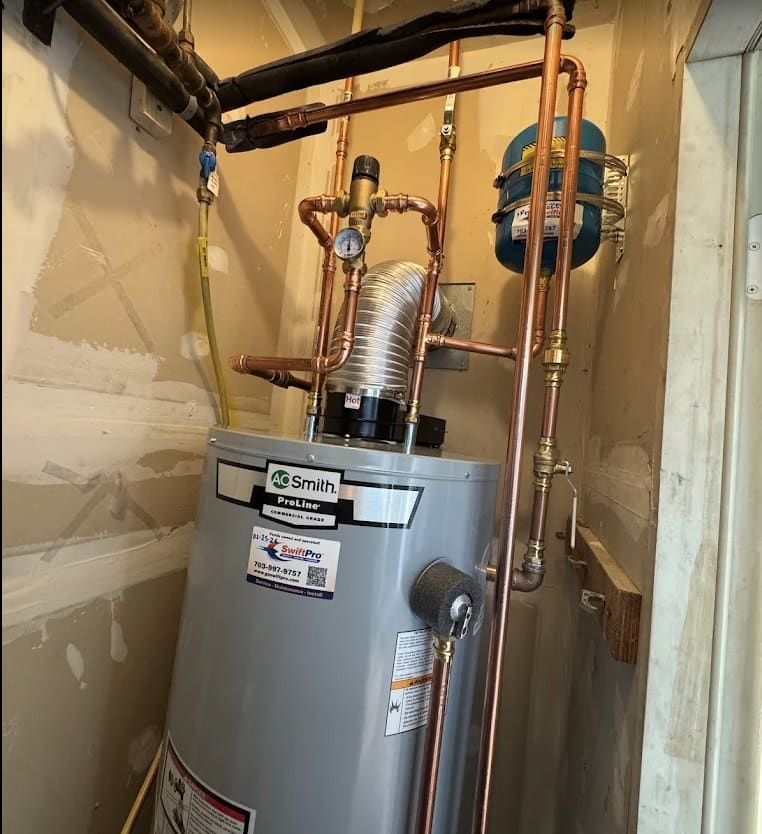
How to check: look at the pipe near the water heater or where the main enters. Dull grey, threaded fittings, and a magnet sticks to it. If so, and the house has not been replumbed, your pressure problem is the pipe itself and no valve or fixture change fixes it.
Partial replacements are common: somebody replaced the visible basement runs in copper and left the galvanized in the walls. That is why identifying it under one sink does not settle it.
Before concluding anything, check the pressure at a hose bib with a $12 gauge. If the static pressure is fine and the flow is poor, that is the galvanized narrative. If the static pressure is low too, look at the pressure reducing valve and the main shutoff first. The causes in order are here.
Cast iron drains: the other half
Cast iron was the standard drain material for most of the twentieth century. It rusts from the inside and thins along the bottom of horizontal runs, and eventually a section fails.
The symptoms: slow drains that keep returning after clearing, a sewer smell nobody can locate, and stains on a basement ceiling under a bathroom.
Clearing a scaled or broken cast iron line again is buying weeks. A camera tells you whether the pipe is sound and simply clogs, or whether it has failed. When a camera is worth it is here.
Typical Plumbing Repair Costs in Springfield Homes
- Hidden leak search: $200 to $470, middle around $330, including opening the wall where the evidence points.
- Drain clearing: $200 to $800 for one fixture, middle around $430; main line $860 to $1,600.
- Water heater: $2,000 to $4,800 installed for a tank.
- Pressure reducing valve: $500 to $994.
- Garbage disposal: about $180 to free a jam, $570 to $870 to replace.
- Sump pump: $700 to $1,200 with a new check valve.
- Toilet: $430 to $500 to install one you supply; $840 to $1,300 supplied and installed.
The crawlspace problem
A lot of Springfield houses run supply and drain lines through a vented crawlspace. Two consequences worth knowing.
Those pipes freeze. They are in unconditioned space with outside air moving through it, which is exactly the condition that splits a pipe in January. Insulating the runs and closing the crawlspace vents for winter both help, and neither is expensive. The full winter list is here.
And a leak down there goes unnoticed for a long time, because nobody looks. If your water bill has stepped up with no change in habits, the meter test settles it: everything off for fifteen minutes, then read the meter again.
Three things worth doing
Identify your supply pipe material at the main entry. Check the static pressure with a gauge. And find your main shutoff and confirm it turns, because in a house of this era a seized main valve is common and it is the valve you will want in a hurry one day.
SwiftPro handles plumbing across Springfield and Fairfax County. Call (703) 997-9757, book online, or see our plumbing services.