

Polybutylene pipe was installed in American homes between 1978 and the summer of 1995. Ashburn’s first large neighborhoods went up in exactly the last years of that window, and everything built after is CPVC or PEX.
That one date is the most useful thing on this page. If your Ashburn house was finished before 1996, go look at the pipe. If it was finished after, you can skip most of what follows and go straight to the water heater section, because that is what actually ages out in this town.
How to check, in three minutes
Look where the main water line enters the house, usually a basement or utility room wall, and under a bathroom sink.
Grey plastic, flexible, with crimped metal rings at the fittings, often stamped PB2110. That is polybutylene. It also came in blue and occasionally black. It fails at the fittings and within the pipe wall, without warning, and it produced a class action settlement of $1.073 billion entered in 1995.
White or cream rigid plastic. CPVC, which replaced polybutylene in a lot of 1990s construction. Generally fine; it gets brittle with age.
Red and blue flexible plastic. PEX, modern, and what most of the later Ashburn construction used.
Copper. Fine, and in a house this young it has decades left.
One caution: a house can be partly repiped. Finding PEX under one sink does not settle it, so check the main entry too.
If it is grey, read what to do about polybutylene. The short version: finding the first leak is finding the first one, it is harder to insure, and a buyer’s inspector will find it.
What actually goes wrong in a newer Ashburn house
Because the plumbing is young, the failures cluster in the fixtures and the appliances rather than in the pipe.
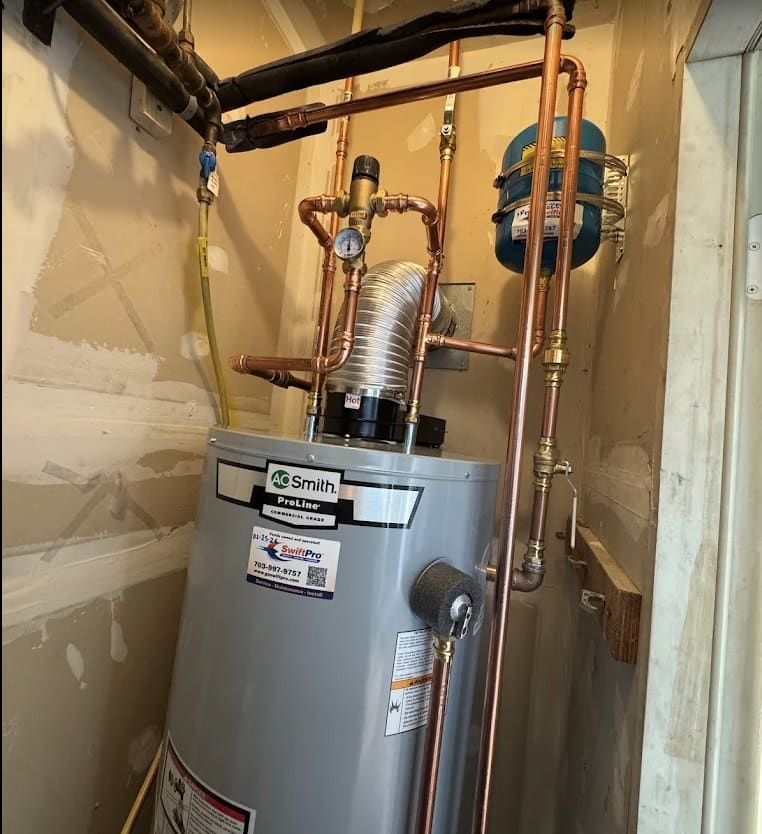
Water heaters, aging out together. This is the big one. Tanks last eight to twelve years in this area, and the houses in a given Ashburn neighborhood were finished within a few years of each other, which means the water heaters are reaching the end of their lives on roughly the same schedule. If yours is original and the house is past ten, you are on borrowed time. The maintenance that extends it is here, and a replacement runs $2,000 to $4,800 installed.
Toilet fill valves and flappers. Builder-grade parts, fifteen to twenty five years in. A silently running toilet wastes more water than people believe: put ten drops of food colouring in the tank, wait ten minutes, and if colour reaches the bowl you have found it. Three fixes, cheapest first, are here.
Angle stops and supply lines. The little shutoff valves under sinks and behind toilets, plus the braided lines. These are the most common cause of an indoor flood in a newer house, and they are inexpensive to replace before they fail.
Garbage disposals. Eight to twelve years. About $180 to free a jam, $570 to $870 to replace. The four minute fix for a humming disposal is here.
Pressure reducing valves. They wear out in ten to fifteen years, which puts the earliest Ashburn houses right at that point. A failed one runs the whole house at street pressure, which stresses every fitting and appliance in it. A $12 gauge on a hose bib tells you; replacing the valve runs $500 to $994.
Hard water, and what it is doing
Loudoun Water’s central system has historically been described as moderately hard to hard. That matters in a town full of newer appliances, because hardness scales the inside of a water heater, shortens the life of fixtures, and is genuinely hard on a tankless unit.
If you have a tankless water heater, annual descaling is not optional: both Navien and Rinnai require it in writing and both exclude scale damage from the warranty. A flush runs $79 to $365, most between $100 and $200. The rest of the tankless symptom list is here.
The things worth knowing about Loudoun Water
The service line from the meter to your house is yours, not the utility’s. So is everything inside. Loudoun Water does offer a courtesy adjustment on underground leaks between the meter and the main cutoff, covering the water and sewer overage on up to two quarters, and it sends smart-meter leak alerts by email or phone.
Two practical consequences. If you get a leak alert, treat it as real and check the meter yourself: everything off for fifteen minutes, then read it again. And if you do find a leak, repair it promptly and keep the invoice, because the adjustment is conditional on both.
Winter, in a house with pipes in exterior walls
Newer construction is better insulated, which helps, but the outdoor spigot still freezes and it still floods a wall in April when somebody hooks up a hose. Disconnect every hose in November, including from a frost-free spigot, because a hose attached defeats the frost-free design completely. That is the whole story.
The five minute check worth doing this weekend
Identify your pipe material at the main entry. Find the main shutoff and confirm it turns. Put a gauge on a hose bib and read the pressure. Look under the water heater for any water at all, and note its age off the label. Those four answers tell you almost everything about what is coming.
SwiftPro handles plumbing across Ashburn and Loudoun County out of a local office. Call (703) 997-9757, book online, or see the Ashburn water heater page.