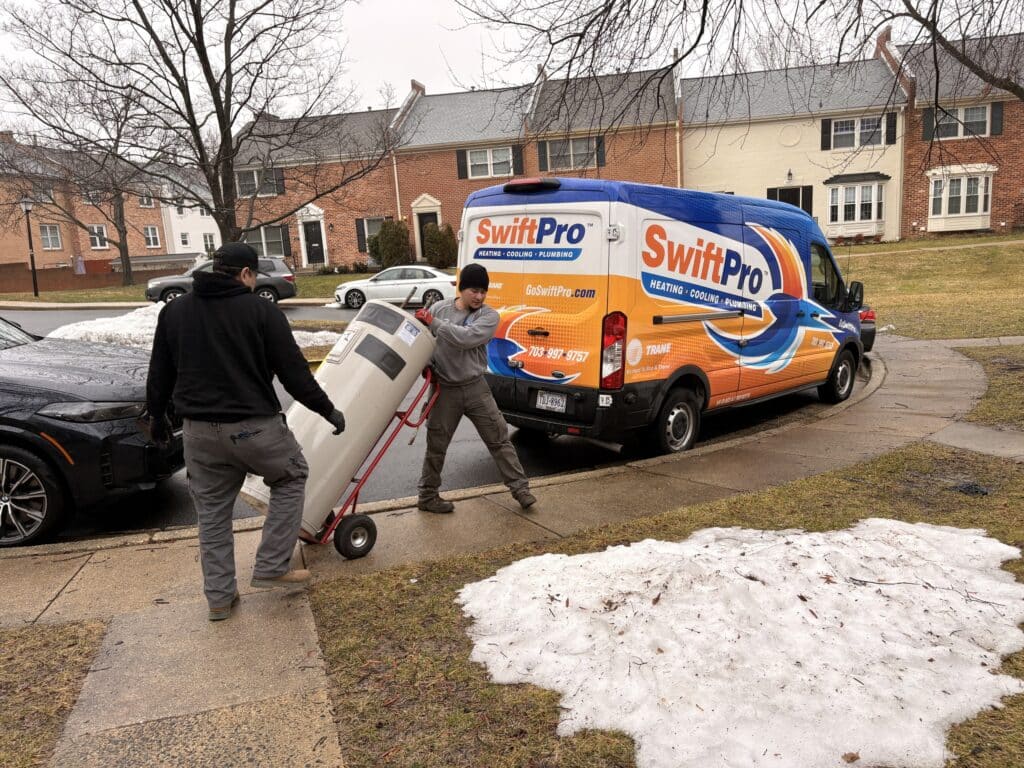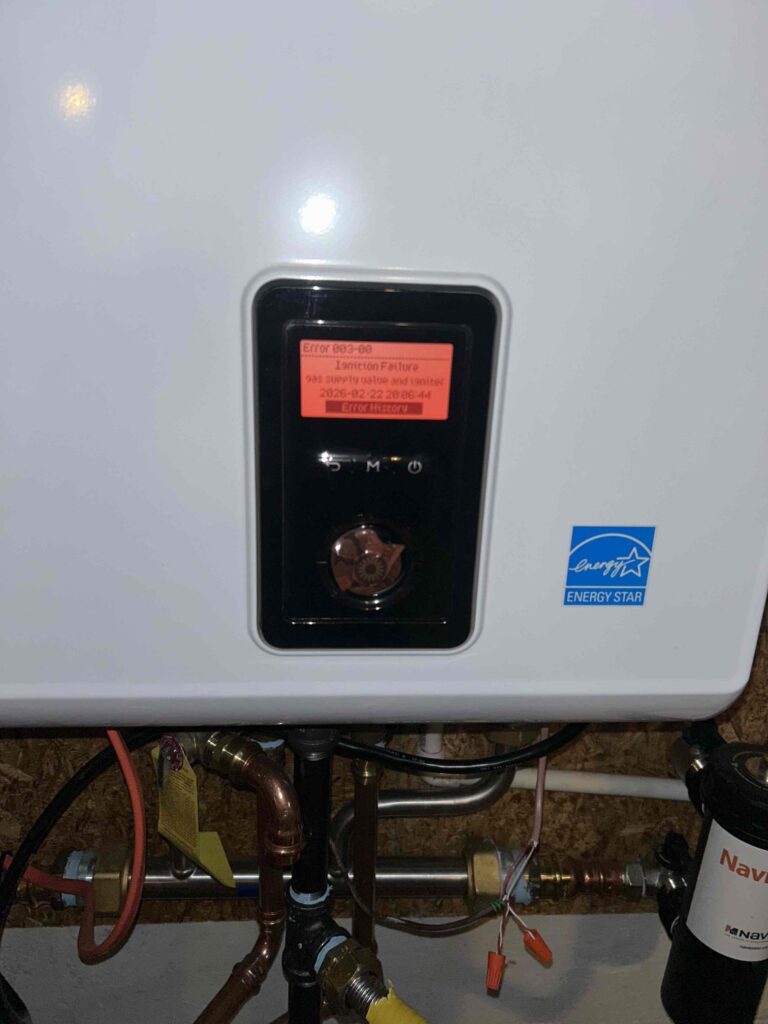


Is a tankless water heater worth it? If your current tank never leaves anyone cold, no. Replace it with a tank. If your household has been running out of hot water for years, replacement day is the cheapest moment you will ever have to switch, because you are paying for the labor either way.
That is the honest answer from a company that installs both every week in Northern Virginia. Here is the reasoning, the numbers, and the two local details that decide it more often than the brochure does.
The prices, installed
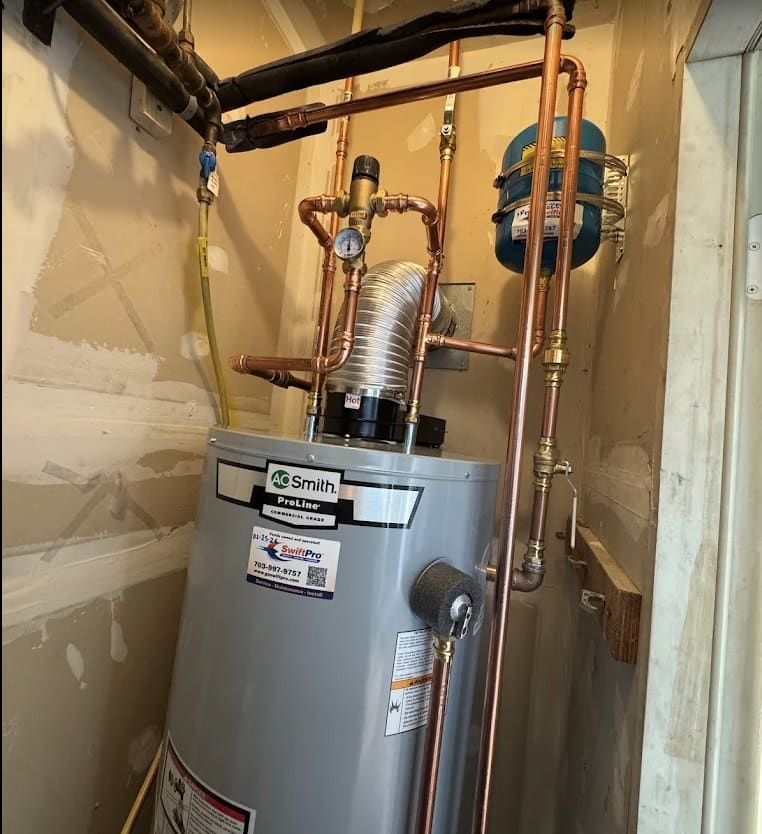
- Tank: $2,800 to $5,800. Most homes land between $3,400 and $4,200. The spread is gas or electric, how it vents, six year or ten year, and 40 versus 50 versus 75 gallons.
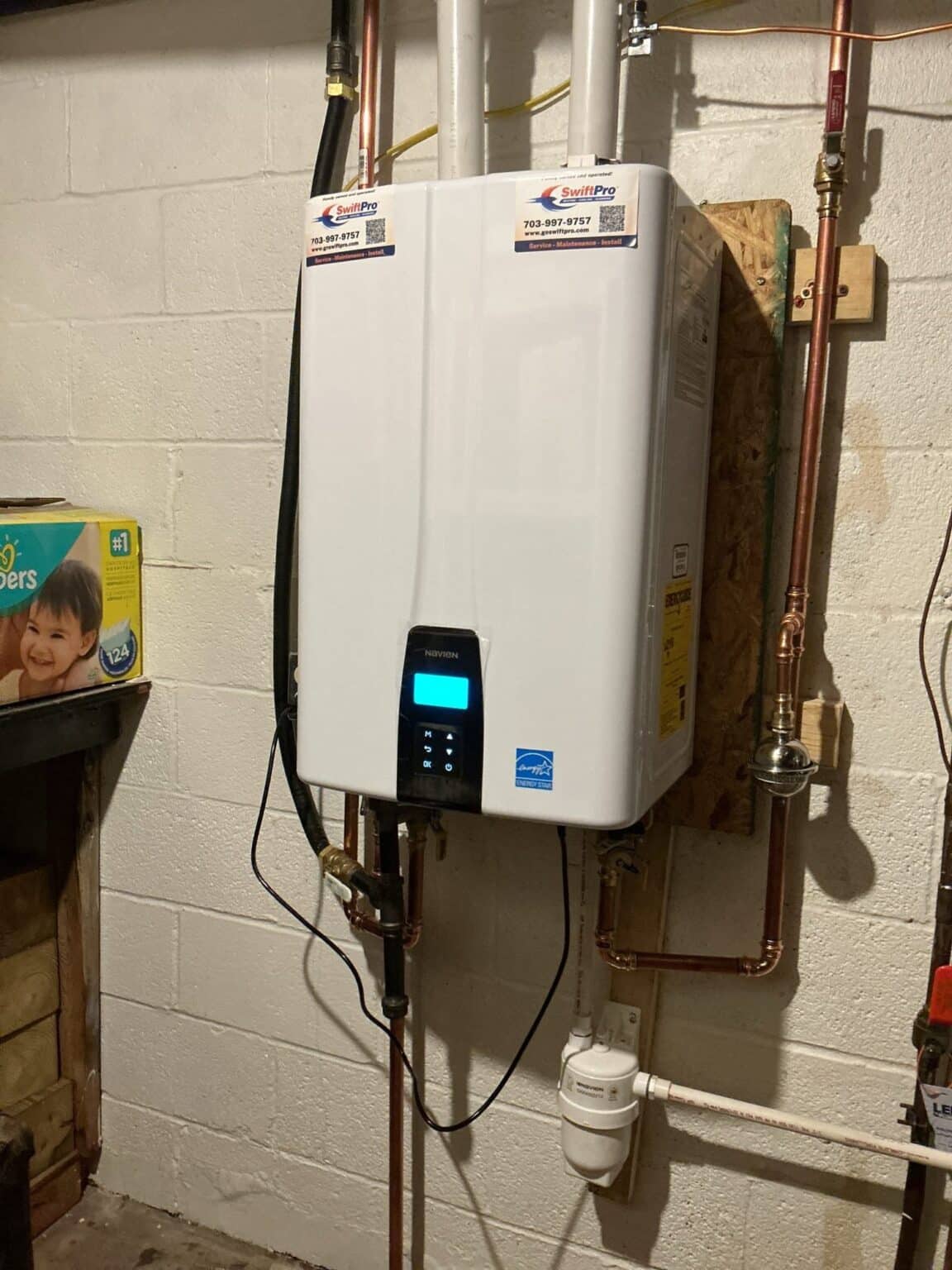
- Tankless (gas): $6,000 to $7,000.
Both include the permit, the expansion tank, the drain pan, haul away and labor. You can price your own configuration in our water heater cost calculator, and the full tank price table by type and size is here.
Why the gap is $2,000 to $3,000, and it is not the box
A tankless unit costs more than a tank, but most of the difference is what it takes to feed one. A typical gas tankless unit fires up to about 199,000 BTU per hour. A 40 gallon gas tank fires at about 40,000. That is roughly five times the gas, on demand.
Run that through the gas sizing tables and the problem is obvious: a half inch pipe carries about 172 cubic feet per hour at ten feet of run and only about 95 at thirty feet, while a tankless unit at full fire wants close to 200. Three quarter inch pipe carries 360 at ten feet and about 199 at thirty. So on most conversions the existing half inch line that fed the old tank has to be upsized, and occasionally the gas meter does too, which is a call to Washington Gas. Add new PVC venting out a side wall. That work, not the appliance, is the majority of the difference.
What the extra money actually buys
Hot water that does not run out. This is the real reason to do it. A tankless unit heats water as it passes through, so the third shower in a row is as hot as the first. Teenagers, a soaking tub, a house where somebody is always the one who gets the cold shower: this is the argument, and it is a good one.
Roughly twice the life. The Department of Energy puts tankless at more than twenty years against ten to fifteen for a tank. Over twenty years you buy one tankless or two tanks, which closes a lot of the gap on its own. Navien and Rinnai both back the heat exchanger for fifteen years.
Lower gas use. A tank keeps 50 gallons hot around the clock whether you use it or not, and eliminating that standby loss is where the savings come from. DOE’s figure is 10 to 20 percent off the water heating portion of the bill. Real, but not huge. Do not go tankless for the gas bill; go for the hot water and take the bill as a bonus.
Floor space. It hangs on the wall. In a Northern Virginia townhouse where the water heater eats a closet you would like back, that matters more than it sounds.
What you give up, including one thing that is specific to here
Flow, not volume. Endless hot water is true up to a rate, and that rate depends on how cold the incoming water is. Navien rates its common residential unit at 11.2 gallons a minute with a 35 degree temperature rise. In a Northern Virginia January the Potomac, which is where most of our water comes from, runs around 34 to 38 degrees. Getting that to a 120 degree tap is an 80 degree rise, and the same unit delivers closer to 5 gallons a minute. Two showers at once, fine. Two showers plus the dishwasher plus a laundry load on hot, not fine, and you feel it as lukewarm rather than cold. A tank handles that surge because the water is already hot; it just runs out later.
A short delay. The unit senses flow, fires, and comes up to temperature. DOE puts it at 5 to 15 seconds longer than a tank. A recirculation pump fixes it and costs more.
Maintenance you cannot skip, because of our water. Fairfax Water describes its water as moderately hard to hard, 5 to 10 grains per gallon. Arlington measures 8 grains. Alexandria’s 2025 report shows 191 parts per million, about 11 grains. The heat exchanger inside a tankless unit is a narrow passage that gets very hot, which is exactly where those minerals come out of solution and stick. Both major manufacturers require annual descaling and both exclude scale damage from the warranty in writing. A flush runs $79 to $365, most between $100 and $200. A scale inhibitor on the cold inlet, $800 installed, cuts the flushing down, and we recommend one on every tankless install in this water.
Power. A gas tankless unit needs electricity for its board, fan and igniter, and its freeze protection only works while it has power. A gas tank with a standing pilot keeps making hot water in a blackout. Minor most years, not minor in an ice storm.
Electric tankless, briefly
Skip it for a whole house. A whole-house electric tankless unit draws enormous current while it runs, which means multiple new double pole breakers and often a panel upgrade, and it still struggles with the winter temperature rise described above. Fine for a single remote bathroom or a workshop sink. As a replacement for a whole house tank it is a way to spend tankless money and get a worse shower.
If you are on electric and want to cut the bill, the better move is a heat pump water heater. Dominion pays $250 on a 40 to 59 gallon unit and $400 on 60 gallons and up, but only when it replaces an existing electric water heater, so a gas-to-heat-pump swap does not qualify.
The paperwork nobody mentions
In Virginia, replacing a gas or oil fired water heater requires a permit. A like-for-like electric swap is exempt by code. In Fairfax County the gas swap is a Household Appliance permit, and if new gas piping is involved it becomes a plumbing permit instead. If your house has a backflow preventer or check valve on the water service, which most Northern Virginia homes now do, code also requires thermal expansion control, which is the expansion tank in the price above. A quote without a permit and an expansion tank is not a cheaper job. It is a different one.
The decision, plainly
Replace with a tank if: hot water has never been a problem, the budget is the budget, or the house has an atmospheric flue and no easy exterior wall to vent through.
Go tankless if: you run out of hot water, you plan to be in the house ten plus years, the gas line and venting are workable, and you will flush it annually or install scale protection.
Ask for both priced side by side for your house before you decide. We do that as a matter of course, and a company that will not is telling you which one it wanted to sell.
Things people ask
Can a tankless unit go where the tank was? Usually, often on the wall right above the old spot. The constraint is the vent run to an exterior wall and the gas line, not the footprint.
How long does either install take? A tank is most of a morning. A tankless conversion is a full day, because of the gas and venting work.
My tank is leaking right now. Do I have time to think about this? If it is dripping from the bottom, no. Here is how to tell what kind of leak you have, and if it is the tank itself, call and we will price both options on the phone.
SwiftPro replaces water heaters, tank and tankless, across Northern Virginia. Price yours in the calculator, then call (703) 997-9757 or book online.