

Most tankless water heater problems in Northern Virginia come down to three things: scale, gas, or flow. Not the unit. The unit is usually fine, which is worth knowing before somebody tells you it needs replacing.
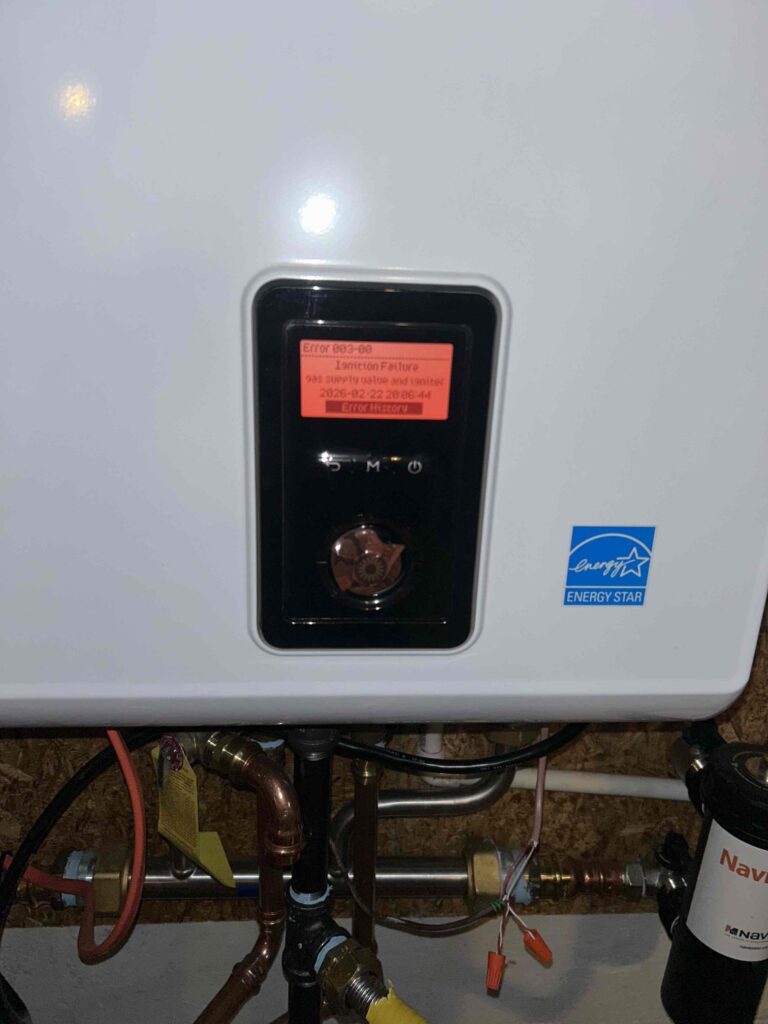
Start with the display. Every gas tankless unit made in the last fifteen years shows a code when something is wrong. Photograph it before you touch anything, including before you reset it, because the reset clears it. That code turns “no hot water” into a specific fault, and each one is a different visit.
No hot water at all
Check these four, in this order, before you call anyone.
Power. A gas tankless unit needs electricity for its board, fan and igniter. Check the breaker and the outlet it plugs into. After a storm, this is the answer more often than not, and it is the reason “no hot water after a power outage” is such a common search.
Gas. Is the stove lighting? Is the valve on the line to the unit open, handle in line with the pipe? If the whole house has no gas, that is Washington Gas, not a plumber.
Flow. The unit will not fire until it senses enough water moving through it. Navien’s minimum is half a gallon a minute; Rinnai needs about 0.4 to light and 0.26 to stay lit. A single low-flow bathroom faucet on a trickle may not trigger it. Open a tub spout or the kitchen tap fully and wait ten seconds. If that works, the unit is fine and the fixture is the problem.
The inlet screen. There is a small filter where cold water enters the unit. Sediment clogs it, especially after a water main repair in your neighborhood. The manual shows how to pull and rinse it. Five minutes.
If all four check out and the display shows an ignition code, that is a service call. On a Navien that is E003; on a Rinnai it is code 11. Igniters, flame rods and gas valves are technician work on a sealed combustion appliance.
Hot, then cold, then hot again
That is the cold water sandwich, and every tankless unit does it to some degree. When a tap closes, hot water sits in the pipe. When it reopens a minute later you get that stored hot water, then a slug of cold that was in the unit while it re-fired, then hot. Rinnai calls a one to two second drop normal. Navien sells units with a small buffer tank specifically to reduce it. It is a characteristic, not a fault.
If the cold gap is getting longer over time, that is different, and the next section is why.
Warm but never hot, or the flow drops when it is hot
This is scale, and in this part of Virginia it is the most common tankless complaint we see.
Fairfax Water describes its water as moderately hard to hard, 5 to 10 grains per gallon. Arlington measures 8 grains. Alexandria’s 2025 water quality report shows about 11. The heat exchanger inside a tankless unit is a narrow passage that gets very hot, which is exactly where dissolved calcium and magnesium come out of solution and stick. As the passage narrows, the unit cannot move enough water past the burner, so it either throttles the flow to hit temperature, which you notice as pressure loss, or gives up and delivers warm.
The fix is a descaling flush: the unit is isolated and a pump circulates a mild acid through the exchanger for about an hour. On our tickets that runs $79 to $365, most between $100 and $200. Once a year in this water, which is what both Navien and Rinnai require in writing.
That “in writing” part matters. Both manufacturers exclude scale and mineral build-up from the warranty, and Rinnai’s also excludes damage from poor water quality. A unit that arrives at a warranty claim with a scaled exchanger and no service history usually gets the claim declined, which is the expensive version of skipping a $150 job. Navien even has a dedicated code for it: E760 is the flushing and service alarm.
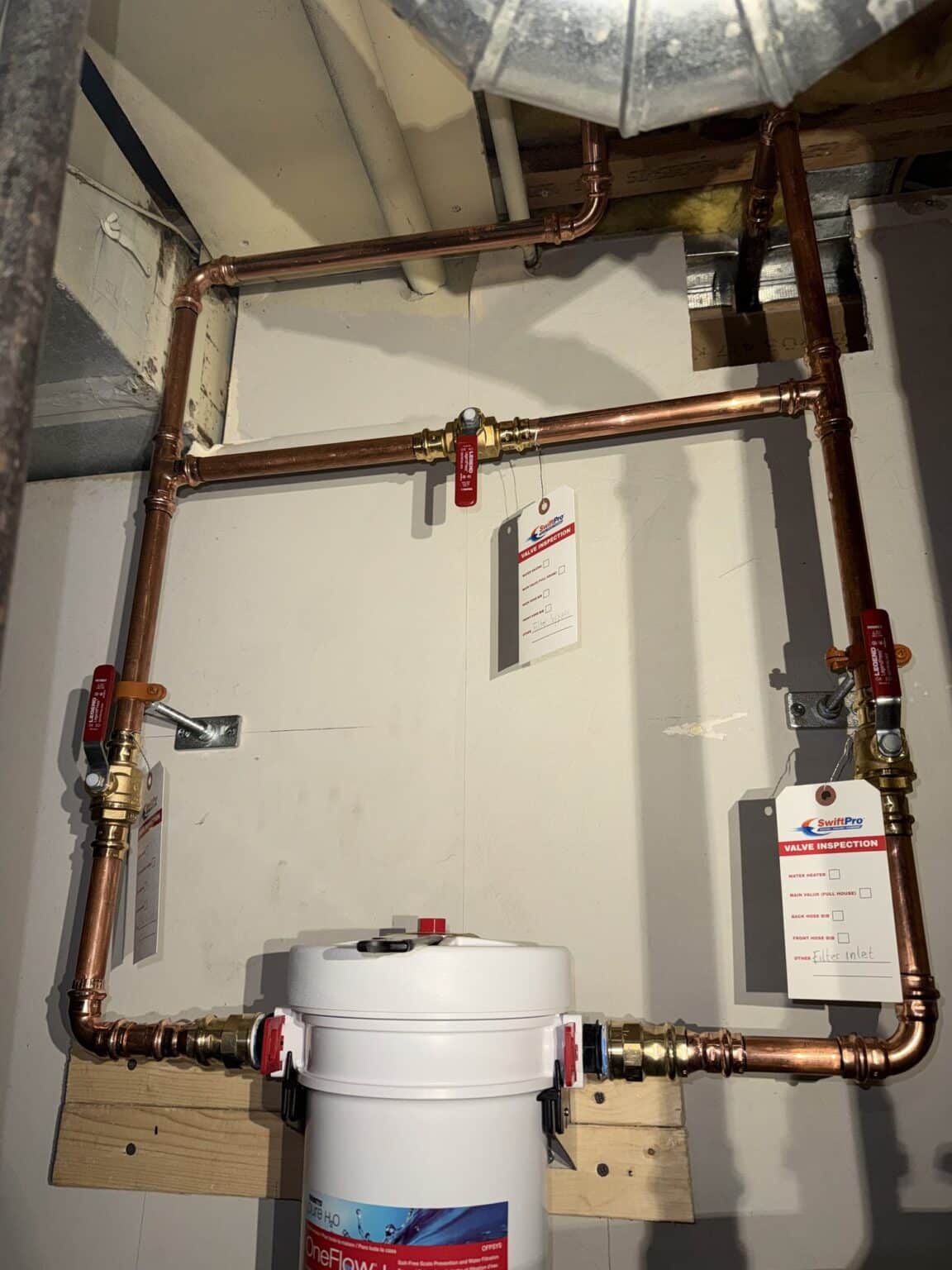
If you are tired of the annual flush, a scale inhibitor on the cold inlet, $800 installed, keeps the minerals from sticking in the first place. We put one on nearly every tankless install we do here.
It fires, gets hot, then shuts off
Usually one of three things, and the codes tell you which.
Exhaust or intake blocked. Rinnai code 10, Navien E110 for abnormal air pressure. On a side wall vent that means leaves, a bird’s nest, or snow in January. Go look at the termination outside before anything else. Navien’s own remedy for E110 starts with clearing the exhaust and cleaning the intake filter.
Condensate backing up. Rinnai’s code 10 also covers a full condensate trap. There is a small drain line off the bottom of most units and it should drip freely when the unit runs.
Gas supply undersized for the unit. Pressure drops under load and the burner loses its flame, which shows as Navien E012 or Rinnai 12. This one appears when a tankless unit was installed on the old tank’s half inch gas line without upsizing it. It ran fine all summer and quits in December when the furnace is also calling for gas. The fix is a bigger gas line, not a new water heater, which is why we size the gas on every install. More on gas line work here.
It is loud, or it smells
A rumble or a kettle sound on firing is scale again. A whine from the fan is a bearing, and it shows as Rinnai 61 or Navien E109. A smell of gas at the unit is a leave-the-house situation: get out, then call Washington Gas at 844-927-4427 or 911 from outside. Do not flip switches on the way. A faint exhaust smell at the outdoor termination is normal; inside the house it is not, and that is a same-day call.
Cold weather, and the one that ruins units
Both manufacturers build in freeze protection, and both say plainly that it only works while the unit has power. Navien’s installation manual states that damage from freezing due to power loss is not covered by the warranty. Rinnai says the same and instructs you to drain the unit manually during a power failure in freezing weather.
So if you lose power in an ice storm and the unit is on an exterior wall or in an unconditioned space, draining it is the move. Outdoor units are rare here for exactly this reason. If yours is outdoors, know where the drain plugs are before December.
Troubleshooting a Tankless Water Heater With No Hot Water
Gas tankless units last around twenty years with annual flushing, and both major brands warrant the heat exchanger for fifteen. Under ten years old, repair it, and check whether the part is covered before paying for it. Fifteen years and up with a failed heat exchanger is replacement money. In between, the question is whether the unit was ever flushed: a twelve year old unit that has been maintained has a lot of life left, and one that has never seen a flush may be finished regardless of which part failed today.
If you are replacing, price both paths in our water heater calculator, and read the honest tank versus tankless comparison, including the case for going back to a tank.
Things people ask
Can I flush it myself? Yes, if the unit has isolation valves with service ports, which most installed in the last decade do, and you are comfortable with a small pump, a bucket and descaler. About an hour. If it has no isolation valves, adding them is the first thing we would do, because it makes every future flush a fraction of the work.
How do I reset it? There is a power button on the front panel or a reset on the controller, and cycling power at the breaker works on most units. Photograph the code first. If it comes straight back, the fault is real.
Do you work on all brands? Navien, Rinnai, Noritz, Rheem, Bosch, A.O. Smith and the rest. Parts availability varies by brand, and that is the one place the badge matters on a repair.
SwiftPro services and installs tankless water heaters across Northern Virginia. Call (703) 997-9757, or book online.