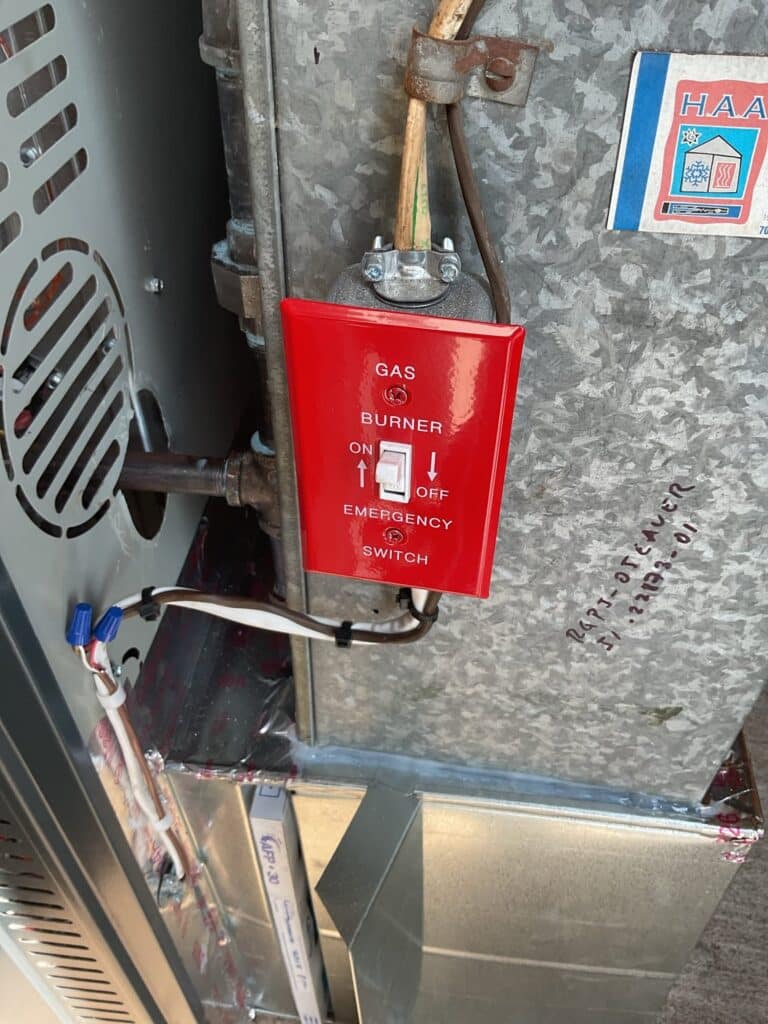


If you smell gas right now: leave the house, do not touch any light switch or appliance on the way out, and call Washington Gas at 844-927-4427 or 911 from outside. Do not go looking for the source. Leave the doors open behind you. They come free, any hour, and they will shut it off at the meter.
Then call a plumber. In that order, and not the other way around. Everything below assumes nobody is smelling anything at the moment.
Who owns which pipe, and why it matters
Washington Gas puts it plainly: it owns and maintains all natural gas pipes up to and including the meter. Everything after the meter, the black iron or yellow flexible pipe running through your basement and up to the furnace, water heater, range and dryer, belongs to you. Its own safety page says each customer is responsible for maintaining and monitoring all above ground and underground piping on the customer’s side of the meter, and for having it repaired by a licensed contractor. Federal pipeline jurisdiction ends at the same place.
That is why the utility will shut off a leak and then leave. It is not their pipe. Fixing it, extending it, moving it, or adding a line for a new appliance is licensed plumbing work, and in Virginia it is permitted and inspected work.
What gas line repair costs
Most gas line repairs and cap-offs run $250 to $475. That covers finding and fixing a leak at a fitting, replacing a flexible connector, capping an unused line to an appliance that is gone, and upsizing a short section. Replacing a longer run came in at $650 to $800. One job that meant rerouting a difficult run through finished space ran over $2,000.
A new line for a new appliance, a gas range replacing electric, a grill, a fire pit, a dryer, a standby generator, gets quoted after we see the run. We are not going to invent a number for a job whose price is the distance and the number of walls in between.
Where leaks actually are
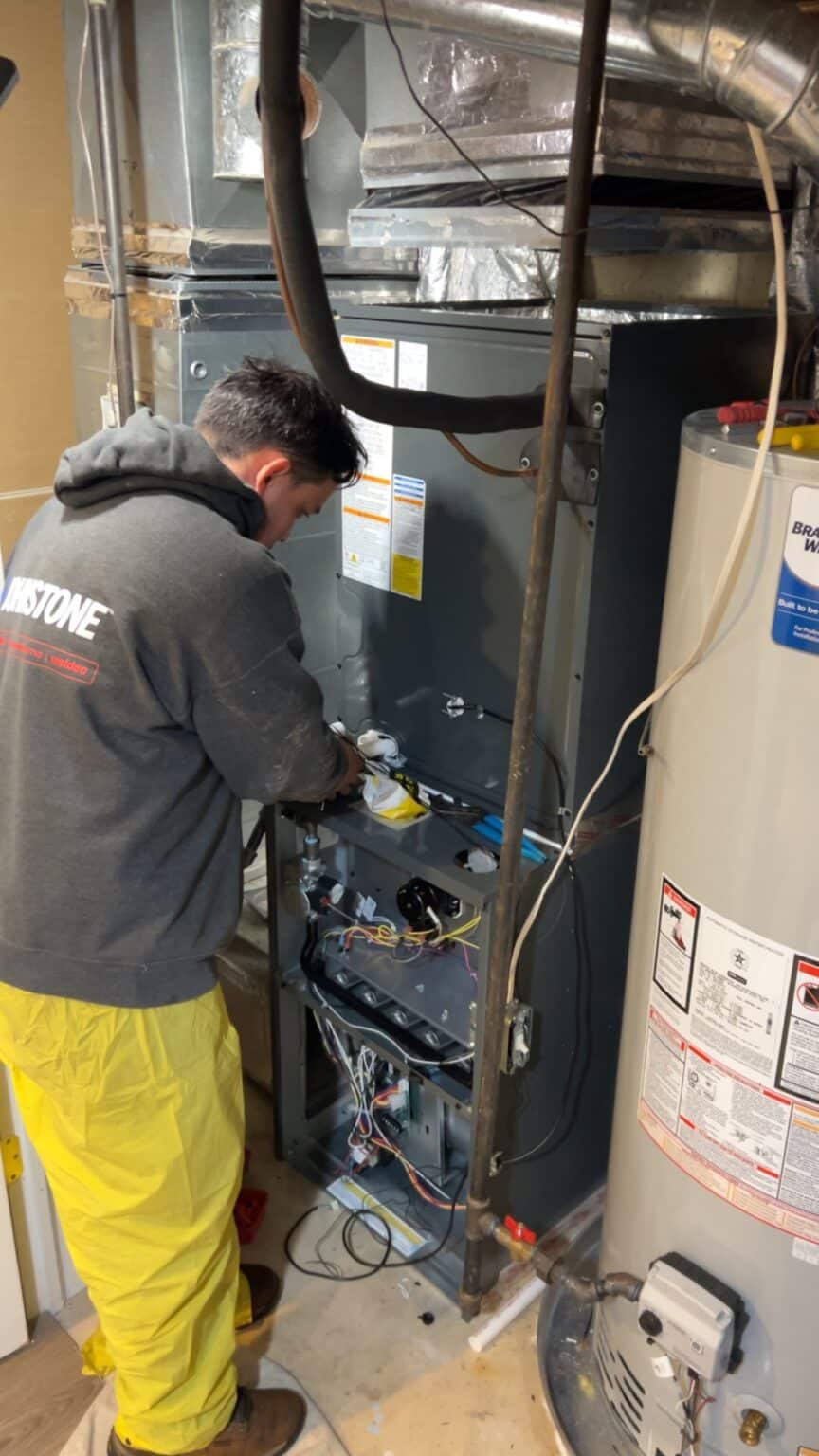
Almost never in the middle of a pipe. They are at threaded joints where the sealant dried out over thirty years, at old flexible connectors behind a range that has been pulled out and pushed back a dozen times, at a shutoff valve that was never quite tight, and at appliances that somebody disconnected and capped with tape instead of a cap.
A technician finds them with a combustible gas detector and a pressure test. The code sets the test: the fuel gas code requires at least one and a half times the working pressure and never less than 3 psi, held for at least ten minutes on a single family house. The City of Alexandria adds its own rule that the gauge has to top out at 30 psi or less so a small drop is actually readable, which is a good rule and a fair thing to ask your plumber about anywhere.
The smell itself is an additive the utility puts in so you notice. A faint whiff at the range when a burner first lights is normal. A smell that lingers, a smell in the basement, or a hissing sound is not.
Three things specific to houses here
Yellow flexible pipe, and the lightning problem. Most homes built or renovated since the late 1990s have corrugated stainless steel tubing, yellow jacketed, running through the joists. Code requires it to be bonded to the house grounding system with a conductor no smaller than 6 AWG copper, attached between the meter and the first fitting. The reason is lightning: a nearby strike can energize unbonded tubing and arc through the thin wall. Older installs frequently skipped the bond. If you have yellow pipe and have never seen a heavy bare copper wire clamped to it, ask to have it checked. Newer black-jacketed arc-resistant tubing does not need the extra bond, but if any segment in the house is yellow, the whole system gets bonded.
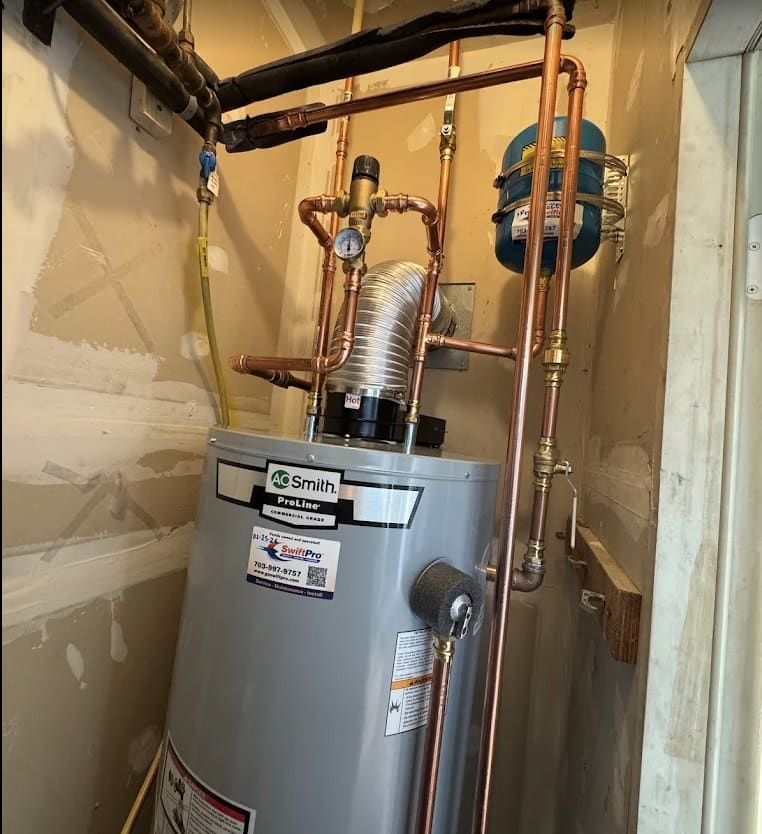
The tankless conversion. A tankless water heater burns gas at four or five times the rate of a tank. The half inch line that fed the old tank often cannot carry it, and a unit on an undersized line runs fine in July and quits in January when the furnace is calling too. Sizing the line for total load is part of the install, which is why “upsize gas line section” is a real line. Rough inputs for sizing, and these are typical rather than your nameplate: a range around 65,000 BTU per hour, a furnace 80,000 to 120,000, a tank water heater 40,000 to 60,000, a tankless 150,000 to 199,000, a dryer 22,000 to 35,000, a standby generator 100,000 to 250,000. Add them up and you see how fast a house outgrows its original pipe.
The orphaned stub. Somebody took out a gas dryer or an old furnace and left a line capped in a basement corner. Fine if it was capped properly. Not fine if it was capped with a plug and pipe dope from a junk drawer. If you bought a house and there is a stub you cannot identify, have it looked at with everything else.
Adding a line: what to expect
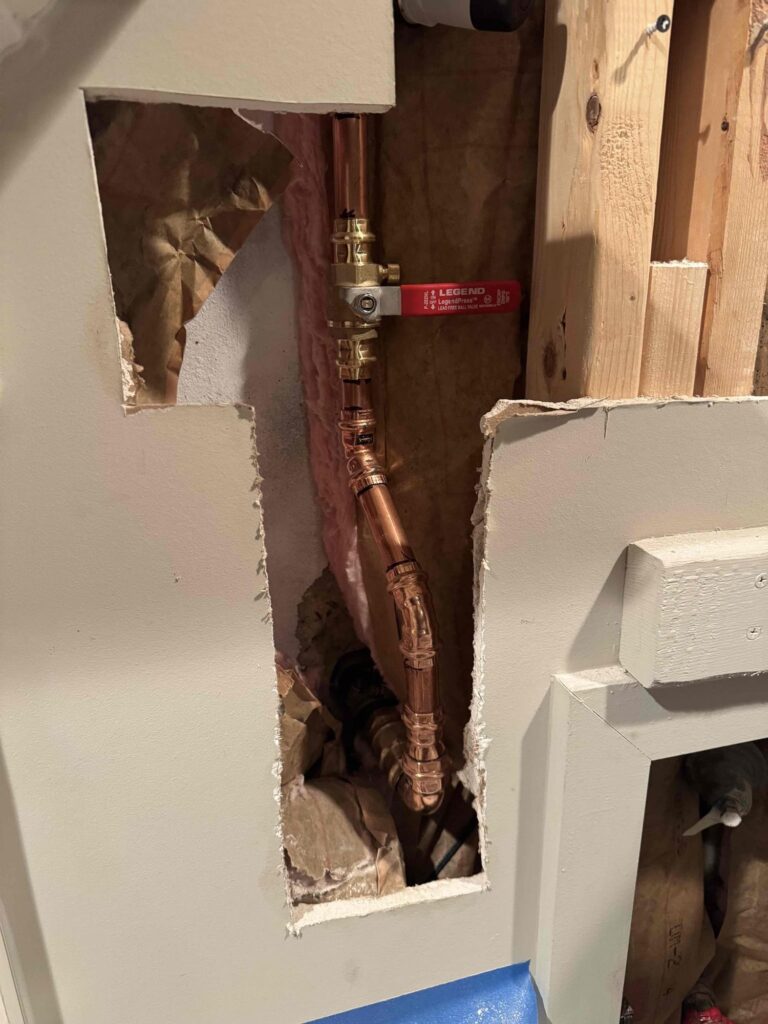
We size the whole system, not just the new branch, because hanging a 65,000 BTU range off a line already at capacity starves everything on it. We pull the permit, run the pipe, pressure test it to the code standard above, and meet the inspector. In Fairfax County an appliance swap uses a Household Appliance permit, but the moment new gas piping is involved it becomes a residential plumbing permit. Alexandria requires a permit for replacing gas fired equipment as well; the permit center is 703-746-4200. The gas stays on to the rest of the house during most of the work.
For a standby generator we do the gas side and an electrician does the transfer switch. Two permits, two trades, and the generator company usually coordinates both.
One thing worth saying plainly: if a handyman offers to tie into the line for a new grill without a permit, that is a hard no. Gas is the one system in the house where the inspection exists for your neighbors as much as for you.

Things people ask
Can you test the whole house for leaks? Yes. A pressure test on the house piping is a routine call and a smart thing to do when you buy a house with a gas system older than you are.
Washington Gas shut me off. How fast can you fix it? Usually same day for a fitting or connector repair. Once the repair is inspected, the utility relights the meter, and that scheduling is theirs, so call them the moment the repair passes.
Do you install the appliance too? The gas connection, the shutoff and the leak check at the appliance, yes. Whether we set the range itself depends on the job, so ask when you book.
My furnace and water heater are both gas. Should I worry about carbon monoxide? You should have an alarm on every sleeping floor regardless. Virginia requires them in new construction with fuel burning appliances and has no retrofit rule for existing homes. More on furnace safety here.
SwiftPro repairs, tests and runs gas lines across Northern Virginia under Virginia Class A contractor license 2705192276. Call (703) 997-9757, or book online.