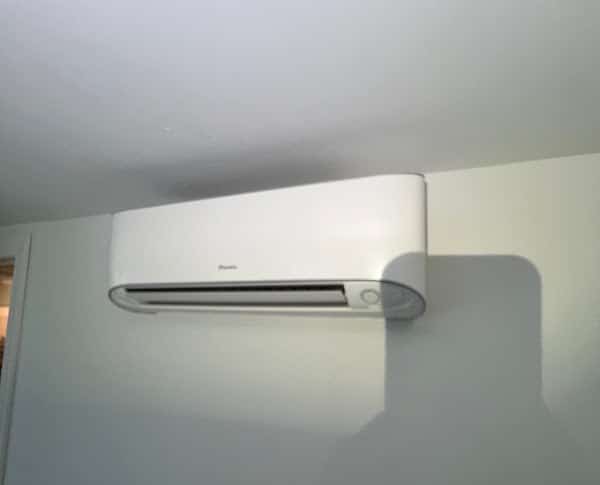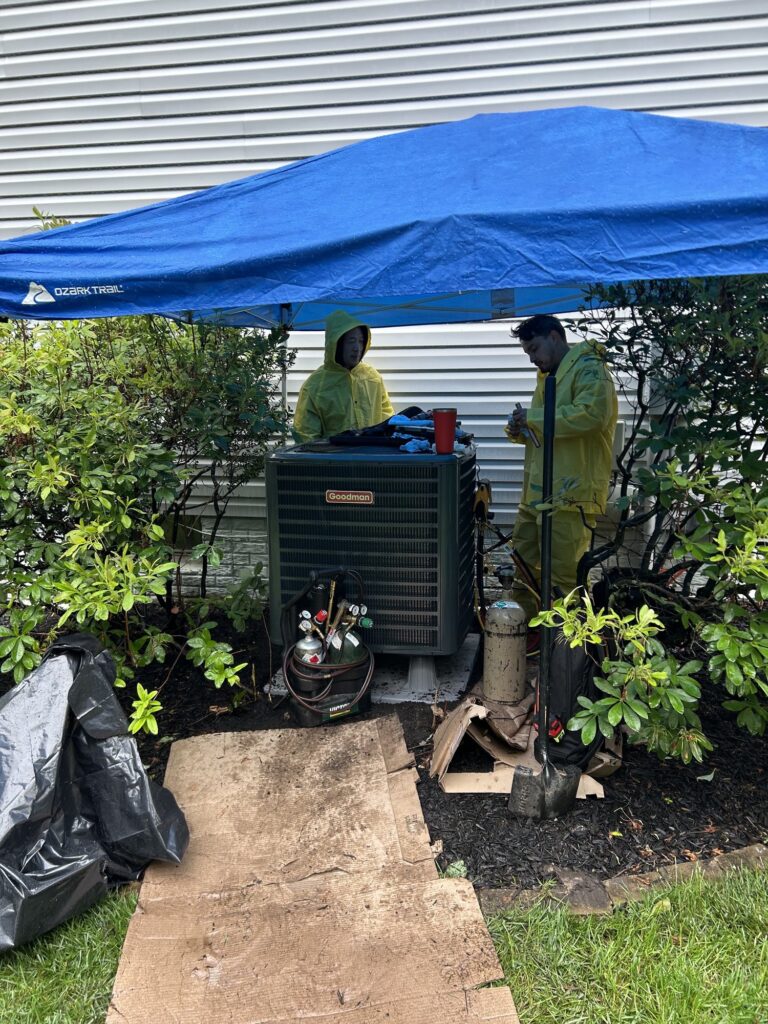


Burke is heat pump country, and the reason is the way it was built. Burke Centre went up in the 1970s as a planned community of clusters and townhouses, much of it all-electric, and all-electric in this climate means a heat pump. We essentially never work on a boiler here.
That single fact changes what a December service call looks like, because a heat pump behaves nothing like a furnace and most of what worries people about one in winter turns out to be normal.
Four things that are normal, and cost you nothing
The air from the vents feels cool. A gas furnace delivers air around 125 degrees. A heat pump delivers it warmer than the room and cooler than your hand. Carrier says the same on its own support pages. If the house is holding temperature, nothing is wrong.
The outdoor unit steams and the fan stops for a few minutes. That is a defrost cycle. On a damp 35 degree day frost builds on the outdoor coil and the unit runs briefly in reverse to melt it. Steam, a hiss, cool air indoors for a few minutes, then back to normal. Manufacturers put it at five to fifteen minutes, as often as every half hour when it is raw.
It runs for forty minutes at a time. Heat pumps are built for long, steady cycles. A furnace mindset expects short blasts.
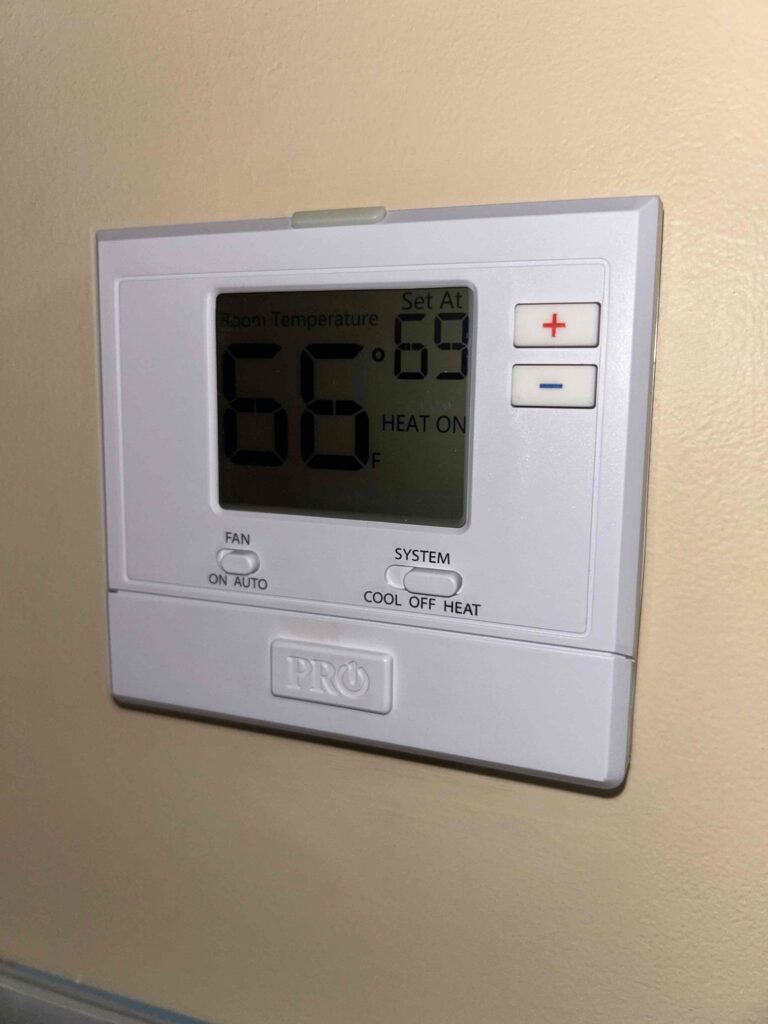
Aux or Em Heat shows on the thermostat on a cold night. Below the balance point, which manufacturers put around 30 to 35 degrees for a typical unit, the electric strips help. On a 20 degree January morning that is the system working as designed.
Four that are not
Ice that never clears. A unit still encased at noon means defrost is not happening. Defrost board most often, $450 to $1,150. Switch to Emergency Heat and call, because running it iced bends the fan blades and eventually damages the coil.
Aux heat running constantly in the 40s. Your resistance strips are carrying the load the heat pump should be carrying, which shows on the Dominion bill before you feel it. Low refrigerant, a failing compressor, a stuck reversing valve, or a thermostat never configured for a heat pump.
It cools when it should heat. Reversing valve stuck, or a thermostat wiring problem. Heat pump thermostats use an O or B wire to flip that valve, and one installed by somebody who did not know that runs backwards all winter. The thermostat fix is $300 to $640.
The outdoor unit hums but the fan does not turn. Capacitor, $240 to $370, and the most common outdoor unit failure there is.
The townhouse constraint
In the Burke Centre clusters the mechanical space is a closet, and that shapes the work more than anything else. Air handlers are compact, the filter slot is often a return grille in a hallway ceiling, and the condensate line runs a long way to somewhere it can drain. When that line clogs, a float switch shuts the system off on purpose, which is a good outcome compared with water through a ceiling, and is why “no heat” in a Burke townhouse is sometimes a $175 to $420 drain job rather than anything expensive.
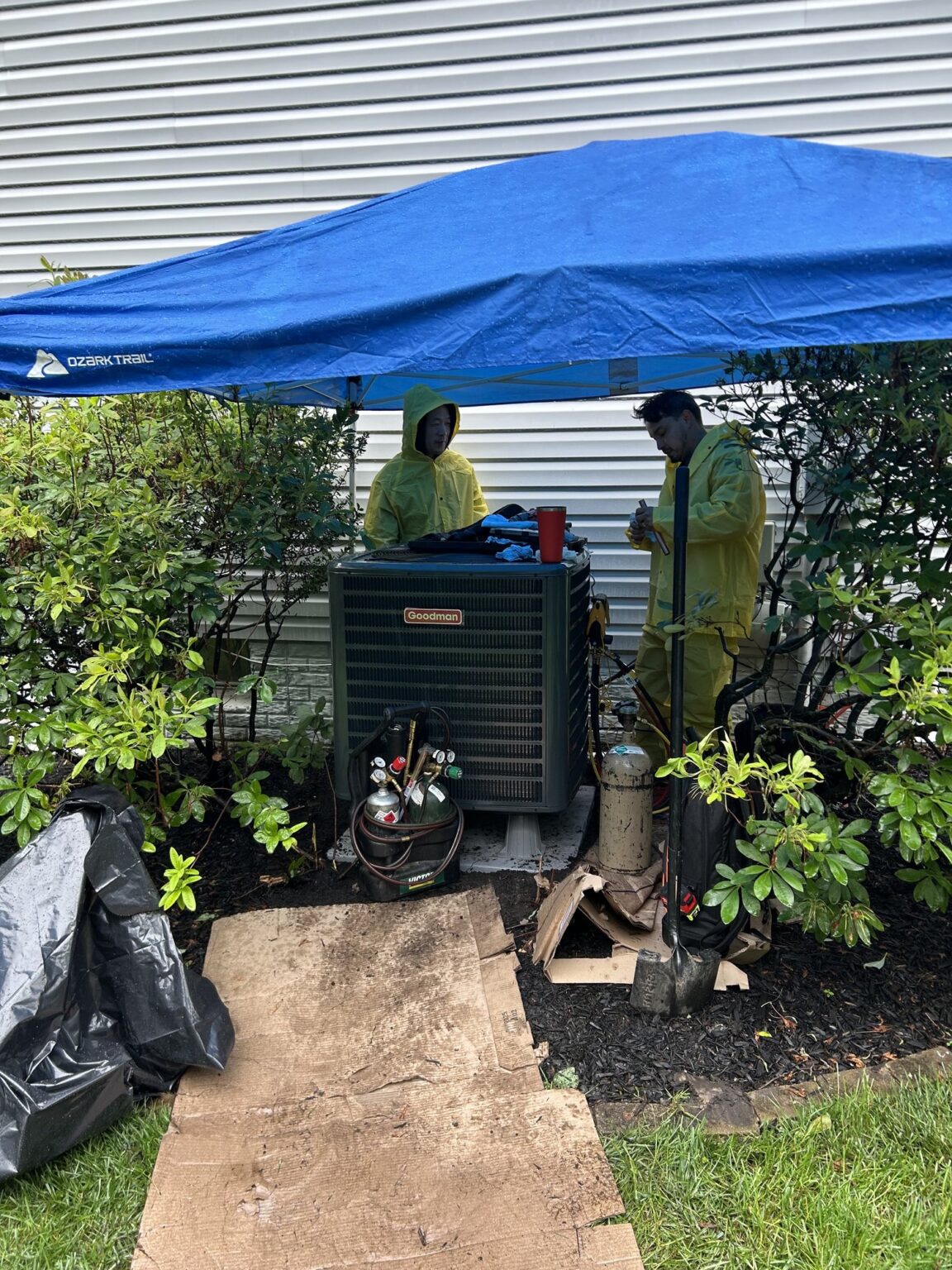
The outdoor units sit close together and close to fences. Two feet of clearance on every side matters here more than in a house with a yard, and a unit boxed in by a fence, a deck, or a row of shrubs runs hot and fails early.
4 Critical Heat Pump Issues Requiring Professional Repair
- Diagnostic visit: about $99.
- Capacitor $240 to $370. Contactor $290 to $425.
- Thermostat, replaced with one that knows it is on a heat pump: $300 to $640.
- Condensate drain or trap: $175 to $420.
- Defrost board: $450 to $1,150.
- Refrigerant added, one to three pounds: $190 to $740. If it is low, it leaked.
- Outdoor fan motor $1,100 to $1,500. Blower motor $670 to $2,400.
- Compressor, out of warranty: $2,200 to $5,100. Under parts warranty: $1,900 to $2,500.
The full heat pump symptom list is here.
The refrigerant question on an older heat pump
A top-off on an air conditioner buys a summer. On a heat pump it buys a summer and then fails you in January, because the system needs that refrigerant in both directions. If it needs gas twice, find the leak.
R-410A, in nearly every system installed from about 2010 through 2024, is being phased down under federal law, and the price has roughly doubled in two years. The EPA is explicit that you may keep repairing an R-410A system, including replacing the compressor. But a refrigerant-heavy repair on an older unit leans toward replacement harder than it used to.
When to replace
Heat pumps run year round here, so a twelve year old heat pump has the hours of a twenty year old furnace. ASHRAE’s median service life is fifteen years and ENERGY STAR’s replacement threshold is ten. Under eight, repair. Over fourteen, a compressor or reversing valve is replacement money, and a new heat pump system starts at $8,698 installed.
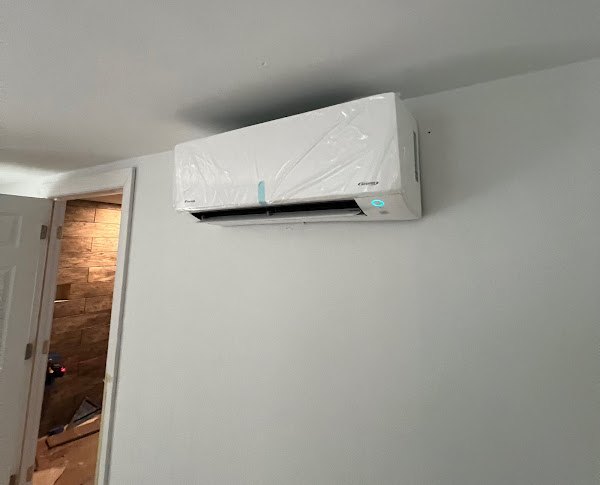
The estimator prices a replacement by system size in about two minutes. If a room in the house has never been comfortable, or you are heating a converted space, the ductless estimator covers that instead: one zone $7,000 to $10,000, two $11,000 to $15,000, three $12,500 to $18,000.
Two things to do in October
Run the heat for an hour and make sure the outdoor unit actually starts. A heat pump that will not come on in October is a Tuesday appointment; the same fault on the first 20 degree night is an evening call behind everyone else’s.
Then clear around and under the outdoor unit. A heat pump drains defrost water out the bottom, and a unit sitting in wet leaves or on a pad that has settled into the mud freezes itself to the ground.
SwiftPro repairs heat pumps and furnaces across Burke. Call (703) 997-9757, book online, or see the heat pump service page. How a heat pump handles a Virginia winter is the longer read.