

People put off replacing a furnace partly because of the money and partly because they do not know what the day involves. Here is the whole thing, start to finish, including the parts that are your job rather than ours.
Before the day
The measurement visit. Someone comes out, measures the house, looks at the ductwork, the venting, the gas line, the electrical and the drain, and asks how the house actually behaves. That last part matters: which rooms are never right, whether the system short cycles, whether anyone has complained about dust. A quote written from a model number and a square footage is a guess.
What we are working out is the load the house actually has, not what the old unit was rated for. Half the systems we replace are a size larger than the house needs, which is why the old one short cycled and never warmed the far bedroom. Matching the outgoing sticker repeats somebody else’s mistake. Why that matters is here.
The quote. It should name the equipment, the efficiency, the stages, the blower type, and what else is included: permit, removal, venting, condensate, a new gas connector and shutoff, and the warranty terms in writing. If your furnace and water heater share a masonry chimney and you are moving to a high efficiency unit that vents out a side wall, the chimney work belongs in the quote rather than in a phone call three weeks later. The fuel gas code requires the chimney to be examined before a new appliance goes in.
The permit. We pull it. In Fairfax County a gas appliance replacement needs a permit even when it is like for like, and it becomes a plumbing permit if new gas piping is involved. The rest of Northern Virginia follows the same statewide code with its own offices. A quote without a permit is not cheaper, it is uninspected, and it surfaces at resale.
What you do the night before
Clear a path from the nearest door to the furnace, and clear about three feet of working space around it. If the basement has become storage, this is the hour that saves the crew two.
Put pets somewhere secure. The door will be open repeatedly and there will be noise.
Know where you want the thermostat, if you are changing it.
Plan for no heat for most of the day, which in a Virginia autumn is a non-event and in January means a few cold hours. We schedule accordingly and you will have heat that night.
The day itself, in order
Protection first. Drop cloths on the path, corner protection where equipment has to turn. If a crew walks straight to the basement without laying anything down, that tells you something.
Shut down and disconnect. Gas off at the appliance valve, power off at the furnace switch and the breaker, the old unit disconnected from gas, electrical, venting and the duct plenum.
Old unit out. Usually broken down into pieces to get it up a staircase. It leaves with us, and haul-away is part of the price, not a line item that appears later.
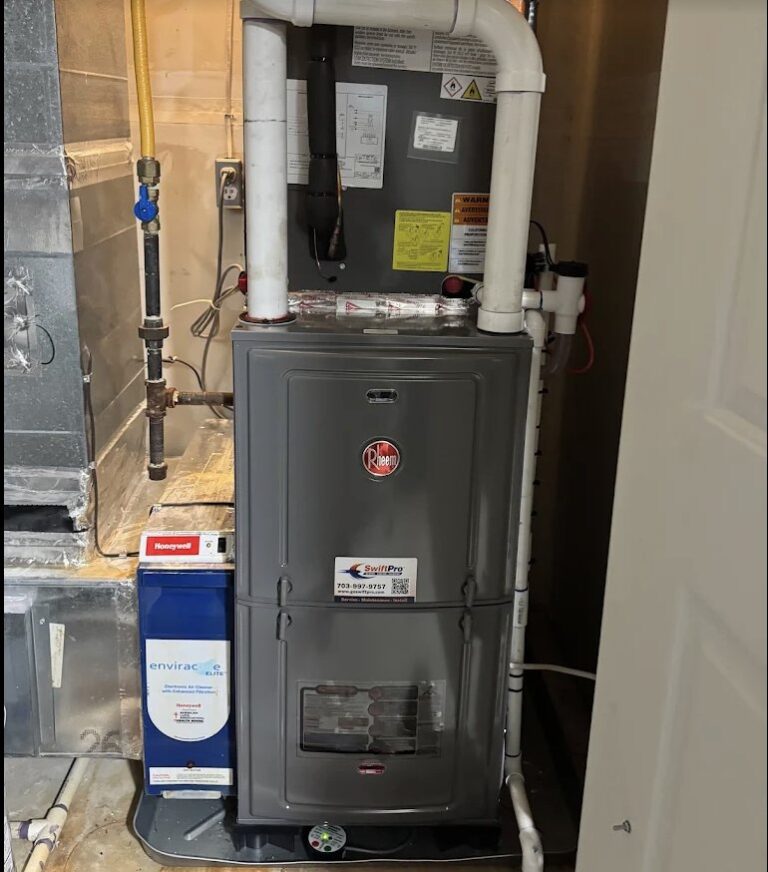
New unit set and connected. The furnace is positioned, the plenum connections made and sealed, the gas line reconnected with a new flexible connector and shutoff, and the electrical tied in.
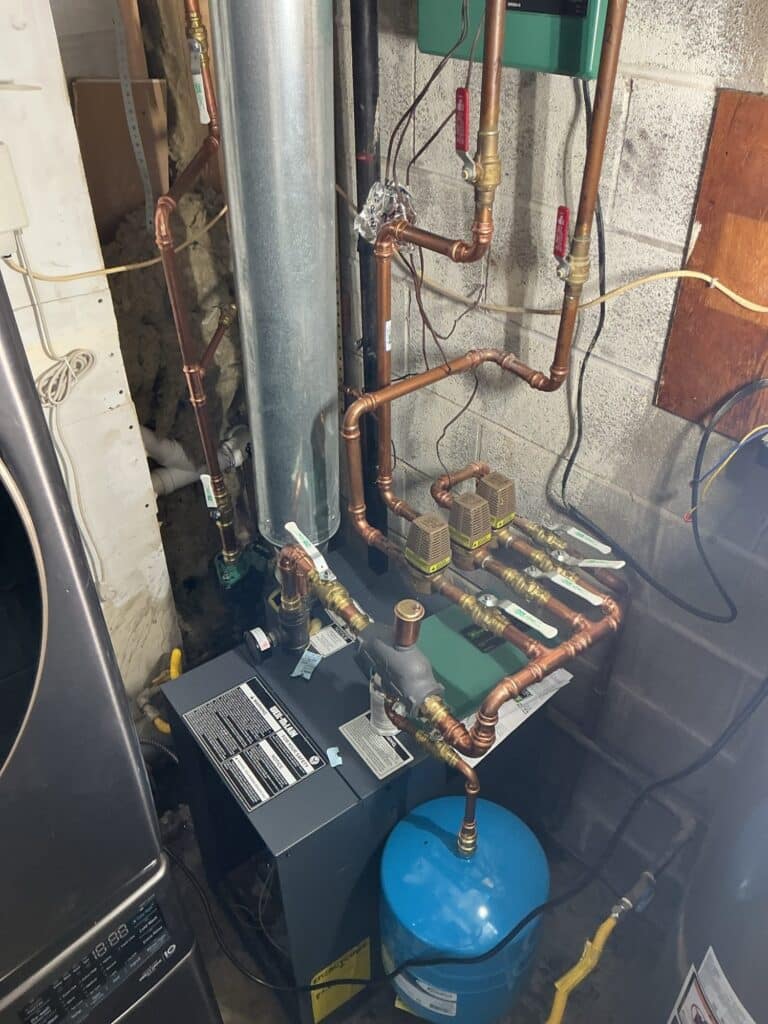
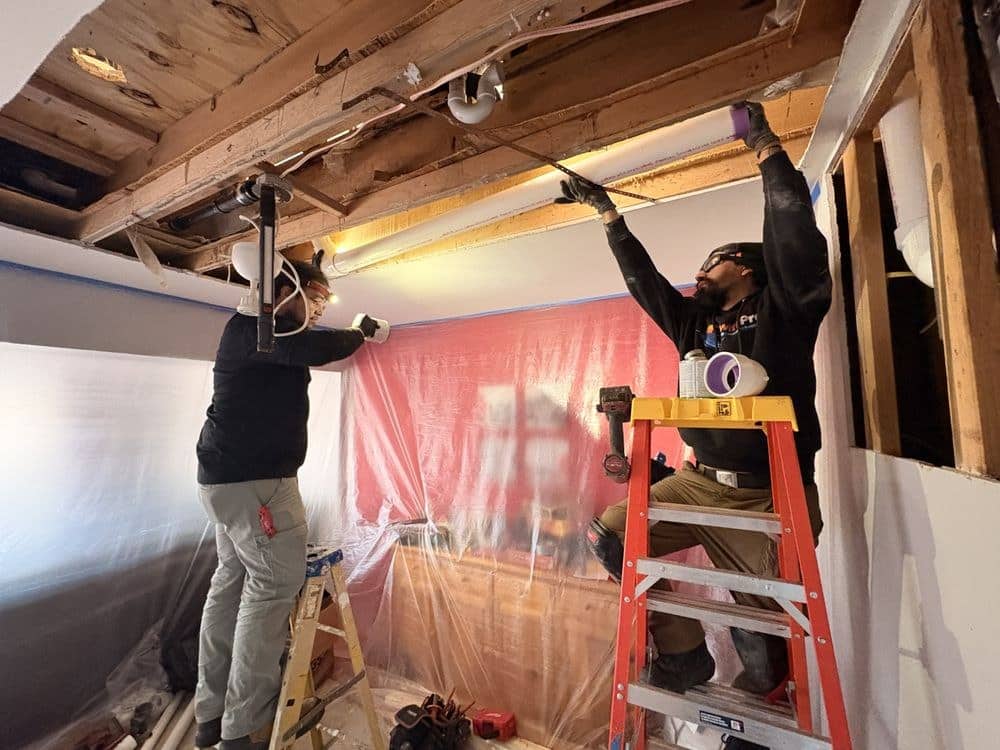
Venting. The part that varies most. An 80 percent furnace generally reuses the existing metal flue, once it has been checked. A 96 percent unit vents in PVC through a side wall, which means cutting, running pipe, sealing the penetration and dealing with the condensate. This is where the hours go in an older house.
Condensate. A high efficiency furnace makes water when it runs. It needs a trap, a drain route, and often a neutralizer. Done badly, it is the single most common cause of a first-winter no-heat call, because the furnace shuts itself off on purpose when it cannot drain. That is on our repair list for a reason.
Startup and commissioning. This is the step that separates a good install from a fast one. Gas pressure set, temperature rise measured across the heat exchanger and compared against the nameplate, blower speed adjusted to suit the ductwork, safeties tested, combustion checked. A furnace that is running is not the same as a furnace that is set up.
Walkthrough. Where the filter goes and what size, where the switch and the breaker are, how the thermostat works, what noise is normal on startup, and what the warranty covers.
Pre-Installation Planning and System Assessment
A straightforward furnace swap is most of a day. A furnace and air conditioner together is a full day and occasionally spills into a second. A job that adds venting through a finished wall, corrects ductwork, or lines a chimney takes longer, and a good contractor tells you that before the day rather than at 4pm on it.
After the day
The inspection. The county or city inspector comes out, usually within a week or two, and checks the venting, the gas connection and the electrical. We arrange it and we meet them. You do not need to know anything technical, and you should be told when it is happening.
Register the warranty. This matters more than people realise. Most major brands cover parts for ten years only if the unit is registered within 60 to 90 days of installation, dropping to five if it is not. Ask whether the contractor registers it or you do, and get it confirmed in writing. Keep the model and serial numbers somewhere you will find them in eight years.
Rebates. Washington Gas currently pays $500 on a furnace at 95.1 to 96.9 percent efficiency and $700 at 97 and up, filed by a contractor in its network. Ask whether your rebate is in the quoted price or claimed afterwards. The federal tax credit ended for equipment placed in service after December 31, 2025, so nobody should be quoting you one.
The first month. Check the filter after a few weeks, because an install stirs up dust. Call if anything sounds wrong; a new system should be quiet, even and boring.
What it costs
A furnace alone runs $4,498 to $12,300 installed. A furnace and air conditioner together run $8,898 to $23,000 by system size. If both are the same age, doing them together costs less than two jobs two years apart, because the permit, the crew day and the electrical overlap.
The estimator gives you the installed range for your size in about two minutes with no phone number, and what moves the number is here. If a quote comes back far outside it, the second opinion is free, and plenty of the quotes we look at turn out to be fair, in which case we say so.
SwiftPro installs furnaces across Northern Virginia. Call (703) 997-9757 or book the free measurement online.