

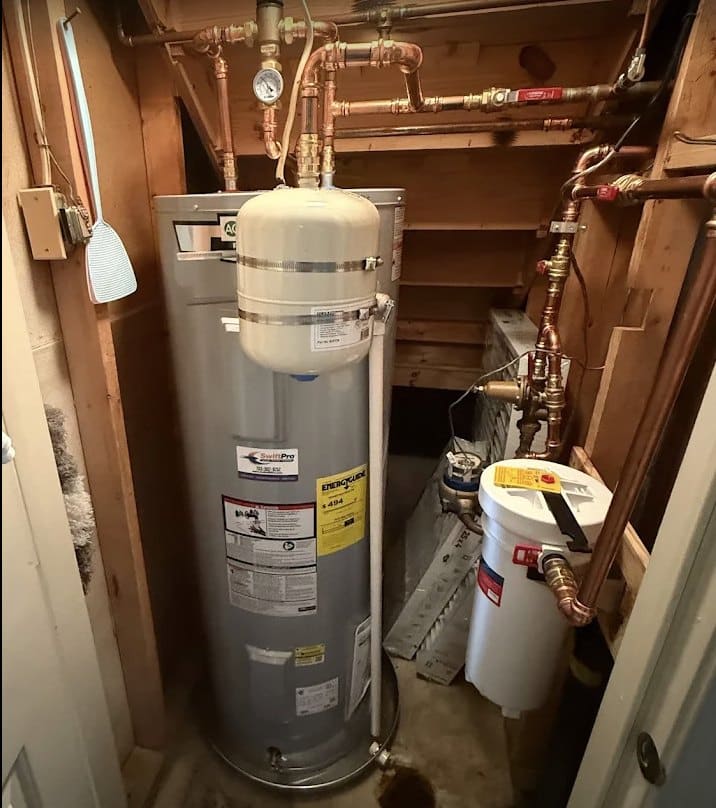
If you only do one thing: go look at the top of your water heater. If there is rust, a white chalky crust, soot, or moisture where the vent pipe leaves the tank, call somebody this week. That is the one item in this whole ten-part series where we would say do not wait.
Here is a thing that happens in Northern Virginia basements several times a week, and almost nobody who it happens to knows about it.
Your house was built with a gas furnace and a gas water heater standing next to each other, both venting into the same chimney or the same metal flue. That was normal and it was correct. The chimney was sized for the two of them together.
Then the furnace wore out and you replaced it with a high efficiency one, which was a good decision. A modern condensing furnace vents through plastic pipe out a sidewall. It does not use the chimney at all.
Which leaves the water heater alone in a chimney built for two appliances.
Why an oversized chimney is a problem
It is the opposite of what intuition says. A bigger chimney should draft better, not worse.
A natural draft chimney works because hot exhaust is lighter than the cold air outside it, so it rises. That takes heat. The furnace was the appliance producing most of it, and it was the one keeping that chimney warm and moving. Take the furnace out and a single water heater, which fires for a few minutes at a time to heat a tank, has to warm a masonry flue sized for both, all by itself, from cold, every time.
The Building Performance Institute describes it in a sentence: the chimney “was originally sized to accommodate the BTU heat input of both” appliances, so on its own it is “often oversized,” which reduces “its ability to provide sufficient draft.” The industry calls this an orphaned water heater, and the code has a name for the situation too. The fuel gas code says the vent has to be “suitable for the appliances to be vented,” and it requires the chimney to be examined before an existing appliance is replaced. It also caps the vent area at no more than seven times the appliance’s draft hood outlet, which is the exact arithmetic that fails when one appliance is left in a two-appliance flue.
What happens when it does not draft
The exhaust has to go somewhere, and if it will not go up it comes out the draft hood, which is the open gap at the top of the water heater where the vent pipe starts. Oak Ridge National Laboratory describes it plainly: the flue gases come “back into the basement through the water heater draft hood.”
That exhaust is hot, wet and mildly acidic. Burning natural gas makes roughly a gallon of water vapor for every 100,000 BTU, so the first thing you see is water: condensation on the tank top, on nearby cold pipe, on basement windows. Then the acid goes to work and you get rust and a white crust where there should be clean metal.
And it contains carbon monoxide. Not always at a dangerous level, and a water heater that spills for two minutes while the flue warms up and then drafts properly is common and is not the same as a water heater that spills the whole cycle. But carbon monoxide has no smell, and the CDC puts unintentional non-fire carbon monoxide deaths in this country at more than 400 a year. In the CPSC’s most recent accounting, about a third of those were associated with a heating appliance, and the overwhelming majority happened at home.
How often this actually happens
This is where the research is genuinely useful, because it turns a scary story into a number.
Lawrence Berkeley National Laboratory tested 1,427 houses in the Minneapolis and St. Paul area under worst-case conditions, meaning every exhaust fan in the house running at once. Thirty-six percent of orphaned water heaters failed. Individually vented appliances failed 5 percent of the time. Sealed combustion appliances failed zero percent.
We should give you the caveat LBNL gives, because it matters: an orphan is held to a tighter standard than anything else in the house, so some of that gap is the threshold rather than the appliance. An orphaned water heater is expected to keep drafting until the house reaches negative 2 pascals. Every other appliance gets somewhere between negative 3 and negative 50.
So the fair way to say it: orphans are the most fragile venting arrangement in a house, and they are held to the strictest limit precisely because they are.
The part that makes this a winter article
Two reasons this belongs in November and not in June.
Your house is closed up. Every window shut, weatherstripping doing its job. The air that a natural draft appliance needs has to come from somewhere, and in summer it leaks in around an open house. In January it does not.
Everything in the house is pulling air out. This is the finding that should bother people. A Department of Energy and Gas Technology Institute field study measured real kitchen range hoods at an average of 219 CFM. Every one of them was under the 400 CFM threshold where the code requires makeup air to be provided. And the houses they were in averaged negative 6.9 pascals.
Negative 6.9, against an orphan’s limit of negative 2. More than three times over, with completely code-compliant equipment, in ordinary houses. Add a clothes dryer, a couple of bath fans and a wood stove and it gets worse.
So the scenario is not exotic. It is Thanksgiving. The range hood is on, the dryer is running, the house is sealed up for the season, and the water heater fires because fourteen people took showers.
What you can check yourself, in two minutes
Turn on a hot tap somewhere and leave it running so the water heater fires. Then go stand at it.
Look at the top of the tank where the vent pipe leaves it. You want clean metal. Rust, a white powdery deposit, soot, flaking paint, or beads of water are all the same message.
Look at the vent pipe itself. It should rise continuously from the draft hood, with no sag and no downward run, and the joints should be screwed together and solid. Rust holes are common and are an immediate call.
Hold a small mirror just under the draft hood opening, about two minutes after the burner lights. If it fogs, exhaust is coming out of the hood instead of going up. A mirror is a legitimate method; it is named in BPI’s own equipment list alongside smoke pencils. The dollar bill test you have read about is not. That is a real technique for checking weatherstripping on a door, and it turns up on HVAC pages because somebody borrowed it. Use the mirror.
Then look at the flame. Blue and steady is right. Lazy, orange, yellow, or dancing out toward you is not.
Now make it harder on purpose. Turn on the kitchen range hood at full speed, the clothes dryer and every bath fan, close the exterior doors and windows, and do the mirror test again. That is a rough home version of what a technician does, and if it fogs only under those conditions, you have found exactly the thing this article is about.
Two minutes is not an arbitrary number. The current standard assesses spillage on a water heater at two minutes of burner operation, because the flue needs a moment to warm up and start pulling. You may also see sixty seconds quoted. That figure is real, but it comes from an older BPI document that has been superseded, so if somebody quotes it at you, ask which standard and which year.
What a real test looks like, and why you want one
The homeowner version above tells you whether to worry. It does not measure anything.
The actual procedure puts the house into worst-case conditions deliberately: exterior doors and windows closed, interior doors set a specific way, the dryer running, the kitchen exhaust at maximum, the next largest fan on, and the air handler running if it makes things worse. Then the technician measures the pressure in the room with a manometer, watches for spillage at the two minute mark with smoke, and measures carbon monoxide in the flue.
That is a combustion safety test, and it is the only thing that turns “it looks okay” into a number. It is part of a proper heating tune-up, and it is one of the things on the list your own ears cannot do, which we wrote about in the first post in this series.
The fixes, roughly cheapest to most
If your water heater is orphaned, there are four real answers and a contractor should walk you through which fits.
Reline the chimney. A correctly sized liner dropped into the oversized masonry flue gives the single appliance a chimney it can actually warm. This is the common fix and often the right one.
Re-vent it separately in metal vent pipe, where the layout allows.
Replace it with a power vented water heater, which has a fan and blows its exhaust out a sidewall and does not rely on draft at all. It needs an electrical outlet.
Replace it with something sealed combustion, which draws its own air from outside and is immune to how negative your house gets. A condensing tank or a tankless unit both do this, and this is the option that makes the problem permanently go away. Tank versus tankless, honestly, is here, and what a replacement costs here is here.
What is not a fix: cracking a basement window. It works when somebody remembers, in a season when nobody wants to.
How to not have this happen to you
If you are replacing a furnace this year and your water heater shares the chimney, ask what happens to the water heater’s vent, and get the answer in writing on the proposal. The code already requires the chimney to be examined before an appliance is replaced. Ask how it was examined and what the finding was.
It is a fair question, a good contractor will be glad you asked, and it is far cheaper to answer during the furnace quote than a year later.
And regardless of any of this: carbon monoxide alarms on every level and outside the sleeping areas, with the date on the back checked. They expire. Interconnected ones are better, so that one going off in the basement wakes the people upstairs.
Do this week
Look at the top of your water heater. Thirty seconds. If it is clean bright metal, you are probably fine and you can go read something else in the Cold Season Field Guide. If it is rusty, crusty or wet, that is today’s phone call.
And if a carbon monoxide alarm is sounding right now, everyone goes outside first and you call 911 from there, not from inside the house.
SwiftPro does combustion safety testing, chimney liners and water heater replacement across Northern Virginia. (703) 997-9757, or book a time online.