

If you only do one thing: put a thermometer where you can see it and write down the indoor temperature every hour. Everything below is a decision, and every one of those decisions gets easy once you know whether the house is losing one degree an hour or five.
An ice storm takes the power out in Northern Virginia every couple of winters, and the honest thing about it is that the heat is usually the second problem. Almost nothing here runs without electricity. A gas furnace needs power for its blower, its igniter and its controls. A heat pump needs it for everything. A boiler needs it for the circulator. Even most gas water heaters need it for the vent fan. When the lights go, the heat goes with them, and the clock starts.
The first hour
Turn the thermostat off, or all the way down. Do it now while you are thinking about it. Power coming back is rarely clean, and you do not want the furnace or the compressor trying to start into a brownout at 3am while everyone is asleep. You will turn it back on deliberately later.
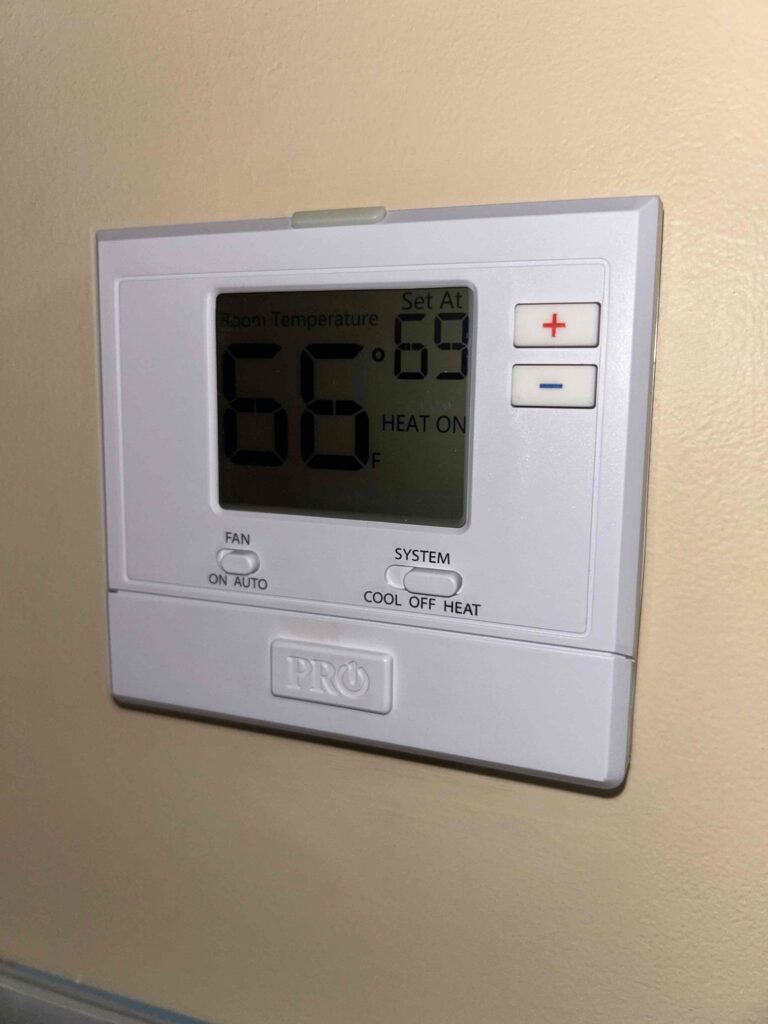
Put a thermometer somewhere central and start writing down the temperature and the time. Every house loses heat at its own rate, and yours is the only one that matters. Two readings an hour apart tell you more than any article can.
Close it up. Shut the doors to rooms nobody is in, close every blind and curtain after dark, and put towels along the bottom of exterior doors. Pick one room, ideally a small interior one, and make it the room everybody lives in.
Do not open the refrigerator. The FDA’s numbers: unopened, a refrigerator holds for about 4 hours, a full freezer for about 48, a half full freezer for about 24. Opened every twenty minutes, none of that applies. Afterward, throw out perishables that sat above 40 degrees for 4 hours or more, and refreeze anything that still has ice crystals in it.
Fill some containers with water if you are on a well, because a well pump is electric and when the pressure tank runs out you have no water at all.
Report the outage rather than assuming someone else did. Dominion and NOVEC both work from reported outages, and a street nobody reports can sit behind streets that did. NOVEC customers, which is much of Loudoun, Prince William, Fauquier and Stafford, can text #OUT to 85700 once the number on the account is registered. Dominion customers report through the app or the website. Downed lines are different: stay at least 30 feet away and call Dominion at 866-366-4357 immediately.
The generator rule, and why it is written in this tone
This is the part of the page we would ask you to read even if you skip everything else.
A portable generator runs outside only, at least 20 feet from the house, with the exhaust pointed away from it. That is the Consumer Product Safety Commission’s number, and they publish it in the same words across multiple documents. Not in the garage with the door up. Not on the porch. Not in a shed, a basement or a crawlspace. Not next to a window, a door or a vent.
CPSC’s own sentence about doing it indoors is four words long: it “CAN KILL YOU IN MINUTES.” They put the annual toll at nearly 100 people a year from generator carbon monoxide alone. In CPSC staff’s most recent full accounting of non-fire carbon monoxide deaths from consumer products, generators were involved in half of them, and more than half of all those deaths happened in November, December, January and February. This is a cold weather problem, and it is a during-and-after-the-storm problem.
Carbon monoxide has no smell and no color. The symptoms are headache, dizziness, weakness, nausea, vomiting, sleepiness and confusion, which is to say they are the symptoms of being cold, tired and stressed in a dark house, which is exactly the problem. If more than one person in the house feels it, or if the pets are affected too, get everyone outside first and call 911 from there.
Some newer generators have a carbon monoxide shutoff that kills the engine when CO builds up nearby. Two industry standards cover it, ANSI/PGMA G300 and UL 2201. Both are voluntary. Neither is federal law, and a mandatory rule has been proposed twice and still has not been issued. So it is worth looking for the feature when you buy, and it is never worth assuming your generator has it.
And never run a generator, grill, camp stove or car engine indoors for heat, and never heat a house with the oven. Nationally, the CDC puts unintentional carbon monoxide deaths that have nothing to do with fires at more than 400 a year, with over 100,000 emergency department visits behind them.
Space heaters, done the way the fire service says
If you have power on one circuit, or a generator, a space heater is reasonable. It is also the single most dangerous appliance in a winter house, and the numbers are not close.
The US Fire Administration’s pair of figures is the argument by itself: portable heater fires were about 3 percent of home heating fires, and 41 percent of the fatal ones. The NFPA’s current count is about 37,000 heating equipment fires a year in American homes, 417 deaths, and space heaters and heating stoves account for roughly 30 percent of the fires and 73 percent of the deaths.
So, the rules, which are short:
- Three feet of clear space on every side. CPSC names what it means: beds, clothes, curtains, papers, sofas, anything that can catch.
- Straight into a wall outlet. CPSC’s wording is emphatic and worth repeating: always a wall outlet, never a power strip, and never run the cord under a rug or carpet. The draw is high enough to cook an undersized cord.
- One heater per circuit.
- Off when you leave the room, and off when you go to bed. Fewer heating fires happen overnight, and a disproportionate share of the deaths do.
- On a hard floor, not carpet, and not where somebody walks in the dark.
A real, maintained fireplace is fine with the damper open, the screen closed, and nothing burning near the hearth. A chimney nobody has looked at in ten years is not the thing to press into service on the worst night of the year.
The pipes, which is the expensive part
A cold house is uncomfortable. A frozen pipe is a ceiling on the floor.
The regional utilities that serve almost everybody here, Fairfax Water, Loudoun Water, Prince William Water, DC Water and the rest, publish the same winter guidance: keep the thermostat above 55, drip cold water from the faucet farthest from your main valve, and open the cabinets and vanities on exterior walls so warm air reaches the pipes behind them. Loudoun Water adds a useful detail most lists leave out: pick the faucet that is farthest from the shutoff and at the highest point in the house.
And here is why the dripping actually works, which almost nobody gets right. A pipe does not usually split where the ice forms. Research at the University of Illinois found that once an ice plug forms, water keeps freezing and expanding behind it, and the pressure builds in the trapped water between that plug and the closed faucet downstream. It is that pressure that splits the pipe. An open faucet gives the pressure somewhere to go, which is why a pipe with a tap cracked open can freeze solid and still not burst. The drip can be very slight.
Two things follow from that, and they matter in an outage. If the drip stops, leave the faucet open, because a pipe has probably frozen and still needs the relief. And with the heat off there is no warm air to let into that cabinet, so dripping is buying you pressure relief rather than warmth. It is real protection. It is not a substitute for heat.
So use the thermometer:
Above 55 indoors. Normal territory. Drip the vulnerable faucets, open the cabinets, and wait it out.
Heading into the 40s. Pipes in exterior walls, crawlspaces, garages and unheated basements are now genuinely at risk. Keep dripping, and close the garage door if there is any plumbing in there. If the outage looks like it has hours left in it and it is well below freezing outside, this is the point to drain the system: shut the main off, then open every fixture, hot and cold, until the water stops running. You do not have to leave them open after that, because the pipes are mostly air at that point. Find that valve before you need it, because doing it by flashlight in a crawlspace is not the moment to learn where it lives.
If a pipe freezes but has not burst. Open the faucet it feeds and leave it open. Warm the pipe with a hair dryer, an electric heating pad, or towels soaked in hot water, working from the faucet back toward the frozen section. Never a blowtorch, a propane or kerosene heater, a charcoal stove or any open flame, which is the Red Cross’s own list and is how house fires start.
Below the mid 50s with an infant, an older adult, or anyone with a heart or breathing condition in the house. Go somewhere warm. A hotel costs less than what happens otherwise, and this decision gets harder to make the colder and more tired everyone gets. Make it early.
One more, and it catches people every time: if you have a sump pump, it is electric. An ice storm is often a wet storm, and a basement that stays dry because a pump runs will not stay dry in a long outage. If yours runs regularly in winter, a battery backup is the answer, and it is a September purchase, not a December one.
When the power comes back
This is the half nobody writes about, and it is where the damage often actually happens.
Wait a few minutes before you ask for heat. Power restoration is frequently not one clean event. Dominion’s own advice is to disconnect whatever was running when the lights went out, because surges and spikes when it comes back are what damages equipment. Let it settle, then turn the thermostat back on deliberately.
Turn it to a normal setting, not to 80. Cranking it does not warm the house faster, it just guarantees every stage and every electric heat strip runs at once, on a grid that is still coming back.
Heat pump owners, there is a real reason not to rush this. Your outdoor unit has a crankcase heater that keeps the compressor’s oil warm, and it only works when the unit has power. Lennox, Rheem and Goodman all instruct that the unit be energized for 24 hours before the compressor is started, and Mitsubishi asks for 12, because starting a compressor with cold oil is how a very expensive part dies. Those instructions are written for a new installation rather than for an outage, and no manufacturer we could find addresses the outage case directly. But after the unit has sat dead through a multi-day freeze, the situation is the same one they are describing. If the house is warm enough to wait, give it time. If it is not, run it and tell us, because at that point a cold house is the bigger problem.
Then walk the house. Look under every sink, at every exposed pipe in the basement, garage and crawlspace, and at the ceilings under bathrooms. A pipe that froze does not usually leak while it is frozen. It leaks when it thaws, which is often hours after the lights come back and everyone has relaxed. If you find a leak, shut the main off first and call. The first four minutes of a burst pipe are here.
Check that the furnace actually relit. Some systems lock out after an interrupted cycle and need the breaker or the switch cycled once. If it will not start, run the ten minute check before calling, because the answer is often on it.
Reset the clocks on the water heater and the thermostat, and if you have a well, run a tap until the water is clear.
What to do in September so December is boring
Three things, and all of them are cheap right now.
Find your main water shutoff and turn it, once, while the lights are on. Valves that have not moved in fifteen years sometimes do not.
Put carbon monoxide alarms on every level and outside the sleeping areas, and check the date on the back. They expire. CPSC recommends interconnected alarms, so that one going off in the basement sounds upstairs where people are.
Get the heating system looked at before the season, because the failure that shows up in an outage is usually the one that was already there. That is the test run in the first post of this series, and the tune-up is included in our Family Care Plan at $199 a year with priority scheduling, which after a regional storm is the difference between today and Thursday.
This is one of ten in the Cold Season Field Guide.
SwiftPro runs heating and plumbing service across Northern Virginia and answers the phone around the clock, storms included. (703) 997-9757, or book a time online.