

A sump pump replacement in Northern Virginia runs $700 to $1,200, and the middle of that is about $1,000. That is a new primary pump with a new check valve, installed and tested. Adding a battery backup is a bigger ticket, generally $2,700 to $4,200 depending on whether the primary pump goes at the same time.
Whether you need any of it is the better question, and the pump usually tells you in advance if you know what to listen for.
Why this matters more here than in most places
Fairfax County publishes a homeowner’s guide to its marine clay soils, and it is blunt about what they do. The clays shrink in dry weather and swell in wet, and the county’s own document notes that the swelling pressures can far exceed the strength of basement walls. Water percolates very slowly through them, which is a polite way of saying it sits against your foundation looking for the lowest point, and that point is the pit in your basement floor. The county’s soil and water district adds the line every homeowner should read twice: most wet basements are the result of water problems outside the house.
Then add the weather. Reagan National’s normal annual rainfall is about 42 inches; 2018 delivered 66. Fairfax County’s environmental office reported that by July 31 of 2025 the National Weather Service had issued 16 flash flood warnings and 20 flood warnings for the county, surpassing the previous record year by ten, and noted plainly that it now rains harder than it used to, with the same total falling in shorter bursts.
A pump that has been quietly cycling a few times a night for ten years gets asked to run for a day straight. That is the day it fails, and it is never a dry Wednesday.
Sump pump not working: what to check
It hums but does not pump, or does nothing while the pit fills. Unplug it. Look at the float, the switch that rides up with the water. It very often wedges against the side of the pit or a discharge pipe. Free it, plug the pump back in, and lift the float by hand. If the pump runs, reposition the float so it swings clear. If it does not run with the float lifted, the switch or the motor is finished.
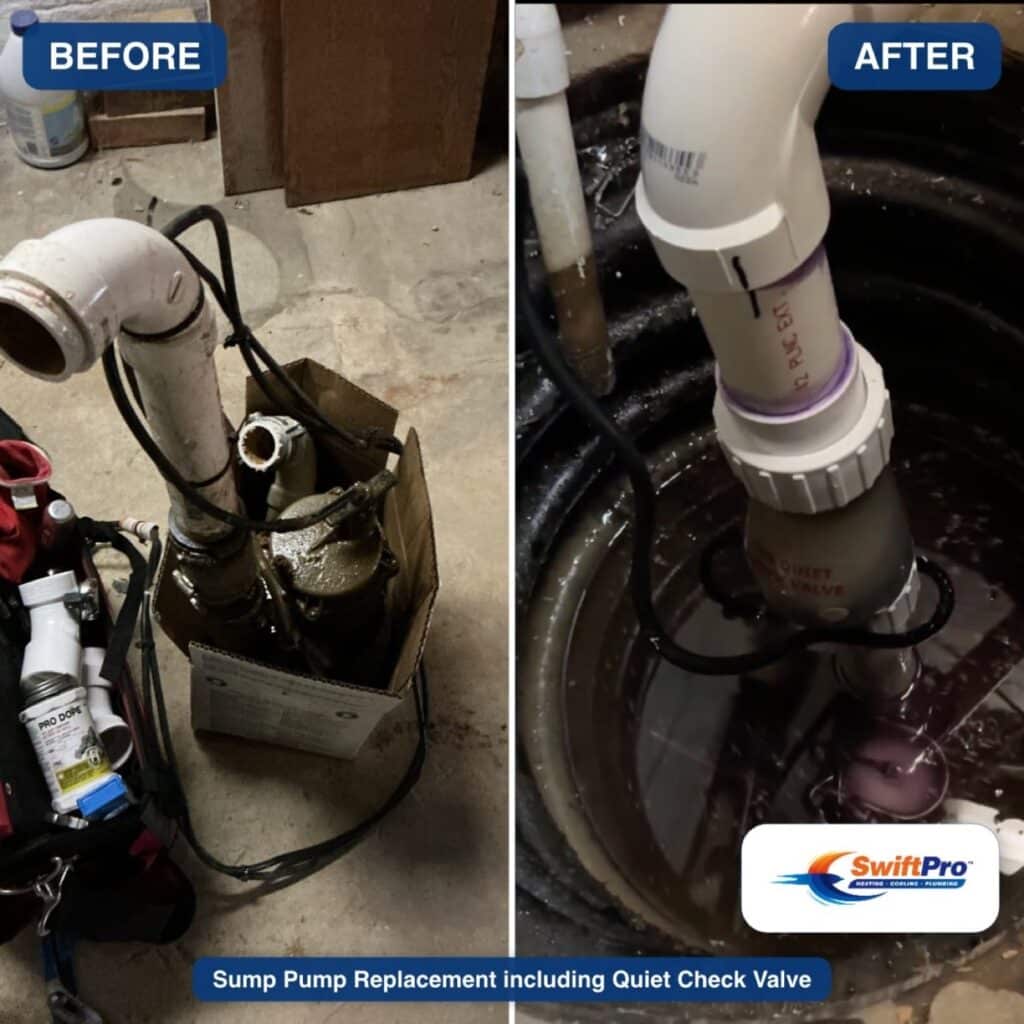
It runs, shuts off, then runs again thirty seconds later, over and over. The check valve. That is water draining back down into the pit through a valve that no longer closes, so the pump keeps re-pumping the same water and works itself to death. Zoeller’s own guidance is that water returning to the pit is the clear sign. Cheap part, and replacing it saves the pump.
Sump pump running constantly after heavy rain. That may be correct behavior. A pump that runs continuously during a two inch storm is doing its job. A pump that runs continuously in a dry week is either a stuck float, a failed check valve, or groundwater that is genuinely that high, and the last one is worth investigating outside the house.
It ran all night and now it is silent and hot. Thermal overload, or it is gone. Either way it is not going to save you during the next band of rain.
Nothing happens and it is January. Look at where the discharge line exits the house. A frozen outside end means the pump is running against a closed pipe until it burns up. There are freeze relief fittings for this.
The thirty second test, and when to do it
Pour a five gallon bucket of water into the pit. The float should rise, the pump should start within a few seconds, the water should drop fast, and the pump should shut off cleanly without running dry for ten seconds. Then listen for water rushing back into the pit.
Do this in March before the spring rain, and again in August before the storms. It takes two minutes and it is the single most useful thing on this page.
How long do sump pumps last?
Zoeller, which makes a lot of the pumps in this area, says seven to ten years with proper installation and maintenance. Ours agrees: the pumps we replace are mostly in that window, and the ones that fail early are usually the plastic hardware store unit doing a job a cast iron pump should have.
If yours is past seven years, runs often, and the basement is finished, replace it on your schedule rather than on the storm’s. That is the entire argument.
What a replacement includes
A third or half horsepower cast iron or stainless pump, not the plastic one we are taking out. A new check valve, and we use the quiet type, because a standard one closing at 3 am carries through the whole house. New PVC from the pump to the existing discharge where it is needed. The old pump hauled away. And a bucket test before we leave, which sounds trivial and is the step that catches a float rubbing the pit wall.
The range moves with access. An open unfinished basement is quick; a pit under a cabinet in a finished basement is not. A quarter of these jobs land under $900 and a quarter over $1,100.
Battery backup, and when it earns the money
A sump pump needs electricity. The storm that fills your pit is the same storm that takes the power out. A backup pump sits in the same pit and starts when the primary stops, whether that is a power failure or a pump failure. Zoeller rates one of its common backup units at about six hours of continuous pumping on a full battery, or 48 hours and more at a ten percent duty cycle.
It earns the money if the basement is finished, if you travel, if you have ever come home to a wet floor, or if your power goes out in every serious storm, which in parts of Loudoun and western Fairfax it does. It does not if the pump runs twice a year and the basement is a concrete box with a floor drain. Batteries need replacing every three to five years; that ran about $775 on the last one we did.
A water powered backup is the other option: no battery, runs off municipal water pressure. It needs at least 30 psi at the house and uses roughly one gallon of city water for every two gallons it removes, and some jurisdictions require a backflow preventer with it. Fine on Fairfax Water or Loudoun Water. Useless on a well.
Fairfax County will pay for half of it. The county’s Flood Mitigation Assistance Program reimburses 50 percent of residential floodproofing up to $5,000, and battery backups for sump pumps are explicitly on the eligible list, along with portable pumps and flood alert systems. It had paid out to 96 households by the end of 2025. Vienna and Herndon are excluded because they run their own programs. If you are in Fairfax County and considering a backup, look at that before you buy.
The insurance part nobody mentions until it is too late
Standard homeowners policies do not cover water that backs up through drains or a sump. Virginia’s Bureau of Insurance says insurers are required by law to offer you water and sewer backup coverage, and that you may have to pay extra for it. That is an endorsement you add, not something you have by default.
Check your policy this week rather than after the storm. It is usually a small annual amount against a five figure finished basement.
Before the next storm
Test it with a bucket. Clear gravel and debris out of the pit. Look at where the discharge line ends outside and make sure it is not buried in mulch or aimed back at the foundation, which is the most common thing we find. And if the pump is over ten years old, replace it now. Our full storm prep list is here.
SwiftPro replaces sump pumps and installs battery backups across Northern Virginia. Call (703) 997-9757, or book online. If water is rising right now, call; that is what the 24 hour line is for.