

Sewer work is the most expensive plumbing most people will ever buy, and it arrives with the least explanation. Somebody hands you a five-figure number for a pipe you have never seen. This is the honest shape of it: what each option costs, what our own signed jobs actually came to, and the one thing that has to happen before anybody quotes you anything.
If the no-dig repair is the part you came for, we have a page on just that: how trenchless sewer lining works, what it costs against digging, and the four situations where we will still tell you the line has to come up. City by city, we go deeper on sewer repair in McLean, Woodbridge and Prince William, and Loudoun County.
The short answer
In Northern Virginia, in our books:
- Camera down the main, while we are already there: $89.
- Camera visit on its own: most run $500 to $620.
- Clearing a blocked main line: $550 to $1,650, with the middle near $1,100.
- Trenchless repair, lining the pipe from the inside: quoted off the camera footage. For scale, the trade’s national average on a short spot repair runs about $3,800.
- Digging the line up and replacing it: our four excavation jobs came to $7,500 to $8,570.
That last one is four jobs, not a statistic, and further down we explain why we are not going to pretend otherwise.
Nobody should quote you a sewer job without a camera in the line
Be suspicious of anyone who tries. A camera is the cheapest part of the whole process and it decides everything after it.
It answers four questions, and every one of them moves the price:
- What is actually wrong. Roots at a joint, a crack, a belly where waste pools, a full collapse, or just a blockage sitting on perfectly sound pipe. Those are four different invoices.
- Where it is. The camera head carries a transmitter, so the fault gets located and marked on the ground above it. Fifteen feet off the house is a different job from sixty feet out under the driveway.
- How deep. Depth drives excavation cost harder than length does.
- What the pipe is made of. Clay, cast iron, Orangeburg and PVC each fail differently, and each one changes what can be done about it.
Those four answers are what turn a five-figure guess into a scoped job. They are also what decides whether you need the expensive option at all, which is the part that matters to you and regularly costs us the bigger sale.
One thing worth knowing before you watch the footage: not every defect is a repair. Seattle’s utility publishes the thresholds plainly, and they are a reasonable way to read your own video. A sag holding less than a quarter of the pipe’s diameter is minor and gets left alone. A quarter to a half will collect debris and is worth re-inspecting every couple of years. Half or more is the one to fix. The same reading applies to roots. So if someone points at a camera screen and says the line is bad, the fair question back is: bad how, and what percentage of the pipe.
Your four options, cheapest first
Most homeowners think this is a yes-or-no question: replace the sewer or don’t. It isn’t. There are four rungs, and the camera tells us which one you are actually on.
1. Clear it
A cable or a jetter opens the line. If the camera then shows sound pipe behind the blockage, you are done, and you spent about $1,100. Roots that grew in through a joint will come back on their own schedule, usually one to three years, so this is a real fix for a real problem and not a permanent one.
2. Line the bad section (trenchless spot repair)
A resin-impregnated fiberglass sleeve goes in through the existing pipe, gets pushed to the fault, inflated against the old wall and cured in place. It becomes a new pipe inside the old one across that section. Nothing gets dug. Repair lengths are typically 5, 10 or 20 feet, and the cure itself takes 5 to 15 minutes.
This is the rung most people have never been offered, and it is the one that saves the most money when it fits. In-Line Renewal Solutions, which supplies UV lining systems to plumbing contractors, puts the national average sale price of a four-foot spot repair at about $3,800. That is their number for the trade, not our price list, but it is the right order of magnitude, and it is roughly half of what the same fault costs to dig.
3. Line the whole run
Same idea, full length. A continuous liner is cast through the entire lateral, up to about 150 feet, and it will navigate 45 and 90-degree bends on the way. You get a new pipe end to end without a trench, and the lawn, the driveway and the mature oak all stay exactly where they are.
4. Dig it up and replace it
Open the ground, take the old pipe out, put new pipe in. Still the right answer sometimes, and we will say so when it is. Our four excavation jobs came to $7,500 to $8,570.
What trenchless actually is, in plain terms
The version people picture, big machines and a torn-up street, is the municipal version. The residential version is quieter than that.
A liner is a fiberglass sleeve that arrives already saturated with resin. It goes into your existing pipe through a cleanout, gets positioned across the damage, and then a light train inside it cures the resin with UV. Not heat, not a chemical you have to mix on site. The resin only hardens when that specific light hits it, which means the crew controls exactly when the clock starts instead of racing a pot life.
The working details that matter to you:
- It works on pipe from 2 inches to 12 inches, and on host pipe of any material. Clay, cast iron, Orangeburg, PVC.
- The cure runs 5 to 15 minutes depending on the length and diameter. The visit is a day, not a week.
- The resins are non-VOC, so there is no solvent smell through the house while it cures.
- The liner material is specified to exceed the structural requirements of ASTM F1216, the standard practice for rehabilitating pipe with a cured-in-place liner. It is a structural pipe, not a coating.
- The design life is 50 years, and that is not a brochure number. ASTM F1216 specifies a 50-year stand-alone design life, and an EPA-funded retrospective that pulled liner samples out of municipal sewers after 21 to 25 years in service found them in excellent condition, with no reason to expect they will not go the distance.
The honest summary: you are getting a new pipe. You are just not getting a new trench.
When lining is the wrong answer
Anybody who tells you trenchless is always better is selling, not diagnosing. A liner needs a host pipe to line. It is not the answer when:
- The pipe has collapsed. There is nothing left to line through. That is a dig, or a burst-and-pull.
- There is a real belly. A sewer lateral runs on gravity and nothing else. Virginia builds to the International Plumbing Code, which sets the minimum fall for a 4-inch building sewer at an eighth of an inch per foot, and a belly is a stretch that has settled below that line. Lining it gives you a smooth, watertight, still-sagging pipe, because a liner follows the pipe it is cast inside and cannot change its grade. Fixing the fall means re-laying the pipe, which means opening the ground.
- The line is badly off-grade or the wrong size. A liner follows the existing path and slightly reduces the diameter. If the geometry is the problem, the geometry has to change.
- The failure is at the connection to the main. That end frequently needs excavation regardless, and it may not be your pipe at all.
On a good day the camera shows a clean crack in sound pipe and you save several thousand dollars. On a bad day it shows a collapse and we tell you so. That is the same camera either way, which is exactly why it goes in first.
Why we will not print a replacement price
We publish our real numbers when we have enough of them to mean something. Drain clearing has 132 signed jobs behind it. Water heaters have 137. Those ranges are worth quoting back to us.
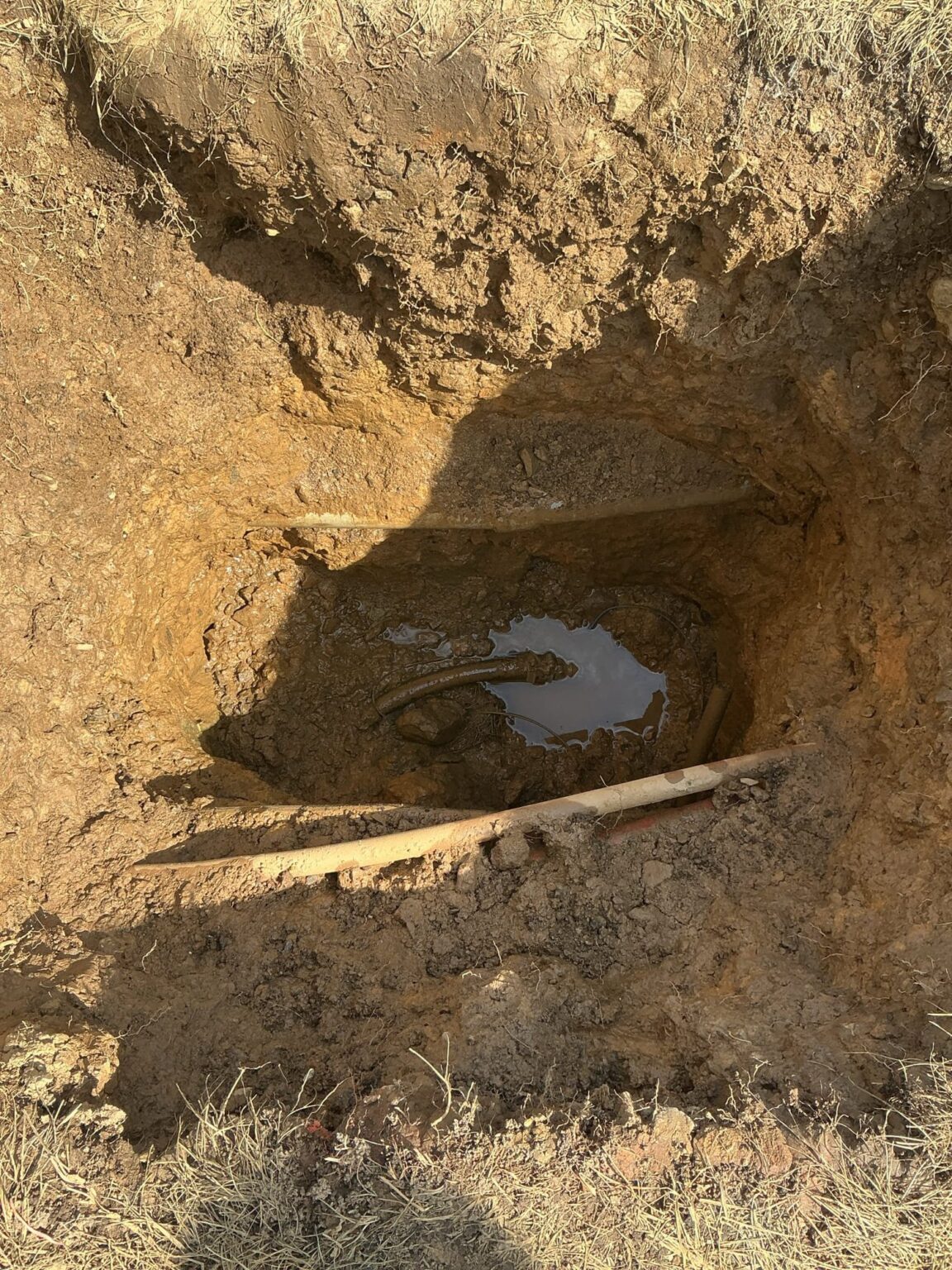
Full sewer excavation has four. They came to $7,500, $7,960, $8,500 and $8,570. Turning four numbers into “sewer replacement costs X in Northern Virginia” would be inventing a statistic, and you would find that out on the day your quote came back at double, because yours runs under a driveway and theirs ran under grass.
So: that is the neighborhood ours have landed in. Yours depends on what the camera finds and on the things below.
What actually moves the number
Length and depth. Every foot is trench, and every foot of depth multiplies it. Four feet down and eight feet down are different machines and different days.
What is sitting on top of it. Lawn is the cheap case. A driveway, a patio, a retaining wall, a finished basement slab or a tree you want to keep all add cost, and some of them add more than the pipe does. This is exactly where trenchless earns its premium: the lining cost is flat whether the line runs under grass or under your new pavers.
How much of it has failed. One located fault in sound pipe is a spot repair. Six failures along the run is a full-length job. Again, the camera.
Access. An existing cleanout in the right place saves real money. If there isn’t one, putting one in is part of the job.
Permits and inspection. Sewer work is permitted work here. That is not a line item to negotiate away, and it means an inspector signs off on the result, which is protection for you and not for us.
What your pipe probably is, by the year the house went up
The camera settles this in about a minute, but the build year gets you most of the way there, and the material decides which of the four options is even on the table.
- Before about 1940: vitrified clay. Fired clay, in short sections. Municipal utilities put clay’s service life at 50 to 60 years, and the body of the pipe often outlasts that. The joints are the problem. They are the doorway roots come through, and clay is brittle enough that it cracks rather than deforms.
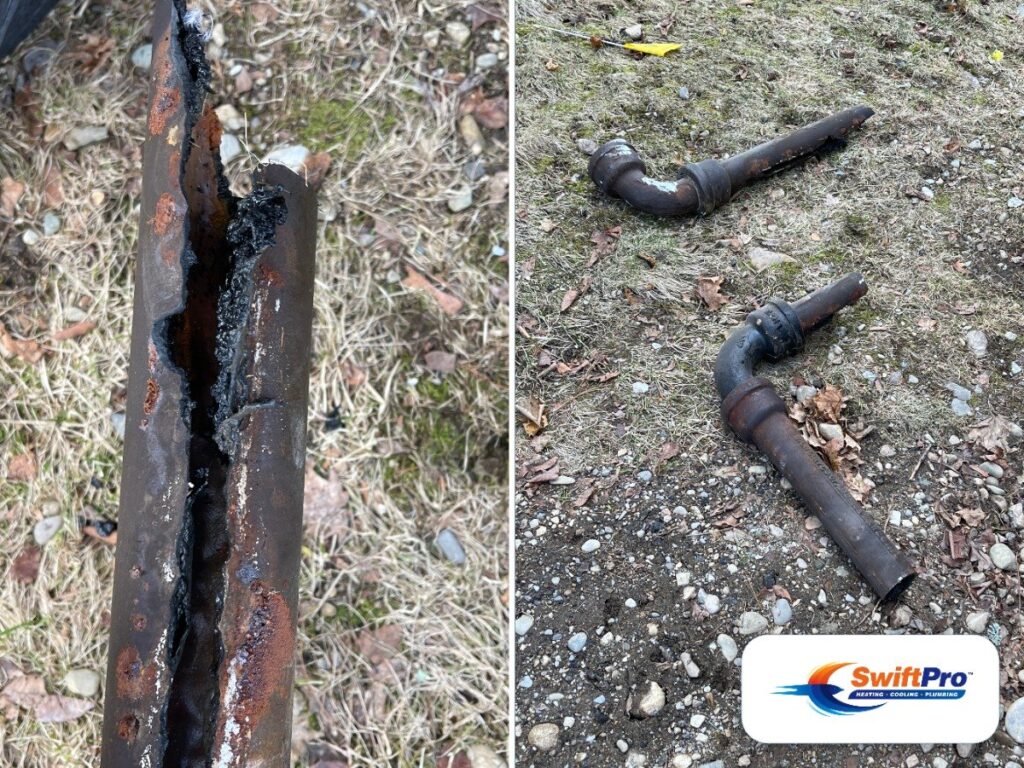
- Roughly 1940 to 1980: cast iron. Estimates vary more than you would expect, from about 30 to 60 years depending on which utility you ask, and the national cost guides claim considerably longer still. It fails from the inside: wastewater etches a channel along the bottom of the pipe, thins the wall, and eventually erodes through. The escaping water then washes out the bedding underneath, which is how a cast iron line grows a belly and then collapses.
- Late 1940s to the early 1970s: Orangeburg. Compressed wood fiber impregnated with coal tar pitch. Advertised at a 50-year life when it went in, which means every piece still in the ground is past it. It deforms under sustained load and goes oval before it fails.
- Roughly 1980 onward: PVC or ABS. 50 to 100 years, glued joints, no root doorway. When newer pipe fails it is almost always a specific event rather than age.
The Orangeburg warning is the one to actually act on. If your line is Orangeburg, running a mechanical cutter down it is not a neutral act. Municipal guidance is blunt about this: when roots intrude into Orangeburg and a rooter goes in after them, the machine tears out pieces of the pipe while it cleans, which brings on the collapse. So the sequence matters. Camera first, then decide. Somebody snaking an Orangeburg line sight-unseen can turn a repair into a replacement in one visit.
The signs you are heading here
Sewer lines almost never fail without warning. The warnings just get cleared and forgotten.
- The main has backed up more than once in a year, or more than twice ever.
- Several fixtures gurgle or back up together, worst on the lowest floor.
- One stripe of the lawn is greener, softer or wetter than the rest.
- There is a smell outside, near the front of the house.
- The house went up before 1990 and there are mature trees between it and the street.
- A plumber told you the cable caught at the same distance every single time.
Two or more of those, and the right next purchase is a camera, not another clearing. Repeat clearings on a failing line are the most expensive way to buy a replacement: you pay for the clearings and then you pay for the pipe anyway.
Older neighborhoods, and why we get these calls
The pattern in Northern Virginia is not subtle. Sewer problems cluster where mature trees meet mid-century pipe, and that describes a lot of McLean, older Vienna, Falls Church and the inside-the-Beltway parts of Fairfax County. Big oaks, houses built when clay and cast iron were standard, and laterals that have been quietly at the end of their service life for a decade.
Newer Ashburn, Brambleton and South Riding are a different story. Those laterals are PVC and they are young. When they fail it is usually a specific event, construction damage, a bad joint, a crushed section, rather than age, and a located spot repair often ends the whole conversation.
Either way the diagnosis is the same and it starts with the camera.
Who actually owns the pipe, and it is not the same rule everywhere
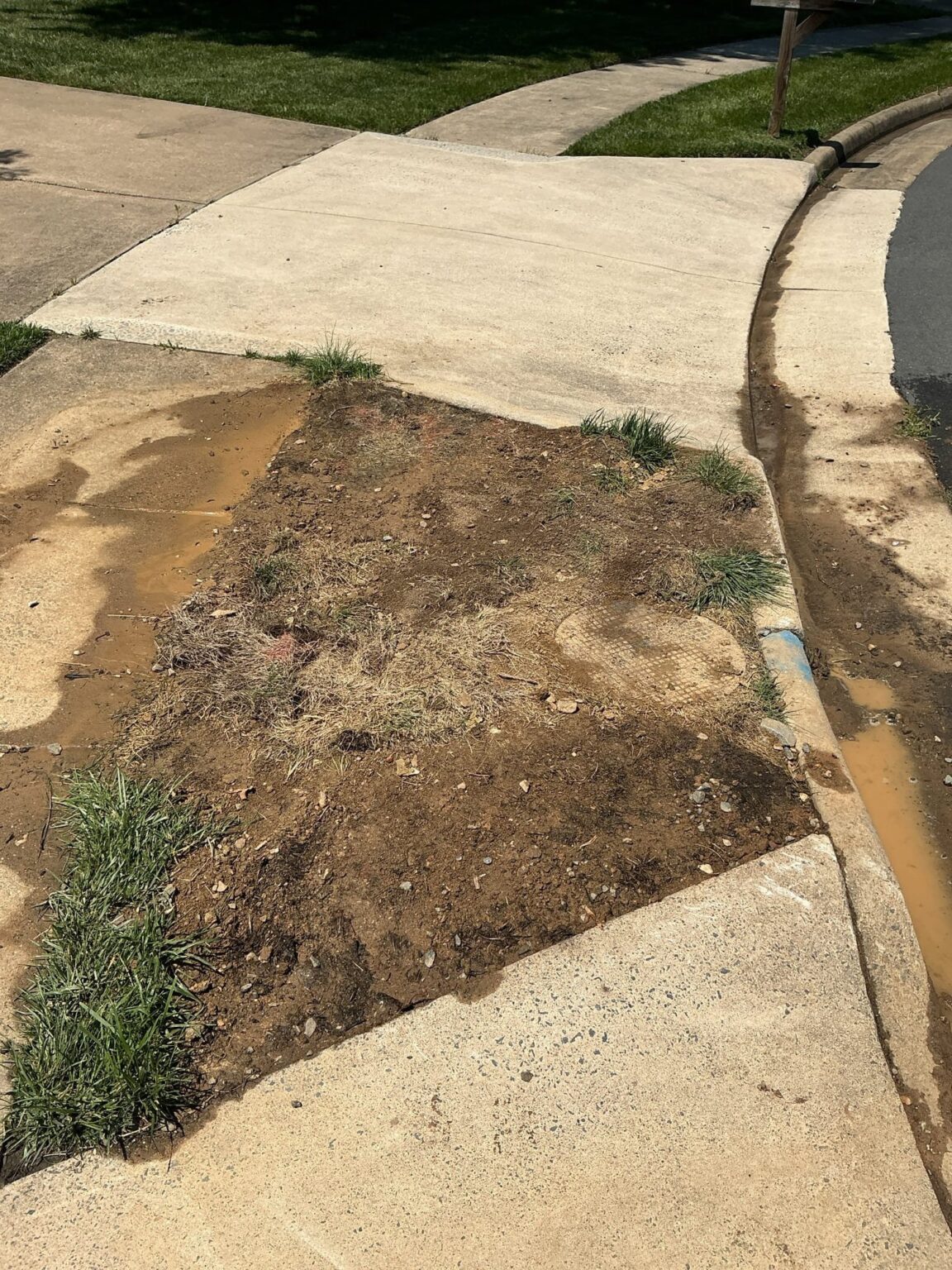
People assume the county owns the sewer once it leaves the house. Mostly it does not. In most of Northern Virginia the pipe from your foundation all the way to the connection at the public main is yours, including the connection itself. But the rule genuinely changes at the jurisdiction line, and the differences are worth real money.
- Fairfax County. Yours from the building to the main, connection included. The county says plainly that the lateral is considered part of the home and will not locate or mark it for you.
- Arlington County. The clearest wording in the region. County Code says service laterals are not part of the sanitary sewage system and are owned and maintained by the owner of the premises served.
- Loudoun Water. Yours to maintain, with a twist worth knowing. Where the building sewer sits in the public right of way, Loudoun Water takes sole control of correcting the work, and can still bill you for repairs caused by faulty materials or workmanship. You own the cost without owning the decision.
- City of Fairfax. Yours to the main, but the city runs a lateral repair reimbursement program, and this is the one people should know about.
- Town of Herndon. Narrower than its neighbors. Herndon describes the private portion as the sewer lateral from the property line to the house, not to the main. A Herndon homeowner and a Fairfax County homeowner two miles away do not own the same length of pipe.
- City of Alexandria. Split by the date the lateral went in, before or after July 1, 1955, and the city’s published wording is genuinely ambiguous about who covers the curb-to-main stretch on the older ones. If your house predates 1955, call Alexandria T&ES and get the answer in writing before you pay for anything.
- City of Falls Church. The city is explicit that it does not own or maintain private laterals, on public or private property. Their own sewer page tells residents a lateral repair is often the most expensive emergency repair a homeowner faces and typically runs more than $10,000.
The City of Fairfax reimbursement almost nobody claims
If your home is inside the City of Fairfax, the city refunds part of a lateral repair under a program its council approved in 2017:
- Repair on your private property only: 25% back, up to $3,250.
- Repair in the right of way only: 25% back, up to $3,250.
- Complete lateral, house to the mainline in the right of way: 75% back, up to $6,500.
On an $8,000 job that is real money, and it is the kind of thing that quietly does not come up when a contractor is quoting. City of Fairfax address, ask about it. The application goes through the city’s permit hub and you pick your own contractor.
Permits, and what a to-code job includes
Sewer work is permitted work in every Northern Virginia jurisdiction, and the permit is the contractor’s job to pull, not yours. The permits themselves are not the expensive part:
- Fairfax County charges $77.70 for a sewer service permit, new, replacement or repair. The catch is that most residential streets here are VDOT-maintained, so if the work reaches into the street you need a state permit on top of the county plumbing permit. Two permits, two schedules, and it shows up in the quote.
- Loudoun County charges $70 for a sewer line permit, new or replacement, through Building and Development rather than through Loudoun Water.
- City of Alexandria lists a sewer lateral permit at $125 per connection plus $250 per block for the excavation, and adds a surcharge for cutting a street paved in the last five years.
- Arlington County requires a contractor to carry a $5,000 street permit bond before cutting a street surface for a sewer connection, which is one reason not every plumber will take that part of the job.
Two code requirements are worth knowing because they are where corner-cutting shows up later:
- It gets inspected before it gets buried. The building code requires plumbing to be inspected before concealment. A trench that got backfilled before an inspector saw it is a problem you inherit, and it surfaces at closing.
- Virginia requires a tracer wire. Virginia amends the plumbing code to require nonmetallic sewer piping running to a public system to be locatable, using an insulated copper tracer wire of at least 18 AWG, run within 12 inches of the pipe and brought up above grade where someone can reach it. It costs almost nothing on installation day and it is the difference between the next person locating your line in ten minutes or guessing with a shovel. Out-of-area contractors miss it regularly.
If a quote comes in noticeably cheap, these are the line items to ask about before you assume you found a deal.
What the national cost guides say, and where they get Northern Virginia wrong
You have probably already read three of these. Here is how they line up against what actually happens here.
Angi publishes a Washington DC metro figure, and Northern Virginia ZIP codes resolve to it. Put our own Chantilly ZIP into their tool and you get an average of $4,439, a normal range of $2,341 to $6,647, and $50 to $400 per linear foot. HomeGuide, working nationally, puts a 40-foot replacement at $2,000 to $10,000. Angi’s separate trenchless guide puts a trenchless project at $1,900 to $6,000, averaging $2,900, with lining at roughly $90 to $250 per foot.
Those are reasonable ranges and we are not going to argue with them. Two honest notes, though.
Our four excavation jobs came in above that local band. $7,500 to $8,570 against Angi’s $2,341 to $6,647. We are not going to explain that away. Four jobs is a small number, all four were full jobs rather than partial repairs, and a national average is built partly from short fixes in easy ground. If you are budgeting, budget for the possibility that yours is a real one, and be pleased if the camera says otherwise.
The permit number in those guides is simply wrong for here. Angi’s DC metro page tells homeowners to plan on spending $1,000 or more on sewer line replacement permits. The actual published fee schedules say otherwise. Fairfax County charges $77.70 for a sewer service permit. Loudoun County charges $70. Alexandria lists $125 per connection plus $250 per block for the excavation. If a contractor is quoting you four figures of permit cost, ask which permit and which jurisdiction, and then go look at the fee schedule yourself. It is a public document.
The place a permit genuinely does get expensive here is the street. Most residential streets in Fairfax County are VDOT-maintained, so work reaching into the roadway needs a state permit on top of the county plumbing permit, and in Arlington a contractor has to carry a $5,000 bond before cutting a street surface for a sewer connection. That is a real cost driver, and it is a completely different thing from the permit fee.
If you are buying or selling
A standard home inspection does not include a sewer camera. That is not your inspector cutting corners, it is the standard they work to: InterNACHI’s Standards of Practice do not require a sewer scope, and buried lines and private waste disposal sit outside what an inspector has to look at. Most will run one as an add-on if you ask. In a neighborhood of older homes with big trees, that add-on is the single most expensive thing a buyer’s inspection leaves out, and the cost of finding out afterward is not in the same universe as the cost of finding out first.
Selling: scope the line before you list. Then you control that conversation instead of renegotiating it under a deadline with the buyer’s contractor holding the footage.
Questions we get asked
How much does trenchless sewer repair cost compared to digging?
The rule of thumb is that lining runs somewhere around half of what the same fault costs to excavate, and the gap widens the worse the ground conditions are. A line under an open lawn narrows it. A line under a driveway, a patio or a finished slab widens it a lot, because the dig price has to include putting all of that back.
How long does a sewer liner last?
Fifty years, by design. ASTM F1216 gives cured-in-place pipe a 50-year stand-alone design life, and the EPA funded a study that pulled real liners out of municipal sewers after 21 to 25 years and found them in excellent condition. For context, the clay and cast iron those liners go inside were built for roughly 40 years, which is exactly why so many Northern Virginia laterals are giving up right now.
Can you line a pipe that has tree roots in it?
Yes, and it is one of the best cases for lining. The roots get cut out and the line gets cleaned back to bare wall, then the liner seals the joint they were coming in through, so there is no longer a way in.
Worth understanding what actually happened, because most people have the story backwards. Roots cannot crack a sewer pipe. Warm water moving through the line pushes water vapor out through cracks and loose joints into cold soil, roots follow that vapor trail to its source, and then they enter through the opening that was already there. As an urban forester with N.C. Cooperative Extension puts it, if you have tree roots in your sewer pipe, it means you had a leaking sewer pipe before the roots got there. The tree did not break your line. It found it.
This is not a fringe problem. A review in the Journal of Infrastructure Systems, published through the USDA Forest Service, reports that root intrusion causes more than half of all sewer blockages.
Two practical consequences. Roots reach somewhere between two and two and a half times the height of the tree, so the oak that looks nowhere near your lateral very likely is. Seattle’s utility draws the obvious conclusion out loud: because roots run that far, taking down the tree above the line will not usually fix a root problem. And a root problem is a symptom, so clearing roots without ever asking how they got in is how people end up buying the same visit every eighteen months.
How long does the work take?
A spot repair is usually a single visit. The cure itself is 5 to 15 minutes. A full-length lining is typically a day. An excavation is several days once you count the permit, the dig, the inspection and putting the ground back.
Do I need a permit?
Sewer work is permitted work in Northern Virginia jurisdictions and the permit is the contractor’s job to pull. If a quote is cheap because it skips the permit, you are buying an unpermitted repair on the pipe that carries your house’s waste, and it becomes your problem at closing.
Is the sewer line even mine?
Usually yes, and in most of Northern Virginia you own it all the way to the main. But it is not the same rule everywhere, and in one city you may get a quarter to three quarters of the bill back. See the jurisdiction section above before you pay for anything.
Will homeowners insurance cover it?
Usually not for the pipe itself. Standard policies treat a failing sewer lateral as wear and maintenance, and many will cover the resulting water damage while excluding the repair that caused it. Some carriers sell a service-line rider for exactly this, often for a small amount a year. Worth a phone call before you need it, not after.
Is a sewer camera inspection worth paying for on its own?
If you have two or more of the warning signs above, yes, and it is the cheapest decision you will make in this whole process. If you are buying a house built before 1990 with mature trees out front, also yes.
On price, our $500 to $620 sits inside the national picture. HomeGuide, working from close to two thousand reported jobs, puts a sewer camera inspection at $125 to $500 with an average near $280, and $100 to $250 when it is added onto a home inspection. Angi’s headline for the same service is $995, which is an outlier against its own itemized tables. Ours runs $89 when we are already at your house on another call, which is the cheapest version of this decision available and the one we would rather you take.
How we handle it
Camera goes in first. You watch the footage with us, we mark the fault on the ground above it, and you get quoted on the job the footage actually supports. If it is a clearing, we will tell you it is a clearing. If it can be lined, we line it and your yard stays a yard. If it genuinely needs to come out of the ground, we will show you why on screen before anybody picks up a shovel.
Call (703) 997-9757 or book online. If it is backing up right now, use the emergency line, and put a towel over the lowest drain in the house until we get there.