

Alexandria spans more plumbing eras than anywhere else we work. The median house here went up in 1977 and roughly three in ten predate 1960, which means that on one street we might find galvanized steel supply, cast iron drains, 1960s copper, and grey polybutylene from the 1980s, each with a completely different failure pattern.
Knowing which one is in your walls is most of knowing what is going to go wrong. Here is how to tell, in about five minutes.
Identify your pipe, today
Look in two places: where the water line enters the house, usually a basement wall on the street side, and under a bathroom sink.
Grey plastic with crimped metal rings. Polybutylene, installed between 1978 and 1995. It fails at fittings without warning and it was the subject of a class action settlement over a billion dollars. In Alexandria this shows up in the later subdivisions rather than the historic neighborhoods. What to do about it is here.
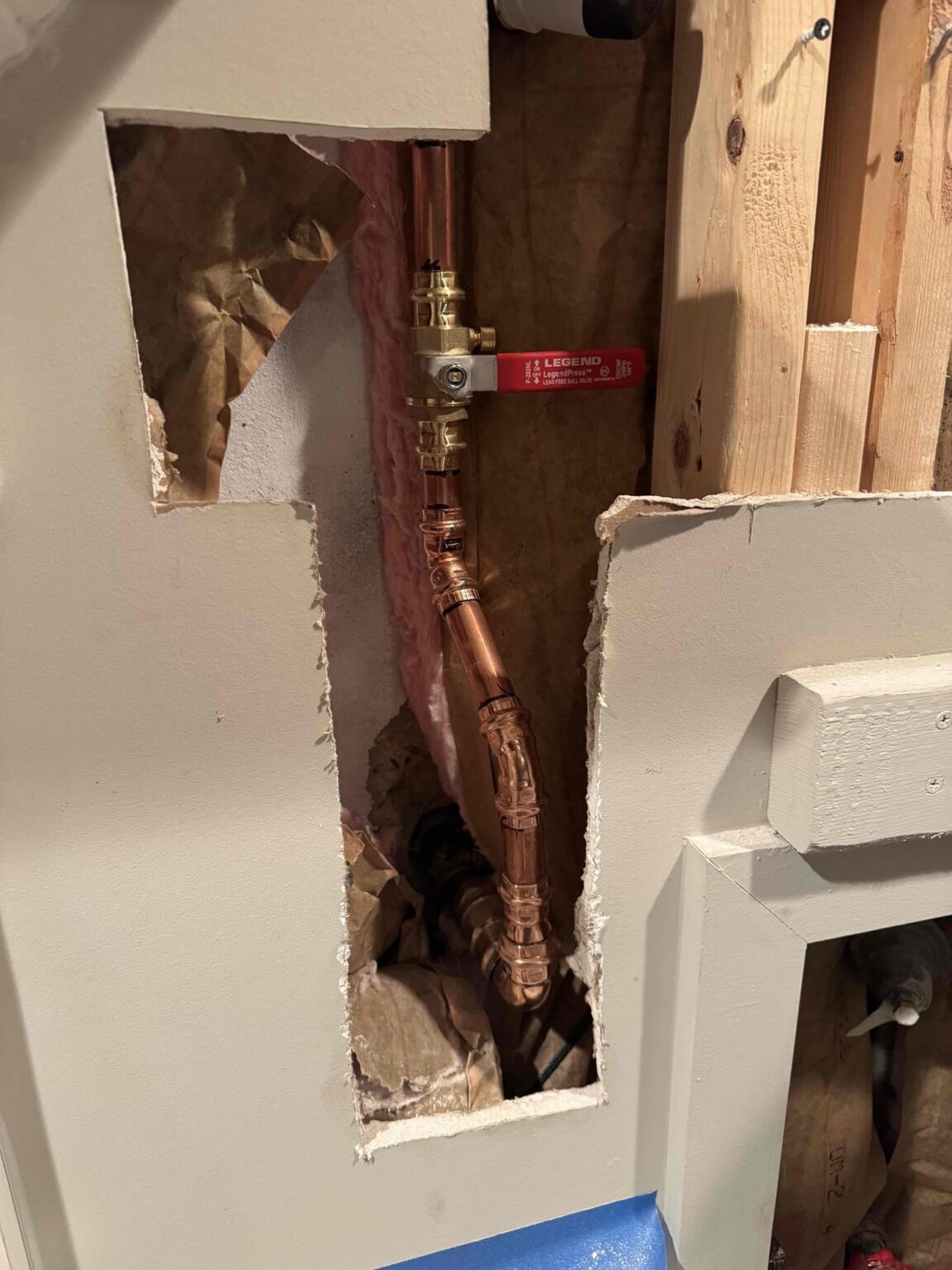
Copper. The most common thing we find. Sound copper lasts generations. Copper in older houses in this region develops pinhole leaks, and it is a documented regional pattern rather than bad luck: across the Potomac the regional utility logged thousands of pinhole reports and found nearly 80 percent of them in homes built before 1970, mostly in cold water horizontal runs.
Dull grey metal, threaded, magnetic. Galvanized steel, which means the house is old and has not been replumbed. Galvanized corrodes from the inside, narrowing until pressure drops. If your water pressure has been quietly declining for years and the pipe is magnetic, that is the answer.
White or cream rigid plastic. CPVC, common in 1990s work. Generally fine, gets brittle with age and UV.
Red and blue flexible plastic. PEX, modern, and what most repipes use now.
Old Town, Del Ray and Rosemont: the drain side
In the oldest neighborhoods the supply has usually been replaced at least once. The drains often have not.
Cast iron drain pipe was standard for most of the twentieth century and it does not last forever. It rusts from the inside, the bottom of a horizontal run scales and then thins, and eventually a section fails. The symptoms are slow drains that keep coming back after clearing, a sewer smell that nobody can locate, and stains on a basement ceiling under a bathroom.
A camera inspection settles it, and in a house of this age it is the single most informative few hundred dollars you can spend before buying, renovating, or arguing with a plumber about repeated backups. If the camera shows a scaled or broken section, clearing the drain again is buying weeks.
The other Old Town issue is the sewer lateral, the pipe from your house to the main. In Fairfax County the homeowner owns and maintains the private sewer line from the house to the county sewer, and the same principle applies across the region. In a historic district, that pipe may be under brick, under a mature tree, or under somebody else’s parking, which is why the trenchless versus dig conversation matters more here than almost anywhere.
The pressure question, which causes more damage than people realize
Parts of Northern Virginia come off the main well over 100 psi. Plumbing code requires a pressure reducing valve where static pressure exceeds 80, and those valves wear out in ten to fifteen years.
When one fails, the whole house runs at street pressure. That accelerates pinholes in copper, makes toilets run, bangs pipes, and pushes a water heater relief valve into weeping. Fairfax Water is explicit that it does not maintain your pressure reducing valve; it is yours, along with everything from the meter to the fixtures.
A gauge that screws onto a hose bib costs about $12. If you have had two leaks in a year, check the pressure before you fix the third. Replacing a failed valve runs $500 to $994, most right around $930.
What we actually get called for here
Hidden leaks. A leak search runs $200 to $470, median about $330, which covers the diagnosis including opening drywall in the one spot the evidence points at. How that works, and the meter test to do first, is here.
Drains. Single fixture clearings run $200 to $800 with the middle around $430; a main line is $860 to $1,600. The five minute test that tells you which one you have is here.
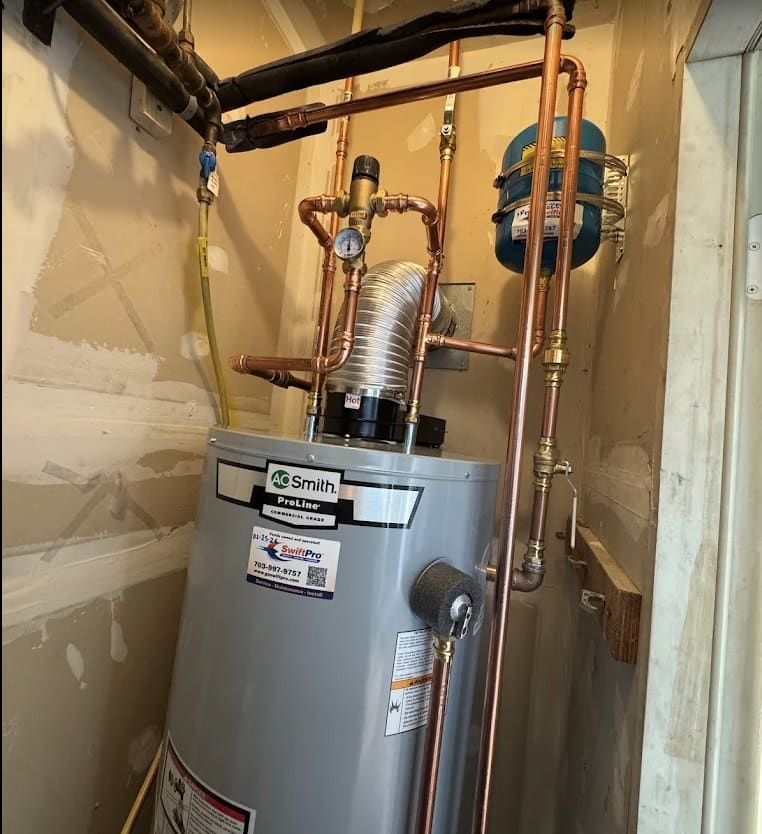
Water heaters. A tank runs $2,000 to $4,800 installed. In a rowhouse or a condo, access is the variable and it belongs in the quote.
Sump pumps. $700 to $1,200 for a replacement with a new check valve. Relevant in the parts of the city built on the marine clays that hold water against a foundation.
Frozen and burst pipes, every January, mostly at outdoor spigots. The five minutes in November that prevent it are here.
Buying or selling in Alexandria
Three things worth knowing before either.
Identify the supply pipe material and write it down. A polybutylene house is harder to insure and a buyer’s inspector will find it, so it is better to know first.
Camera the sewer lateral on anything pre-1970. A few hundred dollars against a five figure surprise is not a close call, and in a neighborhood with mature trees between the house and the street it is close to routine.
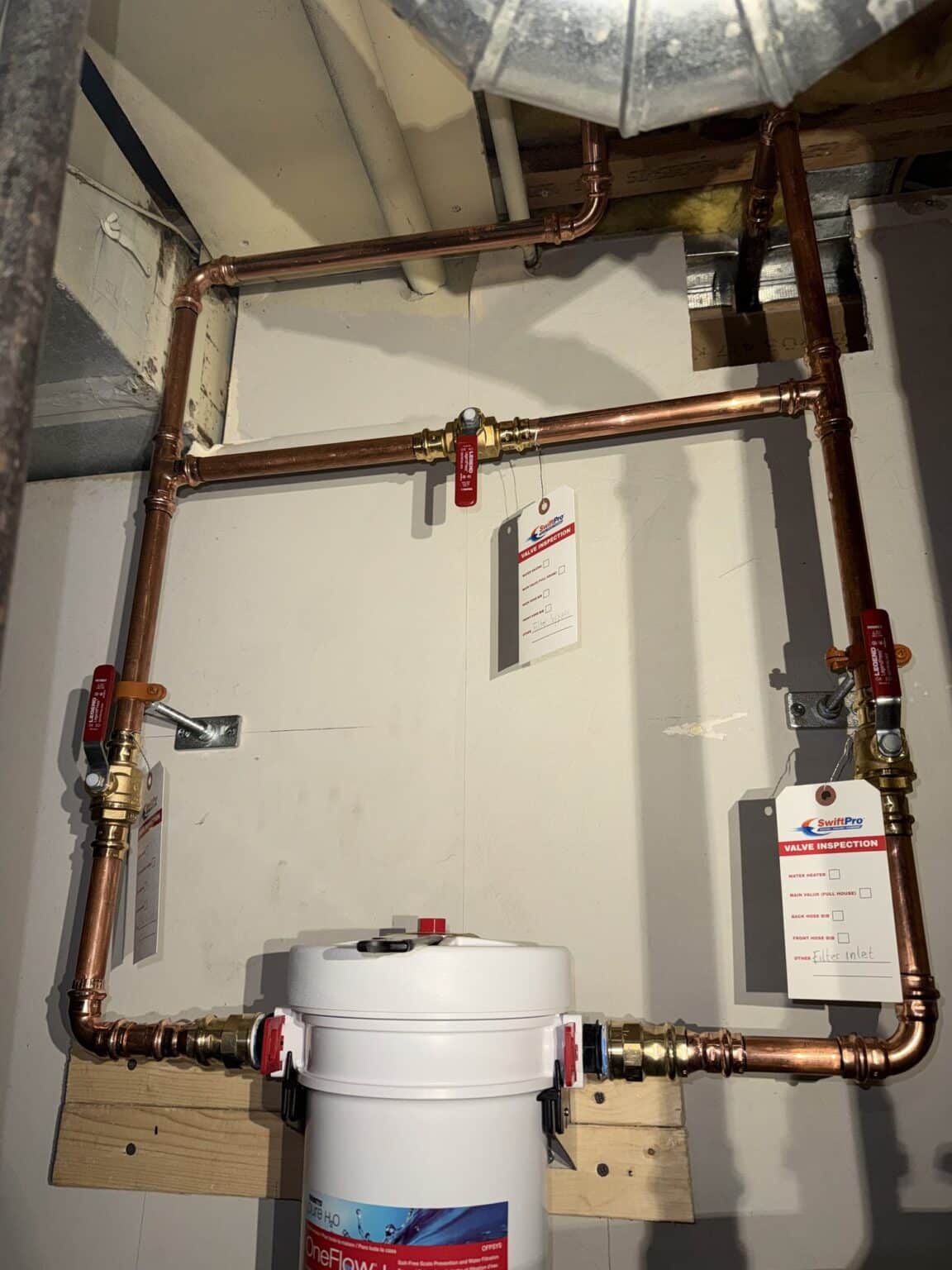
Check the pressure and the shutoff. A main shutoff that will not turn is a repair you want made on your schedule, not during an emergency at 2am.
Working in old houses
Plaster is not drywall, historic district rules constrain exterior work, and in Old Town the mechanical spaces were never designed for modern equipment. All of that is real and it shows up as access time in an honest quote. What it should not do is turn into surprises after the work starts, which is why we would rather look before quoting anything involving opening a wall.
SwiftPro handles plumbing across Alexandria under Virginia Class A contractor license 2705192276. Call (703) 997-9757, book online, or see our plumbing services. Water coming in right now is what the 24 hour line is for.