

If you only do one thing: look up what it is outside, then find your county in the table below. If the outdoor temperature is under that number, your heat is behaving exactly as designed and there is nothing to fix. If it is well above it, something is wrong, and the rest of this page is how to find out what.
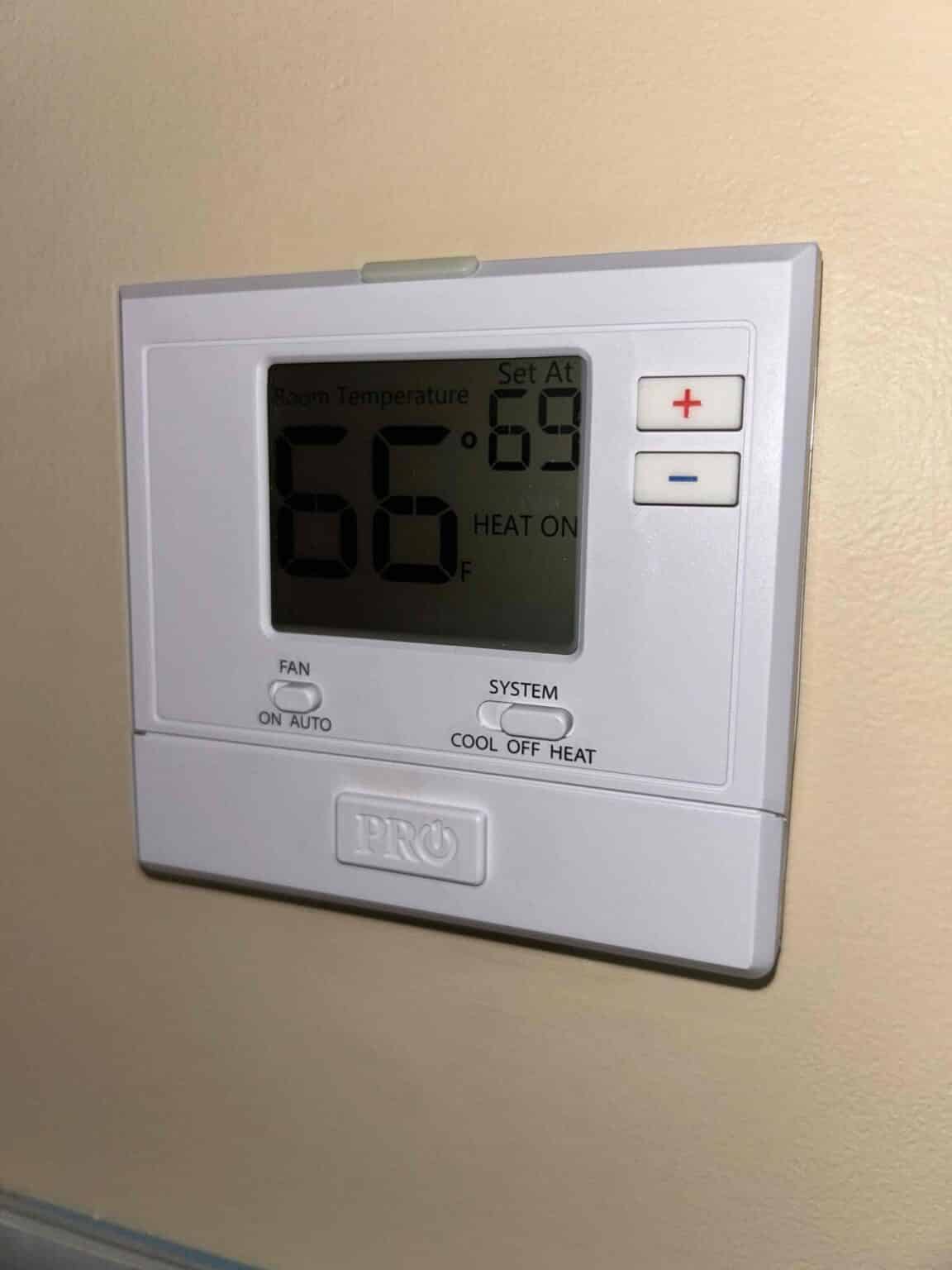
It is the coldest week of the year. The thermostat is set to 69, the house is holding 66, and the furnace has been running more or less continuously since yesterday. Most people conclude one of two things: the system is dying, or it is too small.
Usually it is neither. Usually it is arithmetic, and the arithmetic was done on purpose before the equipment was ever bought.
Your house was sized for a specific temperature
When a contractor sizes a heating system properly, they run a load calculation against a published design temperature for your location. It is not the coldest it has ever been. It is roughly the temperature your area stays above 99 percent of the winter hours.
Here is what that number is where you live:
| County | Design temperature |
|---|---|
| Loudoun | 14 degrees |
| Prince William | 16 degrees |
| Fairfax | 18 degrees |
| Arlington | 20 degrees |
At Dulles the number is 16 and at Reagan National it is 20, which is the same four degree spread showing up a different way. The urban core runs warmer than the western counties, and the equipment out in Loudoun is sized for a colder night than the equipment in Arlington.
The other half of the calculation is the indoor target, and it is 70 degrees. So the sentence the load calculation actually promises is this: hold 70 inside when it is 18 outside. Not when it is 8 outside. The standard is explicit that a contractor should not pad it, either. ACCA’s own instruction to the people doing this work is “do not add a ‘safety factor’ to the design conditions,” because oversizing a furnace causes its own problems, from short cycling to uneven temperatures to a shorter life.
So what happens below the design temperature?
You lose ground, and roughly in proportion.
The arithmetic is simple enough to do in your head. Heat loss from a house is close to a straight line against the difference between inside and outside. A system sized to hold a 52 degree difference (70 in, 18 out) is running flat out at that point by definition. Every degree colder than that adds load it has no more capacity to answer, so the indoor temperature settles about a degree lower for each degree below design.
That is a derivation, not a code, and it is worth saying so plainly. Nobody publishes a number for how far a house drifts below design temperature. But it is the right shape, and it turns a vague worry into a test.
Run it on the photo at the top of this page. 69 set, 66 holding, three degrees down. In Fairfax, design temperature 18, that puts the outdoor temperature somewhere around 15. Which is a normal, unremarkable January night here.
Now run it the other way, and this is the useful direction. If your house is three degrees down and it is 30 degrees outside, the arithmetic does not work, and you have a real problem.
How often does this actually happen here?
Less than people think, which is why a week like this feels alarming.
Dulles drops below its 16 degree design temperature roughly ten nights in an average winter. Last winter it managed nineteen. Normal low for January is about 25 degrees at Dulles and 30 at National, both comfortably above design.
So for most of the winter your system should hold the setpoint without drama, and there are a handful of nights a year where it will not quite. Those nights are the ones that are supposed to happen.
The two tests that settle it
Test one: the arithmetic above. How cold is it outside, how far down is the house, and do those two numbers roughly match? If the gap is bigger than the cold justifies, keep reading.
Test two, and it is the better one: what did it do last winter? Your house has not changed. If it held 70 on a 15 degree night last January and it is losing four degrees on a 25 degree night now, the weather is not what changed. Something in the system is. That comparison is worth more than any measurement a homeowner can take, and it is why writing this down is useful.
When it is a real problem, here is the order to look
The filter. Every time. Pull it and hold it to a light. A choked filter starves the blower, which drops the air moving through the house, which drops how much heat gets delivered no matter how well the furnace burns. Which filter to buy is here.
Only one stage running. Two stage and modulating furnaces have a high fire they are supposed to reach on a cold day. If a control, a sensor or a thermostat wiring problem is keeping it on low fire, you have a furnace delivering roughly two-thirds of its rated output and doing it very quietly. This is a common one and a homeowner cannot see it.
A heat pump with no auxiliary heat. A heat pump makes less heat as it gets colder, which is normal and expected. Below its balance point, the temperature where the house needs more than the heat pump alone can make, the electric strips or the gas side are supposed to pick up the difference. If they are not coming on, because of a failed relay, a tripped breaker on the heat strips, or a miswired thermostat, the house will fall behind steadily on any cold day. The difference between aux and emergency heat is here, and how a heat pump actually behaves in a Virginia winter is here.
Duct losses. If a good part of your ductwork runs through an unconditioned attic or crawlspace, you are heating that space on the way to the rooms, and the colder it gets the more of your heat goes there instead of here. This is one of the most common reasons a correctly sized system underperforms, and the crawlspace version is here.
The thermostat is in the wrong place. On an exterior wall, in a drafty hallway, above a supply register, or in direct sun. It is reporting its own little microclimate, not the house.
A dirty blower wheel. A felt of dust on the blower wheel cuts airflow badly, and it happens gradually enough that nobody notices the year it started.
The furnace is genuinely undersized, or the house changed after it was installed. A finished basement, a bonus room over the garage, or an addition all add load that the original calculation never saw.
The house leaks. Sometimes the honest answer is that the equipment is fine and the building is not. Air sealing and attic insulation usually cost less than a bigger furnace and work on every future winter rather than one.
What is worth doing during the cold snap, and what is not
Do not crank it to 80. It does not warm the house faster, because the furnace has exactly one output either way. All it does on a heat pump is trigger every electric heat strip in the house, which is the most expensive heat you own.
Turn off the setback for the week. A deep overnight setback assumes the system has spare capacity in the morning to catch back up. During a cold snap it does not, so it spends the whole day chasing a number it will not reach. Pick one temperature and hold it.
Close the blinds after dark and open the south-facing ones during the day. Free, and worth a surprising amount.
Do not close registers in unused rooms. On most systems that raises pressure in the ducts and makes the blower work harder for less air.
Run the ceiling fans on low, clockwise. It pulls the warm layer off the ceiling. Which way is which is here.
When to actually call
Not for a house that is three degrees down on a 15 degree night. Do call if:
- The house is losing ground at temperatures where the arithmetic says it should not.
- It is worse than last winter, in the same house, at the same outdoor temperature.
- The air at the registers is not warm, rather than the house just not catching up.
- It is short cycling, starting and stopping every few minutes. That is a different problem and it is here.
- It stops entirely. Ten minute check first.
Our diagnostic visit is about $99. The repairs that usually come out of this particular complaint are a blower wheel pulled and cleaned at $300 to $440, a blower motor at $670 to $2,400, or a control board at $550 to $1,180, all from our Northern Virginia price list.
If the answer turns out to be that the system is undersized or worn out, get the number before you decide. The estimator gives you the installed range in about two minutes, and it is a better position to be in than deciding in February with the house at 64.
The thing to write down
This winter, on the coldest night, write down three numbers: the outdoor temperature, what the thermostat is set to, and what the house is actually holding. Put it somewhere you will find it again.
Next winter that note will answer this question in ten seconds, and it is the only piece of information about your heating system that nobody can get for you.
This is one of ten in the Cold Season Field Guide. If it is the bill rather than the temperature that worries you, that one is here.
SwiftPro runs heating service across Northern Virginia, around the clock. (703) 997-9757, or book a time online.