

If you only do one thing: ignore the dollars and find the usage number. Therms if you heat with gas, kilowatt hours if you heat with electricity. That number, divided by the days in the billing period, is the only thing on the bill that tells you about your house. Everything else is arithmetic somebody else did.
The January bill lands in early February and it is enormous. The question underneath the sticker shock is always the same one, and it is a good question: is this the weather, or is something wrong?
You can usually answer it in about ten minutes with numbers you already have.
Why the dollar amount is the wrong place to look
A bill is three things multiplied together and then added up: how much energy you used, what it costs per unit, and how many days were in the billing period. Any of the three can move, and only one of them is about your heating system.
That last one catches people constantly. Billing periods are not months. A 34 day period against a 28 day period is 21 percent more bill with identical behavior in an identical house. Always divide by days.
And the price per unit is not fixed either. Washington Gas residential customers in Virginia are currently on a flat structure, a monthly customer charge of $15.50 plus about 68.7 cents per therm, so the gas side is at least easy to check by hand. Dominion is more involved, and it has raised rates: a verified increase in 2026 of about $11.24 a month for a typical residential customer, before you use a single extra kilowatt hour.
One small correction while we are in here, because it is repeated everywhere including on Washington Gas’s own bill glossary. Residential gas service here is not tiered. The “first 25 therms, then the next 125” block structure people quote is the commercial rate schedule. You are not being pushed into a higher bracket by using more, because there is no bracket.
The ten minute diagnostic
Step 1. Find the usage, not the dollars. Therms on a gas bill, kilowatt hours on an electric bill. It will be smaller and less dramatic than the dollar figure and it is the one that matters.
Step 2. Divide by the days in the billing period. Now you have therms per day or kWh per day, which is comparable to anything.
Step 3. Compare to the same month last year, not to last month. December against January tells you nothing except that January is colder. January against last January tells you about your house. Both numbers are in your online account, usually as a twelve or twenty four month bar chart, which is the single most useful screen either utility offers and almost nobody opens.
Step 4. Ask how much colder it actually was. Heating degree days are how this gets measured: for each day, how far the average temperature fell below 65. Add them up for the month and you have a single number for how hard the winter leaned on your house. Neither Washington Gas nor Dominion prints degree days on your bill, which is a shame, so you will have to look it up. The National Weather Service publishes them for Dulles and Reagan National.
Step 5. Compare the two changes. This is the whole thing.
Here is a real example. A normal January at Dulles runs about 957 heating degree days. January 2026 came in around 1,058. That is a genuinely cold month, and it is 11 percent above normal.
So an 11 percent colder month explains a roughly 11 percent higher usage, maybe a bit more because the coldest days are the least efficient ones. An 11 percent colder month does not explain a doubled bill. If your usage per day went up 15 percent in a month that was 11 percent colder, you are fine. If your usage per day went up 70 percent, the weather is not what happened.

If the numbers do not reconcile, here is the order to look
The filter, first, every time. Free, takes two minutes, and a choked filter makes the system run longer for the same result. Which one to buy is here.
Heat pump owners: auxiliary heat, and this is the big one. Electric resistance strips cost several times what the heat pump costs to make the same heat. A heat pump that has lost refrigerant, or has a failed defrost board, or has a thermostat calling for aux when it should not, will keep the house perfectly comfortable while running on the expensive heat all month. You will not notice anything except the bill. That is the single most common cause of a genuinely doubled electric bill in this region, and it is exactly the kind of failure that hides. Aux versus emergency heat is here.
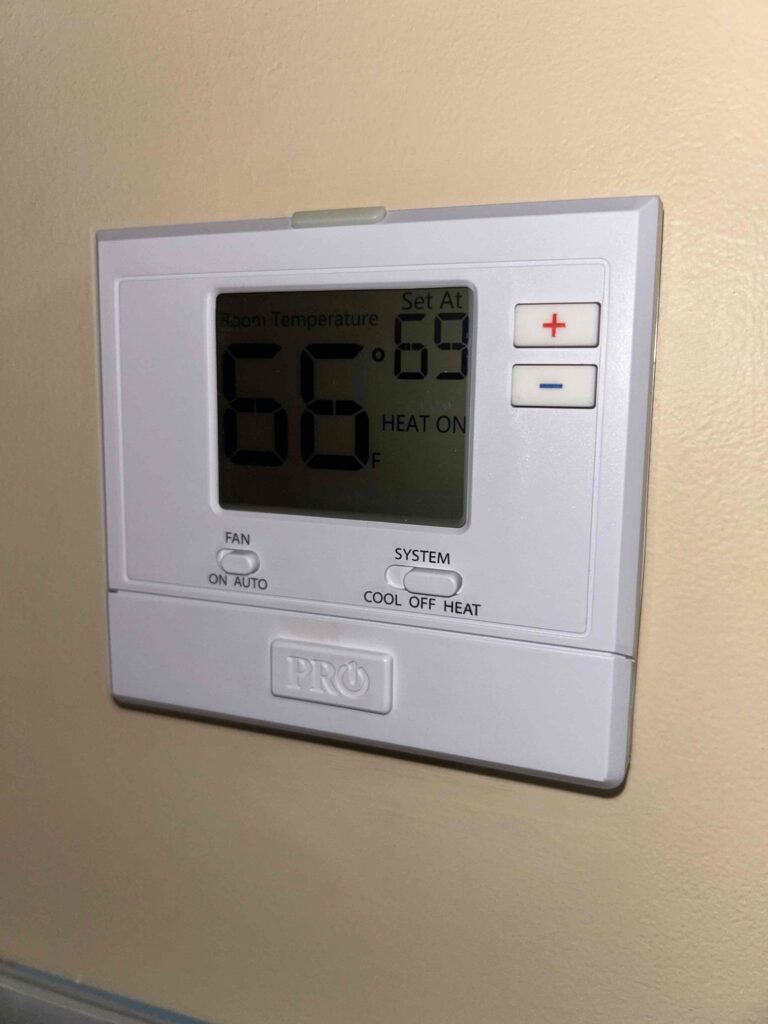
Somebody left it on Em Heat. Same problem, simpler cause. Look at the thermostat right now.
Your thermostat’s own runtime report. Most smart thermostats keep one, and it is genuinely good evidence: hours of runtime this January against hours last January. If the system ran 40 percent more hours in a month that was 11 percent colder, you have found something.
A stage that stopped working. A two stage furnace stuck on low fire runs far longer for the same heat. A dual fuel system that stopped switching over to gas runs on the expensive side all winter.
The house changed. A new hot tub, an electric car, a space heater somebody has been running in a cold bedroom all month, a new tenant, a family member home all day. Space heaters in particular are a much bigger line item than people expect, and the cold room they are treating usually has a fixable cause. Here is that one.
The ducts. If a good part of your duct run is in an unconditioned attic or crawlspace, the colder it gets the larger the share of your heat that never arrives. Leaky ducts here, the crawlspace version here.
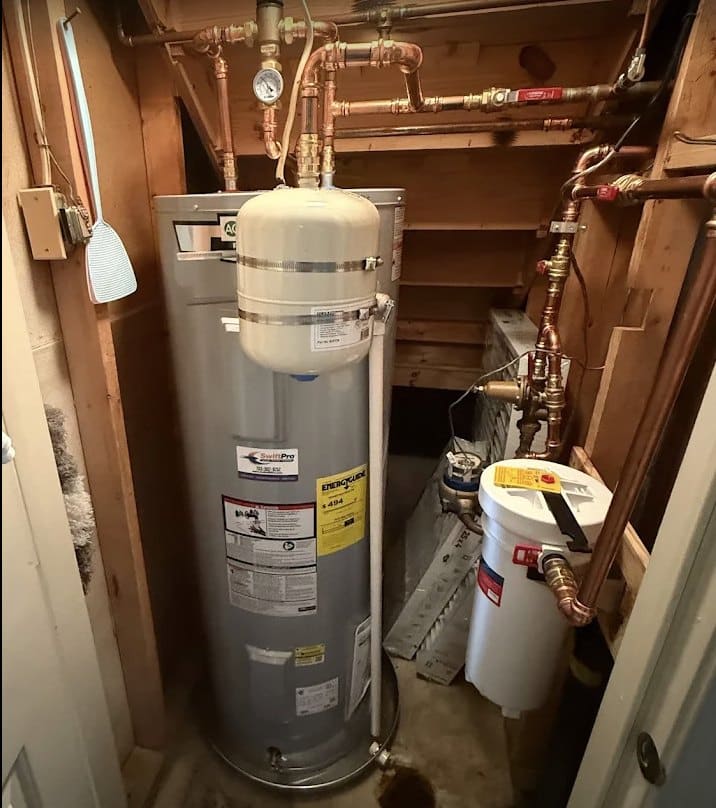
A water heater problem wearing a heating bill costume. Water heating is a serious share of the bill and it gets worse every winter for reasons that have nothing to do with the furnace. That is the post before this one, and a leaking hot water line or a stuck recirculation pump will quietly show up here.
Two things that are not the problem, despite what you have read
Setting the thermostat back is not making it worse. A setback saves energy, including on a heat pump, as long as it is modest and the recovery does not drag the electric strips in. The advice to never set a heat pump back comes from an era of dumber thermostats.
Closing vents in unused rooms is not saving you anything. On most residential systems it raises duct pressure and makes the blower work harder to move less air.
Worth a sanity check before you go hunting. In the federal residential energy survey, space heating accounts for roughly 42 percent of a home’s annual energy use in our climate region. Annual, across all twelve months, so in January specifically it is a much larger slice of that month than 42 percent and in July it is nearly none.
Which is the honest framing for why a winter bill is genuinely shocking compared to a summer one, even in a house where everything works.
When it is worth a service call
Call if the arithmetic does not work: usage per day up materially more than the weather explains, in the same house, doing the same things. Call if the thermostat’s runtime report shows far more hours than last winter. And call if the bill went up while comfort went down, which is the signature of a system working harder to deliver less.
Our diagnostic visit is about $99. The repairs that usually turn up at the end of this particular trail are a blower wheel cleaning at $300 to $440, a defrost board on a heat pump, a refrigerant leak found and repaired, or a control that is calling for auxiliary heat when it should not. The full list is in our Northern Virginia price page and the heat pump version.
If the answer is that a fifteen year old system is simply expensive to run, that is a replacement conversation and it is a better one to have in April than in February. The estimator gives you the installed range in about two minutes, and heat pump versus gas furnace, with the operating costs, is here.
Do this now, while the bill is in front of you
Write down four numbers: this month’s usage, the days in the period, the same month last year, and the degree days for both. Put them in a note on your phone.
Next February that note answers this question in about thirty seconds, and there is no way to get it retroactively. It is the cheapest diagnostic tool you will ever own.
This is the last of ten in the Cold Season Field Guide, our month by month guide to what actually goes wrong in a Northern Virginia house between September and February. If the house is also not holding temperature, start with that one, because the two complaints usually have the same cause.
SwiftPro runs heating service across Northern Virginia. (703) 997-9757, or book a time online.