

If you only do one thing: read the month you are actually in. This page is the whole cold season laid out in order, and most of the trouble in it arrives on a schedule you can see coming.
Here is the part nobody in this business likes to say out loud. More than half of what worries people between October and February is normal. Steam pouring off the outdoor unit is normal. A furnace running for two hours straight when it is 12 degrees out is normal. Hot water running out sooner in January than it did in July is physics, not a failing water heater. Telling you that costs us calls, and we would still rather you knew, because then the one time we say pick up the phone right now, you will.
So this guide marks each item. Normal, watch it, or call today.
September and October: the two hours that save the season
Your heating system has been sitting still since March. Whatever went marginal last winter is still marginal, and it will not announce itself until the first week the furnace has to run for six hours straight, which in Northern Virginia is usually the second week of November. Every company in the region gets that same week.
The First Cold Night: run your heat in September and listen. Twenty minutes of deliberate runtime on a cool afternoon, plus the full key to what every sound, smell and puddle means. This is the one to do this week.
Should you close the crawl space vents for winter? The question every October, with an answer that is more interesting than yes or no. Cold floors, the damp smell, and the pipe that freezes in the same spot every January all live down there.
The drain that shuts your furnace off. If white PVC pipe comes out of your furnace, it makes water every time it runs, and that drain is the single most common reason a healthy furnace quits in a cold snap. Clearing it in October is cheap. Discovering it at 10pm on a Sunday is not.
Also worth an hour while the weather is good: the ten things that actually matter when you winterize a house here, the pipes that actually freeze (it is a shorter list than you would think), and the hose you have to take off the spigot, yes, even with a frost free faucet.

November: safety, and the kitchen
Both the furnace and the water heater are running hard now, often into the same chimney, which is where the one genuinely dangerous item on this list lives.
The vent nobody checks: your water heater after a new furnace goes in. Call today if you see it. Rust or moisture on top of the water heater, a damp basement, a chimney that is now serving one appliance instead of two. There is a test in here you can do yourself in two minutes.
The holiday kitchen: what fourteen people do to your drains. Read this the week before Thanksgiving, not the morning after. The mechanism is not what most people think, and the prevention is about ten minutes of work.
While you are at it: the burning smell on the first cold day is normal, and the one that is not.
December: the house closes up
Your windows are sweating. Mostly normal, sometimes a warning. Water on the inside of the glass is a humidity reading, not a window problem, and there is a number for how much humidity your house should hold at each outdoor temperature.
The power is out and it is 22 degrees. How long a house holds heat, when the pipes are actually at risk, the generator rule that kills people every winter, and the order to restart things in when the power comes back.
Related and already written: whether a whole house humidifier is worth it here, and the ten minute check to run before you call anybody about no heat.
January: the hard month
This is when the systems that have been coping stop coping, and it is when we are busiest, which is worth knowing before you need us.
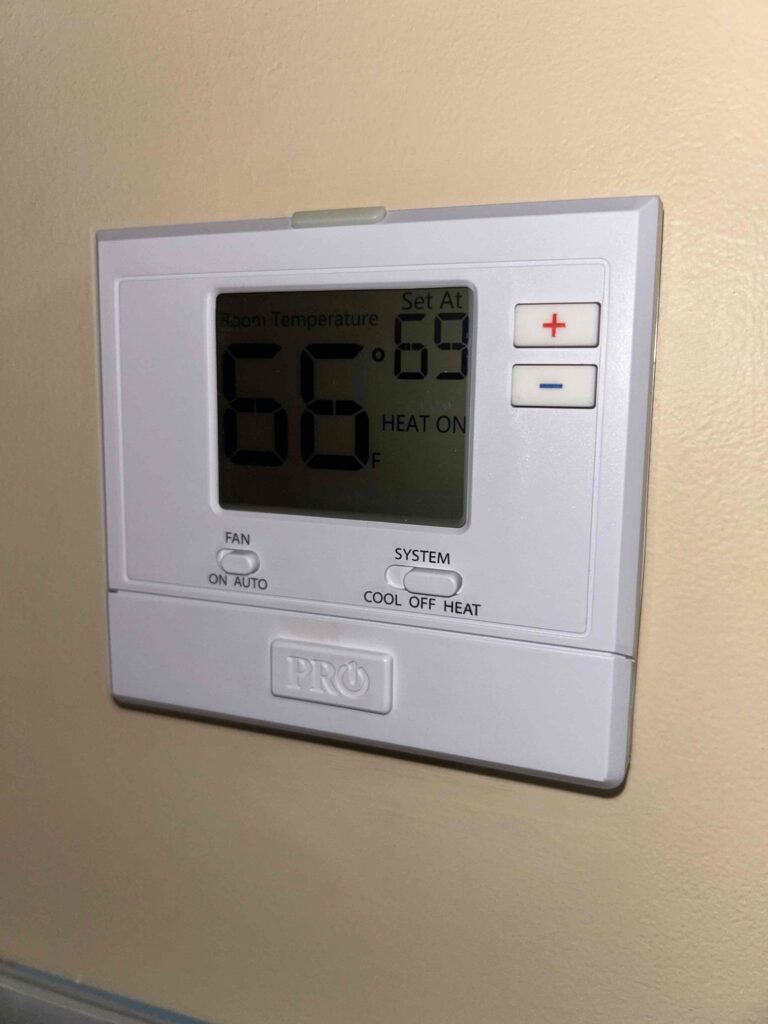
The thermostat says 66 and it is set to 69. Usually normal. Your system was sized to hold the house at a specific outdoor temperature. Below that, losing a few degrees is arithmetic, not failure. This post gives you the two tests that tell the difference.
Your hot water runs out faster in January. Usually normal. The water coming into your house in January is dramatically colder than the water that came in last July, so the same tank makes fewer hot showers. The math is in the post, along with the four symptoms that mean it really is the water heater.
Also for January: ice on a heat pump is supposed to happen, aux heat and emergency heat are not the same light, and the cold room is rarely the room’s fault.
February: the bill, and the thaw
Your heating bill doubled. Weather, or a problem? Usually the weather, and here is how to prove it. A heating bill is a diagnostic readout if you know how to read it, and the numbers you need are already on the statement and in your thermostat.
One thing we watch every year that is not on anybody’s list: plumbing calls do not drop off once the freeze ends. They climb through the thaw. A pipe that split in a 9 degree snap often does not leak until everything warms up and the ice in it melts, which means the damage shows up in a February living room ceiling, not in a January basement. If you had a hard freeze and something has felt off since, this is the page.
The four that are actually emergencies
Everything else on this page can wait for a normal appointment. These cannot.
- A carbon monoxide alarm sounding, or exhaust smell, or headaches that get better when you go outside. Everyone outside first, then call 911 from there.
- Gas smell. Leave, then call 911 and Washington Gas at 844-WASHGAS (844-927-4427), option 1, from somewhere else.
- No heat with an infant, an older adult, or anyone with a medical condition in the house, or an indoor temperature heading for the 40s.
- Water you cannot stop. Find your main shutoff now, while nothing is wrong, so that you are not learning where it is in the dark. Here is how.
Our line is answered around the clock at (703) 997-9757.
What is actually worth paying for before winter
One thing: a heating tune-up, done by somebody who puts a combustion analyzer on the furnace rather than just changing the filter. The list of things that test finds and your ears cannot is in the first post, and it is the difference between a technician and a filter swap.
If your system is old enough that you are already doing the arithmetic, get the number before you are cold and deciding fast. The estimator gives you an installed range for your house in about two minutes, and what a new furnace actually costs in Northern Virginia is here.
The tune-up is included in our Family Care Plan at $199 a year, with 15 percent off repairs and priority scheduling, which in January is the part that matters.
SwiftPro is a Northern Virginia heating, cooling and plumbing company, and this is the guide we would want our own families to have. Questions on any of it: (703) 997-9757, or book a time.