

If you only do one thing: go look at your furnace. If there is white or grey plastic pipe coming out of it, and a small tube running to a floor drain, a sink or a little pump, then your furnace makes water every time it runs, and that drain is the cheapest thing on it that can leave you cold in January.
This is one of the most common no-heat calls we run in a cold snap. It is also one of the least expensive repairs on the list, and a lot of the time it is genuinely preventable by the person who lives in the house. That combination is rare enough that it deserves its own page.
Do you have one of these?
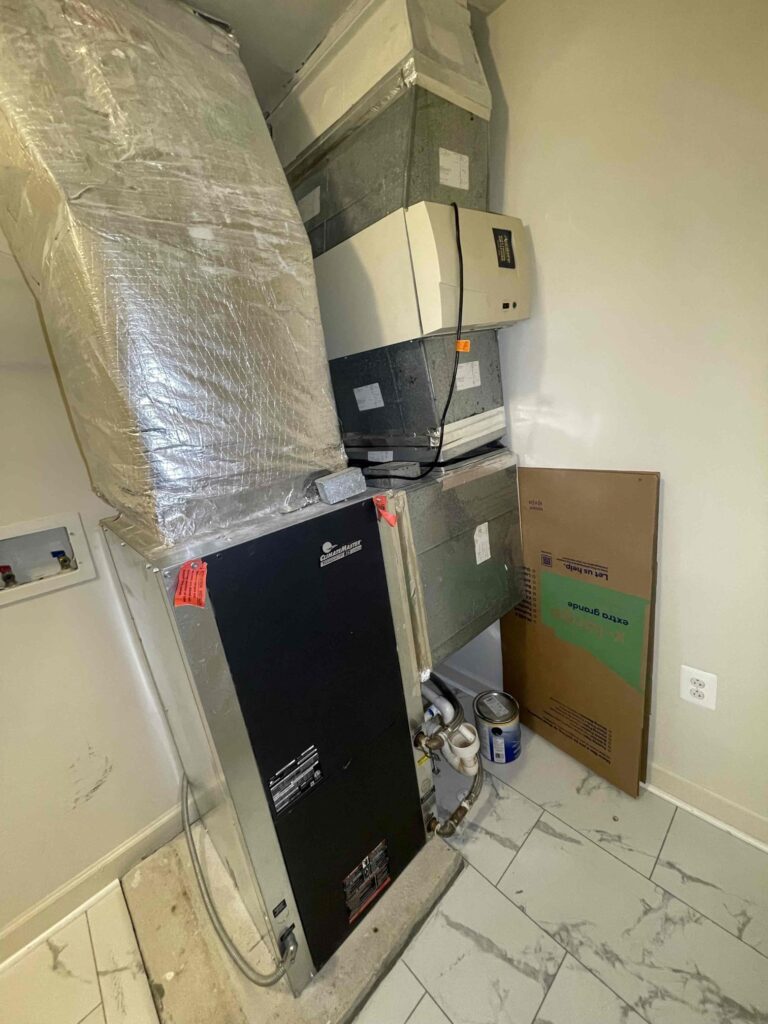
If your furnace vents through white plastic pipe that goes out through a sidewall, rather than up a metal flue or a chimney, it is a high efficiency condensing furnace. Anything installed here in the last fifteen years or so probably is, and anything rated 90 percent or above definitely is.
Look for a plastic box on the side or bottom of the furnace with a small clear or white hose leaving it. That hose goes to a trap, then to a drain. Sometimes to a floor drain, sometimes to a laundry standpipe, sometimes to a little plastic box with a pump in it that pushes the water up and out.
Why a furnace makes water at all
Burning natural gas produces water. That is not a defect, it is chemistry: methane plus oxygen gives you carbon dioxide and water vapor. An old furnace sent that vapor straight up the chimney as hot exhaust, which is precisely why it was only 80 percent efficient. A condensing furnace squeezes the extra heat out of that vapor, and when you take the heat out of water vapor it turns back into water. That water is where the efficiency comes from.
The volume surprises people. A 100,000 BTU furnace makes somewhere in the neighborhood of half a gallon to a gallon of water for every hour it runs. On a January night when it runs most of every hour, that is several gallons going down a half-inch tube. All winter, it is hundreds of gallons.
It is also mildly acidic. Bosch puts it plainly in their installation manual: “the condensate from this unit is acidic.” Carrier requires that any condensate pump be “approved for use with acidic furnace condensate.” That is why the parts in this system are specific parts and not whatever fits.
What you will notice
Water on the floor near the furnace, or in the pan under it. The clearest sign, and the one to act on.
The furnace tries to start and gives up. You hear the inducer fan spin up, run for a bit, and shut down. Maybe it retries a few times. It never lights.
A blinking light with a code on the furnace door. Open the panel and look. Most furnaces flash a fault code, and there is a legend printed right on the inside of the door. Carrier’s own diagnostic tables name “plugged condensate drain” under two different pressure switch codes. You may be able to tell us what is wrong before we get there.
A gurgle or a slurp from the drain hose when it runs. Partial restriction. This is the early warning, and it is the moment to deal with it.
The blower runs but nothing gets warm. The safety has locked out the gas valve while the fan is still allowed to run.
A musty or sour smell near the furnace. Standing water in a warm plastic box grows a slime, and that slime is usually what plugged the drain in the first place.
Why it shuts the furnace off on purpose
This is the part worth understanding, because it turns a scary symptom into a manageable one. The furnace is not broken. It is refusing.
Water leaves the burner section through a plastic collector box. When the trap or the drain line plugs, the water cannot get out, so the level in that box rises. Depending on how your furnace is built, one of two things then happens.
Some furnaces have a dedicated overflow switch watching that box. Bosch describes it exactly: the switch is normally closed, and “when the condensate reaches too high of a level in condensate collector box, the overflow switch will open and shut off the furnace.”
Others have no separate switch, and the rising water floods the little tube that the pressure switch uses to sense draft. The furnace can no longer prove that the exhaust fan is moving air, so the control will not open the gas valve. Carrier lists a plugged condensate drain as a named cause under both of its low-pressure-switch fault codes, alongside “water in vent piping, possible sagging pipe.”
Either way the result is the same and it is deliberate. A furnace that kept firing while its own exhaust passages filled with water would be a much worse problem than a cold house. The code writers agree: the fuel gas code lets an installer skip an auxiliary drain pan under one of these furnaces specifically when the appliance shuts itself down in the event of a stoppage.
The Northern Virginia version: it freezes
Here is the failure that puts this article in a cold season guide rather than a maintenance one.
If any part of that drain line runs through a garage, an unheated crawlspace, or out through a wall to daylight, it can freeze. And when it freezes it is not a different problem from a clog, it is the same problem. Lennox says it in one sentence in their installation instructions: route the line inside the conditioned space “to avoid freezing of condensate and blockage of drain line.”
The other two manufacturers are just as direct. Carrier: “the drain line must terminate at an inside drain to prevent freezing of the condensate and possible property damage,” and where the furnace itself sits somewhere that can drop below freezing, “a Condensate Freeze Protection kit is required.” Bosch: “do not route the drain line outside where it may freeze.”
Now put that together with how a cold snap actually works. The coldest night is the night the furnace runs longest, which is the night it makes the most water, which is the night the line is most likely to freeze. The failure is not random. It is aimed.
And it is not a code violation, which is the confusing part. Running a condensate line to the outside is allowed. The mechanical code specifically contemplates discharging to grade outdoors. What makes it wrong here is the manufacturer’s instructions and our weather, not the code book. If your line goes outside, it needs to be insulated, heat taped, or moved.
What a good installation looks like
Four things, and you can check three of them yourself with a flashlight.
It runs downhill the whole way, about a quarter inch per foot. Carrier, Bosch and Lennox all print the same number. A line with a sag holds water, and held water is what freezes and what grows the slime.
There is exactly one trap, the one that came with the furnace. Both Carrier and Bosch say not to put a trap anywhere else in the line. A second low spot is a second place for water to sit.
It ends somewhere inside. A floor drain, a laundry standpipe, a condensate pump. Not out through the rim joist to the flower bed.
If there is a pump, it is wired so the furnace cannot run when the pump fails. Carrier’s own caution says a plugged drain or a failed pump may shut the furnace down, and for a pump in an attic or crawlspace the fuel gas code requires that interlock. If yours is not wired that way, the first sign of a failed pump is water on the floor rather than a furnace that stopped.
What you can do, and what you should not
You can look. Flashlight, once a month in heating season. Water where there should not be water, a sagging hose, a pump reservoir full to the top.
You can empty and rinse a condensate pump reservoir if you are comfortable, with the power off. They silt up with the same slime that clogs the line.
You can insulate an exposed run in a garage or crawlspace with foam pipe sleeve from any hardware store, which is a fifteen dollar job.
Do not pour bleach into it. It is a popular internet suggestion and it is a bad one here. The line is plastic, the fittings and the pump are not all plastic, and the condensate is already acidic. Undiluted bleach in a condensate system is how a cheap problem becomes an expensive one.
Do not put a shop vac on it and pull hard unless you know where the hose ends and what else is connected to it. It is easy to pull water into the inducer or knock a pressure switch tube off, and then you have two faults instead of one.
Do not defeat a float switch by jumping it out to get the heat back on. That switch is the only thing standing between you and water in the burner compartment.
What it costs
Clearing the drain, replacing the trap, or adding the safety switch that should have been there runs $175 to $420 in Northern Virginia, the same figure as in our full furnace repair price list. Our diagnostic visit is about $99.
That is the whole point of this page. It is a couple hundred dollars on a Tuesday in October, and it is the same couple hundred dollars plus an after-hours premium at 9pm on the coldest Sunday of the year, with a cold house in between. Same part. Same work.
Do this week
Take a flashlight to the furnace. Find the plastic hose and follow it to wherever it ends. If it ends outside, that is a phone call. If it sags, that is a phone call. If there is a pump, look in it.
Then run the heat for twenty minutes and go back and look again, which is the test run in the first post of this series. A drain that is going to fail in January will usually show you in September, in the form of a puddle that was not there before.
The fall tune-up clears this line as a matter of course, and it is included in our Family Care Plan at $199 a year with 15 percent off repairs.
This is one of ten in the Cold Season Field Guide. If the heat is already out, start with the ten minute check.
SwiftPro runs heating service across Northern Virginia, around the clock. (703) 997-9757, or book a time online.