

A tankless water heater in most of Northern Virginia needs one real job a year: descaling. Everything else on the list takes a few minutes, or only applies to some models. Skip the descale, though, and the heat exchanger slowly chokes on minerals from our water, which is the most common reason a tankless runs badly years before it should.
The list
| Job | How often | Yourself? |
|---|---|---|
| Descale the heat exchanger | Once a year, wherever the water is 4 grains per gallon or harder | Yes, with a pump kit and service valves. Or $300 with us, regularly $350 |
| Clean the cold water inlet filter | At every descale | Yes |
| Clean the air intake filter | Every 3 to 4 months, on models that have one | Yes |
| Check the condensate neutralizer | A few times in the first year, then a pH test once a year | Look, yes. Media, usually a plumber |
| Look at the vent and air intake outside | Once a year, before winter | Yes |
| Work the pressure relief valve | At least every three years | Yes, carefully |
The intervals are Navien’s, from its installation and owner’s manuals. Rinnai and the other makers are close, but your own manual is the one that counts for your warranty.
Why the descale is the one that matters here
A tankless heats water on the way through, inside a heat exchanger made of narrow passages. Heat pulls calcium and magnesium out of the water as scale, and the scale sticks to exactly those passages. A tank has a bottom for sediment to settle on. A tankless does not, so draining it does nothing. The scale has to be dissolved.
Navien’s installation manual has a table for this. Soft water, under 4 grains per gallon, needs no flushing at all. From 4 grains up, it calls for a flush once a year in a home, unless a water softener or a scale filter is on the line.
Almost everyone around here is over that line. Fairfax Water describes its water as moderately hard to hard, 5 to 10 grains per gallon, and its 2025 lab reports from the Potomac plant averaged about 7.5. Arlington averaged about 8.3 grains in 2025, and Leesburg runs roughly 6 to 9. The exception is the City of Manassas, whose Lake Manassas water tested soft in 2025, under 3 grains. Our hard water page goes town by town.
Skipping it costs more than performance. Navien’s warranty is void for damage from “hard water deposits, lime or mineral build-up,” and for failure to perform regular maintenance. Rinnai does not cover lime build-up either. A heat exchanger that fails full of scale, with no service history, is the claim that gets turned down.
Which side of the 4 grain line your water is on depends on your utility. Our water heater flush page charts each one’s published hardness.
What a descale actually is
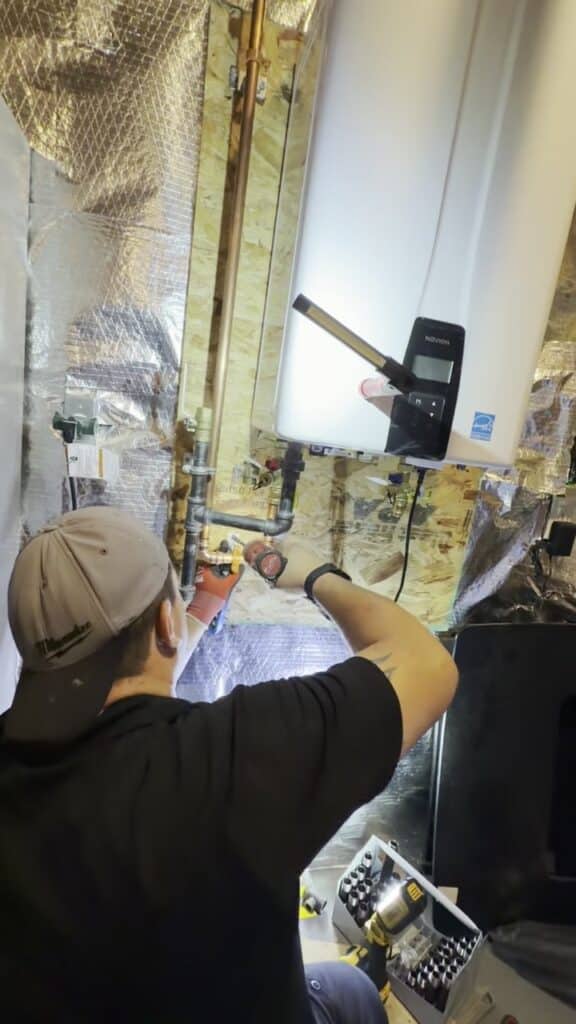
A properly installed tankless has a set of service valves on its water lines, usually with colored handles and a small capped port beside each one. The descale runs through those ports.
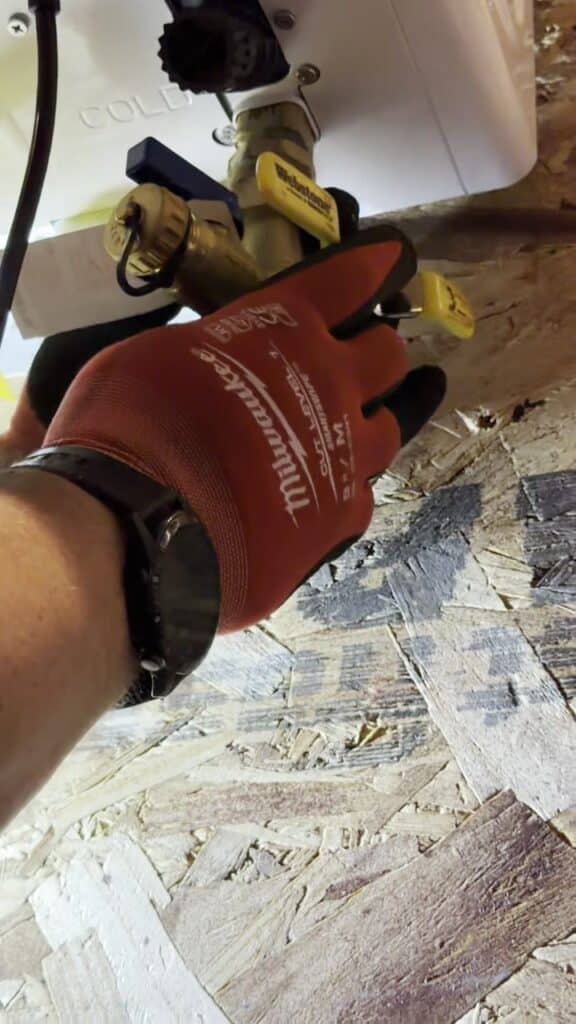
Navien’s sequence goes like this. Power to the unit goes off at the panel. The hot and cold shutoffs close, which cuts the unit off from the house. A small pump sits in a bucket of solution, with one hose from the pump to the cold side port and another from the hot side port back into the bucket. The solution circulates through the heat exchanger for at least 45 minutes, by Navien’s manual. Then the unit is rinsed through with fresh water, the filter on the cold water inlet is pulled and cleaned, the valves go back the way they were and the power comes back on.
Navien allows white vinegar or a solution made specifically for tankless water heaters. If you have another brand, use what its manual names.
Doing it yourself
Plenty of people do. Navien’s owner’s manual lists a bucket of 5 gallons or more, a circulation pump, three hoses and the cleaning solution, and it is honest that this is “a somewhat complicated procedure.” It also warns that “improper maintenance can void your warranty,” which is worth reading twice before you start.
Two things trip people up. The first is the power: it has to be off at the panel before the valves move. The second is a unit with no service valves at all, which happens more on older installs than it should. Without them there is nowhere to connect the hoses, and adding a set is plumbing work. It also makes every descale after that a much smaller job, so it is worth doing once.
One setting worth knowing about: Navien’s controls have a descaling reminder that can be set to 6, 12 or 24 months. It ships switched off. Ask whoever services your unit to set it to 12.
The small jobs
The cold water inlet filter. A little mesh screen where cold water enters the unit. It catches grit, and it clogs fastest after the water company works on a main nearby. When a Navien’s hot water runs cold or stops coming, the first question in its own troubleshooting guide is whether this filter is clean. It unscrews, rinses under a tap and goes back.
The air intake filter. Many indoor units pull combustion air through a filter on the cabinet, and in a laundry room it collects lint. Navien says to clean it every three to four months. A clogged one shuts the heater down with Error 110.
The condensate neutralizer. High efficiency units make acidic water as a by-product, and depending on the local code it can run to the drain through a canister of neutralizing media. If yours has one, Navien says to check it every few months in the first year, then test the water coming out of it once a year with a pH strip. When it drops below pH 6, or below whatever your water authority sets, the media gets replaced.

The vent and air intake outside. Find where your unit vents through the wall and look at it once a year, before winter. Leaves, a bird’s nest or a snowdrift over the termination will shut a tankless down with an air pressure or exhaust error, and clearing it is often the whole repair.
The pressure relief valve. A Navien tankless uses a pressure-only relief valve on the hot water outlet, because the heater shuts itself off if the water gets too hot. Navien says to work it by hand at least once every three years: bucket under the discharge pipe, lift the lever briefly, let it snap back. Water should come out and then stop. If it keeps dripping afterward, the valve needs replacing, which is a small job.
Winter power outages
A tankless protects itself from freezing with small heaters inside the cabinet, and they need electricity. Navien’s manual says to drain the unit if the power or gas will be off for a long stretch in freezing weather, and freeze damage is not covered under warranty. If yours is on an outside wall or in an unheated space, learn where the drain plugs are before December rather than during the ice storm.
Signs it needs a descale now
Hot water that never gets as hot as it used to. Less flow at the hot taps than there used to be. A unit that fires, heats and then shuts off. On the screen, Navien’s overheating codes E016 and E030 both list flushing the heat exchanger among the fixes, and a Rinnai showing LC is telling you in plain terms that it has scale in the heat exchanger. Our tankless problems guide goes through the other codes one by one.
What ours costs
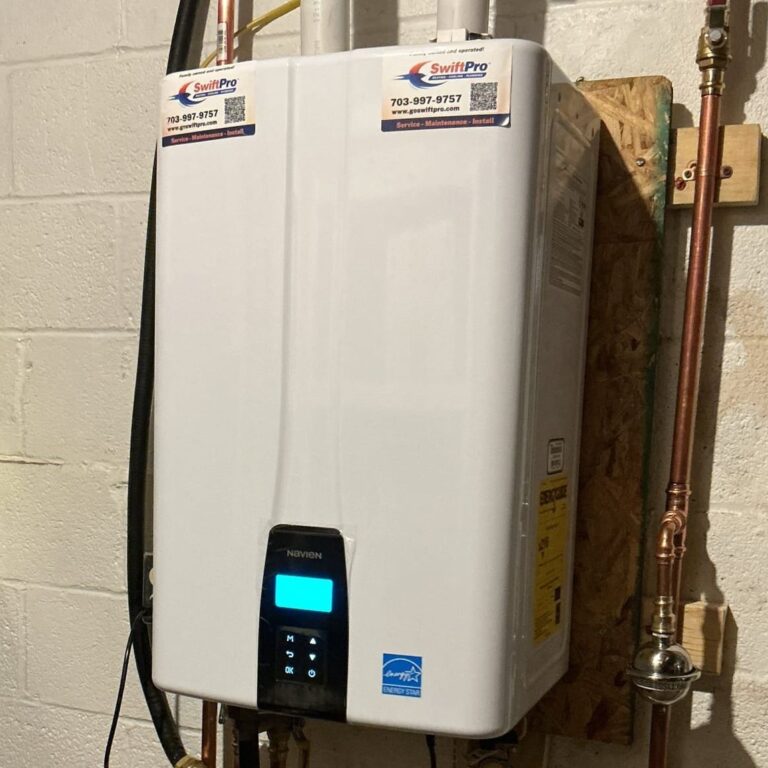
Our tankless water heater descaling is $300 right now, regularly $350: descaling solution pumped through the heat exchanger at the service valves, a fresh water rinse, the cold water inlet filter cleaned, the air intake filter cleaned where there is one and the vent checked, then the unit fired back up and checked at a hot tap. The same visit includes a whole-home plumbing safety check on your supply lines, shutoff valves, water pressure and drains, with photos of anything we flag. Here is what the visit covers, and the booking form.
Still on a tank water heater? That one gets flushed rather than descaled, and it is $99 with the same plumbing check. Tank maintenance is its own list.
Things people ask
How much does tankless water heater descaling cost in Northern Virginia? With us, $300 right now, regularly $350, and the visit includes a whole-home plumbing safety check. Doing it yourself costs a pump kit and the solution your manual names.
How often should a tankless be descaled? Once a year in most of Northern Virginia, because Navien’s schedule calls for it wherever the water is 4 grains per gallon or harder and nearly every utility here is. In the City of Manassas the water is soft enough that Navien’s table skips it.
I have a water softener. Do I still need it? Navien’s yearly flush applies when there is no softener or scale filter on the line, so with a working softener you can go longer. Keep looking at the inlet filter and the neutralizer every year either way.
Can I use vinegar? On a Navien, yes: its manual allows white vinegar or a descaler made for tankless heaters. On other brands, use what the manual names.
Will a descale fix a unit that is already acting up? If scale is the cause, often yes, and it is the first thing to try because it is the cheapest. If the unit is showing an ignition or fan code, scale is not the problem and a descale will not change it.
Do you work on brands you did not install? Yes. Navien, Rinnai, Rheem, Noritz, A. O. Smith, Bosch, whoever put it in.
SwiftPro services and installs tankless water heaters across Northern Virginia. Call (703) 997-9757, or book the $300 descale online.