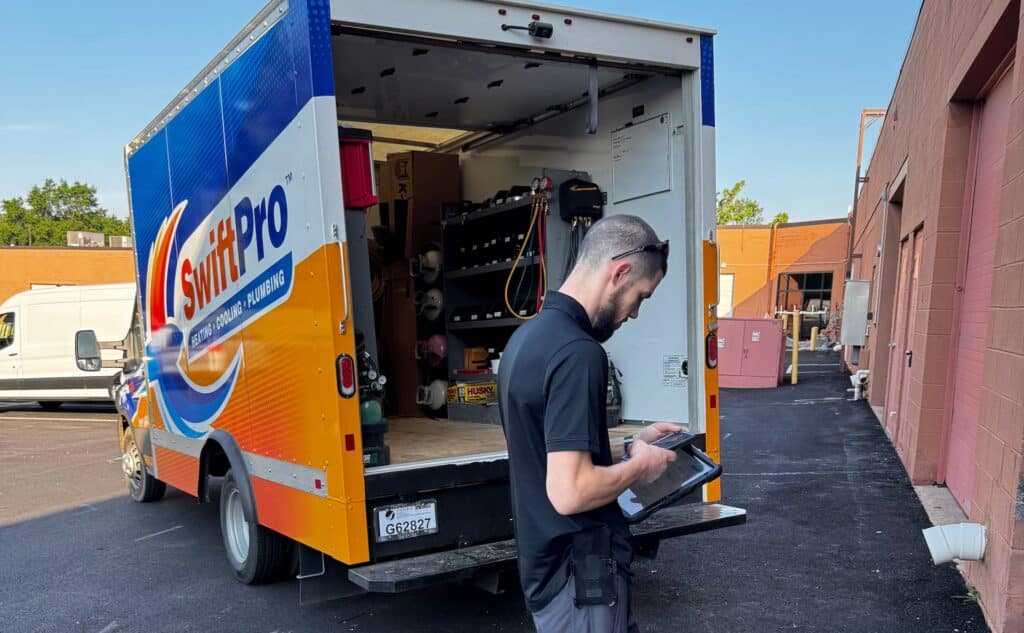


Most people who get a backflow test have no idea what happened in the yard for those thirty minutes. A tester showed up with a case, the water went off for a bit, a tag went on the device, and a report showed up later. Here is the whole procedure, in order, including the numbers on the gauge that decide pass or fail, so you know what you paid for and what a “fail” actually means.
The short answer
A backflow test is a pressure test. The tester connects a calibrated differential-pressure gauge to the small test cocks on the device, isolates the assembly, and measures whether each check valve (and, on an RPZ, the relief valve) holds a minimum pressure difference. The whole thing takes about 30 minutes per device, your water is off for a few of those minutes, and the readings go on a report that’s filed with your water utility.
Step 1: Find and identify the device
The tester locates the assembly (beside the house on the irrigation line, in a mechanical room, in a below-grade box for some double checks), reads the tag and the body casting for make, model, size, and serial number, and confirms it’s the device on the utility’s notice. Type matters because the procedure and the pass thresholds differ: a PVB gets a two-part test, an RPZ gets a three-part test, a double check gets two independent checks.
Step 2: Look before touching
A visual check catches the obvious. Cracked bodies from a freeze, a missing or damaged relief-port screen, corrosion at the test cocks, a device installed backward or below its required height, an RPZ with no drainage under the relief port. Some of these are automatic fails before the gauge comes out.
Step 3: Tell the household, then isolate
You’ll be asked not to run water for a few minutes. The tester closes the downstream shutoff, which stops all flow through the device, and, depending on the test, the upstream shutoff too. On a home irrigation PVB, the house water is usually unaffected; only the sprinkler line is isolated. On a whole-building RPZ, the building is off for the duration of the readings.
Step 4: Connect the gauge
The test kit is a differential-pressure gauge with three hoses. The hoses go on the test cocks (numbered 1 through 4 on an RPZ or double check, 1 and 2 on a PVB), and the tester bleeds the air out of each hose so the readings are honest. Every tester’s gauge has to be calibrated at least annually, and the calibration date goes on your report. That’s not decoration: an out-of-calibration gauge is grounds for a utility to reject the test.
Step 5: The readings, device by device
PVB (pressure vacuum breaker)
- Check valve test. With the assembly isolated, the tester bleeds pressure downstream and reads how much differential the check holds. The check must hold at least 1.0 psid (pounds per square inch, differential). Below that, the check isn’t sealing.
- Air inlet test. The tester slowly drops pressure inside the device and watches for the air-inlet poppet to open. It must open when the internal pressure is still at least 1.0 psi above atmospheric. If it opens late or not at all, the device can’t break a siphon.
RPZ (reduced pressure zone assembly)
- Relief valve test. The tester reduces pressure on the supply side of the first check until the relief valve opens. It must open at a differential of at least 2.0 psid across the first check. Open early or late, and the valve is off spec.
- First check test. The first check must hold at least 5.0 psid. This is the working valve that keeps the reduced-pressure zone at a lower pressure than supply, which is what lets the relief valve do its job.
- Second check test. The tester applies backpressure to the zone and confirms the second check holds tight in the reverse direction. Any leak-through fails it.
Double check valve assembly
- Check 1 and check 2, each independently. Each must hold at least 1.0 psid in the direction of flow. The tester isolates and reads them one at a time.
Step 6: Restore and check for leaks
Hoses come off, test cocks get closed all the way (a test cock left a hair open is the most common “leak” we get called back for after a competitor’s test), shutoffs reopen slowly to avoid hammering the device, and the tester watches the assembly under normal pressure for a minute. On an RPZ, a brief spit from the relief port as pressure stabilizes is normal.
Step 7: The report and the tag
Every reading goes on the report: the psid values, the gauge serial and calibration date, the device details, the tester’s certification number, pass or fail, and the date. A tag goes on the device with the same information so the next tester (or a utility inspector) can see the history. In Fairfax County the testing company has to submit that report within 14 days of the test; other utilities have their own portals and deadlines. Ask for your copy. You’ll want it if the utility’s records and yours ever disagree.
What “fail” means, and what happens next
A fail is a number below threshold or a visual defect. It does not mean your water was contaminated; it means the device would not have protected you in a pressure reversal. From there, most devices are rebuilt on the same visit (new check discs, springs, seals, or the relief-valve diaphragm), retested immediately, and the passing result is what gets filed. If the body is cracked, it’s a replacement and a retest. Virginia requires a test after any repair, so a repair without a retest is not a fix as far as your utility is concerned. And the clock runs: 30 days to repair and retest in Loudoun, 15 in Leesburg. The rest of the utility-by-utility rules are on our backflow service page.
Who is allowed to run this procedure
Virginia is strict here. Since January 1, 2023, the state only accepts backflow tests performed by a certified Backflow Prevention Device Worker, a tradesman certification issued by the Department of Professional and Occupational Regulation, and some utilities add their own tester registration on top. A test by anyone else is void, regardless of how well it was done. If you’re comparing testers, that certification number on the report is the first thing to check.
How to get ready for the visit
- Know where the device is and clear the way to it. Overgrown shrubs and stacked patio furniture add time.
- Know where your irrigation shutoff is (basement, utility area, or a box near the meter).
- Plan around the water being off for a few minutes if the device serves the whole building.
- Have the notice handy so the tester files to the right program with the right account number.
- If you had freeze damage or a leak this year, say so when you book. It changes what gets loaded on the van.
Understanding the Backflow Testing Procedure
This is the procedure every SwiftPro backflow visit follows, and it’s why we can tell you in the same call how long you’ll be without water and what happens if something fails. Call (703) 997-9757 or book online, tell us how many devices and which utility sent the letter, and it’s handled. If you’re wondering what the test costs before you call, we wrote that up honestly in our backflow testing cost guide.
Backflow test procedure FAQ
How long does a backflow test take?
About 30 minutes per device, including hooking up the gauge, the readings, restoring the system, and the paperwork. The water is off for only a few of those minutes.
Will my water be shut off during a backflow test?
The line through the device is isolated. For a home irrigation PVB that usually means only the sprinkler line; the house is unaffected. For a whole-building RPZ or double check, the building is off during the readings.
What tools are used to test a backflow preventer?
A calibrated differential-pressure test kit with three hoses that connect to the device’s test cocks, plus basic hand tools for the shutoffs. The gauge’s calibration date is recorded on the report.
What is a passing backflow test result?
Each check valve holds at least the minimum differential for its device type (1.0 psid on PVB and double check assemblies, 5.0 psid on an RPZ’s first check), the PVB air inlet opens at 1.0 psi or above, and the RPZ relief valve opens at 2.0 psid or above. No visual defects.
Do I need to be home for the backflow test?
Not usually, if the device is outside and accessible and we can isolate the line without entering. For devices inside a building, someone needs to let the tester in.
How often does a backflow preventer need to be tested in Virginia?
At installation, after any repair or relocation, and once a year after that, under Virginia’s waterworks regulations. Arlington County runs its own inspection program and does not require annual third-party testing on residential irrigation.
SwiftPro Heating, Cooling & Plumbing is based in Chantilly and serves all of Northern Virginia. Backflow testing, repair, and installation: (703) 997-9757.