Written October 2026, with MrCool’s manual and warranty, EPA’s guidance and the county permit pages read the same week.
Yes, for the right room. A DIY mini split like MrCool’s is a fair choice for a garage, a workshop, a sunroom or one bonus room, put in by a handy owner who hires an electrician for the circuit and pulls the permit. If you’d rather have it put in, a ductless mini split runs $7,000 to $10,000 installed from us for one zone. From about $117 a month at 0% APR for 60 months, the whole price financed, on approved credit.
The snap-together part is real. MrCool ships its DIY line with the refrigerant already in the lines, so there’s no vacuum pump to rent. Where it goes wrong is everything around that: a line set that’s the wrong length for the run, the electrical circuit, the paperwork (a county permit, and an EPA answer worth reading first), and one small heat pump asked to carry a whole floor through a Loudoun January. Each one is below, in the maker’s and the government’s own words.
If you only do one thing: read the installation manual and the warranty before you order, not when the box shows up. Both are free on MrCool’s site, and they’ll tell you more about whether this job suits you than any review will.
DIY mini split: the rooms it suits, and the ones it doesn’t
Here’s how we’d sort it, room by room. The short version: the less it matters if the room runs a few degrees cool on the coldest night, the better a DIY kit fits.
| The job | DIY kit? | Why |
|---|---|---|
| A detached garage, workshop or shed | Good fit | One room, a short run to the outdoor unit, and if it falls behind on a cold night, nobody’s bedroom is cold. |
| A sunroom, a bonus room, the room over the garage | Fair fit | Same job, but inside the house: plan where the head, the lines and the drain go before you drill through the wall. |
| The one bedroom or office that never keeps up | Check first | A room like that often has a duct problem a new unit only works around. Find out which it is before you buy. |
| The main heat for a floor or a whole house | Hire it out | Several heads, a real load calculation, and a January you can’t afford to get wrong. |
| A room far from where the outdoor unit can sit | Hire it out | The pre-charged lines come in set lengths, and shortening one takes a licensed technician (more below). |
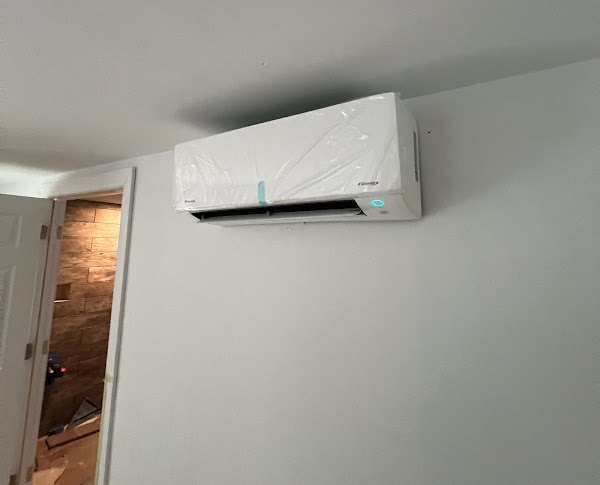
That third row is worth a minute. Before you buy anything for one cold bedroom, find out why it’s cold: the usual reasons one room runs cold, and when zoning, a ductless head or neither is the fix. Sometimes the answer really is a mini split. Sometimes it’s the duct that feeds the room.
How a MrCool DIY kit goes in
MrCool calls its DIY line “the only mini-split on the market designed for full homeowner installation,” and its pitch is short: “No license, no technicians, no compromises.” The trick is the line set, the pair of copper lines that carries refrigerant between the head on the wall and the unit outside. MrCool’s comes “100% accurately pre-charged with R-454B refrigerant,” with a Quick Connect fitting on each end, so there’s “no vacuum required and no specialized tools needed.” Compare MrCool’s own pro-installed line, Advantage: its page says a licensed technician vacuums the system and charges the lines during installation. The DIY kit skips that step on purpose.
Everything else is ordinary work. Mount the head’s bracket high on the wall. Make the hole through the wall for the lines, the drain and the control wire. Set the outdoor unit on a pad or a bracket. Route the line set between them, tighten the fittings and check each one with leak-detection spray or soapy water. That spray, a few wrenches, an Allen key and a screwdriver make up the manual’s tool list. Then the power, which is the part we’d hand to somebody else.
The line set: order the right length, connect it once
A pre-charged line set can’t be trimmed to fit like a garden hose. MrCool sells them in 11.5, 16, 25, 35 and 50 foot lengths, and the single-zone kit comes with 25 feet. So you pick the length before you’ve drilled anything, and the number that matters is the route the lines actually take: up the wall, around the corner, along the siding, down to the outdoor unit. Not the straight line between the two.
Too long is the easy problem. The manual says to keep the extra coiled, wrapped in protective tape and lying flat behind the outdoor unit. Too short means a coupler and a second line set, which MrCool sells for exactly that. Cutting one down is the hard one: MrCool’s help center says a line set can be shortened, but “any alterations to the linesets must be performed by a licensed technician,” you keep the invoice, and “the warranty on the line set itself will be voided.”
And you get one try. The manual is blunt: “The line sets are designed to only be installed once.” Connect one, take it apart and connect it again, and MrCool says the seal can’t be guaranteed and the warranty is void. So the day you tighten those fittings, the head should already be on its bracket and the outdoor unit sitting where it’s going to stay.
What MrCool’s warranty asks of you
The terms first. The DIY warranty is five years on parts and seven on the compressor, and it says “no registration required.” Longer coverage means enrolling in MrCool’s Care Kit program, which, in its words, “has a fee to be covered by the system owner.” It doesn’t pay for labor, and it doesn’t pay for refrigerant. MrCool’s help center adds that a DIY system needs no installation invoice to make a claim.
Then the condition that matters most to a do-it-yourselfer, quoted whole: “This warranty applies only to systems that are installed according to the installation instructions, and in accordance with all applicable local, state or province, and federal laws and regulations including but not limited to electrical codes and permits.” Read the next two sections with that sentence in mind. The permit and the electrical code aren’t just the county’s business here. They’re conditions of the warranty.
Two more lines worth knowing before you buy. The same page says the warranty “is non-transferable,” and that it only applies to a unit that stays at its original registered address, so it won’t pass to the next owner of your house. The same page also calls the owner the “registered owner,” so register anyway. And the installation manual, dated August 5, 2026, puts this at the top of its safety section: “INSTALLATION MUST BE PERFORMED BY AN AUTHORIZED DEALER OR SPECIALIST.” That’s a long way from “no technicians.” We’d go by the manual.
The wiring: its own circuit, and an electrician
Every MrCool DIY unit needs a circuit of its own. The manual: “Only connect the unit to an individual branch circuit outlet. Do not connect another appliance to that outlet.” The standard 9,000 and 12,000 BTU sizes run on 115 volts. The 18,000 BTU size and up, and the Hyper Heat models, run on 208/230 volts. Hard-wired, the manual also wants an all-pole disconnect in the wiring.
Who should run it? The manual answers that itself, more than once: “All wiring must comply with local and national electrical codes and must be installed by a licensed electrician.” Virginia law is a little looser than MrCool is. The state licenses electricians who work “for the general public for compensation,” and its contractor law exempts an owner working on the one home he owns and lives in, as long as the work meets the building code. So you may be allowed to wire your own house in Virginia, with a permit and an inspection. The manual still wants a licensed electrician, and the warranty still wants the electrical code met.
Our advice: hire this part out even if you do everything else yourself. A line set that leaks costs you refrigerant. MrCool’s manual puts the cost of the rest in capital letters: a defective installation “CAN CAUSE WATER LEAKAGE, ELECTRICAL SHOCK, OR FIRE.”
Permits, and what EPA says about the lines
Virginia’s building code is the same in every county, and it says a permit comes before “installations or alterations involving” electric wiring and mechanical systems, among other things. Its exemptions cover replacing some equipment, not adding new. Here’s how the three counties put it on their own permit pages:
- Fairfax County wants a mechanical permit for “New, Replacement, Repair or Conversion of HVAC Systems” and an electrical permit for “new electrical equipment.” Owners may pull permits in their own name, and an owner doing the work without a licensed contractor files a License Exemption Affidavit. Its HVAC form also makes it the applicant’s job to run an ACCA Manual J load calculation “for all HVAC installations.”
- Loudoun County issues electrical and mechanical permits as separate trade permits (“each requires separate applications and permits”), and says you may secure a permit in your own name.
- Prince William County says a permit is always required for “Installing a new electrical circuit” and for work involving the house’s “heating and air conditioning (mechanical) systems.” A homeowner doing the work is the permit holder and signs a Statement of Exemption.
None of the three pages names mini splits. A new one is new heating and cooling equipment on a new circuit, which is what those rules describe.
Now the EPA part. EPA’s own homeowner questions page was asked, “Can I install an R-410A mini-split window unit?” Its answer starts with “No,” and goes on: “connecting or disconnecting hoses or pre-charged lines requires a Section 608 technician certification.” That answer names R-410A, the older refrigerant. MrCool’s current DIY line runs on R-454B, which the answer doesn’t name either way. MrCool’s own manual adds that anyone “working on or breaking into a refrigerant circuit” should hold a valid certificate, and doesn’t say whether tightening a Quick Connect counts. We won’t guess what EPA would say about a case its page doesn’t name. You should just know the page exists before you buy.
Will a DIY mini split heat in a Northern Virginia winter?
It’ll run. Whether it keeps up is a different question, and the answer is on a spec sheet worth opening before you buy.
Start with how cold it gets here. The temperature heating gets sized to, the one it’s colder than only about 1 percent of the hours in a year, is 14 degrees in Loudoun, 16 in Prince William, 18 in Fairfax and 20 in Arlington. MrCool rates its standard DIY units to run in heat mode down to -13 degrees, and its Hyper Heat models to -22. Running isn’t the same as making all its heat. Here’s what the 12,000 BTU DIY unit makes, by the cold-climate heat pump list NEEP keeps, with the house at 70 inside:
| Outside | Heat it makes (BTU an hour) | Share of its rated heat |
|---|---|---|
| 47 degrees | 12,000 | All of it |
| 17 degrees | 8,500 | 70 percent |
| 5 degrees | 8,400 | 70 percent |
| -13 degrees | 3,800 at most | About a third |

So on a night near 17 degrees, about where Fairfax and Prince William size their heat, that unit makes about 70 percent of the number on its box. Across the standard DIY sizes, NEEP’s listings put the heat at 17 degrees at 65 to 75 percent of the rated figure; the two Hyper Heat models are at 74 and 84. For a garage, that’s fine. For a bedroom, it means the unit has to be sized for the cold night, not the mild one, and that’s a load calculation, not a guess. ENERGY STAR tells buyers the same thing: the contractor “should verify the proper size system for your home” with a Manual J.
If the room is somebody’s main heat, look at the Hyper Heat models, or have it sized and put in. More on how heat pumps hold up here: does a heat pump actually work in a Virginia winter.
What it costs to have a mini split installed instead
From us, a ductless mini split runs $7,000 to $10,000 installed for one zone. From about $117 a month at 0% APR for 60 months, the whole price financed, on approved credit. Two to six zones run $11,000 to $30,000, by the number of rooms. From about $183 a month at 0% APR for 60 months, the whole price financed, on approved credit.
Where you land in that range comes down to how far the outdoor unit sits from the room, which kind of head goes in, and the electrical work. It’s priced in writing before anything is ordered, and two years of our labor come with the install. We’re a Mitsubishi Electric Diamond Contractor. The full breakdown is in what a ductless mini split costs in Northern Virginia, and how the brands compare, MrCool included, is in the best mini split brands.
Whoever puts it in, the upkeep afterward is the same: clean the filters in the head, keep leaves and snow off the outdoor unit, and have it looked at once a year.
DIY mini split questions, answered straight
Can I install a mini split myself?
Yes, if it’s a kit sold for homeowner installation, like MrCool’s DIY line, and the job is one room close to where the outdoor unit can sit. You’ll still want an electrician for the circuit and a permit from your county. A mini split that isn’t a DIY kit is a different job: MrCool’s own Advantage line, for one, has a licensed technician vacuum the system and charge the lines.
Is MrCool DIY any good?
For what it’s built for, yes. MrCool calls it the only mini split designed for full homeowner installation, it carries five years on parts and seven on the compressor, and its cold-weather numbers are published. The catches are in MrCool’s own paperwork: the manual wants a licensed electrician on the wiring, a line set connected twice voids the warranty, and the warranty doesn’t transfer. For a garage or a workshop it’s a fair buy. For the room you sleep in, we’d have a system sized and put in.
Do I need a permit to install a mini split in Virginia?
Yes. Virginia’s building code requires a permit before installing mechanical systems or electric wiring, and Fairfax, Loudoun and Prince William all issue permits to homeowners doing their own work. Fairfax spells it out: a mechanical permit for new HVAC systems and an electrical permit for new electrical equipment.
Do I need an electrician for a DIY mini split?
MrCool says yes: its manual says the wiring “must be installed by a licensed electrician.” Every size needs its own circuit; the standard 9,000 and 12,000 BTU units run on 115 volts and the rest on 208/230. Virginia lets an owner work on the home he lives in under a permit, but the manual and the warranty both point at the electrical code, so we’d hire the electrician.
Does a MrCool DIY need a vacuum pump?
No. The line sets come with R-454B already inside, and MrCool says there’s “no vacuum required.” That’s the whole point of the kit. The flip side: the manual says the line sets “are designed to only be installed once.”
Can I cut or shorten a MrCool line set?
Not yourself. MrCool’s help center says only a licensed technician may shorten one, you keep the invoice, and the line set’s own warranty is void afterward. Extra length is fine: the manual says to leave it coiled, wrapped and lying flat behind the outdoor unit. Too short means a coupler and a second line set.
Does a DIY install void the MrCool warranty?
Not by itself. MrCool’s help center says a DIY system needs no installation invoice to make a claim. What can void it is how the install is done: the warranty applies only to a system put in by the instructions and “in accordance with all applicable local, state or province, and federal laws and regulations including but not limited to electrical codes and permits,” and a line set connected a second time voids it too.
Do I need EPA certification to install a MrCool?
MrCool markets the kit with “No license, no technicians.” EPA’s homeowner page, asked about an R-410A mini split, says connecting or disconnecting pre-charged lines “requires a Section 608 technician certification.” MrCool’s DIY line uses R-454B, which that answer doesn’t name. Both are quoted above; read them before you buy.
Will a MrCool DIY heat my house in winter?
It runs down to -13 degrees, or -22 for the Hyper Heat models. At 17 degrees, close to where Northern Virginia sizes its heat, NEEP’s listings put the standard DIY sizes at 65 to 75 percent of their rated heat. Fine for a garage or a sunroom. For a room someone depends on, size it for the cold night or look at Hyper Heat.
What size DIY mini split do I need?
It depends on how much heat the room loses, not just its square footage, which is why ENERGY STAR says the size should be checked with a Manual J load calculation. If you size it yourself, size for a cold night: a 12,000 BTU DIY unit makes about 8,500 at 17 degrees.
How much does it cost to have a mini split installed?
From us, one zone runs $7,000 to $10,000 installed in Northern Virginia. From about $117 a month at 0% APR for 60 months, the whole price financed, on approved credit. Each zone you add raises that, and the ductless estimator prices yours by room.
Is a mini split the right fix for one cold room?
Sometimes. A room over a garage, or an addition the ducts never reached, is a classic mini split job. A room fed by a leaky or undersized duct may just need the duct fixed. Start with why one room runs cold and zoning vs. ductless for one cold room.
Get a mini split priced, or a second opinion
The ductless estimator asks a few questions about your rooms and shows an installed price, and you can book a visit from the same page. Holding someone else’s quote? We’ll give you a free second opinion on it. Whatever we’re running this month is on our offers page, and here’s how financing works.
Call (703) 997-9757 or book online.
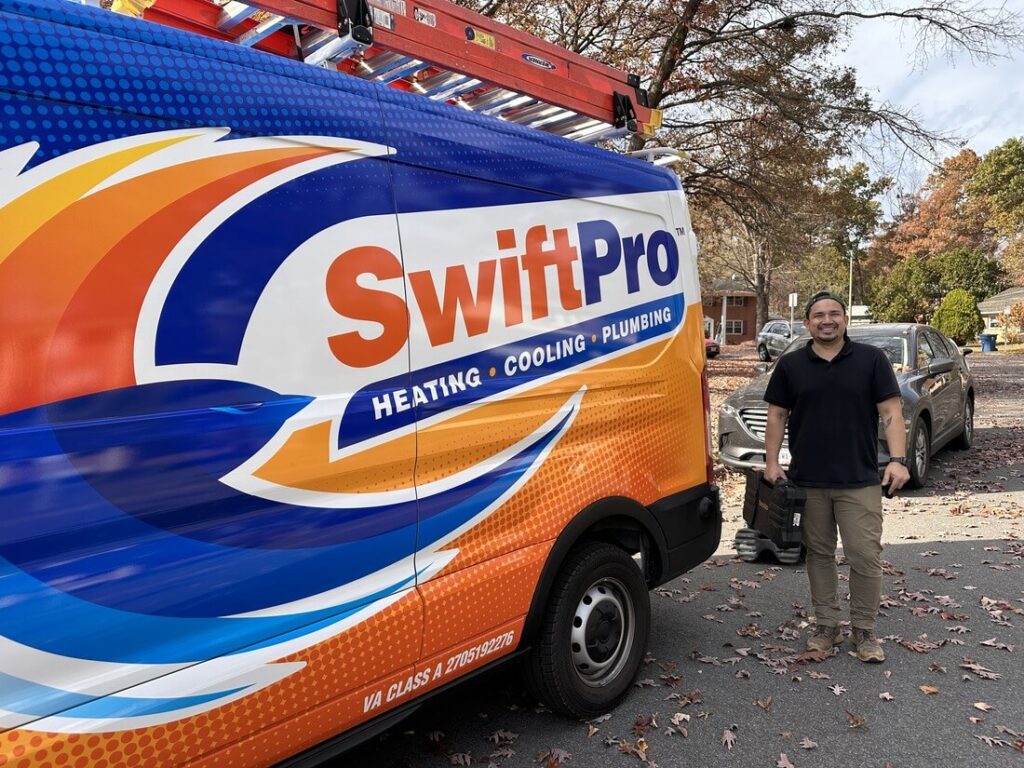
SwiftPro Heating, Cooling & Plumbing installs ductless mini splits across Northern Virginia, based in Chantilly. We’re a Mitsubishi Electric Diamond Contractor and a Trane Comfort Specialist. Family owned, BBB Accredited with an A rating, 24/7 emergency service, Virginia Class A contractor license 2705192276, and rated 5.0 stars across 1,131 reviews on Google, Angi, Yelp, the BBB and Facebook. Read the reviews.