Written October 2026, with Virginia’s contractor law, DPOR’s consumer pages and the county permit pages read the same week.
A good HVAC contractor can tell you roughly what the job costs before anyone is in your basement. Ours are published: a furnace and air conditioner replaced together runs $8,898 to $23,000 installed in Northern Virginia, depending on the size and the equipment. From about $148 a month at 0% APR for 60 months, the whole price financed, on approved credit. Every service we do, with its price, is on our services page.
An HVAC contractor is the company that installs, repairs and maintains your heating and cooling: the furnace or heat pump, the air conditioner, the ductwork, the thermostat. In Virginia it’s also a license with a public record that anyone can look up. Before one starts work on your house, check four things, in this order: the license, the insurance, who pulls the permit, and what the written contract says. Then read the reviews, all of them, not one site’s worth.
If your heat or air is out right now, call first and check while you wait. The license lookup takes a couple of minutes on a phone, and a contractor worth hiring won’t mind that you looked.
What an HVAC contractor does
An HVAC contractor installs, repairs and maintains the equipment that heats and cools your house: the furnace or heat pump, the air conditioner, the boiler, a ductless mini split, the ductwork and the thermostat. Some do plumbing too.
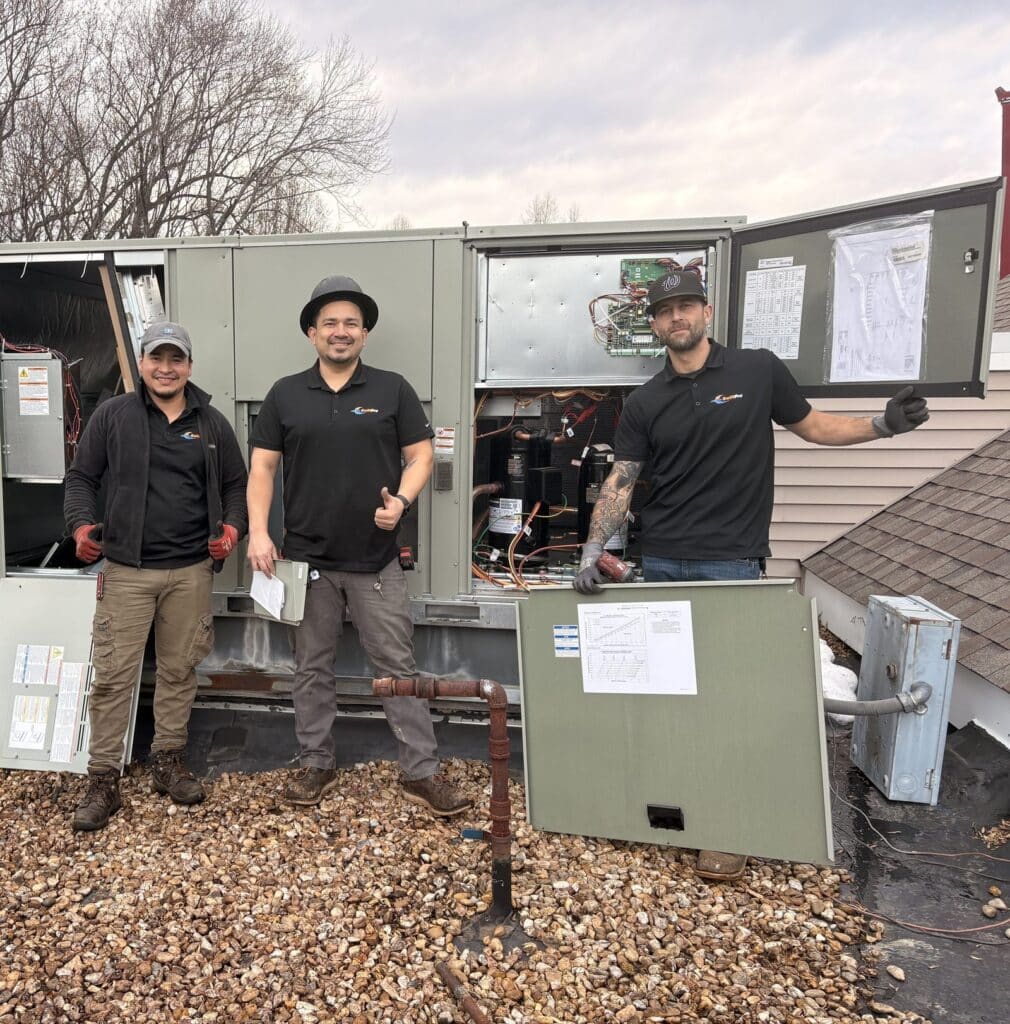
A replacement shows how much of the job is more than the box. The old system’s refrigerant gets recovered, the electrical disconnect often gets replaced, the drain and the venting get matched to the new equipment, and the system gets started up and checked before anyone leaves. For what each kind of visit covers and when you’d call for it, there’s HVAC services in Northern Virginia, explained.
How to check an HVAC contractor’s license in Virginia (the DPOR license lookup)
Virginia licenses contractors through DPOR, the Department of Professional and Occupational Regulation, and anyone can search its records. DPOR’s own guide to hiring a contractor puts it near the top: “Verify license status and check for any past disciplinary actions using License Lookup.” Here’s how.
- Get the license number in writing. It should be on the quote and the contract. Plenty of companies print it on the van too.
- Open DPOR’s License Lookup and type the number, or the company’s name, into the search box.
- Match the name. The name on the license should be the name on your quote. It can be the company’s legal name rather than the one on the truck: ours is listed as SwiftPro LLC.
- Check that it’s active. An expired license doesn’t count.
- Check that it covers HVAC. The record lists the trades a license covers, and heating and cooling shows up as HVA.
- Read the discipline history, if there is one.
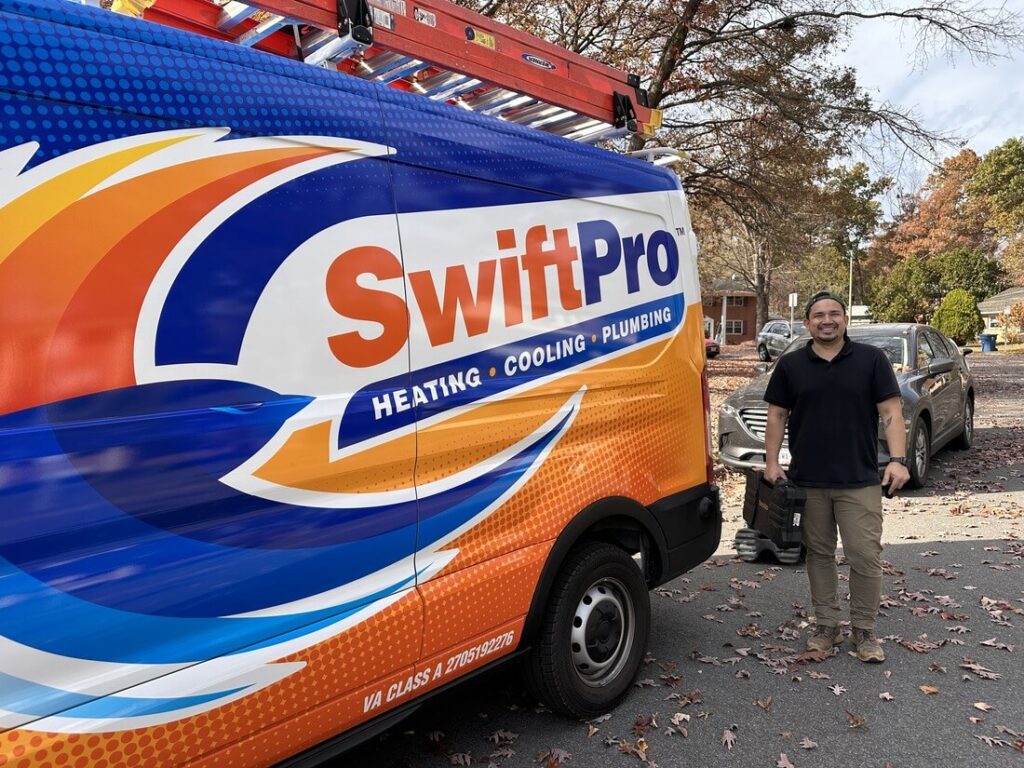
Ours is Virginia Class A, number 2705192276, and it covers HVAC and plumbing. It’s printed on the side of our vans. Look it up; that’s what it’s there for.
One more reason the license matters after the job is done. Virginia keeps a Contractor Transaction Recovery Fund that, in DPOR’s words, gives “relief to eligible consumers who have incurred losses through the improper and dishonest conduct of a licensed contractor.” It’s a last resort, and DPOR says plainly that “filing a claim does not guarantee payment.” But it only reaches licensed contractors.
Insurance: ask for the certificate
A license isn’t proof of insurance, so ask for the certificate. Have the contractor’s insurance agent send it to you, with the policy dates on it. You’re looking for two things: general liability, for damage to your house, and workers’ compensation, for the people working in it. Virginia’s Workers’ Compensation Commission puts the rule this way: “As a general rule, a business with more than two employees regularly employed in Virginia is required to carry workers’ compensation coverage.” If a company sends three people and can’t show you a workers’ comp policy, ask why.
We’re insured, and you can ask us for the certificate the same way you’d ask anyone.
Who pulls the permit, and why it should be the contractor
Replacing a gas furnace takes a county permit, every time. Fairfax County’s appliance permit page says a gas appliance “such as a water heater, furnace, or boiler” “requires a permit, even if it is a like-for-like replacement,” and its mechanical permit list starts with “New, Replacement, Repair or Conversion of HVAC Systems.” Whether a straight swap of an electric heat pump or air conditioner needs one can depend on the county, so ask.
Now, who pulls it. You can, in your own name. Fairfax and Loudoun both allow that, and both tell you not to when a contractor is doing the work. Fairfax: “it is strongly recommended a properly licensed contractor pull the permits as the responsible party so the county can better assist in gaining compliance for defective work.” Loudoun says the same, and adds the line that ties this to the license: “A contractor must be properly licensed in order to obtain a permit.”
Our opinion: the permit is the most underrated check on this list. It’s the one step where someone who doesn’t work for the contractor comes and looks at the job. Fairfax’s appliance permit, for one, comes with an inspection “to verify code-compliant installation.” A contractor who asks you to pull the permit yourself, or says a furnace swap doesn’t need one, is handing you the job’s risk.
What the written quote and contract should show
Virginia sets a floor for a job like a system replacement: the contractor has to give you “a legible written contract,” signed by both of you before work starts or any payment is taken, and the regulation lists what goes in it. The parts that matter most to you:
| Virginia requires | What to look for |
|---|---|
| When work begins, and the estimated completion date | Dates, not “sometime next week” |
| The total cost of the project | One number for the job as written |
| The down payment and the schedule of progress payments | The deposit in dollars, and what has to be done before each payment |
| The materials and work you asked for | Equipment by model number, and what happens to the ductwork, drain, venting and wiring |
| A promise to meet local permit, inspection and zoning requirements | The permit, in writing |
| Cancellation rights | How, and by when, you can cancel |
| The contractor’s name, address and license number | The same number you just looked up |
| Any change in cost, materials, work or dates in writing, signed by everyone | No “while we’re here” add-ons on a handshake |

The equipment side of a replacement quote, how the size was picked and what the model numbers tell you, is its own post: how to read an HVAC replacement quote. And so you know whether the total is in the right neighborhood before you read it, our furnace and AC prices are online, by system size.
Reading the reviews: the total, not one site
Reviews help, and DPOR is blunt about their limits: “A paid advertisement isn’t necessarily a good indication of the quality of a contractor’s work, and not all online reviews are unbiased or truthful.” So read them the way you’d read anything with an angle.
- Add up the platforms. A company can look great on the one site it steers customers toward. Google, Angi, Yelp, the BBB and Facebook together are a lot harder to curate.
- Read the newest ones. A company changes when its people do.
- Read the one-star reviews, and the replies. Every busy company gets a few. How the owner answers a bad one tells you how they’ll answer you.
- Look for the job and the name. A review that names the work and the technician is worth ten that say “great service.”
Ours, added up across every platform: 5.0 stars across 1,131 reviews on Google, Angi, Yelp, the BBB and Facebook. The count is public platform by platform, and so are the reviews themselves.
Manufacturer dealer status: check it on the maker’s site
A dealer program is something the manufacturer grants, and the manufacturer lists its dealers on its own website. So when a company says it’s some kind of Trane, Carrier, Rheem or Mitsubishi Electric dealer, check the maker’s locator, not the logo on the contractor’s homepage.
It can matter in money. Mitsubishi Electric’s residential warranty runs ten years on parts and the compressor when the system is registered within 90 days, and “twelve (12) years” when it’s “installed in an owner-occupied residence by a Diamond Contractor” and registered by that contractor within 90 days. We’re a Mitsubishi Electric Diamond Contractor, so a Mitsubishi system we install in the home you live in qualifies for the twelve when we register it.
The rest of ours you can check yourself on the makers’ own pages: our Trane Comfort Specialist listing, our Rheem Pro Partner listing, our page on Carrier’s dealer locator, and Mitsubishi’s locator, which searches by ZIP code. For which brand to pick in the first place, see the best HVAC brands and who makes the best heating and air conditioning equipment.
Red flags: when to show an HVAC contractor the door
DPOR’s own list of warning signs covers most of it. Here it is with a few of ours mixed in, roughly in the order we’d worry about them.
- No permit, or “you pull it.” Covered above. For a gas furnace there’s no version of this that’s fine.
- Cash only. DPOR’s words: watch for a contractor who “only accepts cash or Venmo type payments.”
- The whole job paid up front. Also on DPOR’s list, with its advice: “Don’t pay 100% of the bill until the work is 100% complete.”
- Pressure to sign today. DPOR flags anyone who “pressures you into making an immediate decision.” A real price is still a real price tomorrow.
- A firm price for a new system over the phone. A range before the visit is honest; ours is online. A binding number before anybody has measured the house, looked at the ductwork or seen where the equipment sits is a guess, or a price with room built in for the surprises.
- A knock on the door. DPOR warns about contractors who solicit door to door, and reminds you that “you have a three-day right to cancel a contract negotiated in your home.”
- A license number that’s missing, expired or under another name. A couple of minutes on DPOR’s site settles it.
Holding a quote that trips one of these? We’ll give you a free second opinion on it. If it’s a fair quote from a licensed company, we’ll tell you that too.
HVAC contractor questions, answered straight
What does an HVAC contractor do?
Installs, repairs and maintains heating and cooling: furnaces, heat pumps, air conditioners, boilers, ductless mini splits, ductwork and thermostats. It’s the company you hire for the job, and the one that pulls the permit and stands behind the work.
How do I check if an HVAC contractor is licensed in Virginia?
Search the license number or the company name on DPOR’s License Lookup. Check that the name matches your quote, that the license is active, and that it covers HVAC. DPOR also says to check for past disciplinary actions.
Does an HVAC contractor need a license in Virginia?
Yes. Virginia licenses contractors through DPOR, and for heating and cooling work the license should cover HVAC. It’s a public record, so look it up before anyone starts. Ours is Virginia Class A, number 2705192276.
Who should pull the permit for a new HVAC system?
The contractor, in its own name. Fairfax and Loudoun both let homeowners pull permits, and both recommend the licensed contractor do it so the county can hold that contractor to the code if the work is defective. A gas furnace replacement needs a permit even when it’s like for like.
How much does an HVAC contractor charge?
It depends on the job, and a good one will tell you the range up front. Ours: a heating or cooling diagnostic visit is $99, and a furnace and AC replaced together runs $8,898 to $23,000 installed. From about $148 a month at 0% APR for 60 months, the whole price financed, on approved credit. Repair prices by part are on the AC repair page and the heating page.
Should an HVAC contractor give me a price over the phone?
A range, yes. A binding price for a new system, no. Nobody can see your ductwork, your venting or your electrical panel over the phone, and that’s where the surprises live. Repairs work differently: you pay the diagnostic, and you get the exact repair price in writing before anyone starts.
What happens if I hire an unlicensed contractor in Virginia?
You lose protection. The state’s Recovery Fund only reaches licensed contractors, and a county can’t issue a contractor a permit without its license number, so on an unlicensed job the permit tends to get skipped or put in your name.
Get your price, then check us the same way
Run every check above on us. The license number is 2705192276, the reviews are on our reviews page, and the makers’ listings are linked in the dealer section. Then see your price: the HVAC estimator asks a few questions about your house and shows an installed price, and you can book a visit from the same page. Deals are on our offers page, and here’s how financing works.
Call (703) 997-9757 or book online.
SwiftPro Heating, Cooling & Plumbing is an HVAC contractor and plumber serving Northern Virginia, based in Chantilly. We’re a Trane Comfort Specialist, Carrier experts, a Rheem Pro Partner and a Mitsubishi Electric Diamond Contractor. Family owned, BBB Accredited with an A rating, 24/7 emergency service, Virginia Class A contractor license 2705192276, and rated 5.0 stars across 1,131 reviews on Google, Angi, Yelp, the BBB and Facebook. Read the reviews, or meet the company.