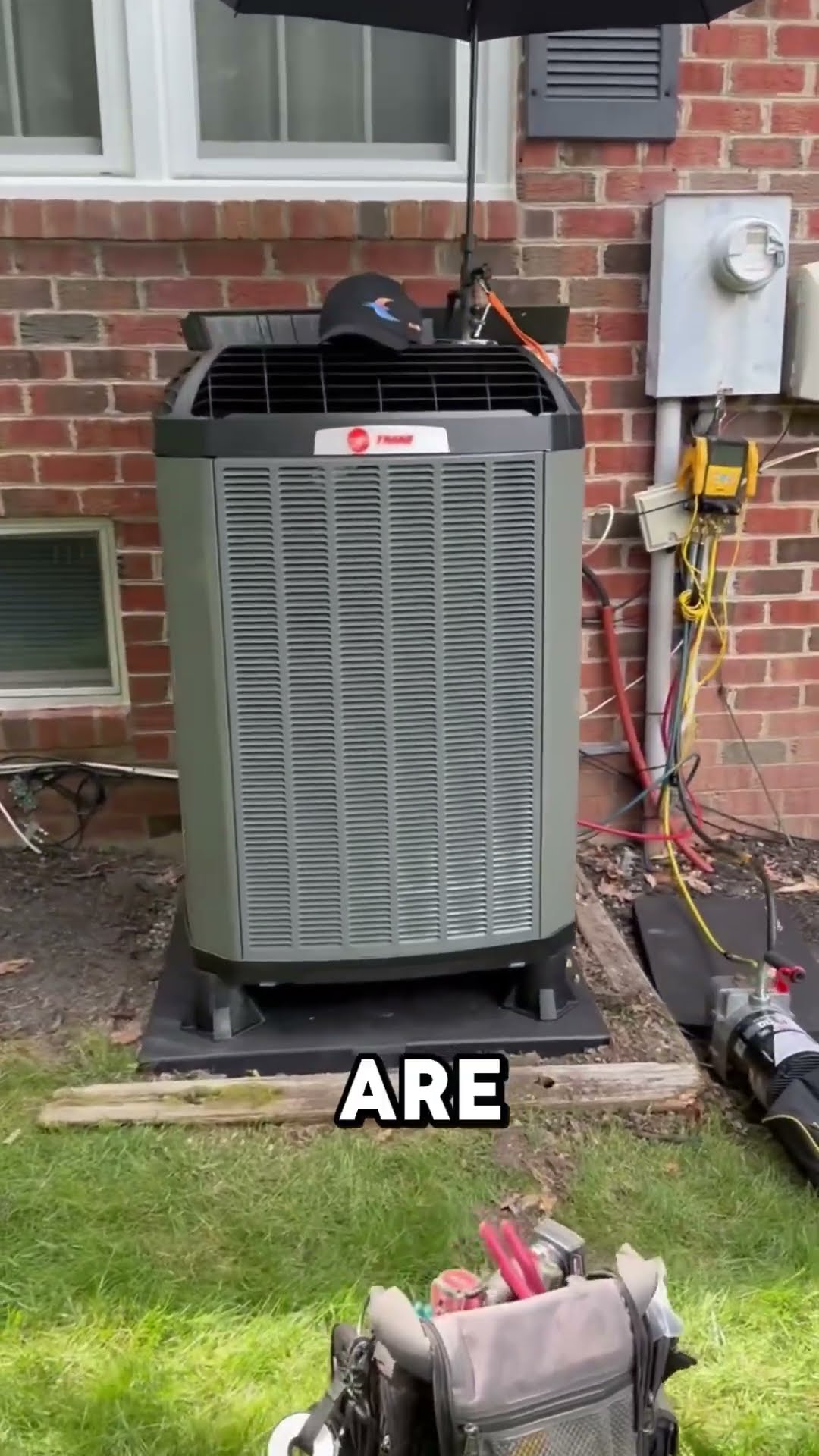
Updated October 2026 with Trane’s new model names, this year’s efficiency rules and our current installed prices.
Our first pick is Trane. Carrier, Rheem and Mitsubishi Electric round out the four brands we install, and each one wins a different kind of house. The short version is right below. After that: why, what changed in 2026, and what a new system actually costs installed in Northern Virginia.
One thing before the list, because it matters more than the list. A good brand installed badly loses to a plain one installed well. Keep that in your back pocket when the quotes come in.

The short list
Swipe to see all columns →
Swipe to see all columns →
| Brand | Best at | Fits | Do we install it? |
|---|---|---|---|
| Trane | Durability, backed by hard testing before it ships | Owners staying ten years or more | Yes, our first pick |
| Carrier | Quiet running and humidity control | Almost any budget, base models up to variable speed | Yes |
| Rheem | Value, and repairs that stay simple | Solid equipment at a sharper price | Yes |
| Mitsubishi Electric | Ductless and cold-weather heat pumps | No ducts, an addition, the one room that never cools | Yes |
| American Standard | Trane’s sibling: same parent company, same warranty | Anyone comparing a Trane quote with one from its sibling | We service it |
| Lennox | Top-end efficiency ratings | Efficiency-first buyers | We service it |
| Goodman, Amana, Daikin | A low price up front | Rentals, short stays, tight budgets | We service it |
What’s different about buying a system in 2026
If you last shopped for heating and air conditioning a few years ago, four things moved.
The refrigerant changed, and so did the model names. Since January 1, 2025, new central air conditioners and heat pumps have been built for refrigerants with a much lower global warming impact: R-454B at Trane, Carrier, Lennox, Rheem and American Standard, R-32 at Goodman, Amana and Daikin. A lot of makers renamed their lines on the way. Trane’s XV20i became the 20 TruComfort Variable Speed, and the furnace people know as the S9V2 now sells as the 97 Two-Stage Variable Speed. Leftover R-410A systems built before 2025 can still be installed until the stock runs out, so if a quote this year names an older model, ask which refrigerant it runs on and when it was built. If the R-410A system you have now works, nobody makes you replace it.
Efficiency is rated in SEER2 now, and Virginia’s floor sits above the national one. Since 2023, a new split central air conditioner installed in Virginia has to rate at least 14.3 SEER2, or 13.8 for big systems of 45,000 Btu/h and up. A heat pump needs 14.3 SEER2 and 7.5 HSPF2 anywhere in the country. So the old advice to look for “SEER 14 or better” is out of date: the floor here is 14.3 SEER2, the same as 15 on the old scale.
The federal tax credit is over. The 25C credit ended for anything installed after December 31, 2025, so a 2026 install gets nothing back from the IRS. What’s left, in more detail.
The rebate money is local now, and it favors dual fuel. If Washington Gas is your gas company, it pays $2,000 for a qualifying heat pump installed with a new 95% furnace, or $1,400 if you keep a furnace that’s 90% or better, as long as the heat pump replaces a central air conditioner. Where a dual fuel system should hand off to gas. Manufacturer rebates come and go with the seasons; whatever we’re running right now is on our offers page.
Free Furnace With a New AC
Put in a new AC with its matching coil and a basic single-stage gas furnace goes in with it, installed together. See the free furnace
Want your own number before anyone comes out? The HVAC estimator prices your house in a few questions.
1. Trane: our first pick
Ask us what we’d put in our own house and you’ll hear Trane. Not because the badge is magic. Three reasons, and you can check every one of them.
Trane tests it hard. Trane says every product it makes goes through rigorous testing in its own SEET labs. In the field, the cabinets and coils hold up, and the compressors are as dependable as any we work on.
The parts warranty is long, if it’s registered. Ten years on parts for most Trane equipment when it’s registered within 60 days of the install, five if it isn’t, and Trane’s multi-speed and variable-speed outdoor units get twelve years on the compressor. It covers parts, not labor, so ask every company you get a quote from who pays the labor. On the systems we install, two years of our labor is included, and you can take five or ten.
We know where the parts come from. We buy our Trane systems and parts through Ferguson, Trane’s distributor for our area.
The honest part: a Trane costs more than a builder-grade system. If you’re staying ten years or more, that premium spreads thin. If you’re selling next spring, it might not be worth it.

The Trane lineup, in plain English
Swipe to see all columns →
Swipe to see all columns →
| Trane’s name | What it is | Fits |
|---|---|---|
| 20 TruComfort Variable Speed (replaced the XV20i) | Air conditioner or heat pump that runs anywhere from 25 to 100% of its capacity, in steps of a tenth of a percent. Up to 22.4 SEER2 and 10.5 HSPF2 as a heat pump. | Comfort first: a hot upstairs, or an all-electric house that has to carry a January cold snap |
| 18 TruComfort Variable Speed | Air conditioner or heat pump, 25 to 100% in 1% steps. Up to 18.1 SEER2 and 8.5 HSPF2 as a heat pump. | Most single-family homes and larger townhouses |
| 17 Multi-Speed | Air conditioner or heat pump with two speeds, 70% and 100%. Up to 18.0 SEER2 as a heat pump with WeatherGuard. | Townhouses, condos and tighter budgets |
| 96 Modulating Variable Speed gas furnace (formerly the XC95m) | The burner eases anywhere between 40% and 100% instead of slamming on and off. Up to 97.3% AFUE. | Gas homes where quiet, even heat is the point |
| 97 Two-Stage Variable Speed gas furnace (formerly the S9V2-VS) | Runs on low as often as it can, with a variable-speed blower. 97% AFUE. | Gas homes, and the furnace half of a dual fuel system |
Trane added a Cold Climate version of the 20 TruComfort in September 2026. Every 20 and 18 runs on Trane’s own Link UX360 thermostat, which Trane requires. The ratings above are Trane’s published “up to” figures for its best matched system. The ones for your house are on your quote.
We’re a Trane Comfort Specialist, which is Trane’s own dealer program. What that means for you: Trane’s instant rebates come off your quote through us, and you can look us up on Trane’s dealer locator before you ever call. Our heating page goes deeper on Trane furnaces and heat pumps.
The system we put in first
Built to take a beating. Put in by our crew.
Heat lamps, snow and rain on one outdoor unit: that’s Trane’s own film. We’re a Trane Comfort Specialist, on Trane’s own dealer locator, and when you pick a Trane, our crew puts it in.
Films: Trane’s own.
2. Carrier
Willis Carrier invented modern air conditioning in 1902, and the company’s engineering still shows in the two things a Northern Virginia summer tests hardest: quiet running and humidity control. Carrier sells three tiers, Comfort, Performance and the variable-speed Infinity line at the top, so there’s a genuine Carrier answer at several prices rather than one premium model. Register a new Carrier within 90 days and the parts are covered for ten years; skip it and you get five.
We install Carrier furnaces, air conditioners and heat pumps, and we service every Carrier we’re called to, whoever put it in.

3. Rheem
The value pick of the big names. Rheem builds solid equipment, its parts are easy to find, and repairs tend to be straightforward, which keeps the cost of owning it down. You get most of the reliability of a premium badge for noticeably less money, and for a lot of households that’s exactly the right trade.
Rheem sells its heating and cooling as the Endeavor Line: Prestige at the top, then Classic Plus and Classic. Ruud is Rheem’s sister brand and sells the same line under its own names. Register most Rheem systems within 90 days for ten years on parts. Rheem is also one of the biggest names in water heaters, and we install those too.

4. Mitsubishi Electric
In its lane, nobody touches it. Mitsubishi Electric’s ductless and ducted mini-splits are the answer for houses without ductwork, additions, finished basements, the bonus room over the garage and the bedroom that never cools. Mitsubishi says its Hyper-Heat models put out their full rated heat at 5°F, and our winters rarely get that cold. In the US, its heating and cooling equipment is sold by a 50/50 joint venture with Trane Technologies, Trane’s parent company.
We’re a Mitsubishi Electric Diamond Contractor, and on a Mitsubishi that changes the warranty. Out of the box Mitsubishi covers parts for five years and the compressor for seven. Registered within 90 days, both go to ten. Installed and registered by a Diamond Contractor, both go to twelve. It covers the parts and the compressor, not labor, and it stays with the original owner. A one-zone ductless system runs $7,000 to $10,000 installed in our price book. From about $117 a month at 0% APR for 60 months, the whole price financed, on approved credit. What moves that price up or down.
The other names you’ll see on quotes
American Standard belongs to Trane Technologies, the same company as Trane, and its warranty is the same document, written by Trane U.S. The lines run Platinum, Gold and Silver. If you’re quoted one, you’re looking at Trane’s sibling under a different badge.
RunTru by Trane is the same company’s budget line, built and warrantied by Trane. It’s single-stage only and tops out at 16 SEER2, with ten years on parts and the compressor when it’s registered, the same as Trane’s own single-stage units.
Lennox builds some of the most efficient equipment on the market, in three lines: Merit, Elite and the Dave Lennox Signature Collection. Lennox skips outside distributors and sells straight to its dealers through its own Lennox Stores, so parts come through Lennox’s channel and nobody else’s. Registered Signature systems get twelve years on parts.
Goodman and Amana belong to Daikin, which bought Goodman in 2012, and all three now run on R-32. Goodman is the budget workhorse: better equipment than the price suggests, and a fair choice when the budget is the budget. Bryant is a Carrier brand, and Payne now sells as WeatherMaker by Carrier.
We service all of them, whoever installed them.
What decides whether you love the system
The badge decides less than you’d think. Here’s what to look for in whoever puts it in:
- A real load calculation. The right size comes from your house’s actual heat gain and loss, not “whatever was here, plus a little.” An oversized system short-cycles, cools without pulling the humidity out, and wears out young. If a quote shows up without anyone measuring anything, that tells you plenty.
- A matched system. A new high-efficiency outdoor unit bolted to a 20-year-old indoor coil won’t deliver the rating on its sticker. The indoor and outdoor halves need to be a rated match, and every rated match has an AHRI number you can ask for.
- Refrigerant charge and airflow, set at your house. Measured with gauges and a thermometer after the system is running, not left the way it shipped from the factory.
- Warranty registration. Trane cuts its parts warranty in half if nobody registers the equipment, and most makers work the same way. The window is 60 days at some brands and 90 at others. Your installer should do it and hand you the proof.

What a new system costs installed in Northern Virginia
Straight from our price book, the same one our free estimator runs on. The spread is size and efficiency: a small two-ton system at the bottom, a big variable-speed one at the top.
Swipe to see all columns →
Swipe to see all columns →
| System | Installed, our price book | From, a month |
|---|---|---|
| Gas furnace on its own | $4,285 to $14,040 | $71/mo at 0% APR for 60 months |
| Air conditioner on its own | $5,942 to $14,450 | $99/mo at 0% APR for 60 months |
| Furnace and air conditioner together | $8,898 to $23,000 | $148/mo at 0% APR for 60 months |
| Heat pump system | $8,499 to $21,650 | $142/mo at 0% APR for 60 months |
| Ductless mini-split, one zone | $7,000 to $10,000 | $117/mo at 0% APR for 60 months |
Monthly figures: 60mo @ 0% APR on each starting price, the whole price financed, on approved credit. Longer plans lower the payment and cost more in total. The lender sets the final terms.
These ranges cover every brand, size and efficiency we carry, not one model. Your price comes in writing, for your house, before anything is decided. Get a range for your own house in a couple of minutes, or take the one-minute quiz. Financing is available, subject to approval (see financing). Already holding someone else’s quote? We’ll give you a free second opinion on it.
What the extra money buys
Climbing from a base system to a premium one buys you a few real things. Whether they’re worth it depends on the house.
- Variable speed. A compressor and blower that slow down instead of shutting off. Steadier temperatures, more humidity pulled out in July, quieter running. It pays off most in a two-story house with a hot upstairs.
- Higher efficiency. Bigger SEER2 and HSPF2 numbers cut the electric bill, slowly. It matters most if you’ll be in the house a long time, or if a heat pump does your heating.
- Zoning. A thermostat per floor and dampers in the ducts, for the house where upstairs and downstairs never agree.
Better filtration is the other upgrade people ask about: a media cabinet or an air cleaner catches far more than a one-inch filter, which is worth it if someone in the house has allergies. And the smart thermostat that used to be the luxury item is now part of the system on Trane’s variable-speed models, which need their own.
Questions people ask us about HVAC brands
What’s the best HVAC brand in 2026?
For durability and the long haul, Trane, which is why it’s our first pick. Carrier for quiet and humidity control, Rheem for value, Mitsubishi Electric for ductless and cold-weather heat pumps. Any of the four, sized and installed right, will outlast a pricier system that was put in badly.
Is Trane better than Carrier?
They’re the two we’d put at the top, and the gap between them is smaller than the ads make it sound. For us Trane wins on toughness; Carrier is strong on quiet running and humidity control at the high end. We install both, and we’d rather talk about your house than the badge.
Should I get a Trane or a Lennox?
Lennox chases the highest efficiency numbers, and its top systems carry some of the best ratings around. Trane builds for durability. In Northern Virginia, where a system has to heat and cool, either will do the job. The bigger difference is who services it in year eight, and how fast they can get the part.
Goodman or Trane?
Goodman costs less up front and is a fair pick for a rental or a house you’re selling soon. If you’re staying, the Trane’s premium buys the equipment we trust most for the long haul. Goodman is a Daikin brand, and we service plenty of them.
Is Rheem a good HVAC brand?
Yes. It’s the value pick of the major brands: solid equipment, parts that are easy to get, repairs that stay simple. We install Rheem heating and cooling, and a lot of Rheem water heaters.
Is RunTru as good as Trane?
It’s built and warrantied by Trane, with the same ten years on parts and the compressor, registered, as Trane’s own single-stage units. So it isn’t a knockoff. What you give up is range: RunTru is single-stage only and tops out at 16 SEER2, while Trane goes up to variable speed and 22.4 SEER2. For a rental or a tight budget, it’s a fair buy. For a house you’ll live in for years, we’d point you at a Trane 17 or 18.
Is American Standard the same as Trane?
Same parent company, Trane Technologies, and the same warranty document, written by Trane U.S. The badge is different. If you’re comparing the two, line up the exact models and the warranties side by side, then compare the installers.
How long does a new system last?
A gas furnace that gets looked at every fall usually gives fifteen to twenty years. Heat pumps run all year, so twelve to fifteen is more typical. The ones that quit early usually die of a sizing mistake or a filter nobody changed, not the brand.
Do you service brands you didn’t install?
Yes, every major brand, whoever put it in. The diagnostic visit is $99, and you get the problem and the price in writing before any work starts. If the system is still under its parts warranty, the part may be covered; the labor usually isn’t.
Should I repair or replace my system?
Past fifteen years old and facing a big repair, replacing usually wins. Under ten with one failed part, fix it. In between, it’s the size of the repair against what’s left of the system’s life, and we’ll tell you straight which side you’re on.
Holding a quote, or ready for one?
Pick from the top shelf, then put your real scrutiny on the installer. Did they measure the house? Is the full scope in writing? Will they register the warranty? If you want a second set of eyes on a quote, our free second opinion is built for exactly that.
When you’re ready to talk options for your house, call (703) 997-9757 or book online.
Brand by brand, one kind of equipment at a time: our rankings of the best furnace brands, heat pump brands, mini split brands, water heater brands and tankless water heater brands.
SwiftPro Heating, Cooling & Plumbing installs Trane, Carrier, Rheem and Mitsubishi Electric systems across Northern Virginia, from three locations in Chantilly and Ashburn. SwiftPro is a Trane Comfort Specialist with Virginia Class A contractor license 2705192276, rated 5.0 stars across 1,138 reviews on Google, Angi, Yelp, the BBB and Facebook.
Repair by brand: if the one you already own is acting up, each brand has its own repair page with its error codes, what usually breaks and what the fix costs: Trane, Carrier, Rheem, American Standard, Lennox, Goodman, Daikin, Bryant, Amana and York, plus Mitsubishi Electric, Fujitsu and LG mini splits. Water heaters too: the list of every brand we repair.
Watch real system replacements go in
Real jobs in Northern Virginia homes, filmed by our own crew. Tap one to watch.