The light on the indoor unit is blinking
A Mitsubishi Electric head that blinks is reporting a fault: the number of blinks, or the code the remote reads back, points at a sensor, the drain, the fan or the outdoor unit. The table below lists them.

Open 24/7 for emergencies

A Mitsubishi Electric mini split repair starts with the $99 diagnostic, priced in writing before anything is opened, and a new one-zone system is $7,000 to $10,000 installed. The blinking light on the indoor unit is a code, and the table below says what it means.
Price range
$7,000-$10,000
8yrs @ 7.99%
$99/mo
15yrs @ 9.99%
$75/mo
Monthly figures on the starting price, the whole price financed, on approved credit. The lender sets the final terms. How financing works
Get your price in writing
Send this and the office calls or texts you back to set a time.
We’ll call or text this number about your request. By sending it you agree to our terms and privacy policy.
Rather talk now? (703) 997-9757
5.0 stars across 1,132 reviews
Licensed and insuredVirginia Class A contractor #2705192276
24/7 emergency serviceOften same-day, and we will tell you honestly when we can get there.
Our own HVAC installersA dedicated heating and cooling team, separate from our plumbers
Price in writing firstYou see every option priced before anything is ordered
Read your own mini split
The things people describe on the phone, and what they usually turn out to be.
A Mitsubishi Electric head that blinks is reporting a fault: the number of blinks, or the code the remote reads back, points at a sensor, the drain, the fan or the outdoor unit. The table below lists them.
The head’s drain pan or line is clogged, or the unit was mounted without enough fall toward the drain. A dirty coil and blower wheel make it worse. It’s a cleaning and a drain fix, not a new unit.
A clogged filter or blower wheel first, then a dirty outdoor coil, then refrigerant. Mini splits lose refrigerant at the flare fittings where the copper meets the unit, and a leak there gets found and fixed.
Check the breaker and the disconnect. If they’re on, the indoor unit can’t talk to the outdoor one (a communication code), or the outdoor board or fan motor has failed.
Dust and moisture living on the coil and the blower wheel inside the head. A deep cleaning takes the wheel and coil back to metal.
Frost that clears every hour or so is the unit defrosting, which is normal. Ice that keeps building, or water that refreezes under the unit, is a drain or a defrost problem.
The blinking light
The indoor unit’s operation light blinks a number of times, pauses, and repeats. The number is the code. Most remotes can also read the code back. Write it down before you power it off: that clears it.
The upper operation light blinks a number of times, goes dark for 2.5 seconds, and repeats. Count the blinks.
| Blinks | What it means | What it usually takes |
|---|---|---|
| Steady, every half second | The indoor unit hasn’t heard from the outdoor unit for 6 minutes | Wiring or communication between the two units |
| 2 | Indoor temperature sensor (thermistor) shorted or open | A sensor |
| 3 | Indoor fan motor isn’t reporting its speed | The fan motor, or a blower wheel that’s dragging |
| 4 | Indoor control board can’t read its memory | A new indoor board |
| 5 | The compressor stopped on overcurrent three times in a minute | The outdoor unit: a valve, the power side or the compressor |
| 6 | Outdoor temperature sensor fault | An outdoor sensor |
| 7 | Outdoor or inverter board memory fault | An outdoor board |
| 14 or more | Something else | Read the code at the outdoor unit |
Source: Mitsubishi Electric MSZ-GL service manual. Codes vary by model and control board: the chart printed on your unit, or its manual, is the final word.
Ceiling cassettes, PKA wall units and SVZ or PVA air handlers show a letter and a number on the wired remote instead of blinking.
| Code | What it means | What it usually takes |
|---|---|---|
| P4 | Drain sensor or float switch | The drain |
| P5 | Drain pump error | A clogged or failed condensate pump |
| PA | Compressor stopped for a water leak | The drain, then the leak |
| P6 | Freeze or overheat protection | Start with a clogged filter |
| P8 | Pipe temperature error | Often low refrigerant: a leak to find |
| E6, E9 | Indoor and outdoor units aren’t communicating | Wiring or a board |
| U2 | High discharge temperature or low refrigerant | A leak to find |
| U8 | Outdoor fan stopped | The outdoor fan motor |
Source: Mitsubishi Electric PLA service manual. Codes vary by model and control board: the chart printed on your unit, or its manual, is the final word.
What it costs
A mini split repair is priced after the $99 diagnostic, because the fix depends on the code and what we find. A new system is a range we can print, by the number of rooms.
Diagnostic visit
$99
The code read, the fault found, the repair priced in writing.
One zone, installed
$7,000 to $10,000
or $117/mo at 0% APR for 60 months
Two zones, installed
$11,000 to $15,000
or $183/mo at 0% APR for 60 months
Three zones, installed
$12,500 to $18,000
or $208/mo at 0% APR for 60 months
Monthly figures: 60mo @ 0% APR on each starting price, the whole price financed, on approved credit. Longer plans lower the payment and cost more in total. The lender sets the final terms. How financing works
Comfort+ members get the $99 diagnostic included in the visit, 15% off any service, and 50% of each repair bill banked toward replacing that system, up to $1,500. How Comfort+ works.
Fix it or replace it
The serial number on the outdoor unit’s label gives the year. Here’s how to read it.
Mitsubishi Electric doesn’t publish a way to read the year from the serial number. It stamps a manufacture date on the unit’s label, and if you can’t prove when the system went in, its warranty counts the install as 120 days after that date. Most homeowners can find the install date on the original invoice or the registration email.
Mitsubishi Electric recommends cleaning a wall unit’s filters every two weeks, and an inspection by a dealer after several seasons on top of that. Dirty filters cause condensation inside the unit, which is where most of the dripping starts.
Four zones, installed
$16,000 to $21,000
or $267/mo at 0% APR for 60 months
One outdoor unit, four indoor heads.
Ducted heat pump system
$8,499 to $21,650
or $142/mo at 0% APR for 60 months
Heat pump and air handler for the whole house.
Monthly figures: 60mo @ 0% APR on each starting price, the whole price financed, on approved credit. Longer plans lower the payment and cost more in total. The lender sets the final terms. How financing works
Want your own number before anyone comes out? The mini split estimator prices your house in a few questions.
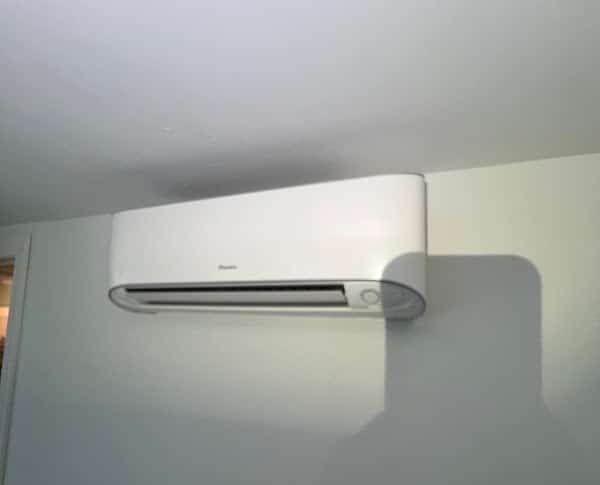
A ductless mini split indoor head we installed high on a wall in a Northern Virginia home.
Diamond Contractor
Mitsubishi Electric picks its Diamond Contractors and lists them on its own site.

A Mitsubishi Electric unit on one of our commercial jobs, set on rails above an aircraft hangar’s roof.
The warranty
Probably, if it’s under 10 years old and was registered. Here’s how it works.
Mitsubishi Electric’s statements: its warranty page.
Where we work
Out of Chantilly and Ashburn, across six counties. Pick your town for its own ductless mini split page: the houses there, the county’s permit rules, and the same prices.
Keep reading
Every make we work on, in one place: the brands we repair.
Asked on the phone
The diagnostic is $99, and the repair is priced in writing after it, because a drain clog and a failed board are very different jobs. A new one-zone Mitsubishi Electric system is $7,000 to $10,000 installed, two zones $11,000 to $15,000. From about $117 a month at 0% APR for 60 months, the whole price financed, on approved credit. How financing works
It’s reporting a fault. On an M-Series wall unit, count the blinks on the upper operation light between the 2.5-second pauses: 2 is an indoor sensor, 3 the indoor fan motor, 5 an outdoor compressor trip. The table on this page has the rest. A steady fast blink means the indoor and outdoor units aren’t talking.
Dust in the unit clogs the drain passage, and dirty filters make condensation inside it: Mitsubishi Electric’s own manual says both push water out of the indoor unit. It’s a cleaning and a drain fix, not a new unit. Water dripping from the outdoor unit is normal.
No. In heat mode the outdoor unit defrosts itself for up to 10 minutes, and the white vapor coming off it is steam, not smoke. It also won’t restart for about 3 minutes after you turn it off: that’s protection.
Mitsubishi Electric and Trane run a joint venture, Mitsubishi Electric Trane HVAC US, and Trane recommends Mitsubishi Electric mini splits. The co-branded Trane/Mitsubishi Electric systems are made by that joint venture.
The system we put in first
Built to take a beating. Put in by our crew.
Heat lamps, snow and rain on one outdoor unit: that’s Trane’s own film. We’re a Trane Comfort Specialist, on Trane’s own dealer locator, and when you pick a Trane, our crew puts it in.
Films: Trane’s own.
Get the room comfortable
Call (703) 997-9757, 24/7, or send the form at the top with the code it’s showing, and the office calls or texts you back.
SwiftPro Heating, Cooling & Plumbing
4230 Lafayette Center Dr N, Chantilly, VA 20151
44679 Endicott Dr, Suite 211, Ashburn, VA 20147
Virginia Class A contractor license #2705192276
New system prices are SwiftPro’s installed ranges by number of zones; a repair is quoted in writing after the diagnostic.
Mitsubishi Electric, Hyper-Heating INVERTER, H2i and Diamond Contractor® are trademarks of Mitsubishi Electric Corporation or Mitsubishi Electric Trane HVAC US LLC.