Written October 2026 by the SwiftPro team, with EPA’s refrigerant rules, Virginia’s code and Fairfax County’s permit page read the same week.
Commercial HVAC covers two kinds of equipment that often share a roof: the rooftop units and split systems that keep a building comfortable, and the walk-in coolers and freezers that keep a kitchen’s food cold. We work on both across Northern Virginia. In the last two years that has meant walk-ins in Marshall, Springfield, Herndon and Manassas, rooftop units from a 3-ton unit over one suite to 20-ton units over a sanctuary, and new rooftop units set by crane in Fairfax Station and Herndon. Book commercial HVAC and refrigeration service online, or call (703) 997-9757. We have 24/7 emergency service.
The short version for an owner or a property manager: have every unit looked at twice a year, spring for cooling and fall for heat, with the walk-ins on the same two visits. Expect every service call to end with something in writing. Know which refrigerant each system runs on, because EPA’s leak rules for commercial refrigeration took effect in January 2026 and its limits on new walk-in systems in July. And keep our number where whoever closes up at night can find it.
What commercial HVAC covers in a Northern Virginia building
Most shops, offices and restaurants here are heated and cooled by a packaged rooftop unit: one cabinet on the roof that does the cooling, the gas heat and the fan, sitting on a curb over an opening into the ductwork. EPA describes rooftop units as products that “combine the compressor, condenser, evaporator, and a fan for ventilation in a single package,” and calls them “common in small commercial buildings such as a single store in a mall.” Bigger floors often run commercial split systems instead, a condensing unit outside and an air handler inside. One Marshall store we redid in 2025 runs on two 10-ton Trane commercial splits and a 5-ton.
If there’s a kitchen, there’s refrigeration too: walk-in coolers and freezers, reach-ins and prep tables. A walk-in’s condensing unit sits on the roof or out back, and EPA describes that unit as “one (and sometimes two) compressor(s), one condenser, and one receiver assembled into a single unit, normally located external to the sales area,” piped to the evaporator inside the box. Keep that in mind for the refrigerant rules further down. Here’s what each piece is, and what we usually find when it quits:
| Equipment | Where it sits | What we usually find when it quits |
|---|---|---|
| Packaged rooftop unit | On the roof, on a curb over the ducts | A part, most of the time: a capacitor, a contactor, a belt, a blower or inducer motor, a zone sensor. In the fall, now and then, a cracked heat exchanger. |
| Commercial split system | Condensing unit outside, air handler inside | Leaks and compressor trouble on older systems. One store’s had blown its suction line off the compressor and lost its whole charge. |
| Walk-in cooler or freezer | The box inside, the condensing unit on the roof or out back | A failed temperature control, an evaporator iced solid because a fan stopped or the defrost isn’t happening, dirty coils, a plugged drain, a slow leak at an old braze joint or service valve, a tired compressor. |
| Make-up air and exhaust fans | On the roof over the kitchen line | Belts, bearings and motors. A dead make-up air motor once had a Springfield dining room smelling like gas, with the hood pulling air backwards through the brick oven. |
Kitchens have their own air problem, the balance between what the hood pulls out and what the make-up air brings back, and it has its own post: restaurant HVAC and the balance problem nobody diagnoses. Churches have theirs too, a big room that sits empty most of the week: heating a church that is empty six days a week, and our church HVAC service.
Commercial HVAC maintenance: spring, fall, and the walk-ins on both
Twice a year covers most buildings: spring before the cooling season, fall before the heat. ENERGY STAR’s checklist for restaurants gives the same advice, a tune-up “both pre-heating and pre-cooling seasons.” This is what each visit should cover, and what’s on you in between.
| When | Rooftop units and splits | Walk-ins and reach-ins |
|---|---|---|
| Spring visit | Coils cleaned, refrigerant pressures checked, condensate drains flushed, belts and filters changed, the economizer damper checked so it opens and closes when it should | Condenser and evaporator coils cleaned, the drain flushed, evaporator fans checked, the box temperature read against what the controller says |
| Fall visit | The heat exchanger, burners, gas pressure, the inducer, the igniter and flame sensor; filters and belts again | The same cleaning, plus the door gaskets and the defrost. A coil that ices up between defrosts is next month’s emergency call. |
| Every month, your part | Look at the filter. ENERGY STAR says check it monthly and change it at least every 3 months | The dollar-bill test on each door gasket, a check that every door shuts on its own, and a written log of box temperatures |
The walk-in column matters more than it looks. Virginia’s food regulations hold cold food at 41°F or less, so a box that drifts to 44 means deciding what to keep and what to throw out, and the health inspector will want to know about it. One walk-in we were called to in Marshall read 44°F because its temperature controller had quit. The gasket test comes from ENERGY STAR: close the door on a dollar bill, and if it pulls out easily, replace the gasket. Its page for restaurants counts “leaky walk-in refrigerator gaskets” and “freezer doors that do not shut” among the energy leaks that add up every month.
A kitchen loads filters and coils faster than an office does, so on a restaurant roof, plan on filters between the two visits, and put the make-up air filters and belts, and cleaning and sanitizing the ice machine, on the same two visits as everything else. We put all of this on an agreement priced per building, after we’ve walked the roof and counted the equipment. One rooftop unit or a whole roof of them.
What a commercial service call should leave you with
When the tech climbs down, you should have more than a running unit. Ask for these, from us or anyone else:
- The price before the work. We find what’s wrong and tell you what it costs before we fix it. A bigger repair or a replacement gets a written proposal with options.
- Findings in writing, by unit. What was wrong, what was done and what should happen next, tied to the unit it was on. On a roof full of identical units, “RTU 3” beats “the unit” every time.
- Photos of what they found. You probably weren’t on the roof. A picture of the burned contactor or the iced coil is how you see what you’re paying to fix.
- The refrigerant, by the pound. How much went in, and what kind. Refrigerant doesn’t get used up, so a system that needs some every summer is leaking, and the pounds are how you’ll know it’s getting worse.
- A plan if the part isn’t on the truck. One Herndon restaurant’s walk-in got through a weekend on temporary parts while the permanent repair was written up.
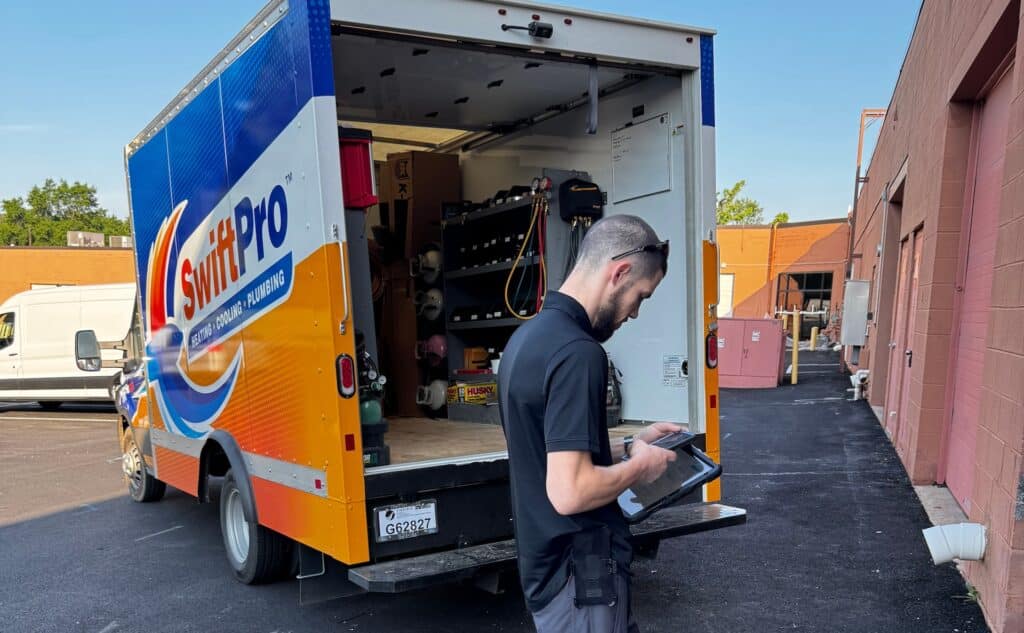
On some refrigeration systems that refrigerant record isn’t a courtesy anymore. Since January 1, 2026, on a system holding 15 pounds or more of HFC refrigerant, whoever services it has to give the owner a record of the equipment, the date, the parts worked on, what was done, the technician’s name, and the amount and type of refrigerant added. The owner keeps those records at least three years (40 CFR 84.106). Which systems that reaches is in the refrigerant section below.
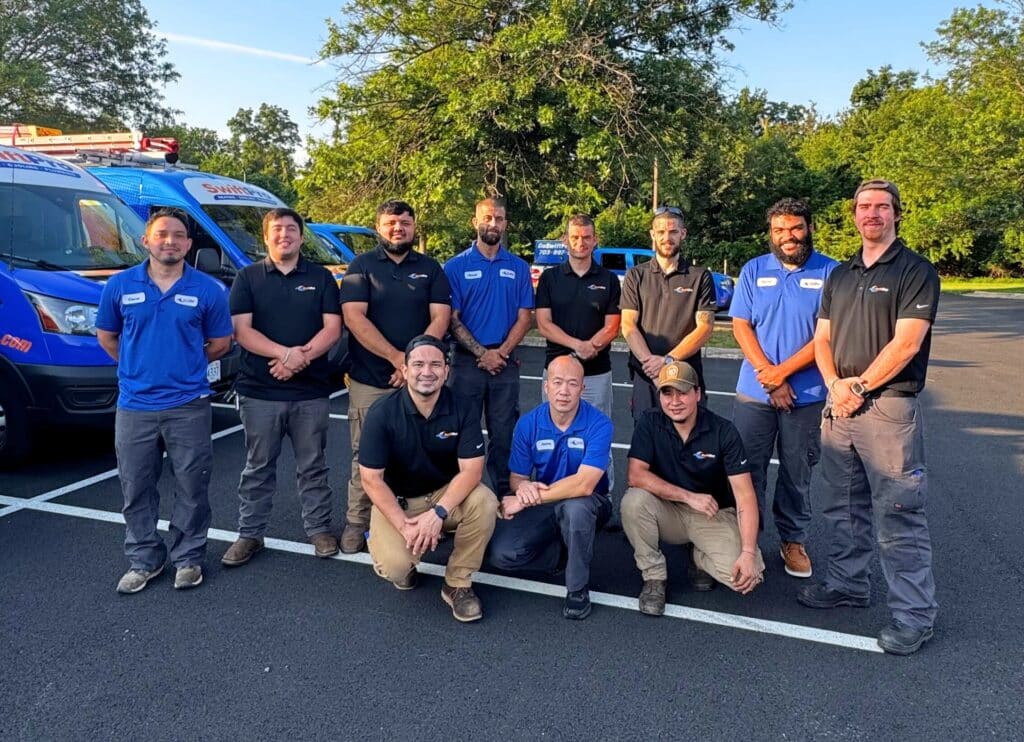
Efrain, Elvis and Moises handle a lot of our commercial calls. If a unit quits after you close, call anyway: we have 24/7 emergency service. Tell us which unit it is, what it’s doing and when you open.
Repair or replace a rooftop unit
Most rooftop unit repairs are a part, and a part is worth replacing on a unit of almost any age. Three things change the conversation. The first is a cracked heat exchanger, the metal box the gas flame burns in: when it cracks, combustion gas can get into the air your staff and customers breathe. We’ve found cracked ones on restaurant rooftop units in Gainesville and Alexandria in the last two years, and shut both units down. The second is a failed compressor on an old unit, where the rest of the cabinet is usually just as tired. The third is R-22. No new R-22 has been made or imported in the U.S. since January 1, 2020, so every recharge comes from recovered and reclaimed supply or what was made before then. A tight R-22 system with a good compressor can keep going. A leaking one is where we’d start talking about a new unit.
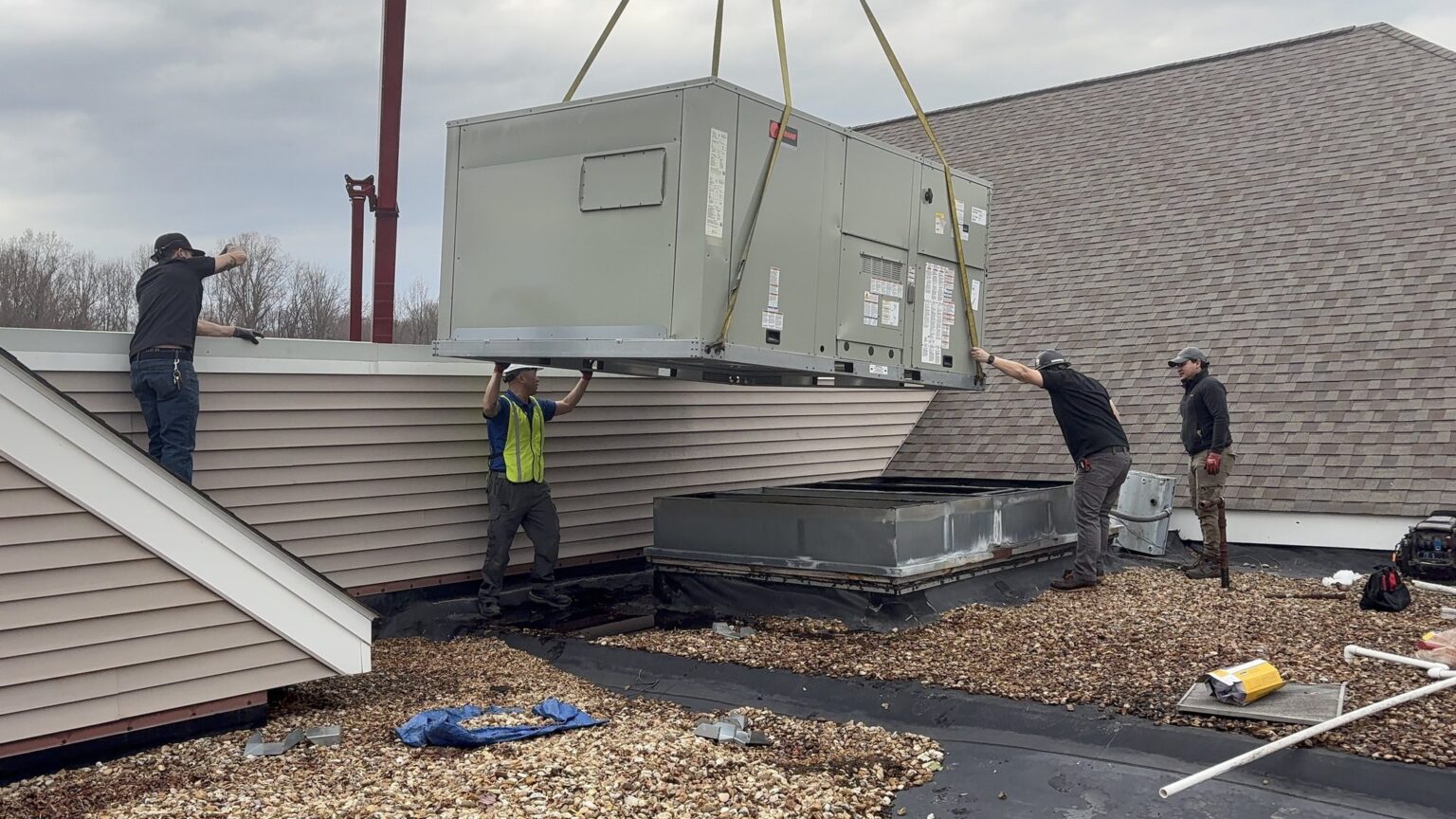
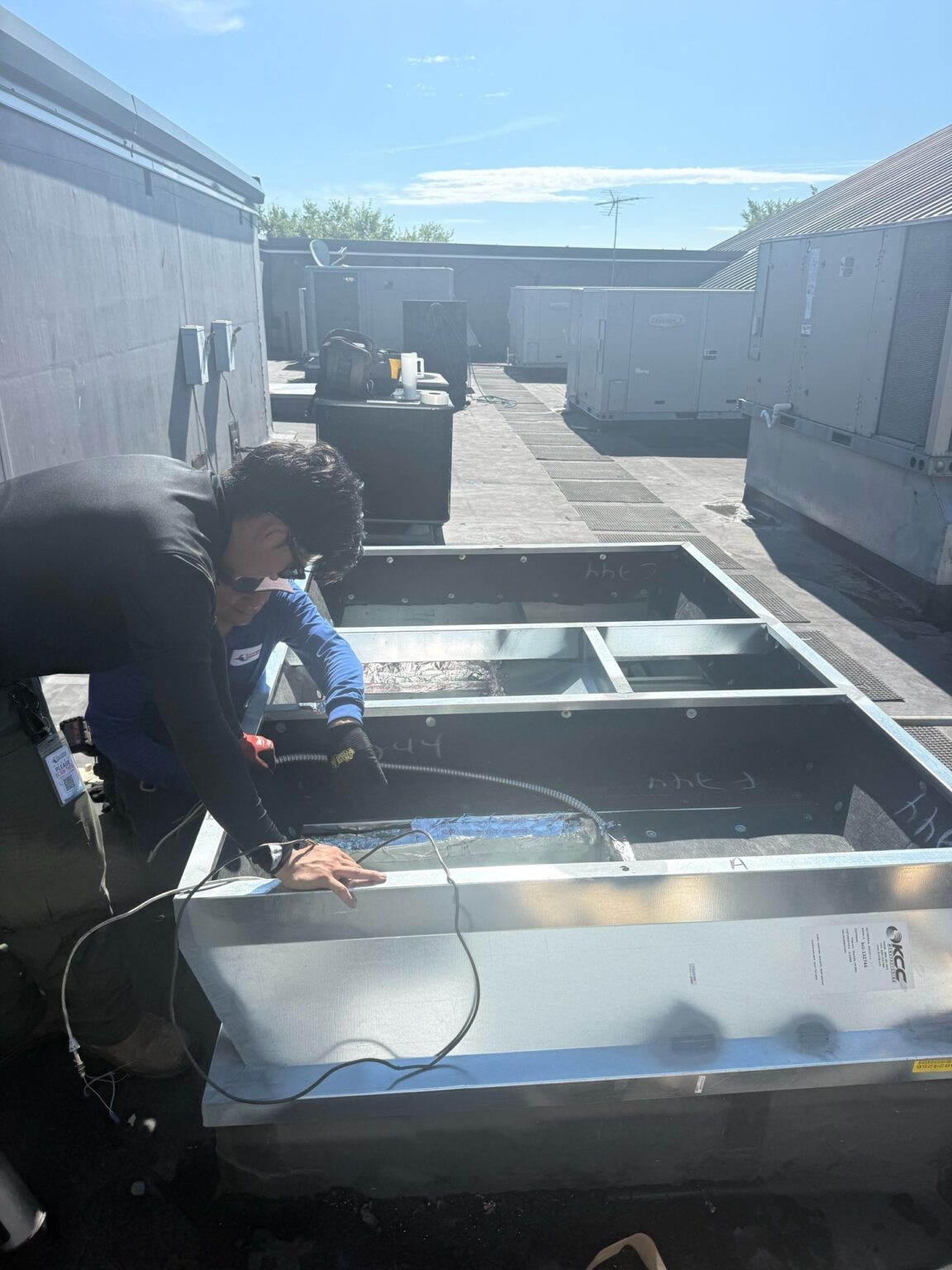
When a unit is done, replacing it is a project, not a service call. In July 2026 in Herndon, Efrain and a helper swapped a 3-ton rooftop unit from 2007, still on R-22 and its original compressor, for a Carrier 48FE packaged unit: the old unit off and the new one on by crane, then power and controls, gas piping, a drain trap and a new commercial thermostat. They also wrote up the building’s gas regulator, which couldn’t hold flow on high heat. Expect the same pieces on yours: the crane, a curb adapter if the new unit’s footprint doesn’t match the old curb, the hookups, and a permit. Fairfax County says commercial mechanical permits “are required for conversion, new, repair or replacement projects” and strongly recommends a licensed contractor pull them “as the responsible party.” You should know the day and the hours the unit will be off before anyone starts.
A new rooftop unit built since 2025 also runs on a different refrigerant from the R-22 or R-410A unit it replaces, which is the next section. For the fall inspection and the rest of the repair-or-replace math, including what to check before paying for a major part, see commercial rooftop units: the fall inspection, and when to stop repairing.
Refrigerant rules for a business in 2026
Two sets of federal rules reach a business’s equipment, and neither one makes you scrap something that works. EPA’s table of restrictions says it in a footnote: “Components used to repair existing systems are not subject to these restrictions.” What the rules change is the paperwork when a big system leaks, and which refrigerant a new system may use, judged by a number EPA calls global warming potential, or GWP. This is how they land on the equipment in a typical Northern Virginia building:
| Equipment | The leak rule | A new system or unit |
|---|---|---|
| Walk-in cooler or freezer on a condensing unit, HFC refrigerant such as R-404A | Covered at 15 pounds or more since January 1, 2026: the leak rate gets figured every time refrigerant goes in, and over 20 percent a year the leaks get found and fixed within 30 days | Installed on or after July 27, 2026: a refrigerant with a GWP under 1,400, and lower again from 2032 |
| Rooftop unit or commercial split system, HFC refrigerant such as R-410A or R-454B | Not covered: EPA left light commercial air conditioning out of the HFC leak rule | Built since January 1, 2025: a refrigerant with a GWP under 700 |
| Anything still on R-22 | Covered at 50 pounds or more under the older Section 608 rule: over 20 percent a year for commercial refrigeration, over 10 percent for comfort cooling | Not an option: no new R-22 has been made or imported since January 1, 2020 |
| Self-contained reach-in cooler or freezer | The same 15-pound line as a walk-in | Made or imported since January 1, 2025: a refrigerant with a GWP under 150 |
So the question for any walk-in is its full charge, the pounds of refrigerant it holds running normally. The first way EPA lists to find it is “the equipment manufacturer’s determination of the full charge”; another is a calculation from the component sizes and the volume of the piping. If yours is covered, the leak rate gets figured every time refrigerant goes in. Past 20 percent a year, a certified technician has to find the leaks and repair them within 30 days of that addition, with an initial and a follow-up verification test to show the repair held (40 CFR 84.106). The other road is a written plan to retrofit or retire the system.
Rooftop units and commercial splits are a different story. When EPA wrote that HFC leak rule in 2024, it exempted the residential and light commercial air conditioning and heat pump subsector, and it named the equipment: rooftop AC units, “single packaged units, split system central air conditioners and heat pumps,” and others. An old R-22 rooftop unit is another matter if it holds 50 pounds or more. The older Section 608 rule sets a 10 percent leak rate for comfort cooling, and the fix is a repair within 30 days, or a plan within 30 days to retrofit or retire the unit and finish within a year.
For new equipment the line is that GWP number, and EPA prints one for each refrigerant. On EPA’s table, R-404A rates 3,922, so a new walk-in system can’t go in on it after July 27, 2026; R-448A and R-449A rate 1,386 and 1,396, under that line for now. In 2032 it drops to 300 or 150, depending on the size of the system. On the air side, R-410A rates 2,088 and R-454B 465, which is why new rooftop units and splits built since 2025 run on R-454B or another refrigerant under 700. Pricing a new walk-in system or a new rooftop unit? Ask which refrigerant it uses, and where that number sits.
What to ask a commercial HVAC contractor
- Is the license active? Look anyone up on DPOR’s license lookup before they quote. Ours is Virginia Class A, number 2705192276.
- Who pulls the permit? On a replacement, the contractor should. Fairfax County recommends it.
- Is your insurance current? Ask for a certificate of insurance before anyone goes up on your roof, and check that its dates cover the job.
- What happens after hours? Ask who answers at 2 a.m. and what they do next. Ours is 24/7 emergency service: a walk-in that’s warming up or a building with no heat gets a technician on the way.
- Can planned work happen around our hours? Replacements and crane lifts get scheduled with you ahead of time, so the unit is off when it hurts least.
- What will I get in writing? The findings, the price before the work, and the refrigerant record. The list is above.
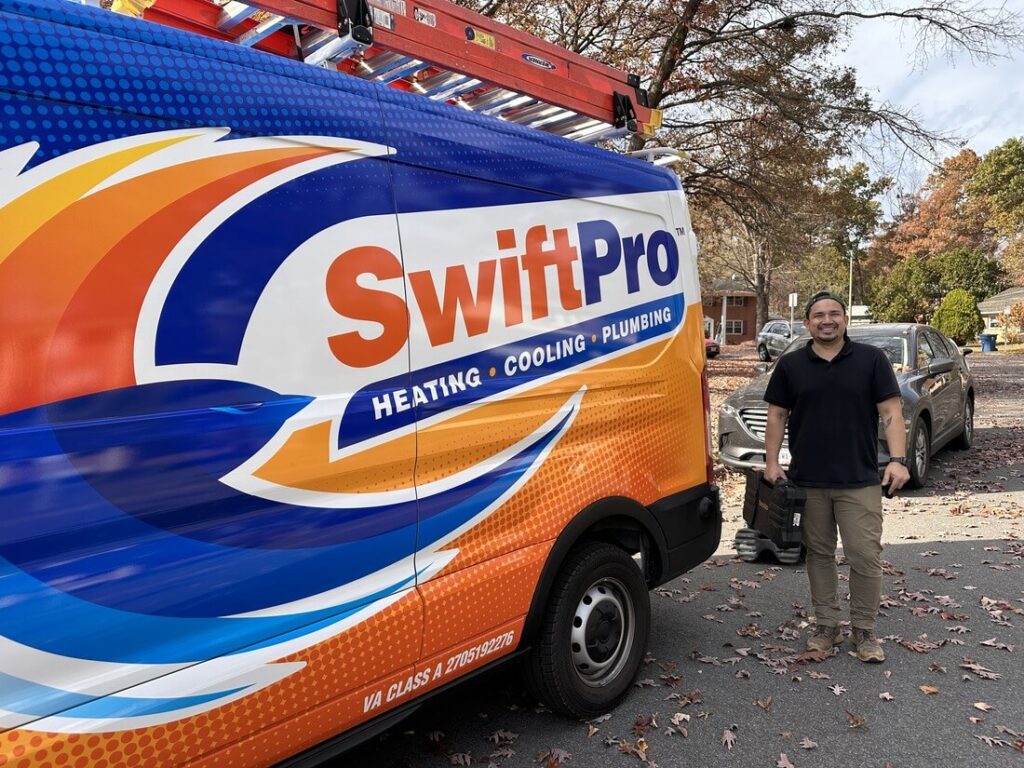
One more, if you look after more than one building: ask whether the same company can take the plumbing. We’re a heating, cooling and plumbing company, so one call covers the water heater in the back, the drain under the kitchen and the commercial backflow test the water utility asks for.
Commercial HVAC questions business owners ask us
What is commercial HVAC?
The heating, cooling and ventilation in a business building: mostly packaged rooftop units and commercial split systems, plus the make-up air and exhaust fans over a kitchen. Commercial refrigeration, the walk-ins, reach-ins and prep tables, usually gets serviced by the same company, often on the same visit.
What’s the difference between commercial and residential HVAC?
The equipment, mostly. A house usually has a split system: a furnace or air handler inside and a condenser in the yard. A shop or a restaurant usually has a rooftop unit that does it all in one cabinet, sits on a curb over the ducts, and comes off by crane when it’s done. Commercial work also gets scheduled around business hours, and in Fairfax County a replacement needs a commercial mechanical permit.
How often should commercial HVAC be serviced?
Twice a year for most buildings: spring for cooling, fall for heat. Check the filters monthly in between, the way ENERGY STAR suggests, because a kitchen loads filters and coils faster than an office. Put the walk-ins and the make-up air on the same two visits.
What does commercial HVAC maintenance include?
In spring: coils cleaned, refrigerant pressures, condensate drains, belts, filters and the economizer. In fall: the heat exchanger, burners, gas pressure, the inducer, the igniter and flame sensor. On walk-ins, at both visits: condenser and evaporator coils, drains, evaporator fans, door gaskets, the defrost, and the box temperature checked against the controller.
Do you have 24/7 emergency commercial HVAC service?
Yes. Call (703) 997-9757 any time, nights and weekends included, and tell us which unit it is and what it’s doing. A walk-in that’s warming up or a building with no heat gets a technician on the way.
Do I need a permit to replace a rooftop unit?
In Fairfax County, yes: the county says commercial mechanical permits are required for new, repair or replacement projects, and it strongly recommends a licensed contractor pull them as the responsible party. Ask whoever quotes the job to pull it.
What are the EPA leak repair requirements for commercial refrigeration?
Since January 1, 2026, a refrigeration system holding 15 pounds or more of HFC refrigerant has its leak rate figured every time refrigerant is added. Over 20 percent a year, a certified technician has to find and repair the leaks within 30 days and verify the repair, and the owner keeps the records at least three years. Systems still on R-22 fall under the older Section 608 rule, which starts at 50 pounds.
Can I keep repairing an R-22 or R-410A unit?
Yes. EPA’s limits on refrigerants apply to new systems, and its own table says components used to repair existing systems aren’t restricted. No new R-22 has been made or imported since 2020, so it comes from reclaimed supply or stock made before then. A tight R-22 system with a good compressor can keep going; a leaking one is when we’d start the replacement conversation.
Do you repair walk-in coolers and walk-in freezers?
Yes. Most of our refrigeration work is walk-ins, reach-ins and prep tables in restaurant kitchens: controls, fans, defrost, coils, leaks and compressors.
Do you offer commercial HVAC maintenance agreements?
Yes. They’re priced per building once we’ve walked the roof and counted the equipment, and they cover two visits a year. Restaurants on one get their refrigeration done on the same visits.
Tell us what the unit is doing
Call (703) 997-9757 any time, day or night, or book online. Tell us the equipment, what it’s doing and when you’re open. Everything we do for businesses, and the form to book it, is on our commercial HVAC and refrigeration page.
SwiftPro Heating, Cooling & Plumbing works on commercial HVAC and refrigeration across Northern Virginia, from our shop in Chantilly. We’re a Trane Comfort Specialist and Carrier experts. Family owned, BBB Accredited with an A rating, 24/7 emergency service, Virginia Class A contractor license 2705192276, and rated 5.0 stars across 1,131 reviews on Google, Angi, Yelp, the BBB and Facebook. Read the reviews.