


The short answer
When a dishwasher in a Northern Virginia kitchen leaves dirty water in the bottom, the problem is usually somewhere between the dishwasher’s own filter and the sink drain it empties into, not the dishwasher itself. A dishwasher has no drain of its own. It pumps its water through a hose into the garbage disposal or the sink’s tailpiece, and from there it goes down the same pipe as the sink. So a clogged filter, a sink drain packed with grease, a disposal full of food and a kinked hose all look the same: water standing in the tub when the cycle ends. Check the filter first, then the sink. The pump is the last suspect, not the first.
A little water in the small well under the filter is normal. Many dishwashers keep a cup or so there on purpose so the seals don’t dry out. An inch or more across the floor of the tub is not.
What you see, and what it usually is
Swipe to see all columns →
Swipe to see all columns →
| What you see | What it usually is | How soon |
|---|---|---|
| An inch of dirty water after every cycle, the sink drains fine | The dishwasher filter, packed with food and grease | Today. It’s a ten-minute fix. |
| Dishwasher won’t drain and the kitchen sink is slow too | A clog in the sink drain the dishwasher empties into | This week. It’s one clog, and it’s getting worse. |
| The disposal was just replaced and the dishwasher hasn’t drained since | The knockout plug inside the new disposal’s dishwasher inlet was never knocked out | Now. It’s a five-minute fix. |
| Water spits out of the chrome cap on the back of the sink | The air gap, or the hose from it to the disposal, is clogged | This week. |
| Sink water runs back into the dishwasher | The kitchen drain is blocked, and the hose has no high loop or air gap (kitchen sink backing up) | Soon. Dirty sink water is getting into a clean machine. |
| It hums at the end of the cycle, nothing moves, and the sink is clear | The drain pump, or something caught in it | That’s the dishwasher itself. |
Free Second Opinion
Holding a big HVAC or plumbing quote? A tech looks at the system you were quoted on and tells you what it actually needs, with our price if you want it. Get a second opinion
What the error codes mean
Most newer dishwashers tell you when they can’t drain, with a code on the display. These are the drain codes on the common brands. More codes from around the house are in error codes and warning lights.
Swipe to see all columns →
Swipe to see all columns →
| Brand | Code | What it’s telling you |
|---|---|---|
| Bosch | E24 | Water isn’t draining. Check the filter, the hose and the sink drain. |
| Bosch | E25 | The drain pump is blocked. Something is caught under the pump cover. |
| LG | OE | Drain error. The water didn’t leave in time. |
| Samsung | 5C, SC or 5E, depending on the display | Drain error. |
| Whirlpool, KitchenAid | F9E1 | A long drain. It took too long to empty. |
| Frigidaire | i20 | A drain problem. |
Every one of those codes starts the same way: the water didn’t leave. Check the filter and the sink drain before you blame a part. If the code comes back with both clear, it’s the pump.
Fix it in this order
- Turn the dishwasher off. Unplug it or switch off its breaker before you reach into the bottom.
- Pull the filter. On most dishwashers it’s a round cylinder in the floor of the tub that twists out a quarter turn. Rinse it under the tap and scrub the mesh with an old toothbrush and a drop of dish soap. It’s the first thing to check, and often the whole fix.
- Sponge out the standing water, then look in the well under the filter for broken glass, a cherry pit or a bottle cap. Those jam the pump.
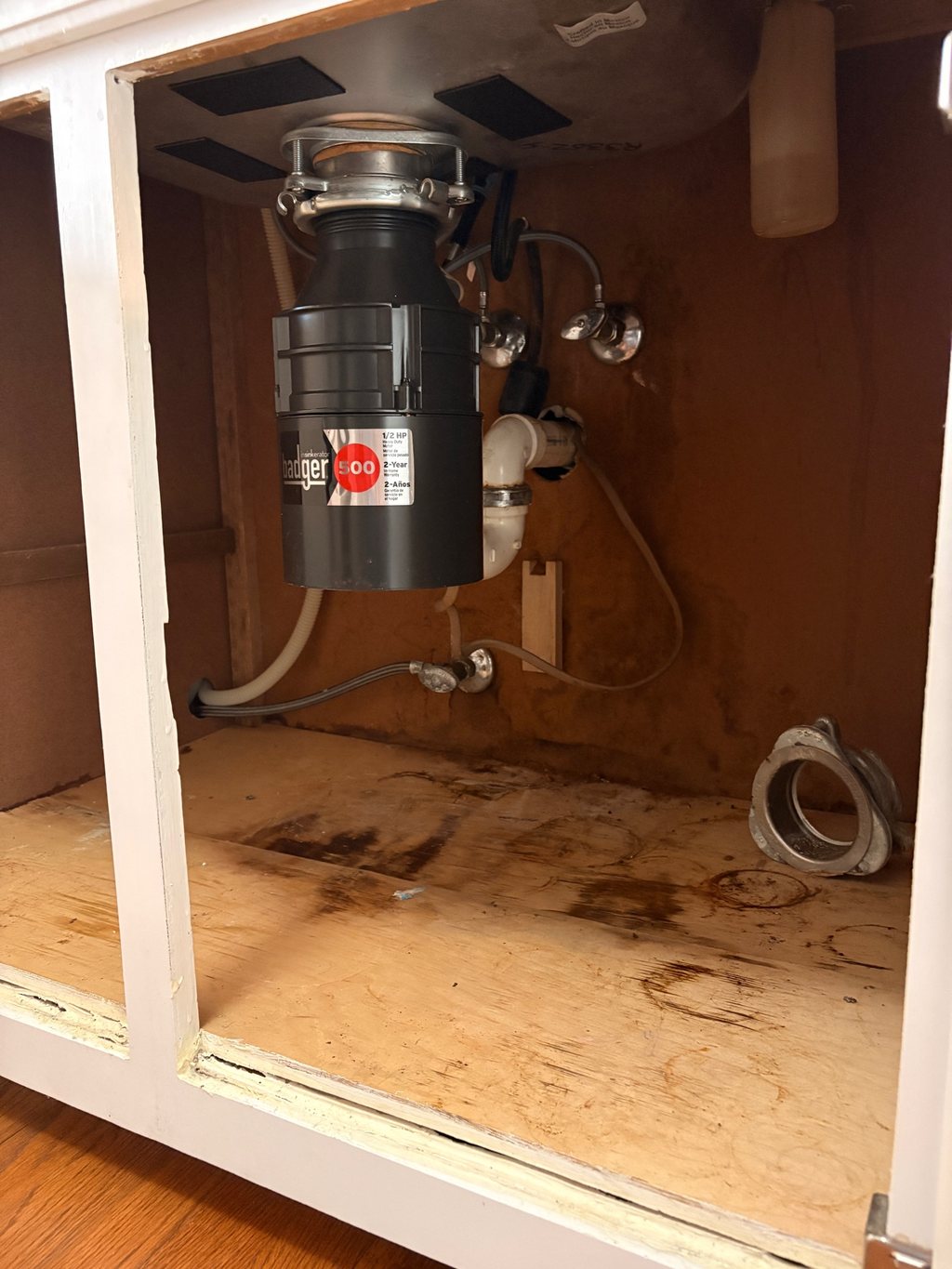
- Run the garbage disposal with cold water for 30 seconds. The dishwasher drains into it, and ground food sitting in the disposal blocks the way.
- Run the kitchen sink hard. If it’s slow, the dishwasher can’t drain either, and the sink drain is the real job (how to unclog a sink drain).
- Just put in a new disposal? Check the knockout. A new disposal comes with a plastic plug inside its dishwasher inlet. With the power off and the hose off, a screwdriver and a tap of a hammer knock it into the disposal. Fish it out, then reconnect the hose.
- Look at the drain hose under the sink. A trash can or a bottle of cleaner pushed against it will kink it. It should loop up high under the counter, or run to an air gap, before it comes down to the disposal.
- Run a short rinse cycle and watch it drain.
The air gap, and why it spits water
The air gap is the small chrome cylinder on the back of the sink, next to the faucet. The dishwasher hose runs up to it, and a second hose runs from it down to the disposal. The open gap inside means dirty sink water can never be pulled back into the dishwasher. When water spits out of it during a cycle, the hose from the air gap to the disposal is clogged, or the disposal is full. Pull the chrome cap off, unscrew the plastic cover under it, and clear the gunk with a bottle brush. Run the disposal. If it still spits, the short hose under the sink needs clearing or replacing.
No air gap? Then the drain hose should loop up and be fastened high under the counter. That loop does the same job. A hose that sags to the cabinet floor lets sink water run back into the dishwasher, which is why some people find dirty water in a dishwasher they haven’t run.
Mistakes that make it worse
- Drain cleaner. Don’t pour it into the dishwasher or the sink it drains into. It sits in the tub, it’s hard on rubber seals, and it’s still in the line when somebody has to open it (is Drano bad for pipes).
- Grease down the sink. The dishwasher shares that drain, so the grease poured in the sink is what the dishwasher’s water runs into. Let it cool in a can and put it in the trash (what never goes down a drain).
The dishwasher, or the plumbing?
If the sink drains fast, the filter is clean, the hose isn’t kinked and the code still comes back, the drain pump is the part, and that’s an appliance repair. If the sink is slow, or water comes up in it while the dishwasher runs, it’s the drain, and that’s a plumber.
When to call
Call when the sink is slow too, when the air gap spits and cleaning it didn’t help, when water comes up in the sink while the dishwasher runs, or when you’ve cleaned the filter and it still sits full. SwiftPro’s $99 drain clearing covers the kitchen sink drain up to the P-trap. Deeper drain or main sewer-line work is a separate service, and we’ll give you that price before we start. A clog farther down the kitchen line runs $200 to $800. There’s $50 off any plumbing repair over $400, and the whole-house plumbing inspection is included with any repair, a $149 value (every current deal).

Book it
Book the $99 drain clearing. Call (703) 997-9757, or book online from goswiftpro.com/cookiesoffer and a box of warm cookies comes with the visit. Our plumbers work in Chantilly, Centreville, Fairfax, Burke and across Northern Virginia, 24 hours a day. Rated 5.0 stars across 1,138 reviews on Google, Angi, Yelp, the BBB and Facebook, Virginia Class A license 2705192276.
Questions people ask
Why is there water in the bottom of my dishwasher?
A cup or so in the small well under the filter is normal on many machines. More than that means the water couldn’t leave: usually a clogged filter, then a clogged sink drain or garbage disposal, a kinked drain hose, or a blocked air gap. Clean the filter first.
Can a clogged sink cause the dishwasher not to drain?
Yes. The dishwasher pumps into the disposal or the sink’s tailpiece, so it shares the sink’s drain. If the sink is slow, the dishwasher can’t empty.
How do I get my dishwasher to drain?
Turn it off, clean the filter, clear the well under it, run the disposal, check the drain hose for kinks and clean the air gap. Then run a rinse cycle. If it still won’t drain and the sink drains fine, it’s the drain pump.
What does E24 mean on a Bosch dishwasher?
E24 means water isn’t draining: a clogged filter, a kinked hose or a blocked sink drain. E25 means the drain pump itself is blocked, usually by something caught under the pump cover.
Why does my dishwasher air gap leak?
Water spits out of the air gap when the hose from it to the disposal is clogged or the disposal is full. Clean the air gap cap, run the disposal, and if it keeps spitting, have the hose cleared.
How much does it cost to fix a dishwasher that won’t drain?
If it’s the kitchen drain, SwiftPro clears it up to the P-trap for $99, and a clog farther down the line runs $200 to $800. If the drain is clear and the dishwasher’s pump has failed, that’s an appliance repair.


