


The short answer
Every big system in a Northern Virginia house has a way of telling you something’s off: a blinking light on the furnace board, flashes on the water heater’s gas control, a number on a tankless or a mini split, a message on the thermostat, a beep from an alarm. Most of the time it’s one of two things: normal status, or a fault the system already shut itself down for. A few mean get out, or turn it off now.
Swipe to see all columns →
Swipe to see all columns →
| System | Where the code shows | Normal | Call now |
|---|---|---|---|
| Gas furnace | A light behind the window in the lower door | Steady, or a slow blink | Flame with no call for heat, or a limit code that keeps coming back |
| Gas tank water heater | A light on the gas control | One slow blink every 3 seconds | 4 flashes (too hot), 8 flashes (flame with the knob off), any gas smell |
| Tankless water heater | A number on the front panel | The temperature setting | An ignition code that keeps coming back. LC on a Rinnai means descale |
| Thermostat | Words on the screen | Heat On or Cool On flashing up to about 5 minutes | A blank screen, or Waiting For Equipment that never ends |
| Heat pump outdoor unit | A light on the board inside the service panel | Steady, or a slow blink | A scream, a buzz with no fan, ice that won’t clear |
| Mini split | Lights blinking on the indoor head | The operation light on, steady | A blinking pattern. Mitsubishi mini split codes |
| Boiler | A display code, and the pressure gauge | About 12 to 15 psi with the water cold | Pressure near 30 psi, or the relief valve dripping |
| Carbon monoxide alarm | Beeps | Silent | Four beeps and a pause: get out |
| Sump pump | A high-water alarm | Silent | Any alarm: water is rising in the pit |
| Drains and sewer | No code. Water at the lowest drain in the house | Every drain clears on its own | Water coming up the basement floor drain or a lower tub |
| Well pump | The pressure gauge by the tank | Steady water pressure | A pump clicking on and off fast, or no water |
| Leak sensor | A beep or a phone alert | Silent | Any alert near the water heater |
Furnace
Count the flashes on the control board light, match the chart on the door, and don’t pull the door off first: that clears the code. Our furnace blinking light guide covers what the code families mean and which you can reset. Brand charts: Carrier, Bryant, Payne, Goodman (and its two-digit display), Amana, Lennox (red light here, green light here), Trane, American Standard, York, Luxaire, Coleman, Armstrong Air, Ducane, AirEase, Rheem and Ruud. An older furnace may have a standing pilot, not a board light: here’s how to tell and relight it.
Most codes point at one part. The usual two are the flame sensor (Carrier, Goodman, York, American Standard) and the pressure switch (Carrier, York, American Standard, Armstrong Air), plus the inducer motor it checks. Some codes have their own page: Bryant 31, Bryant 33, Lennox E228 and E229. A reset is fine once, never as the fix. Here’s how on a Carrier, a Lennox and a Goodman.
The $67 Heating Check
We check your furnace, heat pump or boiler before winter. Through December 31. See the offer
Water heaters
A gas tank blinks a count on its gas control. Our water heater blinking light chart covers the common counts and power vent codes. By brand: Bradford White codes, A. O. Smith codes and Rheem codes. A tankless shows a number: Rinnai codes, Navien codes, Rheem tankless codes, or start with tankless water heater problems.
No light at all? An older tank has a standing pilot: here’s how to light it, what to check when the pilot keeps going out, and how to tell a bad thermocouple. An electric tank that went cold may have tripped its reset button. A dripping relief valve isn’t a code, but it’s telling you something, and so is hot water that smells like rotten eggs: that usually starts at the anode rod. A leak sensor going off by the tank? Here’s what to do when the water heater leaks.
Thermostats
Most screen messages are a delay or a schedule doing its job. Thermostat messages goes through each one. A flashing snowflake or Wait is usually the compressor delay, up to 5 minutes. A blank or offline smart thermostat is often low on power: the batteries or the C wire. By brand: Nest, Sensi, Amazon, White-Rodgers, Daikin One, Lennox, Trane, Carrier, Bryant Evolution and American Standard. A Nest on a Trane or a Carrier system has its own wiring rules. Before a factory reset, try the safe restart on a Trane or a Lennox, and here’s what a Trane ComfortLink II alert means.
The system we put in first
Built to take a beating. Put in by our crew.
Heat lamps, snow and rain on one outdoor unit: that’s Trane’s own film. We’re a Trane Comfort Specialist, on Trane’s own dealer locator, and when you pick a Trane, our crew puts it in.
Films: Trane’s own.
Heat pumps and mini splits
The outdoor unit has a status light on its board too, but leave that panel closed. It’s high voltage, and the capacitor holds a charge after the power is off. If the outdoor unit acts up, switch the thermostat to Em Heat to stay warm and call. Heat pump codes by brand: Carrier, Goodman, Lennox, Rheem.
A mini split blinks its code on the indoor head, and some read it out on the remote: Mitsubishi, Daikin (and its blinking green light), Fujitsu, LG, Samsung, MRCOOL and Carrier. Water dripping from the head is its own fix. If the problem is a sound, not a light, see heat pump noises or mini split noises.

Boilers
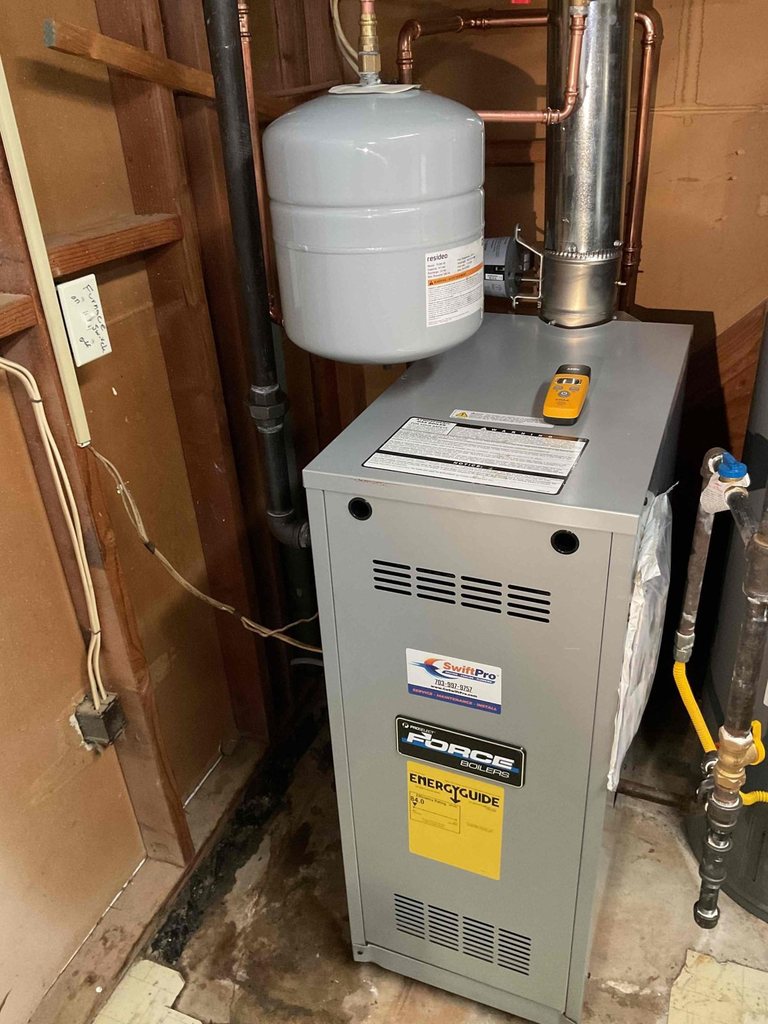
Newer boilers show a code on a display, and every brand numbers them its own way. The pressure gauge is the code every boiler has: about 12 to 15 psi with the water cold, a bit higher when it’s hot. The relief valve opens at 30 psi, so a needle climbing toward 30, or water dripping from the relief valve pipe, means call. If the radiators are cold, start with radiators not heating. More on boiler service and repair.
Alarms that beep
A carbon monoxide alarm sounding four beeps and a pause, over and over, means it’s sensing CO. Get everyone out and call 911 from outside, then read what to do when the CO alarm goes off. A single chirp about once a minute is a low battery, or an alarm at the end of its life. Smoke alarms use three beeps.
A sump pump high-water alarm means water is coming in faster than the pump is moving it out, or the pump stopped. A chirp from the backup battery is a different alarm: here’s how to tell the two apart. Then what a hum, a click or silence means when the sump pump is not working, what to check when a sump pump stops working, how the float switch sticks, and what sump repair and replacement cost.

Drains and sewer
Drains don’t have codes, except the dishwasher: here are its drain codes. A disposal that goes silent usually needs its reset button. Otherwise the warning is water showing up where it shouldn’t, at the lowest drain in the house. Water coming up the basement floor drain when the washer empties can be lint in that one line, or a clog in the main: here’s how to tell which. If more than one drain is slow or backing up, read the signs of a main sewer line clog.
Once a camera goes down the line, these are the usual findings: tree roots, a belly (a sag that holds water), and cast iron pipe rotting from the inside. And when it’s time to clear it, here’s hydro jetting vs snaking.
Well pumps
A well has one gauge, on the line by the pressure tank. Read it first when the pressure drops. A pump that clicks on and off fast usually means a waterlogged pressure tank, and a switch that chatters or won’t kick on is the pressure switch.
No code, still not working
Sometimes there’s no code, just a house that won’t heat or cool. Start with what it’s doing: an AC that won’t turn on (Carrier, Trane) or runs but won’t cool (Carrier, Lennox, Trane), a furnace that won’t turn on (American Standard, York), a Lennox blowing cold air or not lighting, a heat pump running but not heating (Trane, American Standard, York), a mini split not heating or cooling, or a furnace or heat pump that never shuts off. On a Goodman, here’s the troubleshooting order.
The sounds side
Codes are what a system shows you. Noises are what it tells you. Our guide to house noises covers the whole house, and these go deeper: water heater noises, water hammer, heat pump noises, ductwork popping, furnace noises and toilet noises.
Book it
A heating or cooling repair visit starts with a flat $99 diagnostic, or $250 after hours. A plumbing diagnosis visit is $49, or $250 after hours. Either way you get the price of the fix before we start. Call (703) 997-9757, day or night, or book the heating check or the water heater flush from goswiftpro.com/cookiesoffer by November 30 and a box of warm MOLTN cookies comes with it. Every current deal is on our offers page. Rated 5.0 stars across 1,138 reviews on Google, Angi, Yelp, the BBB and Facebook, Virginia Class A license 2705192276.
Questions people ask
What does a blinking light on my furnace mean?
A steady light or a slow blink is normal. A pattern of quick flashes with a pause is a fault code. Count it and match it to the chart on the inside of the furnace door.
Why is my water heater light blinking?
One slow blink about every three seconds is normal. A count of quick flashes is a fault code on the gas control: 2 is a weak pilot, 4 is too hot, 7 and 8 are gas control faults.
What do four beeps on a carbon monoxide alarm mean?
The alarm is sensing carbon monoxide. Get everyone out of the house and call 911 from outside.
Why does my alarm chirp about once a minute?
A single chirp about once a minute is a low battery or an alarm at the end of its life. Check the date on the back. Most wear out somewhere between 7 and 10 years.
What does a flashing snowflake on my thermostat mean?
Usually the compressor delay. The thermostat holds the outdoor unit off for up to 5 minutes after it stops, so it doesn’t restart against pressure. If it keeps flashing past that, the system needs a look.


