The short answer
The anode rod is a metal rod that hangs inside your water heater and corrodes on purpose, so the steel tank doesn’t. When it’s eaten down to its wire core, the water starts on the tank instead, and that’s the start of a leak. In Northern Virginia, check it every 2 to 3 years, more often if you run a water softener, and replace it when 6 inches or more of bare wire shows.
What it does
The inside of a tank is steel with a glass lining, and no glass lining is perfect. Hot water finds every pinhole. The anode rod is a more reactive metal, so the water goes after it first and leaves the steel alone. It’s called a sacrificial anode because that’s its whole job: to get eaten so the tank doesn’t. A tank with a healthy anode can outlast its warranty by years. A tank with a spent one rusts from the inside out.
$99 Water Heater Flush
We drain and flush the tank, check the anode rod and test the relief valve, then go through the house's plumbing with photos, included. See the flush
Want your own number before anyone comes out? The water heater estimator prices your house in a few questions.
The three kinds
Swipe to see all columns →
Swipe to see all columns →
| Type | What to know |
|---|---|
| Magnesium | The usual one. Protects best, wears fastest, and it’s the one that reacts with sulfur bacteria to make the rotten-egg smell |
| Aluminum/zinc | Wears slower. The zinc tames the rotten-egg smell, which makes it the usual swap on well water |
| Powered | A titanium rod that plugs into an outlet and runs a small current. It doesn’t wear away, and it stops the smell |
Where it is
On most tanks it’s a hex head on top of the tank, under a plastic cap or right on the metal. Some tanks use a combination anode built into the hot water outlet fitting instead, and some have both. The rod itself runs most of the height of the tank.

When to replace it
- 6 inches or more of the steel core wire shows.
- It’s thinner than about half an inch anywhere along its length. New ones are about three quarters of an inch.
- It’s caked in hard scale that’s flaking off in chunks.
- The hot water smells like rotten eggs and the cold doesn’t.
- The hot water runs rusty or brown, and the cold runs clear.
Softened water eats anodes faster, so a house with a softener should have it checked every year or two. Hard water coats the rod in scale and fills the bottom of the tank with sediment, so a regular flush pays off there. More on hard water in Northern Virginia.
The rotten-egg smell
If only your hot water smells like rotten eggs, the anode is usually part of it. Sulfur bacteria in the water react with a magnesium rod and make hydrogen sulfide gas. It’s common on well water. The fix is to swap the magnesium rod for an aluminum/zinc or a powered one and disinfect the tank. Our house smells guide covers the other smells and what they mean.
Can you check it yourself?
You can, with care. Turn the gas control to OFF, or the breaker off on an electric tank. Shut the cold water valve, open a hot tap to drop the pressure, and drain a few gallons. Then it takes a 1 1/16 inch socket and a breaker bar, because the hex is usually seized. Two things go wrong: the tank twists and strains its pipes, or there isn’t room over the tank to pull the rod out. That second one is why segmented, bendable rods exist.
If the anode won’t budge on an older tank, take that as information. A tank that’s 10 or more years old with its first anode has likely started on the steel. Here’s how long a water heater lasts and how to read its age.
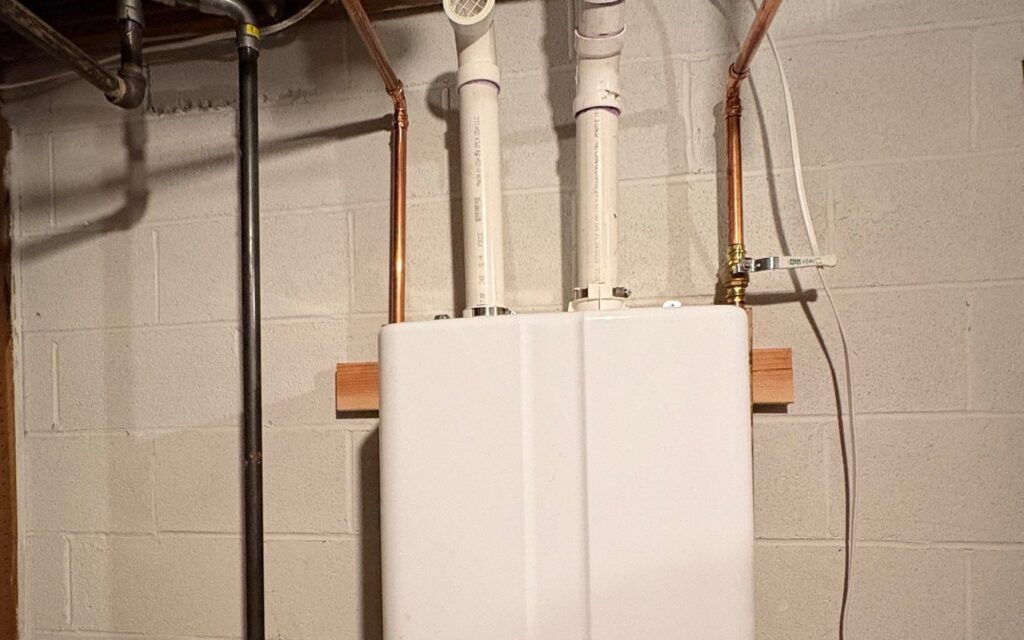
Tankless heaters don’t have one
No tank, no anode. A tankless heater’s enemy is scale in the heat exchanger, and it gets descaled instead. See tankless maintenance.
What we do
The water heater flush is $99 (normally $199): we drain and flush the tank, check the anode rod and test the relief valve, then go through the house’s plumbing with photos, included. If the rod’s spent, you see it, and you get the price to replace it before we touch it. If the tank’s spent too, the water heater estimator shows your installed price first, and $500 comes off it. More on water heater maintenance.
Book it
A plumbing diagnosis visit is $49, or $250 after hours, and you get the price of the fix before we start. Call (703) 997-9757, day or night, or book the water heater flush from goswiftpro.com/cookiesoffer by November 30 and a box of warm MOLTN cookies comes with it. Every current deal is on our offers page. Rated 5.0 stars across 1,138 reviews on Google, Angi, Yelp, the BBB and Facebook, Virginia Class A license 2705192276.
Questions people ask
How often should a water heater anode rod be replaced?
Check it every 2 to 3 years and replace it when 6 inches or more of core wire shows. With a water softener, check it every year or two, because softened water eats anodes faster.
What happens if you don’t replace the anode rod?
Once the rod is gone, the water corrodes the steel tank instead, and that ends in a leak. A spent anode is one of the main reasons tanks fail early.
Does the anode rod cause the rotten egg smell?
Often. Sulfur bacteria react with a magnesium rod and make the smell. Swapping to an aluminum/zinc or powered anode usually fixes it.
Where is the anode rod on a water heater?
Usually a hex head on top of the tank. Some tanks have a combination anode in the hot water outlet instead.
Do tankless water heaters have an anode rod?
No. There’s no tank to protect. Tankless heaters get descaled instead.