October 2026: every lifespan figure and serial number code read on the maker’s or agency’s own site, prices from our current price book.
Most tank water heaters last 8 to 12 years, by the makers’ own count, and a tankless one can reach 20 with a yearly descale. When yours is done, a new tank installed in Northern Virginia runs $2,757 to $7,494 in our price book, with the permit, the expansion tank, the drain pan and hauling the old one away all in that number.
From about $46 a month at 0% APR for 60 months, the whole price financed, on approved credit. How financing works
Where your tank lands in that range has more to do with the water and the upkeep than the name on the front. The water here is moderately hard to hard, and that pushes a tank nobody flushes toward the short end. Below: the number for every kind of water heater, what wears one out, the signs it’s going, how to read its age off the label, what a new one costs and how long the swap takes.
How long does a water heater last? The short answer by type
| Water heater | How long it lasts | Who says so |
|---|---|---|
| Gas tank | 8 to 12 years, often the short end | A.O. Smith says gas tanks may start failing around 6 to 10 years. Rheem puts the average near 10 |
| Electric tank | 8 to 12 years, often the long end | A.O. Smith says closer to 10 to 12. Rheem says a bit longer than gas |
| Heat pump (hybrid) tank | 10 to 15 years | A.O. Smith says 12 to 15, Rheem 10 to 15. ENERGY STAR works out its savings over 13 |
| Tankless, gas | Up to 20 years, or more | Navien and Rinnai say up to 20. The Department of Energy says more than 20 |
For tanks in general, A.O. Smith, Bradford White and Rheem all say 8 to 12 years, and the Department of Energy says 10 to 15. Those numbers assume a heater that was sized and installed right and looked after. On a tank, the steel is what wears out, and once it rusts through it can’t be patched. So the real question is how fast the inside of yours is going, and that’s mostly the water, the anode rod and the flush.
Tank vs. tankless, gas vs. electric vs. heat pump
Gas or electric tank. Both are a steel tank with a glass lining and an anode rod. The makers who split them say electric tends to outlast gas: A.O. Smith gives gas 6 to 10 years and electric 10 to 12, and Rheem says electric may last a bit longer than gas’s average of about 10. A.O. Smith’s reason is that a gas heater has more parts that can break, the ones that handle its exhaust. Bradford White and the Department of Energy give one number for both. Either way, the fuel you have is usually the fuel you keep.
Heat pump (hybrid). An electric tank with a small heat pump on top. A.O. Smith puts its hybrids at 12 to 15 years, Rheem says 10 to 15, and ENERGY STAR figures its savings over 13. It has more parts than a plain tank (a compressor, a fan, a condensate drain, an air filter Rheem says to clean every 3 to 6 months), but the tank underneath is the same story. Whether one fits your house, and Dominion’s rebate.
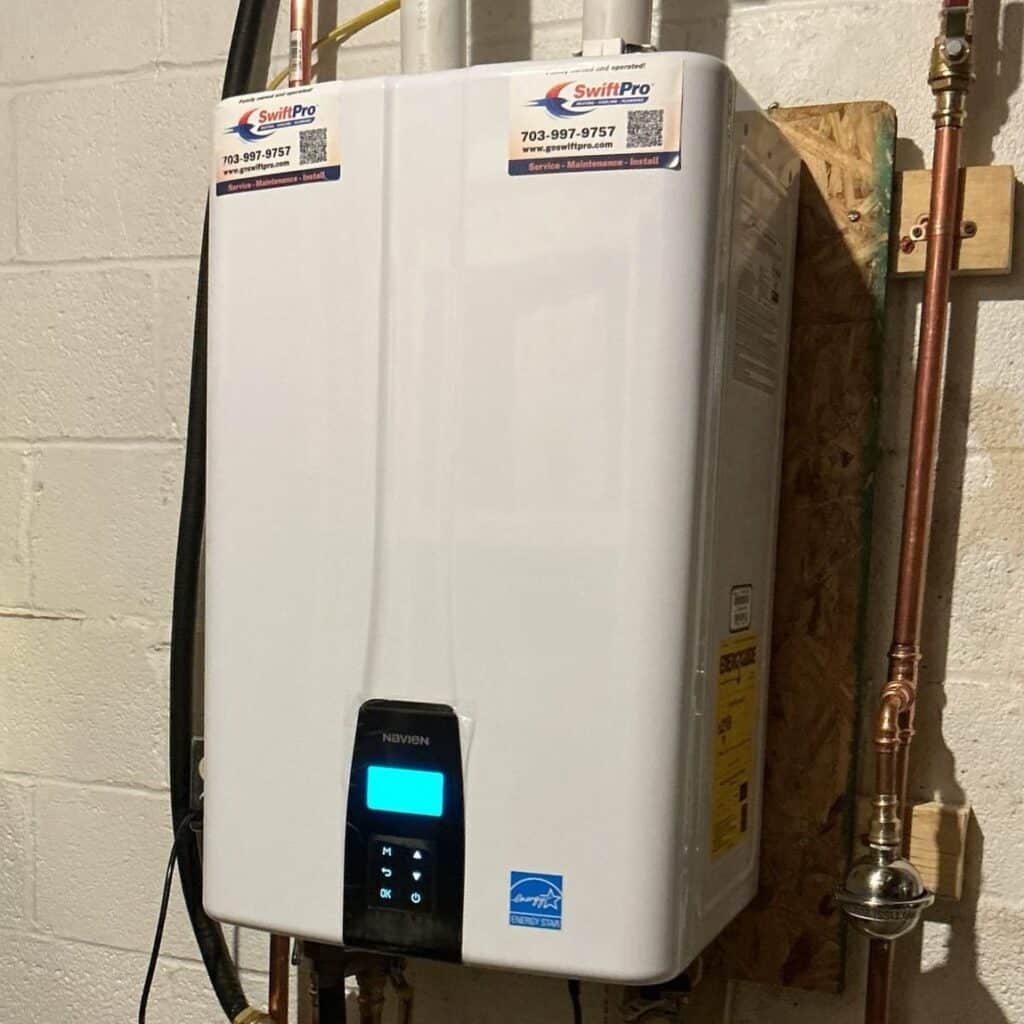
Tankless. No tank to rust out, and the parts that wear can be replaced. Navien and Rinnai both rate theirs for up to 20 years, and the Department of Energy says more than 20. The catch in water this hard is scale inside the heat exchanger. Navien and Rinnai both say to descale at least once a year, and Navien says harder water means more often. Skip it and Navien says the warranty may be void. Tank vs. tankless in Northern Virginia, with the math.
What shortens a water heater’s life in Northern Virginia
- Hard water and sediment. Fairfax Water’s own lab readings this year run about 5 to 10 grains per gallon (78 to 170 mg/L), moderately hard to hard. Heat that water and the minerals settle on the bottom of the tank. On a gas tank the burner has to heat through that layer, which is the popping and rumbling you hear. Rheem says that buildup makes the bottom of the tank overheat, and the repeated overheating stresses the metal until it cracks or leaks. Bradford White lists a shortened lifespan as a cost of hard water. The hardness where you live.
- An anode rod that’s used up. A metal rod inside the tank that corrodes so the steel doesn’t. In Rheem’s words, once it’s depleted, corrosion starts on the tank itself. It’s a maintenance part, not a warranty part: Bradford White and State both leave it out of their warranties.
- No expansion tank on a closed system. If your water line has a pressure reducing valve, a check valve or a backflow preventer, heated water has nowhere to expand, and the pressure climbs every time the heater runs. A.O. Smith says most homes are closed systems and every tank water heater needs a thermal expansion tank. Bradford White’s and State’s warranties don’t cover a heater put in a closed system without one, and Bradford White’s doesn’t cover damage from thermal expansion either. That’s the small tank on the pipe above the heater, and it’s in our price.
- High water pressure. High pressure shortens a water heater’s life, A.O. Smith says, and a pressure reducing valve can help. Rheem says to aim for 40 to 60 psi.
How to make a water heater last longer
- Flush it once a year. A.O. Smith and Rheem both say so, and A.O. Smith says the yearly flush and a regular relief valve test can help a tank reach the long end of its range. Our water heater flush drains and flushes the tank, checks the anode rod and tests the relief valve.
- Check the anode rod before it’s gone. Bradford White says to inspect it every 2 years; Rheem says to replace it every 3 to 4. A new rod is a small part next to a new tank. Got a water softener? Bradford White says to inspect the anode more often.
- Have an expansion tank if your house is a closed system, and keep the pressure in Rheem’s 40 to 60 psi.
- Keep it at 120°F. That’s the setting the Department of Energy and A.O. Smith both recommend.
- Test the relief valve once a year. It’s the safety device on the tank, and one that weeps can be a sign the pressure is off.
- Descale a tankless at least once a year in water this hard. How the descale works.
None of that makes a tank last forever. What it does is get you the long end of the range instead of the short one. The whole maintenance list, step by step.
Signs your water heater is going out
- It’s past 10. Rheem says to start planning a replacement around year 10, and that the risk of leaks and sudden failure climbs after it, even if it still works. That’s not a reason to rip out a working tank. It’s a reason to know your number and keep an eye on the floor. How to read the age is a few sections down.
- Water around the base. A drip from a valve or fitting on top may be a repair. A leak from the tank itself usually means a new heater, Rheem says, and Bradford White says a leaking tank can’t be fixed. Leaking from the bottom vs. the top.
- Rusty or brown hot water while the cold runs clear. Bradford White says it can mean corrosion inside the tank, especially if the anode rod has never been replaced, and Rheem lists it among the signs a tank is failing.
- Popping, rumbling or banging when it heats. Water trapped under hardened sediment, boiling. A.O. Smith says a flush can fix it; if the noise comes back, the tank or an element may be failing.
- Hot water that runs out sooner than it used to, or comes out lukewarm. It also runs out faster in January, which is normal.
- Repairs that keep coming. One part on a young tank is maintenance. A third call on an old one is the tank telling you something.
Out of hot water right now? Start with what to check.
Repair or replace?
Here’s how we call it.
- The tank itself is leaking: replace it. A rusted-through steel tank is not a repair. Shut off the cold water above the tank and the gas or the breaker, then call.
- Under about eight years old and not leaking: repair is usually the right call. A thermocouple, a gas control valve, a heating element, a thermostat or a burner assembly is a real repair on a tank with years left in it.
- Past ten and acting up: hear both numbers. A big part on a twelve-year-old tank buys you a tank that’s still twelve years old. If the repair is still worth doing on yours, that’s what you’ll hear.
The makers draw the same lines. A.O. Smith says it’s probably time to replace if the heater is more than 10 years old, leaks around the base or runs erratically. Rheem says a repair makes sense on a unit under 6 to 8 years old with no corrosion, and gives a rule of thumb for the middle: if the repair costs more than half the price of a new heater, replace it. Everything we do with water heaters is on one page.
How old is my water heater? Reading the serial number
Find the rating plate, the label on the side of the tank with the model and serial numbers. Most makers write the build date into the serial number. Here’s how the three biggest tank brands say to read theirs:
| Brand | How to read the date | The maker’s example |
|---|---|---|
| Rheem, Ruud, Richmond | Newer labels (from 2012): a plant letter, then the week, then the year. Older labels: the month, then the year. Newer labels also print the date outright, after MFG. DATE | Q231299996: week 23 of 2012. 1209D01234: December 2009 |
| A.O. Smith | The first two digits are the year, the next two the week. The rating plate also prints a build date | 1719106145074: the 19th week of 2017 |
| Bradford White | The first letter is the year, the second the month (A is January through M is December, skipping I). The year letters repeat every 20 years, so C means 2006 or 2026 | JC16433183: March 2012 |
A Bradford White tank that’s been in your basement a while is the older of its two years, and Bradford White’s warranty site will give you the manufacture date if you type in the serial. State and American don’t publish a date code on their own sites; their warranties point you to the date of manufacture on the rating plate. For a Navien or Rinnai tankless, call the maker with the serial number. Can’t read the plate at all? Look on the tank and the expansion tank: some installers write the install date right on them.
What a new water heater costs, if yours is done
These are our install prices, straight from the price book our water heater estimator runs on. Each tank range runs from a 50 gallon with the 6 year warranty to a 75 or 80 gallon with the 10 year.
| Water heater | Installed, our price book | Monthly, from |
|---|---|---|
| Electric tank, 50 or 80 gallon | $2,757 to $5,493 | 60mo @ 0% $46/mo |
| Gas or propane tank, 50 or 75 gallon | $3,379 to $5,485 | 60mo @ 0% $56/mo |
| Power vent gas or propane tank, 50 or 75 gallon | $5,957 to $7,494 | 60mo @ 0% $99/mo |
| Tankless, gas, condensing | $8,886 to $10,486 | 60mo @ 0% $148/mo |
| Heat pump (hybrid) tank | Priced at your house |
Monthly figures: 60mo @ 0% APR on each starting price, the whole price financed, on approved credit. Longer plans lower the payment and cost more in total. The lender sets the final terms.
The permit, the expansion tank, the drain pan, hauling the old one away and the labor are all in those numbers. Get your own number from our water heater estimator in about a minute, or see the full price breakdown. Holding another company’s quote? We’ll give you a free second opinion on it. Whatever we’re running right now is on our offers page. Picking a brand? Our water heater brand rankings and tankless brand rankings.
How long does it take to replace a water heater?
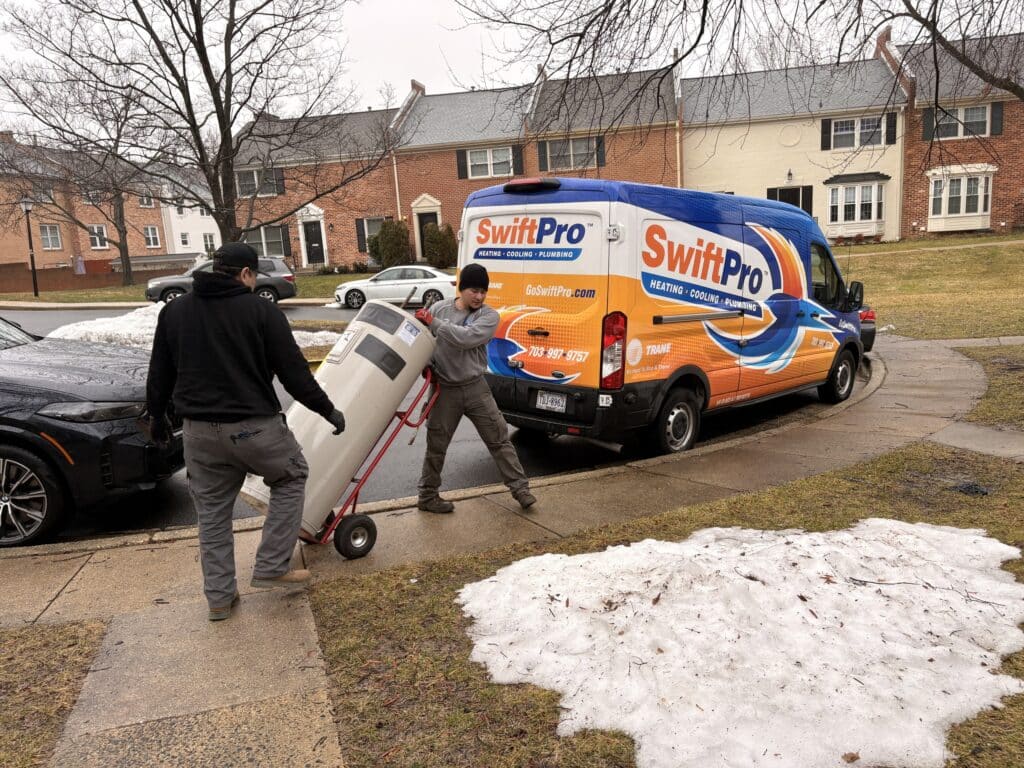
A like-for-like tank swap takes our crew two to four hours: shut it off, drain it, carry the old one out, set the new one, make the connections, check the venting, fill it and fire it. A.O. Smith gives the same two to four hours for a pro. Then give the new tank an hour or two to heat its first full load, which is A.O. Smith’s figure too.
Going from a tank to a tankless takes most of a day, because the gas line, the venting and the condensate drain are new work, not reconnections. Navien puts a professional tankless install anywhere from 3 to 12 hours. A heat pump water heater, Rheem says, takes 4 to 8.
Getting on the schedule is usually the longer wait. Most of our tank jobs go in the next day, and the same day if you call in the morning and your size is in stock.
We pull the permit on every replacement, and it’s in the price.
Questions people ask us about how long water heaters last
How long does a water heater last?
Most tank water heaters last 8 to 12 years, according to A.O. Smith, Bradford White and Rheem. The Department of Energy says 10 to 15. A tankless can reach 20 or more. Hard water and a tank nobody flushes push you toward the short end.
How long does a tankless water heater last?
Navien and Rinnai both say up to 20 years, and the Department of Energy says more than 20. Both makers tie that to a descale at least once a year, which in Northern Virginia’s water isn’t optional.
How long does a gas water heater last?
Usually 8 to 12 years, and often the shorter end of that. A.O. Smith says gas tanks may start failing around 6 to 10 years, and Rheem puts the average near 10. A yearly flush helps, because the burner has to heat through whatever sediment settles on the bottom.
How long does an electric water heater last?
Usually 8 to 12 years, and often the longer end. A.O. Smith says electric tanks last closer to 10 to 12 years, and Rheem says a bit longer than gas. Elements and thermostats are replaceable parts; the tank is what eventually goes.
How long does a heat pump water heater last?
About 10 to 15 years. A.O. Smith says 12 to 15, Rheem says 10 to 15, and ENERGY STAR works out its savings over 13.
Can a water heater last 20 years?
A tankless can: that’s what Navien and Rinnai rate theirs for, and the Department of Energy says more than 20. A tank rarely does. The makers put most at 8 to 12, and even the Department of Energy’s average for tanks, which counts the ones that run unusually long, is around 15.
Should I replace a 10 year old water heater that still works?
You don’t have to pull out a tank that’s working. Rheem says to start planning around year 10, because the risk of a leak climbs after it. Know where the shutoffs are, look at the floor around it now and then, and get a price before it fails. If it sits over a finished floor, replacing it on your own schedule is cheap insurance.
How often should I flush my water heater?
Once a year, say A.O. Smith and Rheem. In water as hard as ours, don’t stretch it. A tankless gets a descale at least once a year instead.
How do I tell how old my water heater is?
Read the serial number on the rating plate. On an A.O. Smith, the first two digits are the year and the next two the week. On a newer Rheem or Ruud, a plant letter comes first, then the week and the year; older Rheems start with the month, then the year. On a Bradford White, the first letter is the year and the second the month.
How long does it take to replace a water heater?
Two to four hours for a like-for-like tank, plus an hour or two for the new tank to heat up. Most of a day to switch from a tank to tankless, because the gas line and venting are new work.
Does a longer warranty mean the water heater lasts longer?
Not necessarily. Bradford White says its 6 and 10 year tanks are of identical quality, and the extra years are for peace of mind. Every tank in our price book comes as a 6 year or a 10 year, and if you’ll be in the house past year six, we’d take the 10.
Is it worth repairing a water heater?
On a tank under about eight years old that isn’t leaking, usually yes. Rheem’s rule of thumb: if the repair costs more than half the price of a new heater, replace it instead. A leak from the tank itself is never a repair.
Do you service water heaters you didn’t install?
Yes. Repair, flush, anode rod, tankless descale, any brand.
Want to know how much life yours has left?
If yours is past eight and nobody’s flushed it in a while, start with a flush: we drain it, check the anode rod and test the relief valve, and you’ll hear straight what shape it’s in. If it’s already done, our water heater estimator gives you your price in about a minute. Or call (703) 997-9757 (we run 24/7 emergency service), or book online.
More straight answers from our crew: how long a furnace lasts, how long an AC unit lasts, heat pump vs. air conditioner and what size AC unit you need.
SwiftPro Heating, Cooling & Plumbing repairs and replaces water heaters across Northern Virginia, out of Chantilly and Ashburn. SwiftPro is a family-owned Rheem Pro Partner with Virginia Class A contractor license 2705192276, BBB Accredited with an A rating, and rated 5.0 stars across 1,131 reviews on Google, Angi, Yelp, the BBB and Facebook. Read the reviews.