
Written October 2026 with the current refrigerant rules and our current installed prices.
Most central air conditioners last about 15 years. With a tune-up every spring, 15 to 20 is realistic; left alone, plenty quit around year 10. When yours is done, a new air conditioner on its own runs $5,942 to $14,450 installed from us, by size and efficiency. From about $99 a month at 0% APR for 60 months, the whole price financed, on approved credit.
Two identical units can finish ten years apart. What decides it is mostly the summers they run through, how they were put in, and whether anybody ever cleans the outdoor coil.
How long do AC units last? Every type in one table
| System | How long it usually lasts | Who says so |
|---|---|---|
| Central air conditioner | About 15 years | Trane says about 15; American Standard says 10 to 15 |
| Central AC, maintained every year | 15 to 20 years | Carrier and Lennox, both “with proper maintenance” |
| Central AC, never maintained | 10 to 12 years | Carrier |
| Heat pump (heats and cools) | About 15 years | Lennox, “an average of 15 years” |
| Ductless mini split | 15 to 20 years | Lennox |
| Window unit | 5 to 8 years | Lennox |
Our own rule of thumb for a central AC in Northern Virginia is 12 to 15 years with average care, and we’re glad to be wrong on the long side. The outdoor unit and the indoor coil usually go in together and age together, so when one fails at 14, the other one is 14 too.
What decides how long an AC lasts in Northern Virginia
Trane puts the climate part plainly: run an AC long and hard year after year and it may wear out before the average; run it a few weeks a summer up north and it may outlast it. Here’s where Northern Virginia lands, and the five things we see shorten an AC’s life most.
The summers are long, not just hot. Dulles Airport has hit 90°F on 33 days in an average year over the last 30 years, and on 41 a year over the last ten. It sees 80°F or warmer about 115 days a year. That’s a lot of hours on a compressor, and it’s why we don’t promise anyone 20.
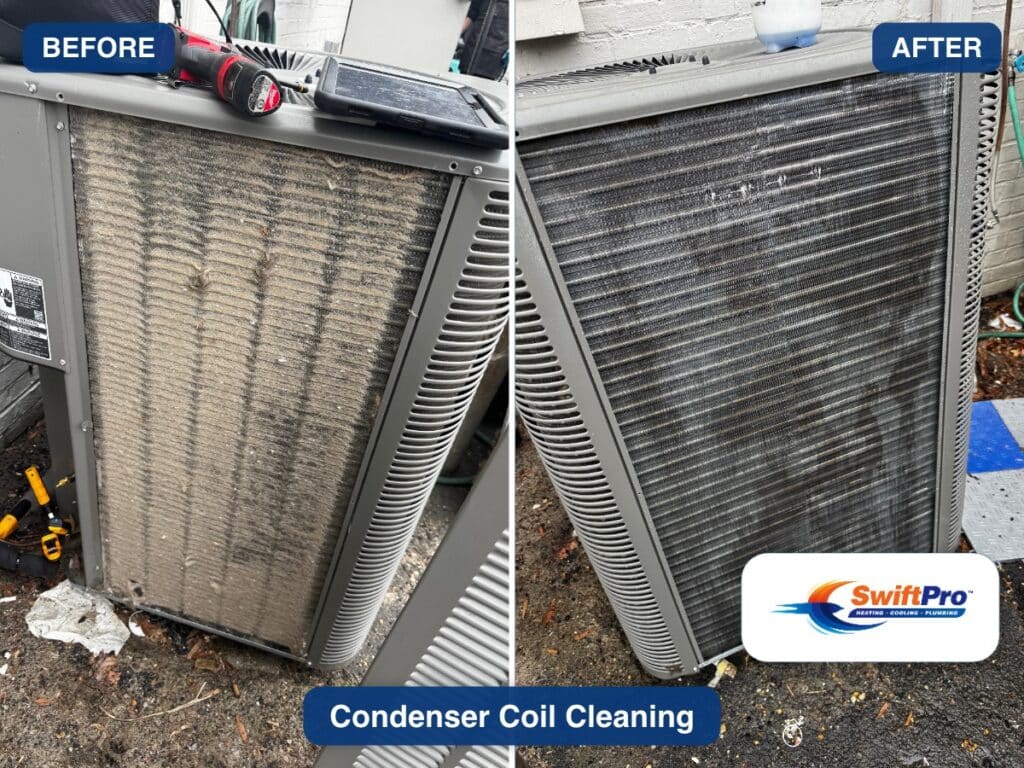
No salt air, plenty of fluff. Carrier names salt spray near the coast as one of the hardest things on an outdoor coil. We don’t have that here. We have cottonwood fluff and spring pollen instead, and by June they can mat the outside of the coil so it can’t get rid of heat. ENERGY STAR says dirty coils make a system run longer and shorten the life of the equipment.
Ducts too small for the system. When the indoor coil can’t get enough air across it, it can ice up, and the compressor works harder every hour it runs. ENERGY STAR lists a noisy system as a sign of an undersized duct system. We see it most where someone put a bigger AC on the old ductwork.
Nobody’s touched it in years. ENERGY STAR ties routine items straight to how long the equipment lasts: dirty coils, too much or too little refrigerant, and loose electrical connections each shorten it, and a dirty filter can lead to early failure. Carrier says an AC with no maintenance may only get 10 to 12 years.
Sized wrong on day one. Trane and Carrier both put sizing and the install near the top of their lists, and the DOE says an oversized air conditioner performs less efficiently and effectively than one sized right. Too big, it runs in short bursts that are hard on the compressor and leave the house clammy. Too small, it runs nonstop through every heat wave.
Can an AC unit last 20 or 30 years?
Some do. Carrier calls 30 years rare but possible with exceptional maintenance and mild use, and every so often we meet one. This summer our Oldest AC Giveaway went to a couple whose system was about 30 years old; their home inspector had called it “really old” when they bought the house eight years earlier (the knock on their door).
Running isn’t the same as running well, though. A unit that old almost certainly runs on R-22, which hasn’t been made or imported in the US since 2020, and it was built to an efficiency floor far below today’s. ENERGY STAR’s line for thinking about a replacement is an AC more than 10 years old, and it says a new unit that has earned the ENERGY STAR label, installed correctly, can save up to 20 percent on heating and cooling costs.
How old is my AC? Read the nameplate
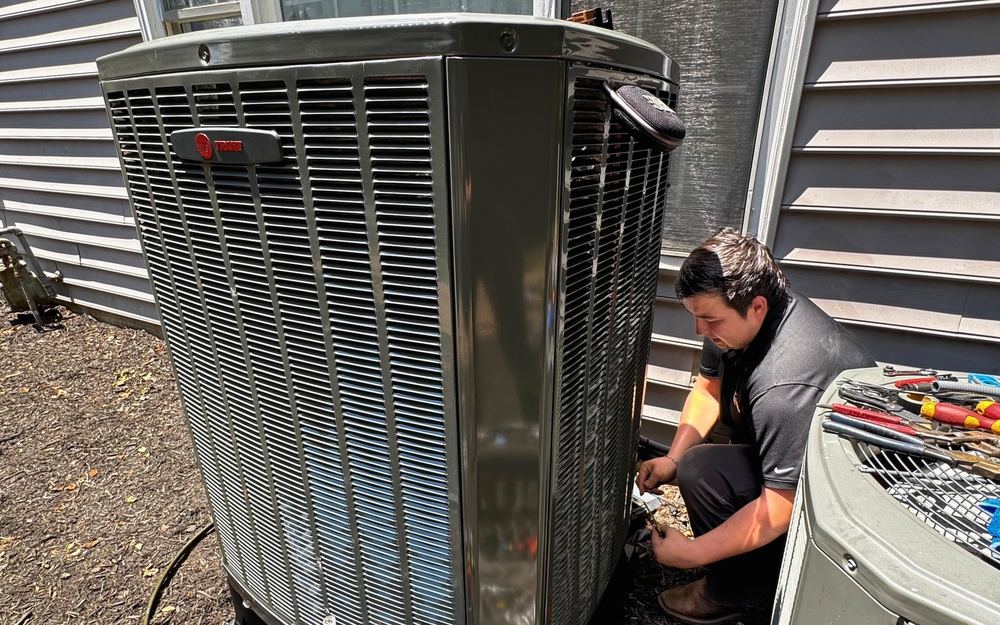
Go look at the outdoor unit. There’s a nameplate on the side or back, metal or a sticker, with the model and serial number, and most list the refrigerant too; the EPA sends homeowners to the same plate to find out whether a system runs on R-22. Many print the manufacture date outright. If yours doesn’t, the date is coded into the serial number, and every brand codes it differently.
Don’t trust the guess. A homeowner told Tyler, our owner, the outdoor unit went in around 2005; he read the plate and it said 2016 (watch him read it). A ten-year-old AC and a twenty-year-old one get very different advice. Your home inspection report may list the age too, and any of our technicians will read the plate for you on a visit.
Signs your AC is dying
- It needs refrigerant again. An AC doesn’t use refrigerant up. If it’s low, it’s leaking, and a second top-up in two summers means the leak is winning.
- Repairs every summer, and bills climbing. ENERGY STAR lists both as signs it’s time to think about replacing.
- Rooms that won’t cool, or a house that feels sticky. Uneven cooling is on Carrier’s list; humidity problems are on ENERGY STAR’s.
- New noises. Grinding, rattling or a loud clank at the outdoor unit when it starts. Inside, ENERGY STAR points at undersized ducts or the indoor coil.
- Ice on the copper line or the indoor coil. Low airflow or low refrigerant, and either one is hard on the compressor.
- The outdoor unit hums but won’t start, or trips the breaker. Often a capacitor, which is a cheap fix. On an old unit it can also be a compressor on its way out.
- The nameplate says R-22, or the date says it’s past 12. Neither means replace it today. Both mean start planning.
One of these on a ten-year-old AC usually means a repair. Three of them on a fifteen-year-old one is the system telling you something. If yours is acting up right now, here’s what common AC repairs cost.
Repair or replace an old AC?
Carrier and Goodman draw the same line: when a repair costs close to half the price of a new system, it’s usually time to replace it. That’s a fair start. We’d add age, because the same repair means something different at year 4 and year 14. Here’s how we’d call the common ones, with our prices.
| Repair | Our price | Our call |
|---|---|---|
| Run capacitor | $240 to $370 | Fix it at any age. It’s the most common reason an outdoor unit hums and won’t start. |
| Contactor | $290 to $425 | Fix it at any age. |
| Outdoor fan motor | $1,100 to $1,500 | Under 10, fix it. Past 10, fix it if the compressor and coil check out healthy. |
| Compressor, part still under warranty | $1,900 to $2,500 or $32/mo at 0% APR for 60 months |
Usually fix it: the manufacturer covers the part and you pay labor and refrigerant. Check this before anyone quotes you a system. |
| Refrigerant leak found and repaired | $1,850 to $2,700 or $31/mo at 0% APR for 60 months |
Under 10, fix it. Past 10, or on R-22, the money usually belongs in a new system. |
| Compressor, out of warranty | $2,200 to $5,100 or $37/mo at 0% APR for 60 months |
Usually where replacing the system wins. We’ll price both so you can compare. |
Monthly figures: 60mo @ 0% APR on each starting price, the whole price financed, on approved credit. Longer plans lower the payment and cost more in total. The lender sets the final terms.
Two more things push an old AC toward replacement. On R-22, every recharge comes from a shrinking supply, so a leak on an R-22 system is usually where the repair turns into a replacement. And the parts around the one that failed are the same age: fix the compressor on a 14-year-old unit and you’ve still got a 14-year-old coil, fan motor and capacitor bolted to it.
Whatever we find, you get the problem and the price in writing before any work starts, and the diagnostic visit is $99. Our longer repair-or-replace guide walks through more cases.
R-22, R-410A and R-454B: what your refrigerant means
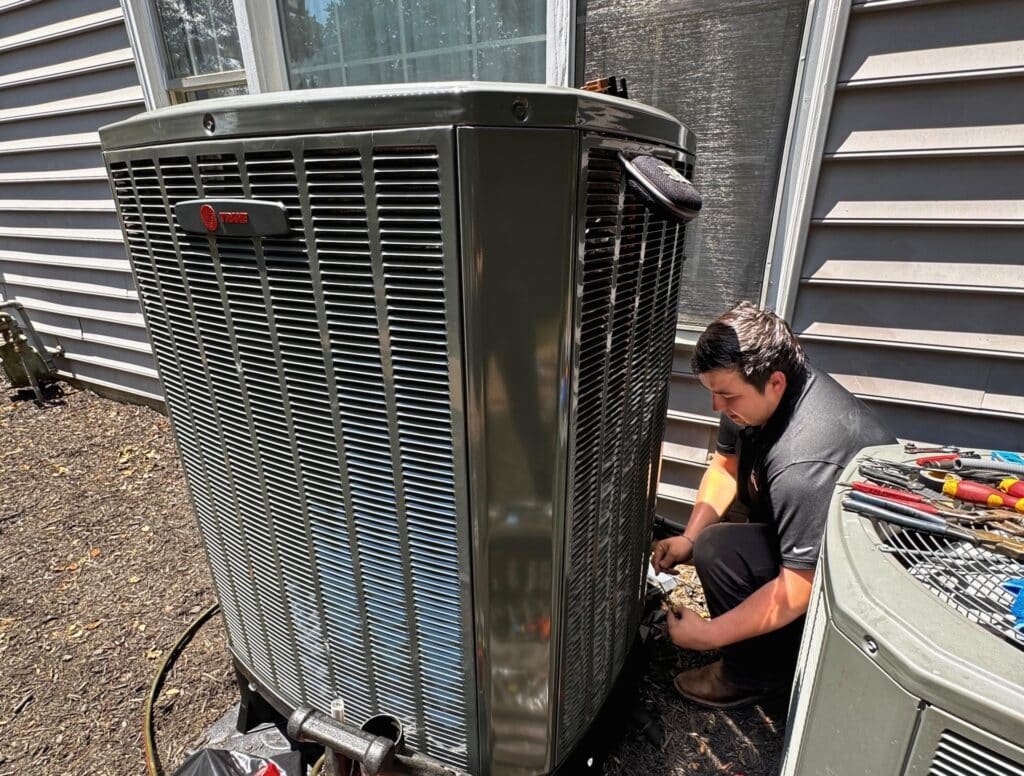
R-22, on most systems built before 2010. Since January 1, 2010, R-22 could only be made for equipment built before that date, and since January 1, 2020, it hasn’t been produced or imported in the US at all. You can keep running an R-22 system as long as it lasts; the EPA says so plainly. Repairs draw on recovered and reclaimed R-22 and what was made before 2020, and the EPA expects that supply to shrink and prices to rise.
R-410A, on most systems from about 2010 through 2024. Since January 1, 2025, new central air conditioners and heat pumps have had to use a refrigerant with a global warming potential under 700, which means R-454B or R-32 (R-410A rates 2,088). If your R-410A system works, nobody makes you replace it. You can replace a failed outdoor unit or indoor coil with a matching R-410A part; replace both at once and the EPA counts it as a new system. R-410A systems built before 2025 can still be installed until the stock runs out, so ask which refrigerant a quoted model uses.
R-454B or R-32, on new systems. Moving from an old system to a new one isn’t just a swap of boxes. The copper line set between the outdoor unit and the coil may be the wrong size for the new equipment, which is why we check it instead of assuming.
What a new AC costs installed in Northern Virginia
Straight from our price book, the same one our free estimator runs on. The spread is size and efficiency: a small two-ton system at the bottom, a big high-efficiency one at the top.
| System | Installed, our price book | Monthly, from |
|---|---|---|
| Air conditioner on its own | $5,942 to $14,450 | $99/mo at 0% APR for 60 months |
| Furnace and air conditioner together | $8,898 to $23,000 | $148/mo at 0% APR for 60 months |
Monthly figures: 60mo @ 0% APR on each starting price, the whole price financed, on approved credit. Longer plans lower the payment and cost more in total. The lender sets the final terms.
The price covers the parts of the job that decide how long the new one lasts: sizing it to the house, a matched indoor coil, the line set checked or replaced, a new disconnect and whip, a vacuum and a measured charge at startup, and the manufacturer’s warranty registered for you. On systems we install, two years of our labor is included, and you can take five or ten. If your furnace is near the end too, doing both at once usually costs less than two separate replacements.
Your price comes in writing, for your house, before anything’s decided. Get a range for your own house in a couple of minutes, see what’s running on our offers page, or read how an AC install runs with us. Already holding someone else’s quote? We’ll give you a free second opinion on it.
How to make an AC last longer
ENERGY STAR’s advice is a check-up before every season, cooling in the spring and heating in the fall, and it’s right. Here’s what actually buys years:
- A spring tune-up with the coils cleaned, the refrigerant charge checked, and the electrical connections tightened and measured. Those are the items ENERGY STAR ties to how long the equipment lasts. What a real tune-up includes.
- The filter, checked every few weeks in summer. A dirty one can damage the equipment and lead to early failure, in ENERGY STAR’s words.
- Two feet of clear space around the outdoor unit, no mulch piled against it, and the cottonwood fluff hosed off the outside in late spring. The real coil cleaning happens from inside the cabinet, at the tune-up.
- A thermostat setting you can live with. Carrier’s example: a house kept at 70°F puts far more strain on the system than one kept at 78°F.
- Small problems fixed while they’re small. A weak capacitor caught in May is a $240 to $370 repair on a Tuesday. Left alone, it makes the compressor fight every start through July.
Who installs it decides a lot of those 15 years
Trane says improper sizing and faulty installation lead to decreased comfort and repair headaches, and Carrier puts installation quality first on its list. Here’s what to ask whoever quotes you:
- A load calculation, not “the same size as the old one.”
- A matched outdoor unit and indoor coil, with an AHRI number you can look up.
- The line set checked for size and condition, and replaced when it’s wrong for the new system.
- A vacuum and a measured charge at startup, on gauges.
- Ducts that can carry the air the new system needs.
- The warranty registered on time, with the proof handed to you.
The brand matters less than any of that. If you’re choosing one anyway, here’s how we rank the best HVAC brands, and the best heat pump brands if you’re weighing a heat pump instead.
AC lifespan questions people ask us
How long does an air conditioner last?
About 15 years for a central AC. The manufacturers’ own numbers run from 10 to 15 years (American Standard) to 15 to 20 with yearly maintenance (Carrier and Lennox). In Northern Virginia we tell people to plan on 12 to 15 and enjoy anything past it.
How long does a central air unit last?
The outdoor unit and the indoor coil usually go in together, so they age together: about 15 years. The furnace under the coil often outlasts it: ENERGY STAR’s line for thinking about a new furnace is 15 years, against 10 for an air conditioner.
How long should a Trane AC last?
Trane’s own answer for a central air conditioner is about 15 years, and it says some of its dealers have customers who replaced a Trane after 20. We’re a Trane Comfort Specialist. What gets a Trane to 20 is what gets any brand there: sized right, installed right, a tune-up every spring.
How long should a Goodman AC unit last?
Goodman doesn’t publish a lifespan number, so treat it like any central AC: about 15 years with care, less without. Goodman is owned by Daikin, and it gives ten years on parts if the unit is registered online within 60 days of installation. We service Goodman systems, whoever installed them.
How long does a Carrier AC last?
Carrier says most of its air conditioners last 15 to 20 years with proper maintenance, and that a neglected one can fail around year 10. We’re Carrier experts: we install Carrier air conditioners and service every Carrier we’re called to.
How long do HVAC systems last?
The cooling side usually goes first. Central air conditioners and heat pumps run about 15 years, and a gas furnace often runs longer: ENERGY STAR’s line for thinking about a replacement is 10 years for an AC or heat pump and 15 for a furnace or boiler. If both are near the end, replacing them together usually costs less than two separate jobs; the price is in the table above.
How long does an AC last in Virginia?
About the national number: 12 to 15 years with average care, more with a tune-up every spring. Our summers are long, with Dulles averaging 33 days a year at 90°F or hotter (41 over the last decade). We don’t have the salt air that eats coils at the beach, but we do have cottonwood and pollen, which is why the yearly coil cleaning matters here.
Do I have to replace my R-22 air conditioner?
No. The EPA says you can keep using an R-22 system as long as it works. What changes is the cost of a leak: R-22 hasn’t been made or imported in the US since 2020, so every recharge comes from recovered or older stock.
Is it worth repairing a 15-year-old AC?
For a small part like a capacitor or contactor, often yes. For a compressor or a refrigerant leak, usually not: you’d be putting a big repair into a system at the end of its expected life, with everything around the new part just as old. We’ll price both so you can compare.
Can I replace just the outdoor unit?
On an R-410A system, it’s allowed: the EPA lets you replace a failed outdoor unit with a matching R-410A one, and on a younger system that’s often the right call. On an R-22 system, we’d replace the outdoor unit and the indoor coil together: they’re a matched pair, and the new equipment runs a different refrigerant.
Should I replace my AC before it dies?
If it’s past 12, runs on R-22, or needed a big repair last summer, start planning now. Replacing on your schedule means time to compare quotes and pick the system. Replacing in a July heat wave means taking the first install date anyone has open.
Is your AC near the end?
Read the nameplate, count the years, and think back over last summer’s repairs. If it’s under 10 and just broke, it probably needs a repair, not a new system. If it’s past 12, runs on R-22, or the repairs keep getting bigger, get a price on a new one before July decides for you.
Call (703) 997-9757 or book online. Already holding a quote? Our free second opinion is built for exactly that.
More straight answers from our crew: how long a water heater lasts, how long a furnace lasts, heat pump vs. air conditioner and what size AC unit you need.
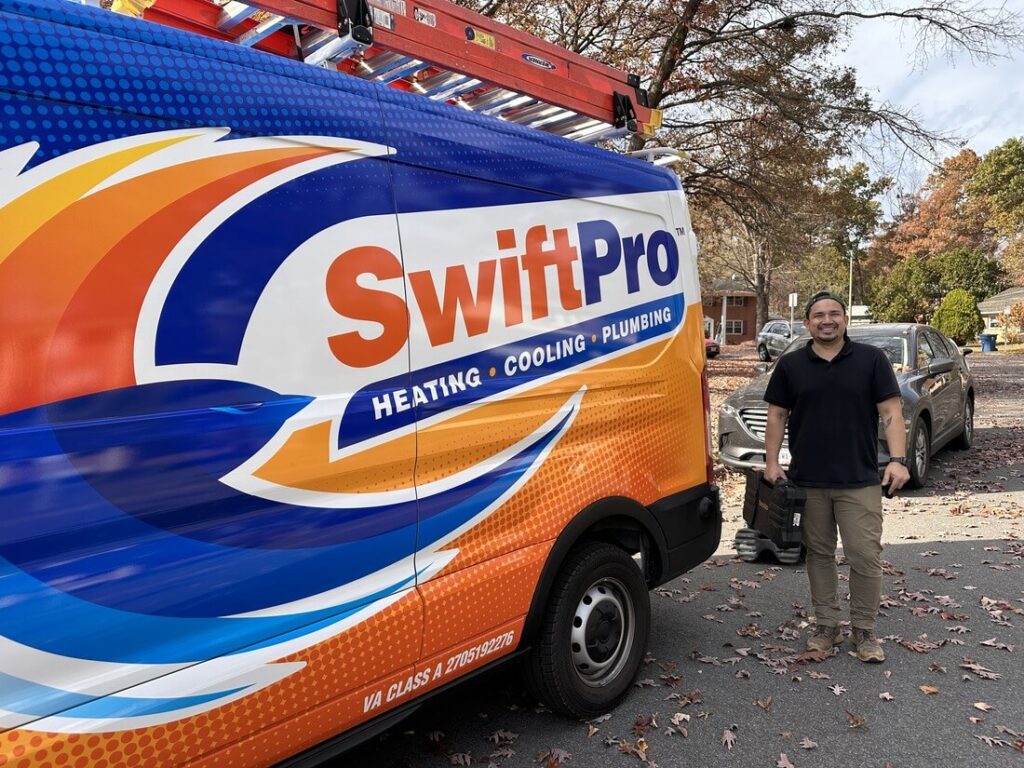
SwiftPro Heating, Cooling & Plumbing installs and services air conditioners across Northern Virginia, out of Chantilly and Ashburn. SwiftPro is a Trane Comfort Specialist and a Rheem Pro Partner, and we’re Carrier experts. Family owned, BBB Accredited with an A rating, 24/7 emergency service, Virginia Class A contractor license 2705192276, and rated 5.0 stars across 1,131 reviews on Google, Angi, Yelp, the BBB and Facebook. Read the reviews.