Written October 2026, with the county permit pages, EPA’s rules, the federal efficiency floor and the makers’ warranty terms read the same week.
A new central air conditioner runs $5,942 to $14,450 installed in Northern Virginia, keeping the furnace you have. From about $99 a month at 0% APR for 60 months, the whole price financed, on approved credit. That’s our price book, the same numbers as our AC installation and replacement page, which is where you book the visit. Where your number lands depends on the size the house needs, the efficiency you pick, and what the job turns up once the old unit is out.
If your AC still runs, you have time. Get it priced, and priced again by somebody else, before a heat wave makes the decision for you. If it just quit, start with a $99 diagnostic visit instead: a dead air conditioner is sometimes one failed part, and you should know that before anybody quotes you a new one. The five checks to try first are in our AC repair guide.
The rest of this page is what that price should buy. Most of a proper install happens where you’ll never look: inside the coil cabinet, inside the copper, on a gauge. Those are the steps a rushed crew skips.
If you only do one thing: ask every company quoting you for two pieces of paper. One is the load calculation that set the size. The other is the AHRI certificate for the exact outdoor unit and indoor coil on the quote. A quote that can’t produce either one is a guess with a price on it.

What AC installation costs, and what moves the price
That range runs from a 2 ton air conditioner to a 5 ton. Inside each size, the spread is mostly efficiency and how the compressor runs: a basic single-stage unit at the low end, a two-stage or variable-speed one at the high end. Our HVAC estimator narrows it to your house in a couple of minutes, and what AC replacement costs in Northern Virginia walks through the number line by line.
The rest of what moves it is the job itself, and a written quote should name each of these:
- The coil. A new outdoor unit almost always means a new indoor coil. Why is below.
- The line set. The two copper lines between them, reused or replaced.
- The electrical. A new disconnect, the whip (the short flexible cable) to the unit, now and then work at the panel.
- The pad and the drain. A new pad where the old one sank or cracked, and the condensate line with its safety switch.
- The paperwork. The permit and the inspection, where your county asks for them.
Holding a quote already? How to read an HVAC replacement quote takes it apart line by line, and we’ll give you a free second opinion on it.
Sizing: a load calculation, not the old sticker
Which size your house takes is a calculation, not a guess off the square footage or the label on the old unit. The standard method is ACCA’s Manual J load calculation: how much heat and moisture the house takes on during a hot afternoon, room by room, from the windows, the insulation, the air leaks and the way it faces.
Fairfax County puts it in writing. Its residential HVAC certification form, which “is required to be onsite for all mechanical inspections,” says that under the Virginia Residential Code, “equipment sizing shall be in accordance with ACCA Manual S based on building loads calculated in accordance with ACCA Manual J or other approved methodologies.” The same form makes running that Manual J the applicant’s job on every HVAC installation.
Why it matters so much here: an air conditioner pulls water out of the air as well as heat, and a Northern Virginia summer is humid. One that’s too big cools the room fast and shuts off before it has dried it out, and you live in a cool, clammy house. The full answer, with sizes by square footage, is in what size AC unit do I need.
The coil inside, and what an AHRI match is
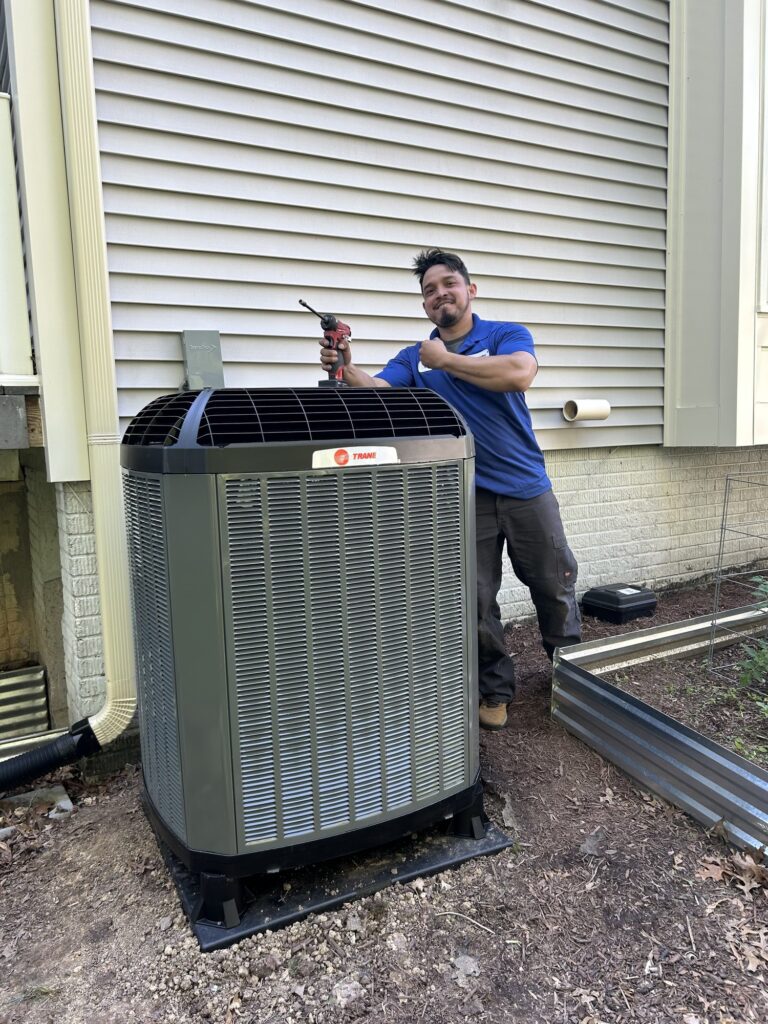
Central air is two halves. The condenser sits outside. The evaporator coil sits inside, usually on top of the furnace, and it’s the part that actually cools and dries the air. They’re built and rated as a pair. AHRI, the industry group that certifies the ratings, says it plainly: “For split systems, AHRI certifies the performance of the system and not the individual units.”
Each certified pairing gets its own Certified Reference Number, and AHRI’s directory prints an “AHRI Certificate of Product Ratings” for it: the outdoor model, the indoor model, and the efficiency they reach together. Federal law works the same way. The Department of Energy’s rule says “Any model of outdoor unit that has a certified combination with a rating below the applicable standard level(s) for a region cannot be installed in that region.” So when a quote promises a SEER2 number, the AHRI certificate is how you check that the outdoor unit and the coil on that quote reach it together.
That’s also why a new AC almost always means a new coil. Air conditioners built since 2025 run on the newer refrigerants, R-454B or R-32, and Trane says “The coils need to be compatible with the type of refrigerant.” Its product manager for outdoor units goes further: “My recommendation is to always replace the refrigeration system at one time.” Trane’s installer’s guide for its R-454B air conditioners sends the installer to the same place: “See AHRI directory for approved indoor and outdoor model combinations.”
AC installation day, step by step
Here’s the job in order. Your quote should cover every step. If one is missing, ask before the day, not during it.
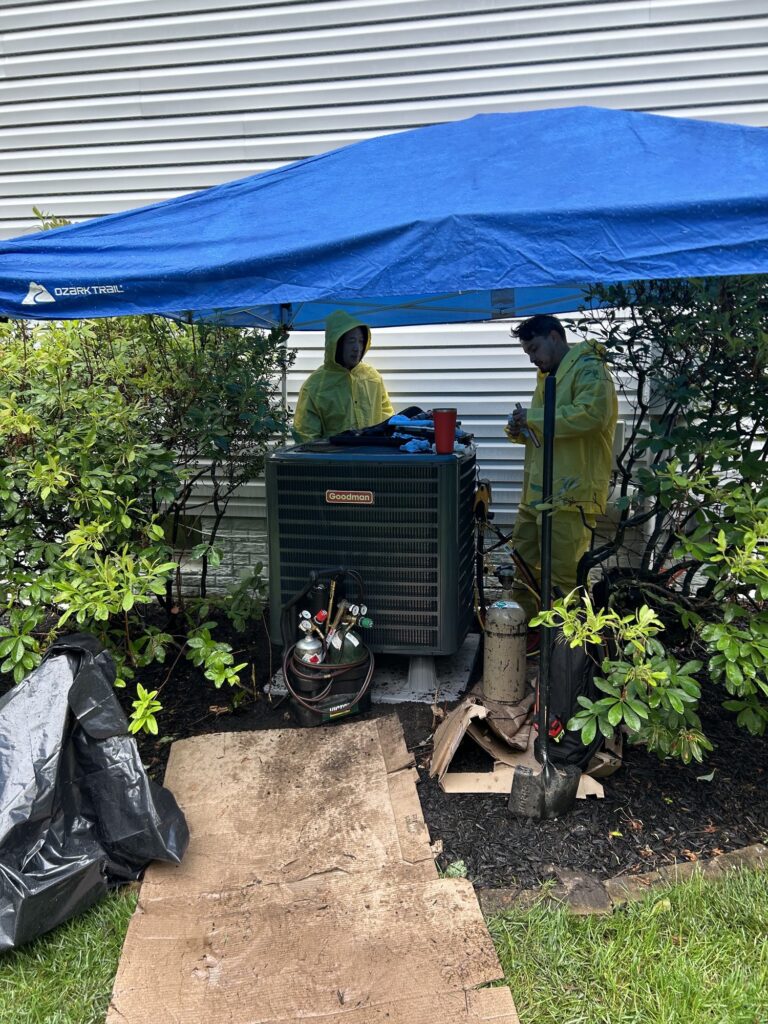
- Protect the path. Drop cloths or boards from the door to the furnace, and on the driveway if a unit is rolling across it.
- Recover the old refrigerant. It gets pumped out into a recovery cylinder, never let into the air. EPA’s rules say central home air conditioning “must have refrigerant recovered” before it’s disposed of, and they prohibit venting refrigerant while servicing or disposing of equipment.
- The old equipment comes out. The outdoor unit, and the old coil off the top of the furnace.
- The new coil goes in. Set on the furnace and sealed to the ductwork, so the air goes through the coil and not around it.
- The line set. The copper lines get inspected, cleaned out or replaced. More on that choice just below.
- Brazing, with nitrogen flowing. Every copper joint is brazed, a hotter and stronger joint than solder, with a trickle of nitrogen running through the pipe. Without it, the heat scales the inside of the copper and those flakes travel. Trane’s guide says “Purge the refrigerant lines and indoor coil with dry nitrogen,” then “Continue the dry nitrogen purge” until the brazing is done.
- Pressure test. The sealed system is filled with nitrogen and watched for a drop. Fairfax County sets the bar for the new refrigerants: pressure tests “for a minimum of 60 minutes at 450 PSI.”
- Evacuation. A vacuum pump pulls the air and moisture out, read on a micron gauge. Trane’s guide pulls it to “no higher than 350 microns,” shuts the pump off, and calls it done if the gauge “does not rise above 1500 microns in ten (10) minutes.” A system that won’t hold a vacuum has a leak, and today is the cheap day to find it.
- The charge. Refrigerant goes in by the maker’s method: weighed in on a scale, then checked by subcooling against the chart. Trane: “Always verify proper system charge via subcooling.” The total charge gets written on the unit, and Fairfax wants new A2L units labeled with “installer contact information, system charge, and refrigerant number.”
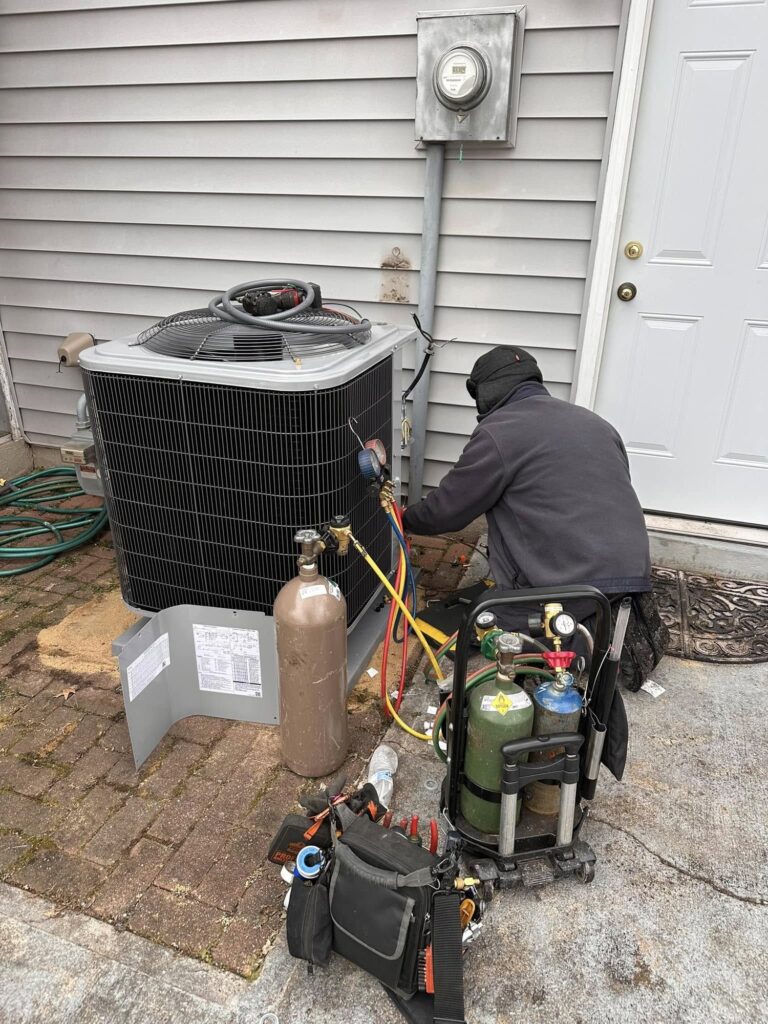
Reuse the line set, or replace it? It depends on the lines. EPA notes that “Refrigerant lines are generally not removed when replacing the other mechanical components of a system,” and its 2021 rule on the new refrigerants says existing tubing “can be inspected and if suitable re-used.” Trane’s guide sets the test for reusing them: “the correct size,” no leaks, clean inside, and every joint “brazed and not soldered.” Lines that fail it get replaced. In the clip below, the old line was a 1/4 inch from an R-22 system, too small for the new unit, so the crew ran a new 3/8 inch set.
The finish: the drain, the power and the startup readings
The last five steps, picking up where the copper work ends:
- Condensate. The coil makes water all summer. It needs a trap, a drain line with the right slope, and a float switch that shuts the system off if the drain backs up, before the water finds a ceiling.
- Pad, disconnect and wiring. The outdoor unit goes on a level pad with room to breathe on every side, with a disconnect on the wall beside it and a new whip to the unit.
- Thermostat. Checked, or replaced and set up for the new system.
- Startup and readings. Once the system has run long enough to settle (Trane says “a minimum of 20 minutes”), the technician reads pressures and temperatures at the outdoor unit and the temperature drop across the coil, then checks that the drain carries water and the float switch trips.
- The walkthrough. Where the filter goes and what size it takes, where the disconnect and the breaker are, and what each warranty covers.
A unit can run on a bad charge or weak airflow and still blow cold air for a while. The startup numbers are how you know it’s set up, not just running. Ask for them.
Permits and inspections: what each county says
Virginia has one building code, but each county runs its own permit office. Here’s what four of them say on their own pages:
- Fairfax County lists “New, Replacement, Repair or Conversion of HVAC Systems” among the jobs that need a mechanical permit, with county inspections once the work starts. Its A2L bulletin adds that “A permit is required for any new installation of equipment using A2L refrigerants.” In the towns of Vienna and Clifton, the town signs off too.
- Loudoun County issues mechanical work as a separate trade permit, and its fee schedule lists a mechanical permit fee “for adding, replacing, or relocating mechanical equipment,” central air conditioning included.
- Prince William County says a permit is always required for “any work involving alterations to the house plumbing, electrical, or heating and air conditioning (mechanical) systems.” The same page lists, among jobs that don’t need one, “Replacing an electric furnace, heat pump, or air conditioning condensing unit with the same type unit in the same location.”
- Arlington County wants a mechanical permit for adding, removing or relocating air conditioning systems, and says “Replacement of these elements of the same type, size and location do not require a permit” unless the equipment burns gas. Where no permit is needed, it asks you to “contact Zoning for approval of the location of any outdoor equipment.”
So the same swap can need a permit in Fairfax and Loudoun and not in Prince William or Arlington. Whether a new system on a new refrigerant still counts as a same-type swap is the county’s call. Ask, and get the answer written on the quote. Fairfax lets owners pull permits in their own name, but says “it is strongly recommended a properly licensed contractor pull the permits as the responsible party.”
SEER2 and the 2025 refrigerant switch
The efficiency floor. Virginia sits in the Department of Energy’s Southeast region, where a split air conditioner installed today has to be at least 14.3 SEER2 under 45,000 Btu an hour (just under 4 tons), and 13.8 SEER2 at 45,000 and up. The national floor is 13.4. Above the floor, more SEER2 is a choice, not a requirement. We’ll price it both ways. Whether the higher one pays you back depends on how hard you run it, and we won’t pretend to know your number.
The refrigerant. Home air conditioners and heat pumps made or imported since January 1, 2025 have to use a refrigerant with a global warming potential under 700, and EPA notes the U.S. makers “already are providing equipment using R-32 or R-454B.” Both are A2L refrigerants, the lower-flammability class, which is why many new systems carry a refrigerant leak sensor and why Fairfax wants that sensor tested before the final inspection. EPA’s May 2026 rule removed the deadline for installing R-410A equipment built or imported before 2025, so some older stock is still out there; anything built after that date still can’t use R-410A (EPA’s sector table shows both dates).
The system you have now. If it runs on R-410A, nothing makes you replace it. EPA’s answer to whether you can repair it: “Yes, you can continue to repair your existing refrigeration, air conditioning, and heat pump system.” If it’s old enough to run on R-22, that refrigerant hasn’t been made or imported since January 1, 2020, which usually ends the repair road on a leak. How old is too old: how long AC units last.
Warranties: register the equipment, and get the labor in writing
A new AC comes with two warranties, and people mix them up. The manufacturer’s covers parts. The installer’s covers labor. Know both before you sign.
The manufacturer’s, and the clock on it. Trane and Carrier both tie their longer parts warranty to registering the equipment soon after the install. Trane’s Registered Limited Warranty needs registration “within 60 days of installation.” It covers parts “but not the labor to repair them,” and in most cases it runs 10 years, against five for the base warranty you get without it. Carrier’s window is 90 days: miss it, and “the standard 5-year parts-only limited warranty will apply.” Trane’s own advice: “Never assume your dealer is registering your product.” Ask who is registering yours, and keep the certificate.
Ours. Two years of our labor come with every install, and five or ten years is an option. Whichever you choose, get it on the quote in writing, with what it covers. A parts warranty won’t pay anybody to put the part in.
AC alone, the furnace too, or a heat pump instead
With a gas furnace, the new coil sits on top of it and the AC borrows its blower. So the question at the estimate is often bigger than the AC.
Replace the furnace too? If it’s about as old as the AC, think hard about it. Both together run $8,898 to $23,000 installed, as one matched system. From about $148 a month at 0% APR for 60 months, the whole price financed, on approved credit. Replacing both usually costs less than two jobs a few years apart. Whatever we’re running on HVAC replacements this month is on our offers page. What the furnace half of the day looks like is in furnace installation day, and the pair is priced on our HVAC replacement page.
A heat pump instead of an AC? A heat pump cools exactly like an air conditioner, and it can also run in reverse and heat. Paired with a gas furnace it becomes dual fuel: the heat pump on mild winter days, the furnace on the cold ones. It’s worth pricing both ways. Heat pump vs air conditioner lays out where each one wins, dual fuel in Northern Virginia covers the pairing, and heat pump replacement has the prices.
AC installation questions, answered straight
How much does AC installation cost?
From us, a new central air conditioner runs $5,942 to $14,450 installed in Northern Virginia, keeping your furnace. From about $99 a month at 0% APR for 60 months, the whole price financed, on approved credit. Size, efficiency and what the job finds decide where yours lands, and the HVAC estimator narrows it to your house.
Do I need a new coil with a new AC?
Almost always, yes. The outdoor unit and the indoor coil are certified as a pair, new air conditioners run on R-454B or R-32, and Trane says “The coils need to be compatible with the type of refrigerant.” Ask for the AHRI certificate that shows your exact pair.
Can I reuse my old AC refrigerant lines?
Sometimes. EPA says refrigerant lines “are generally not removed” when the rest of a system is replaced, and its rule lets existing tubing be reused if it’s inspected and suitable. Trane’s guide wants reused lines the correct size, with no leaks and clean inside; lines that fail that get replaced.
Do I need a permit to replace my AC in Virginia?
It depends on the county. Fairfax requires a mechanical permit to replace an HVAC system, and Loudoun’s fee schedule lists one for replacing central air. Prince William and Arlington exempt a same-type swap in the same spot. Get the answer on your quote.
What SEER2 does a new AC need in Virginia?
At least 14.3 SEER2 for a split air conditioner under 45,000 Btu an hour, and 13.8 SEER2 at 45,000 and up. Virginia is in the Department of Energy’s Southeast region, which sets a higher floor than the national 13.4.
Can I still get an R-410A air conditioner?
Maybe, from stock built before 2025: EPA’s May 2026 rule removed the installation deadline for that equipment. Anything built since has to use a refrigerant under 700 GWP, in practice R-454B or R-32. And a working R-410A system can keep being repaired.
What size AC do I need?
Most houses take 2 to 5 tons, and the real answer comes from a Manual J load calculation. Sizes by square footage, and why bigger isn’t better here, are in what size AC unit do I need.
Do I have to register my new AC’s warranty?
For the longer parts warranty, yes, and soon. Trane wants it registered within 60 days of installation, Carrier within 90. Miss it and you’re on the shorter base warranty, usually five years of parts at both. Ask who is registering it and keep the certificate.
Should I replace my furnace at the same time as my AC?
If it’s about as old as the AC, usually yes. Both together run $8,898 to $23,000 installed. From about $148 a month at 0% APR for 60 months, the whole price financed, on approved credit.
Should I get a heat pump instead of an air conditioner?
Price it both ways. A heat pump cools exactly like an AC and also heats, and next to a gas furnace it runs as dual fuel. Heat pump vs air conditioner has the trade-offs.
Get your AC installation priced
The HVAC estimator asks a few questions about your house and shows an installed price for your size, and you can book the in-home measurement from the same page. Already holding a quote? We’ll give you a free second opinion on it. Our offers page has this month’s deals, and here’s how financing works.
Call (703) 997-9757, book online, or start from our AC installation and replacement page.
SwiftPro Heating, Cooling & Plumbing installs central air conditioners, furnaces and heat pumps across Northern Virginia, based in Chantilly. We’re a Trane Comfort Specialist, a Rheem Pro Partner and Carrier experts. Family owned, BBB Accredited with an A rating, 24/7 emergency service, Virginia Class A contractor license 2705192276, and rated 5.0 stars across 1,131 reviews on Google, Angi, Yelp, the BBB and Facebook. Read the reviews.