


Written October 2026, with Trane’s, Carrier’s and Rheem’s warranty documents and maintenance guides read the same week.
Twice a year, by a technician: the heating every fall and the cooling every spring. That’s ENERGY STAR’s schedule and Trane’s, and between the two visits your part is a filter and a few minutes outside. It’s late October in Northern Virginia, so the visit due now is the heating one. Our Heating Check is $67 per furnace or heat pump through December 31. Book it before the first week the heat runs all day. If the heat is already acting up, that’s a heating repair call, not a maintenance visit.
Rather not keep track of any of it? Comfort+ is the maintenance we sell by the year: both of those visits booked for you, plus a dryer vent cleaning and a water heater flush with a sewer camera inspection. The spring visit on its own books on our AC maintenance page.

HVAC maintenance, month by month
Here’s the whole year on one screen. Two technician visits anchor it. Everything else is yours, and none of it needs tools.
| When | What | Who |
|---|---|---|
| Late September to early November | The heating visit: furnace, heat pump or boiler, before you lean on the heat | Technician |
| November 1, when the clocks go back | Fresh batteries in the thermostat, test the carbon monoxide alarms, look at the filter | You |
| Every month, all year | Look at the filter, and change it when it’s dirty | You |
| December to February | Heavy snow off the heat pump; a high-efficiency furnace’s white vent pipes outside kept clear | You |
| Late February to early May | The cooling visit: AC or heat pump, before the first hot week | Technician |
| The second Sunday in March, when the clocks go forward | Batteries again, and a walk around the outdoor unit | You |
| May to September | Two feet clear around the outdoor unit, and an eye out for water near the indoor unit | You |
The fall and spring windows are the ones Trane’s maintenance guide gives. ENERGY STAR puts it more simply: the cooling system checked in the spring, the heating in the fall, and if that’s hard to remember, “around the time changes.” Its reason is a practical one: “Contractors get busy once summer and winter come.” This year the clocks go back on November 1. Have the heating visit on the calendar by then.
The fall visit: what gets checked on a furnace, a heat pump or a boiler
A maintenance visit is mostly measuring, and what gets measured depends on what heats the house. Here’s the fall list by system, from Trane’s own technician checklists for a gas furnace and a heat pump, and from our Heating Check.
Gas furnace. The burners and flame sensor cleaned and the flame looked at. Gas pressure checked. The heat exchanger inspected for cracks, holes or leaks. The flue checked clear, or on a high-efficiency furnace, the PVC intake and exhaust pipes and the condensate drain. The blower inspected, the thermostat checked, and the heat the furnace puts out compared with the maker’s own numbers. On our Heating Check that last one is the temperature rise, measured with a meter instead of guessed at, and anything we flag comes to you in writing with photos.
Heat pump. Trane schedules a heat pump twice a year, fall and spring, because it heats and cools and runs most months. The fall visit adds two things the spring one skips: the defrost control (Trane checks it “in the fall only”) and the reversing valve, the part that flips the system from cooling over to heating. Then the backup heat. On a heat pump with an air handler that’s usually electric heat strips inside it, and fall is when you want to know they come on, not the first 15 degree morning. If your thermostat says AUX a lot, here’s what AUX and emergency heat mean.
Boiler. Different equipment, different list: the pressure gauge, air trapped in the radiators, the expansion tank, the relief valve. Here’s what a boiler service covers, and our boiler page.
No visit predicts everything. What it does well is catch the part that’s on its way out while you still have a choice about when to fix it: a flame sensor with a film on it, an igniter reading weak, a drain running slow. What a furnace tune-up includes item by item, and what those usual repairs cost here, is in our furnace tune-up guide. If you’d like to listen to your own system first, the twenty-minute test run tells you what to listen and smell for.
The spring visit: the cooling side
Spring is the AC’s turn, or the heat pump’s second visit of the year. Trane’s AC checklist and ENERGY STAR’s agree on the core of it: the thermostat and controls checked, electrical connections tightened with voltage and amps measured on the motors, the refrigerant charge checked, the condensate drain line and pan cleared, the blower looked at, the filter changed if it needs it. On a heat pump, the technician also makes sure the heating is locked out when the thermostat calls for cooling, and clears the drain holes in the outdoor unit’s base pan.
Coil cleaning is the line to read twice on any quote. Trane’s own list says the outdoor and indoor coils get cleaned “as needed, most likely with an additional charge.” That’s normal, and it’s honest. Trane also tells homeowners to ask to see a company’s checklist before booking, “so you know what’s included and what’s not.” Good advice from anyone, including us. Line by line, with the reason for each item, it’s in what an AC tune-up actually includes.

What you do between visits
Four jobs, and none of them takes a panel off. Anything past these, with gauges on or the power cut at the disconnect, belongs to the technician, and Trane’s warranty wants that part done “by a licensed HVAC service provider” anyway (more on warranties below).
The filter, by the month and by MERV. ENERGY STAR’s rule is to look at it once a month. How often it needs changing depends on who lives there. Here are the numbers from Trane’s maintenance guide:
| Your house | Change the filter |
|---|---|
| No pets | At least every 90 days |
| Pets | Every 30 to 60 days |
| Someone with allergies or asthma | Every 30 days for a 1 inch filter, 60 to 90 days for a 4 inch |
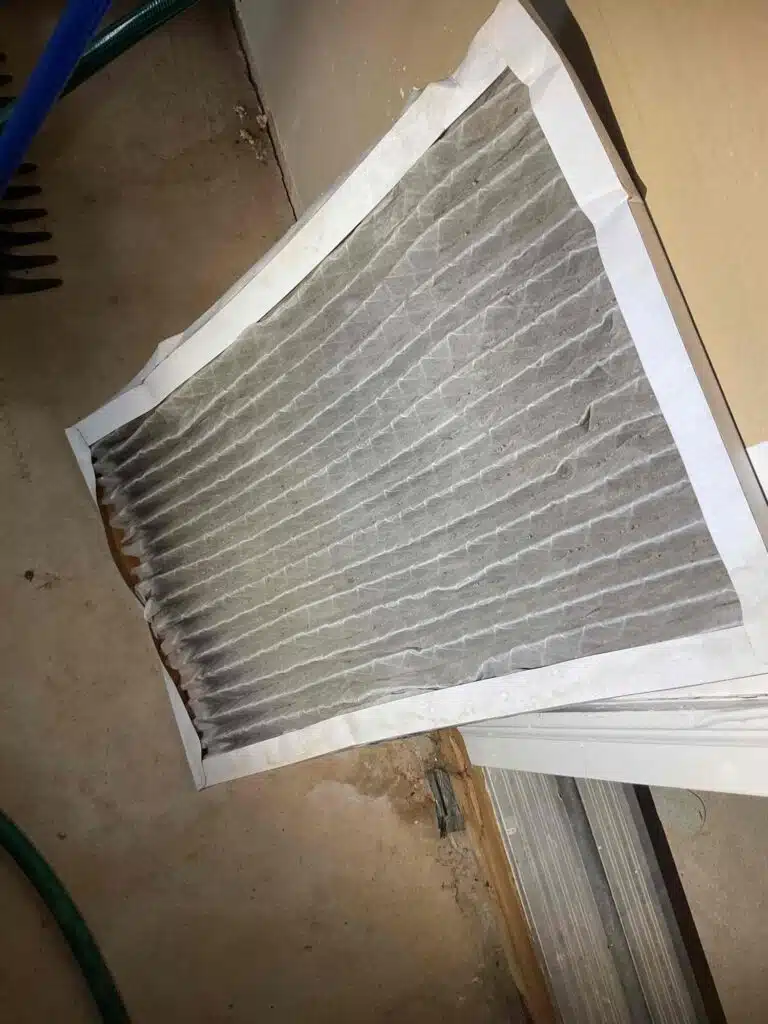
In Northern Virginia the system works hardest in July and January, so those are the months a 1 inch filter fills fastest. The furnace and the AC breathe through the same filter, which makes it a year-round job, not a winter one. On MERV, the short version from our filter guide: a basic pleated MERV 8 is the sensible default for most houses, and MERV 13 belongs in a 4 or 5 inch media cabinet, not a 1 inch slot, where it can choke the airflow it’s supposed to clean.
The outdoor unit. Keep plants back at least two feet on every side and four feet above it (Trane’s numbers), and point the mower’s grass away from it. A gentle rinse of the fins with a garden hose is fine. A pressure washer is not, and neither is spraying cleaner in from the outside, which pushes the dirt deeper. One of our technicians shows that one below.
Winter adds two jobs outside. Brush heavy snow off a heat pump; Trane says its defrost cycle “will deal with minor icing,” so the light frost you see on a cold morning is normal. And if you have a high-efficiency furnace, its two white PVC pipes through the wall are its intake and exhaust. Trane’s guide says to keep drifting snow from clogging them.

The condensate line. Your AC coil wrings water out of the air all summer, and a high-efficiency furnace makes water all winter. A small PVC line carries it away. When that line clogs, a float switch shuts the system off if one is fitted, and if one isn’t, the water ends up on the floor or through a ceiling. Your job is to look. Water around the indoor unit means a clogged drain line or a frozen coil (Trane’s list says the same), and either one is a call. The spring visit flushes the line. The furnace’s drain can clog or freeze in winter too, and here’s that one.
The thermostat and the alarms. If your thermostat runs on batteries, put fresh ones in when the clocks change. A blank screen is the first thing Honeywell’s own support page sends you to the batteries for, and a blank thermostat can’t call for heat. Test the carbon monoxide alarms the same day, which Trane’s guide also asks of anyone with a gas furnace.
What HVAC maintenance costs with us
The fall visit. The Heating Check is $67 per furnace or heat pump, through December 31: the safety and operation check above, on one system, with photos of anything we flag. The Blower Wheel Deep Clean is $229, regularly $467: everything in the check, plus the blower wheel out and cleaned blade by blade, a new standard filter, the dampers set for winter and a full furnace tune-up. The wheel doesn’t need pulling every year. Every three to five years is plenty for most houses.
The spring visit is one of the four visits in Comfort+. On its own, book it on the AC maintenance page from late February.
A repair the visit turns up is priced in writing before anyone starts, and you decide. A heating or cooling diagnostic visit, when something has already stopped working, is a flat $99. Whatever we’re running this month is on our offers page.
Is an HVAC maintenance plan worth it?
The best deal we have for the year is the membership: $199 a year for dryer vent cleaning, a water heater flush, heating and cooling maintenance, and 15% off any service. That’s Comfort+, and it’s also $20 a month, month to month. Its four visits every year are a heating maintenance visit in the fall, a cooling maintenance visit in the spring, a dryer vent cleaning, and a water heater flush with a sewer camera inspection and a plumbing safety inspection, both included. We call when each one is due, book it around your schedule and keep the record of every visit. Members also get the $99 diagnostic included, and half of each repair bill goes into a credit toward replacing that system, up to the cap on the membership page.
The comparison we’d look at first: a dryer vent cleaning booked by itself is $298, which is more than the whole year of membership. The two HVAC visits, the flush and 15% off any service come with it. The full receipt, visit by visit, is on the membership page. What the flush itself involves is in our water heater maintenance guide.
When it isn’t worth it: if the system is being replaced this year, put that money toward the new one. And no plan stops things from breaking. It gets the equipment looked at twice a year and takes 15% off the repair when something does.
Does skipping maintenance void your warranty? What Trane, Carrier and Rheem say
We read the current residential warranties from three of the brands we install, in October 2026, word for word. The short answer: none of them prints a visit schedule inside the warranty, all three tie the coverage to maintenance done the way the manufacturer’s instructions say, and Trane’s is the strictest of the three.
| Warranty | What it says about maintenance | Proof of maintenance | Register within |
|---|---|---|---|
| Trane furnaces and outdoor units made since March 1, 2024 | Must be “properly installed, operated, and maintained by a licensed HVAC service provider” per Trane’s instructions; not doing so “shall void this limited warranty” | Trane “may request written documentation showing the proper preventative maintenance” | 60 days for the longer term |
| Carrier air conditioners and heat pumps (edition 08/26) | “Installation, use, care, and maintenance must be normal and in accordance with instructions contained in the Installation Instructions, Owner’s Manual” and Carrier’s service information | Not in the warranty | 90 days |
| Rheem split systems (ACs, heat pumps, furnaces) | Doesn’t cover failures “resulting from failure to properly install, operate or maintain” the equipment “in accordance with the Manufacturer’s instructions” | Not required; it suggests you “keep proper documentation” | 90 days |
So what does a missed visit cost you? The warranties don’t count visits. They send you to the owner’s manual and the installation instructions, which makes that booklet the document that sets the schedule for your unit. Trane’s maintenance guide says a furnace every fall and a heat pump twice a year. The real risk is a failure the manufacturer ties to skipped maintenance, and with Trane, not being able to show the maintenance was done by a licensed company. Follow the owner’s manual, have the visits done by a licensed company, register the equipment inside the window and keep every invoice.
One more thing every one of them says: the warranty pays for the part. Trane’s says “only for parts (but not labor),” and Carrier’s and Rheem’s exclude labor too. That’s why a covered failure still comes with a bill. On equipment we install, two years of our labor are included. Comfort+ members get 20% off repair labor on that equipment in years 3 to 10, as long as the membership stays continuous, and because we keep the record of every visit, the maintenance history is on file if a manufacturer ever asks for it.
HVAC maintenance questions, answered
How often should HVAC be serviced?
Twice a year if you have a heat pump, or a furnace with central AC: the heating side in the fall, the cooling side in the spring. That’s ENERGY STAR’s schedule and Trane’s. A furnace with no AC needs the fall visit only. Between visits, the filter is yours to look at every month.
When is the best time to schedule HVAC maintenance?
Late September to early November for the heat, late February to early May for the cooling, by Trane’s windows. ENERGY STAR suggests tying them to the clock changes. Book before the first cold week, not during it.
How much does HVAC maintenance cost?
With us this fall, the Heating Check is $67 per furnace or heat pump through December 31, and the deep clean with a full furnace tune-up is $229. Comfort+ is $199 a year and covers the fall and spring visits plus a dryer vent cleaning and a water heater flush with a sewer camera inspection.
Is an HVAC maintenance plan worth it?
If you’d book the visits anyway, usually yes. Ours costs less than one dryer vent cleaning booked on its own ($199 a year against $298), and the two HVAC visits, the water heater flush and 15% off any service come with it. Replacing the system this year? Skip the plan and put the money toward the new one.
Does skipping maintenance void my HVAC warranty?
It depends on the brand, and the answer is in the warranty itself, not on a sales sheet. Carrier’s and Rheem’s tie coverage to maintenance done the way the owner’s manual says, and Rheem’s excludes failures caused by skipping it. Trane’s requires maintenance by a licensed HVAC service provider and says Trane may ask for written proof. Keep your invoices.
What does an HVAC maintenance visit include?
On a gas furnace: the burners, flame sensor, gas pressure, heat exchanger, venting and blower, and the heat output measured. On an AC or heat pump: the electrical connections and motor amps, the refrigerant charge, the condensate drain, the coils and the controls. A heat pump’s fall visit adds the defrost control and the reversing valve. The detail is in our furnace tune-up guide and AC tune-up guide.
Can I do HVAC maintenance myself?
Part of it. The filter, two feet of clearance around the outdoor unit, snow off the heat pump, an eye on the condensate line and fresh thermostat batteries are all yours. Anything with a panel off, gauges on or the power cut at the disconnect is a technician’s job, and Trane’s warranty wants that part done by a licensed provider. The spring checklist for homeowners is in our DIY air conditioner maintenance checklist.
How often should I change my HVAC filter?
Look at it every month. By Trane’s numbers, change a 1 inch filter at least every 90 days with no pets, every 30 to 60 days with pets, and every 30 days if someone in the house has allergies or asthma. A thicker 4 or 5 inch media filter lasts longer.
Does a heat pump need more maintenance than a furnace?
It needs the same care, twice as often. A heat pump heats and cools, so it runs most of the year, and Trane schedules it for a visit in the fall and another in the spring. A furnace gets its visit in the fall and the AC beside it gets one in the spring, so a house with both ends up with two visits as well.
Book the fall visit
The Heating Check is $67 per system through December 31, and the deep clean with a full furnace tune-up is $229. If you’d rather have both visits handled every year without thinking about it, Comfort+ books them for you. Whatever else we’re running is on the offers page.
Call (703) 997-9757 or book online.

SwiftPro Heating, Cooling & Plumbing maintains, repairs and installs furnaces, heat pumps, air conditioners and boilers across Northern Virginia, based in Chantilly. We’re a Trane Comfort Specialist and a Rheem Pro Partner, and we’re Carrier experts. Family owned, BBB Accredited with an A rating, 24/7 emergency service, Virginia Class A contractor license 2705192276, and rated 5.0 stars across 1,131 reviews on Google, Angi, Yelp, the BBB and Facebook. Read the reviews.


