

The short answer
A Nest thermostat error code in Northern Virginia almost always points at the wiring or the heating and cooling system behind the Nest, not the Nest itself. E codes are the serious ones: Google says the thermostat won’t let you control heating or cooling, and the message won’t go away until the cause is fixed. N codes are notices about the same wires, often ones that come and go. Find your code in the tables, check the breaker, the system switch, the furnace door and the filter, and call if it comes back.

How Nest codes work
A Nest runs on power from your heating and cooling system and watches every wire it’s connected to. When a wire it expects goes dead, or carries power it shouldn’t, it puts up a letter and a number. The letter tells you how serious it is. The number tells you which wire.
The same problem carries a different number on different Nest models. E74, E24 and E4 all mean the same thing, no power to the Rh wire, on three generations of the Learning Thermostat. So match the meaning, not just the number. One more trap: W1 through W5 on a Wi-Fi screen are Wi-Fi codes about the internet connection. They have nothing to do with the W1 heating wire.
The $67 Heating Check
We check your furnace, heat pump or boiler before winter. Through December 31. See the offer
E codes
Swipe to see all columns →
Swipe to see all columns →
| Code | What Google says it means | Start here |
|---|---|---|
| E1 | C wire is required | Delayed and the C wire |
| E2, E22, E72, E402 | No power wires detected, Rc or Rh wire required | E74 and power |
| E3, E23, E73 | No power to Rc wire | E74 and power |
| E4, E24, E74 | No power to Rh wire | E74 and power |
| E195 | No power to R wire | E74 and power |
| E298, E448, M20 | No system power | E74 and power |
| E5, E25, E75, E155, E255, E405 | No heating or cooling detected, W1 or Y1 wire required | W1 and Y1 |
| E7, E27, E77, E407 | Y1 wire not detected, a heat pump requires a Y1 wire | W1 and Y1 |
| E8, E28, E78, E408 | Additional wires required, W2/AUX detected by itself | Wiring at the Nest |
| E9, E29, E79, E159 | No power to C wire | Delayed and the C wire |
| E10, E30, E66, E80, E116, E160, E196, E296 | No power to Y1 wire (cold weather shutoff) | W1 and Y1 |
| E11 | Heat pump wire O/B detected, no heat pump system present | Wiring at the Nest |
| E12, E32, E82, E162 | No power to W1 wire | W1 and Y1 |
| E52 to E58, E102 to E108, E182 to E184, E188 | Overcurrent: the Nest’s internal breaker tripped | Overcurrent |
| E297 | C wire or Y1 wire required | Delayed and the C wire |
| E299 | Contact Google support |
N codes
Swipe to see all columns →
Swipe to see all columns →
| Code | What Google says it means | Start here |
|---|---|---|
| N1, N21, N71, N401 | Rc wire detected, not connected to equipment | Wiring at both ends |
| N2, N22, N72, N402 | Rh wire detected, not connected to equipment | Wiring at both ends |
| N3, N23, N73, N153, N403 | No power to W1 | W1 and Y1 |
| N4, N24, N74, N154, N404 | No power to Y1 | W1 and Y1 |
| N260, N410 | A C wire or Nest Power Connector is recommended | Delayed and the C wire |
| N261, N411 | Low power to C wire | Delayed and the C wire |
| N262, N263, N412, N413 | In extremely cold weather only: no power to Y1 (cold weather shutoff) | W1 and Y1 |
| N416 to N423 | Overvoltage or overcurrent detected on the heating and cooling equipment | Overcurrent |
Messages with no code
- “Delayed” or “Starts in,” like “Heating is delayed for 2:30 mins.” Google lists it as a power problem. Delayed and the C wire.
- A blinking red light. The battery is very low but charging. Once is fine. Every few days is the same power problem: does a Nest need a C wire. A Nest Thermostat (2020) also takes two AAA batteries as backup: thermostat batteries.
- “Nest noticed that your furnace shuts down within 15 minutes of heating.” The Furnace Heads-Up. Check the filter first. Furnace Heads-Up.
- “There’s an issue with your compressor.” The compressor heads-up on an AC or heat pump. Compressor heads-up.
If the code is blinking on a ductless mini split’s remote or indoor unit, not on the Nest, it’s the mini split’s own list: Mitsubishi mini split error codes.
Nest on your brand of system
Some codes come from what the Nest is wired to, not the Nest. A Nest runs fine on a regular 24 volt Trane or Carrier with a C wire. On a Trane communicating system or a Carrier Infinity, keep the brand’s own control.
- Google Nest on a Trane system
- Google Nest on a Carrier system
- Google Nest on a Mitsubishi mini split
- Is Google Nest the best thermostat for your house?
The system we put in first
Built to take a beating. Put in by our crew.
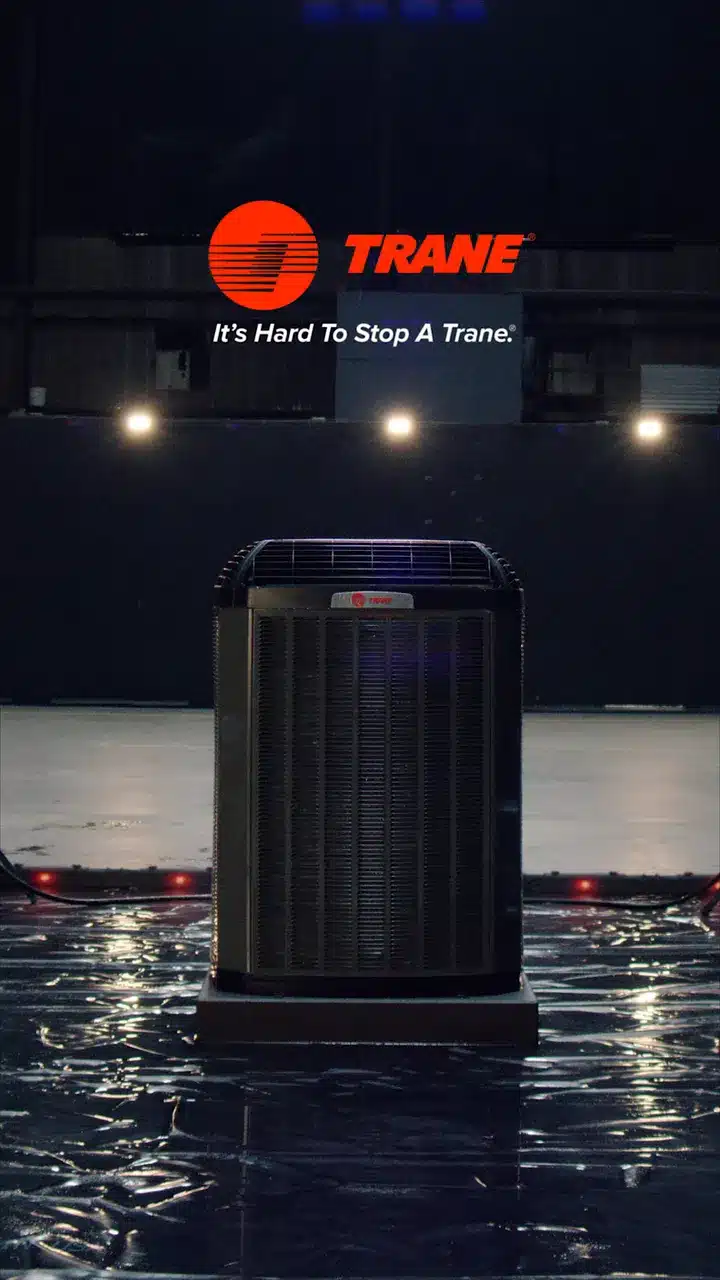
Heat lamps, snow and rain on one outdoor unit: that’s Trane’s own film. We’re a Trane Comfort Specialist, on Trane’s own dealer locator, and when you pick a Trane, our crew puts it in.
Films: Trane’s own.
Check these before you call
- The breaker. If you’ve had construction or repairs done, Google says a breaker may still be off.
- The system switch. It looks like a light switch near the furnace or air handler. Some houses have two, one for heat and one for cooling.
- The furnace door. A furnace won’t run if a panel is off or loose. Push it until it seats. Don’t pull off a panel sealed with metal tape or sealant.
- The drain. Water in the drip pan, a full condensate pump or a wet floor by the furnace can shut the system off on purpose. Why the drain shuts the furnace off.
- The filter. A clogged one trips the furnace’s safeties. Which filter to buy.
- Then wait. Once power is back, the Nest has to recharge before it acts normal.
If the Nest just went in, the code is usually the wiring: a wire in the wrong connector, two wires in one, or a jumper the old thermostat needed and the Nest doesn’t. Turn the breaker off before you touch a wire.

When it’s a call
- An E code that comes back after the breaker, the switch, the door and the filter check out.
- Any overcurrent code, or N416 to N423.
- A Furnace Heads-Up with a clean filter, or a compressor heads-up.
- Water in the pan you can’t clear, or a blown fuse on the control board.
- No heat and a code you can’t place.
When we come out for a Nest code, the technician checks the whole system, not just the thermostat: the equipment, the wiring at both ends, the filter and the drain. The diagnostic is a flat $99, the repair is priced in writing before anything starts, and if the problem really is the thermostat, we say so. A thermostat replaced and set up runs $300 to $640. A control board, the most expensive thing a Nest code usually turns into, runs $550 to $1,180.
If yours is a 1st or 2nd generation Learning Thermostat, Google ended support for those models in the Nest and Home apps on October 25, 2025 (Google). A code on one of those is a good moment to decide whether it stays.
Every repair visit is a good time to get ahead of the rest of winter. Our heating check is $67 per system, through December 31: furnace, heat pump or boiler. The blank-screen steps are in our thermostat guide, and the no-heat checklist is on our service page.
Code meanings and on-screen messages are Google’s, from its Nest help pages: error codes, power problems, overcurrent errors, Furnace Heads-Up, compressor heads-up, older Nest support. Last checked November 10, 2026.
Book it
Book a visit online and put the code in the note, or call (703) 997-9757, answered 24/7. Book from goswiftpro.com/cookiesoffer by November 30 and a box of warm cookies comes with the visit. Rated 5.0 stars across 1,138 reviews on Google, Angi, Yelp, the BBB and Facebook, Virginia Class A license 2705192276.
Questions people ask
What do Nest thermostat error codes mean?
Each code names a wire problem. E codes are critical: Google says the Nest won’t let you control heating or cooling until the cause is fixed. N codes are notices about the same wires. E74, for example, means no power to the Rh wire.
What’s the difference between an E code and an N code on a Nest?
E codes block heating or cooling control until the cause is fixed. N codes flag a wire or power problem the Nest noticed, often one that shows up only some of the time, like in extreme cold.
Is a Nest error code a problem with the thermostat or the furnace?
Usually the system side: a breaker, a switch, a furnace door, a clogged drain, a loose wire or a worn part on the control board. The Nest is reporting what it sees on its wires.
Will restarting my Nest clear an error code?
Not an E code. Google says the message won’t go away until the cause has been fixed, so find the cause first.
Who fixes Nest thermostat errors in Northern Virginia?
SwiftPro Heating, Cooling & Plumbing checks the Nest, the wiring and the system behind it across Northern Virginia, with a flat $99 diagnostic and the repair priced in writing first.


