


The short answer
A Nest Furnace Heads-Up in Northern Virginia means the Nest saw your forced-air furnace keep quitting within 15 minutes of starting to heat. The message reads “Nest noticed that your furnace shuts down within 15 minutes of heating.” Google names a clogged air filter as the most likely reason, so check the filter first. If the filter’s clean, a safety inside the furnace is shutting it down, and that’s a service call.
What the Nest is watching
The Furnace Heads-Up works on forced-air furnaces. The Nest keeps track of how long the furnace runs each time it heats, and when it keeps shutting down early, the alert goes up. Google itself says it isn’t foolproof and doesn’t replace regular service, so treat it as a tip, not a diagnosis.
Google’s list of likely causes: a clogged filter, a clogged evaporator coil, a broken fan motor, blocked ducts or vents, and poor gas pressure. Most of those choke the airflow. A furnace that can’t move enough air overheats, a limit switch shuts the burners off to protect it, and once it cools down it lights again. That’s short cycling, and the Nest is the one that noticed.

The $67 Heating Check
We check your furnace, heat pump or boiler before winter. Through December 31. See the offer
Check these first
- The filter. Pull it and hold it up to a light. If you can’t see through it, replace it. Which filter to buy.
- Vents and returns. Open, and not covered by rugs, furniture or curtains.
- Google’s test. In the Nest’s System Test menu, run the Furnace Heads-Up test. It’s a 15-minute heating test and needs Wi-Fi. If it still fails with a new filter in, the cause is in the furnace.
What it usually turns out to be
Swipe to see all columns →
Swipe to see all columns →
| What we find | What it does | Price |
|---|---|---|
| Clogged filter | Chokes the airflow until a limit switch shuts the burners off | A new filter |
| Dirty flame sensor | The burners light, then shut off within seconds | $95 to $180 |
| Dirty blower wheel | Moves less air every year until the furnace overheats | $229 with the heating check |
| Weak blower capacitor | The blower slows or hums and the heat builds up | $240 to $370 |
| Clogged condensate drain | A high-efficiency furnace shuts itself off before the water overflows | $175 to $420 |
| Low gas pressure | The furnace can’t make full heat | Measured on the visit |
The compressor heads-up
The heat pump version shows up on air conditioners and heat pumps, in heating or cooling, as a message like “There’s an issue with your compressor.” Google says it goes up when the Nest sees a pattern of unexpected temperature changes that a temporary shutoff doesn’t fix.
Google’s list of causes: a safety lockout, a failed compressor motor or startup capacitor, the system running in the wrong mode because of a wiring problem, and on heat pumps, a stuck reversing valve. You can dismiss the alert by turning the ring. Before you call, check that the heat pump’s O/B setting in the Nest matches your system, because a wrong setting heats when it should cool.
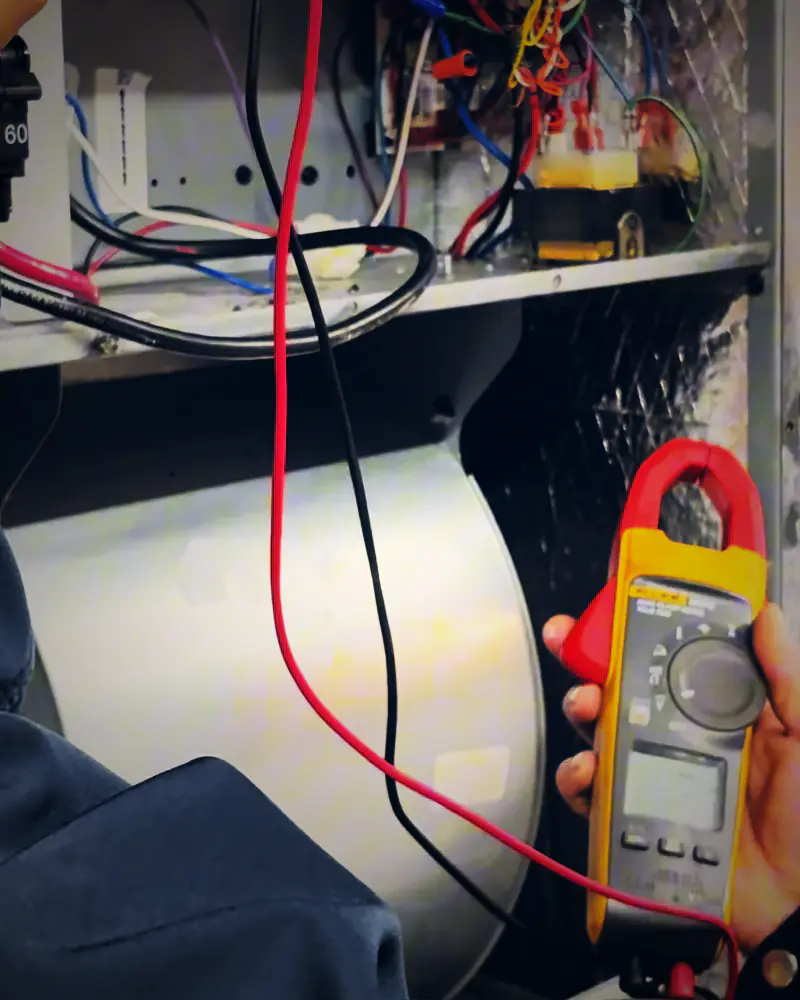
A capacitor is one of the more common fixes. A run capacitor replaced runs $240 to $370. If the heat pump is iced over, read heat pump covered in ice, and if the house is warm but the bill isn’t, aux heat and emergency heat is probably why. Heat pump repair covers the rest.
When it’s a call
- The Furnace Heads-Up comes back, or the test fails, with a new filter in.
- The burners light and shut off within seconds.
- Any compressor heads-up after the O/B setting checks out.
- A burning smell, or the furnace cycling on and off all night.
When we come out for a Nest code, the technician checks the whole system, not just the thermostat: the equipment, the wiring at both ends, the filter and the drain. The diagnostic is a flat $99, the repair is priced in writing before anything starts, and if the problem really is the thermostat, we say so.
A furnace that throws a Heads-Up has usually gone a while without a cleaning. Our heating check is $67 per system, through December 31: furnace, heat pump or boiler. On a furnace, for $229 (regularly $467) we also pull the blower wheel and clean it blade by blade.
Every Nest code is on our Nest error code list. If the screen says E74 instead, it’s the E74 post.
Code meanings and on-screen messages are Google’s, from its Nest help pages: Furnace Heads-Up, compressor heads-up. Last checked November 10, 2026.
Book it
Book a visit online and put the code in the note, or call (703) 997-9757, answered 24/7. Book from goswiftpro.com/cookiesoffer by November 30 and a box of warm cookies comes with the visit. Rated 5.0 stars across 1,138 reviews on Google, Angi, Yelp, the BBB and Facebook, Virginia Class A license 2705192276.
Questions people ask
What is the Nest Furnace Heads-Up?
An alert that the Nest saw your forced-air furnace keep shutting down within 15 minutes of starting to heat. Google names a clogged filter as the most likely cause.
Why does my furnace shut off after a few minutes?
Usually airflow: a clogged filter, a dirty blower wheel or blocked vents let the furnace overheat until a limit switch shuts it off. If it shuts off within seconds of lighting, a dirty flame sensor is the usual cause.
How do I run the Nest Furnace Heads-Up test?
Open the System Test menu on the Nest and run the Furnace Heads-Up test. It heats for 15 minutes and needs a Wi-Fi connection.
What does there’s an issue with your compressor mean on a Nest?
It’s the compressor heads-up. Google lists a safety lockout, a failed compressor motor or startup capacitor, a wiring problem putting the system in the wrong mode, or a stuck reversing valve on a heat pump.


