


The short answer
A Rheem heat pump in Northern Virginia shows its fault on a board inside the outdoor unit, and on a communicating system the same code shows on the EcoNet thermostat. On the variable-speed units an L in front of the number means it locked out. The codes we see most are 21 (low refrigerant pressure), 29 (high pressure), 83 and 84 (a temperature sensor) and 27 (low voltage). A plain d on the display isn’t a fault at all: the unit is defrosting.

Where to look
There’s 240 volts behind the outdoor unit’s service panel, so don’t open it to read a light. On an EcoNet system the thermostat shows the code with a suffix, and _O means the outdoor unit. Older single-speed heat pumps show two lights on the defrost board, which a technician reads with the panel off. If you can’t see a code, the symptom and the thermostat screen are enough for us to start.
The $67 Heating Check
We check your furnace, heat pump or boiler before winter. Through December 31. See the offer
Variable-speed units: the two-digit display
Rheem’s variable-speed outdoor units (the P20 and P17 heat pumps and the A20 and A17 air conditioners) have a small two-digit display on the board.
Swipe to see all columns →
Swipe to see all columns →
| Code | What it means | What usually causes it |
|---|---|---|
| 21 / L21 | Low refrigerant pressure | A leak, a restriction or the metering device |
| 29 / L29 | High refrigerant pressure | A dirty outdoor coil, the outdoor fan or too much refrigerant |
| 27 | Low line voltage | Under 187 volts at the unit: the breaker, the disconnect or the utility |
| 28 | High line voltage | A call to the power company |
| 31 | Compressor outside its safe range | Often too much refrigerant |
| 35 / 36 | Suction temperature or pressure sensor | The sensor or its wiring |
| 83 | Coil temperature sensor | Cools fine, won’t heat |
| 84 | Outdoor temperature sensor | The sensor or its wire |
| 4 / L4 | The compressor couldn’t start | A weak capacitor, refrigerant in the compressor after a long off cycle, or a seized compressor |
| 9 / L9 | Brownout | Voltage dropped at start or while running: loose connections, wire size |
| 48 | No voltage at the compressor | The contactor isn’t pulling in |
| 49 | Voltage at the compressor in standby | A welded contactor |
| 93 / d1 | Board setup or memory card | A technician restores or replaces it |
Not every model uses every code, and 15 or 16 on its own only says the inverter drive has a fault. The alarm on the thermostat names which one.
When it locks out
The pressure switches get three tries. In cooling, three low pressure trips in one call lock the unit out for an hour, and three high pressure trips lock it out until it’s reset. In heating, three low pressure trips within two hours is a hard lockout. The voltage codes, 27 and 28, clear on their own once the power is back in range.
One reset is fine: turn off both breakers, the one for the outdoor unit and the one for the indoor unit, wait about a minute so the boards fully power down, then turn them back on. If the same L code comes back, it’s a refrigerant or electrical problem, and another reset just runs the compressor into the same wall.
Single-speed heat pumps: two lights
Rheem’s Classic single-speed heat pumps (the P14 and P15) use two lights on the defrost board.
Swipe to see all columns →
Swipe to see all columns →
| Light 1 | Light 2 | What it means |
|---|---|---|
| Flash | Flash | Normal |
| Alternating | Alternating | Five-minute wait before the compressor restarts. Normal. |
| On | Off | Defrosting |
| Off | Off | No power to the board |
| On | On | Coil sensor failed, so no defrost |
| Off | On | Outdoor air sensor failed |
| Off | Flash | Low pressure lockout |
| Flash | Off | High pressure lockout |
| On | Flash | Low pressure switch open |
| Flash | On | High pressure switch open |
A pressure lockout comes after three trips in one call. A technician clears it by shorting the board’s test pins, which is why it isn’t a homeowner reset.
Older two-stage units: a yellow alert light
Some older two-stage Rheem heat pumps have a Comfort Alert module with a yellow light. Count the flashes: 1 is a long run time, 2 a pressure switch trip, 3 short cycling, 4 a locked compressor, 5 an open circuit, 6 an open start circuit, 7 an open run circuit, 8 a welded contactor and 9 low control voltage.
Defrost is normal
In heating weather the outdoor coil frosts over. When the coil is under 35F after about 34 minutes of run time, the unit defrosts: the outdoor fan stops, the valve shifts and the indoor unit brings on backup heat so you don’t get cold air. It ends when the coil warms up, or after 14 minutes. You’ll hear a whoosh and may see steam off the top, and the variable-speed display shows d. A defrost that runs the full 14 minutes every time points at the coil sensor. Our heat pump covered in ice guide covers when frost isn’t normal.

The indoor unit has its own light
A Rheem air handler has its own fault light, with codes 2 through 10. Don’t mix it up with the CFM light next to it, which shows airflow, not a fault.
What you can safely check
- Set the thermostat to heat, a few degrees over the room temperature.
- Check both breakers: one for the outdoor unit, one for the air handler and its backup heat.
- Change the filter if it’s gray. Our filter guide covers sizes.
- Keep 2 feet clear around the outdoor unit, and brush snow off the top and away from the sides.
- Reset once, the way we described, and write down any code that comes back.

What not to do
Don’t chip ice off the coil: the fins fold and the tubes puncture. Don’t open the outdoor panel or short the test pins. If the house is cold while you wait, switch the thermostat to emergency heat; our aux and emergency heat guide explains what that costs to run.
What a technician does
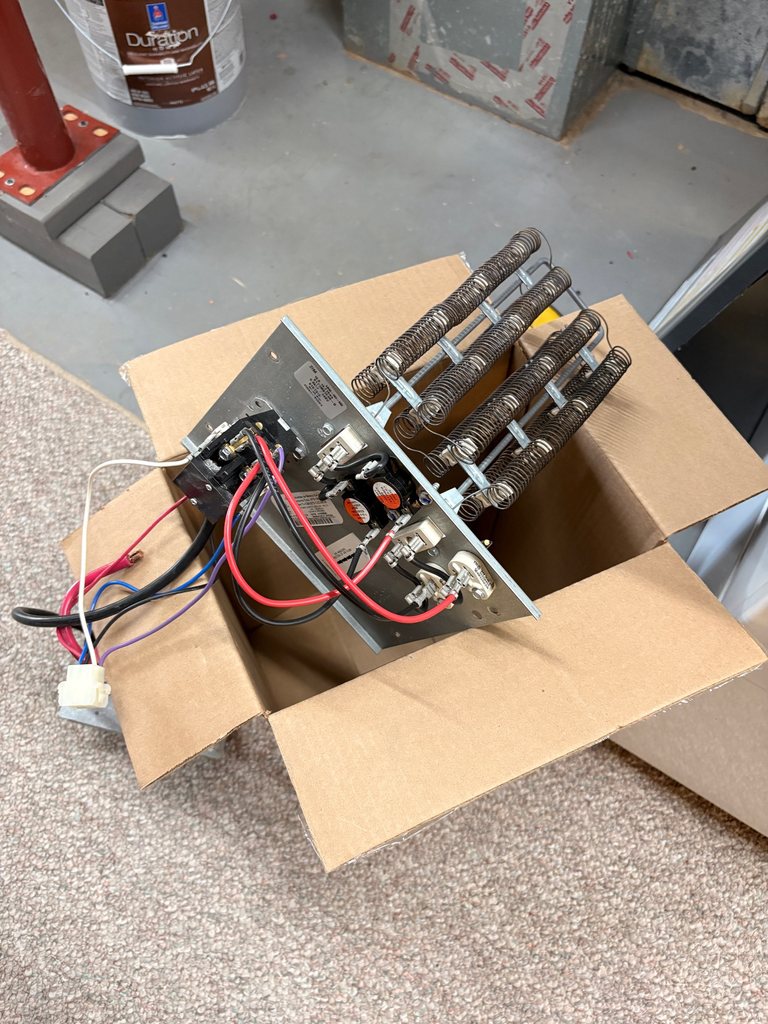
We read the fault history first: the variable-speed board stores it in a service menu. Then we test what the code points at: pressures on gauges, superheat and subcooling to judge the charge, the sensors’ resistance against Rheem’s chart (10,000 ohms at 77F), the capacitor in microfarads, the contactor and the line voltage. You get the price before we fix anything.
Our heating check is $67 per system, through December 31: furnace, heat pump or boiler.
Related: heat pump noises, heat pump running constantly, heat pumps in a Virginia winter, Rheem EcoNet thermostat codes, Rheem AC not turning on and heat pump repair. Different brand? Goodman, Carrier, Lennox or every brand in our error codes guide.
Every code meaning here comes from Rheem’s own documents: P20 heat pump manual, P17 heat pump manual, Classic Plus heat pump manual, P14 and P15 manual, A17 troubleshooting, Comfort Alert guide and air handler troubleshooting.
Call or book
A repair visit starts with a flat $99 diagnostic, or $250 after hours, and you get the price of the fix before we touch anything. Call (703) 997-9757, day or night, and tell us the code you counted, or book online from goswiftpro.com/cookiesoffer by November 30 and a box of warm MOLTN cookies comes with the heating check. Every current deal is on our offers page. Rated 5.0 stars across 1,138 reviews on Google, Angi, Yelp, the BBB and Facebook, Virginia Class A license 2705192276.
Questions people ask
What does L21 mean on a Rheem heat pump?
The low pressure switch opened three times and the unit locked out. That usually means low refrigerant from a leak, or a restriction. It needs gauges, not another reset.
What does code 29 mean on a Rheem outdoor unit?
High refrigerant pressure. Start with a dirty or blocked outdoor coil and the outdoor fan. After three trips in one cooling call it locks out as L29 until it’s reset.
Why does my Rheem heat pump show d?
It’s defrosting, which is normal in cold weather. The outdoor fan stops for up to 14 minutes and the backup heat runs so the air inside stays warm.
How do I reset a Rheem heat pump?
Turn off the breakers for the outdoor unit and the indoor unit, wait about a minute, and turn them back on. One reset is fine; if the same code comes back, call for service.


