


The short answer
Carrier heat pump codes in Northern Virginia flash on an amber light on the control board inside the outdoor unit: short flashes are the first digit, long flashes the second. 31 is high pressure, 32 is low pressure, 46 is a brownout, 47 means no 230-volt power, and the 80s are 4-hour lockouts after repeated trips. Before you chase a code, know this: a heat pump blowing cool air for a few minutes with steam rising off the outdoor unit is often just defrosting, and that’s normal.
How to read the light
A short flash lasts about a quarter second and a long flash about a full second, with a 2.5 second pause before the code repeats. 3 short and 2 long is 32. The board sits behind the outdoor unit’s service panel, where there’s 240 volts, so that panel is a technician’s job. If you have a Carrier Infinity control indoors, it shows the same number on the screen.
Swipe to see all columns →
Swipe to see all columns →
| The light shows | What it means |
|---|---|
| Steady on | Standby, no fault |
| 1 flash, then a pause | Running on low stage (or variable speed) |
| 2 flashes, then a pause | Running on high stage |
| Continuous flashing, variable-speed units | Emergency mode: a regular thermostat is wired in place of the Infinity control |

The $67 Heating Check
We check your furnace, heat pump or boiler before winter. Through December 31. See the offer
Carrier heat pump codes
These come from Carrier’s service manuals for its two-stage 24 and 25 series and its variable-speed 25VNA heat pumps.
Swipe to see all columns →
Swipe to see all columns →
| Code | What it means | What usually takes it |
|---|---|---|
| 16 | Lost communication with the indoor unit | The ABCD wiring, the model plug, or a brownout that froze the data line; cycle the power |
| 25 | Invalid model plug | A tech |
| 31 | High pressure or discharge temperature switch open | Refrigerant charge, outdoor fan, airflow |
| 32 | Low pressure switch open | Refrigerant charge, indoor airflow |
| 45 | Control board failed | A new board |
| 46 | Brownout: under 187 volts for 4 seconds or more | Waits for power over 190 volts |
| 47 | No 230 volts at the unit | The breaker or the outdoor disconnect |
| 48 | Lost communication with the inverter (variable speed) | A tech |
| 53, 55, 56 | A temperature sensor fault | A sensor or its wiring |
| 68 | Warming the compressor after a power loss (variable speed) | Wait: up to 2 hours, backup heat covers |
| 69 | Inverter or compressor fault (variable speed) | A tech |
| 71, 72 | Thermal cutouts | A tech |
| 73 | Contactor shorted | A new contactor |
| 74 | No 230 volts at the compressor | A tech |
| 81, 82 | Thermal lockout, 4 hours | A tech |
| 83 | Low pressure lockout, 4 hours | Charge or indoor airflow |
| 84 | High pressure lockout, 4 hours | Charge or outdoor airflow |
| 95 to 99 | 2-hour lockouts (variable speed) | A tech |
On the two-stage units, a 31 or 32 waits 15 minutes and tries again, and cycling the thermostat power skips the wait. Three trips in a row brings the 4-hour lockout. A 31 that keeps tripping ends in an 84 lockout, and a 32 in an 83.
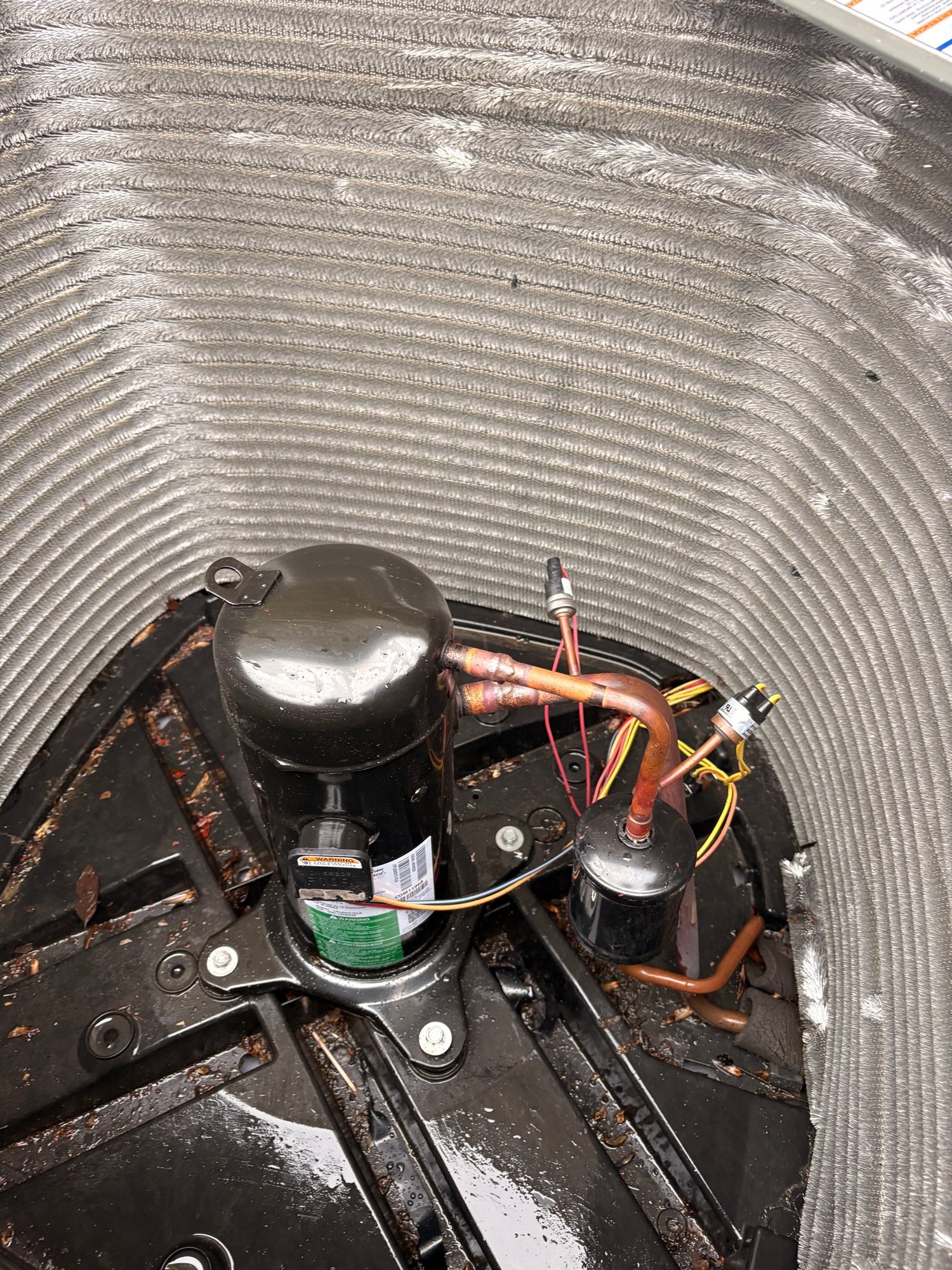
What sets off a pressure lockout
Carrier’s list for an 83, the low pressure lockout: a service valve left closed, low refrigerant charge, low airflow across the indoor coil from a clogged filter, ice or a blower problem, a restriction in the filter drier or a kinked line, or a metering valve problem. For an 84 or 99, the high pressure side: a closed service valve, too much refrigerant, low airflow across the outdoor coil, a restriction, air in the system, or the electric heat or furnace running at the same time as the heat pump.
When it’s only defrost
In heating mode, frost builds on the outdoor coil, and the heat pump reverses for a few minutes to melt it. Carrier says defrost typically runs 5 to 10 minutes, and frost under a quarter inch thick is normal. You’ll see steam outside and feel cooler air at the vents. Normal heat pump air runs 85 to 100 degrees, which feels cooler than a furnace. Call if heavy ice stays on the coil after a defrost, and use emergency heat sparingly until then. Our heat pump covered in ice guide and aux heat vs emergency heat explain both.
What you can safely check
- Thermostat set to heat, and set a few degrees over the room.
- Both breakers: the one in your panel and the disconnect box next to the outdoor unit. A 47 points here.
- A clean filter. Low indoor airflow sets off a 32 or an 83.
- Snow, leaves or a cover around the outdoor unit. Clear it by hand, and don’t chip ice off the coil.
- After a power outage on a variable-speed unit, give it up to 2 hours. A 68 means it’s warming the compressor on purpose.
What a technician does
We read the code history, put gauges on the system, and check the charge, airflow on both coils, the sensors and the board. A lockout that keeps coming back has a cause, and the reset just buys time. A repair visit starts with a flat $99 diagnostic, and you get the price of the fix before we touch anything. Our Carrier repair page lists what the common repairs cost. Our heat pump repair page covers the rest.
Our heating check is $67 per system, through December 31: furnace, heat pump or boiler.
Related: heat pumps in a Virginia winter, heat pump covered in ice, and for the furnace side, our full list of Carrier furnace codes.
Every code meaning here comes from Carrier’s own documents: 24 and 25 series service manual, 25VNA service manual and heat pump not heating guide.
Call or book
Call (703) 997-9757 and tell us the code you counted, or book online from goswiftpro.com/cookiesoffer and a box of warm cookies comes with the visit. Rated 5.0 stars across 1,138 reviews on Google, Angi, Yelp, the BBB and Facebook, Virginia Class A license 2705192276.
Questions people ask
How do I read Carrier heat pump error codes?
Count the amber light on the outdoor unit’s control board: short flashes are the first digit, long flashes the second, then a 2.5 second pause. An Infinity control shows the same number indoors.
What does code 83 mean on a Carrier heat pump?
A low pressure lockout for 4 hours after repeated trips. Carrier points at low refrigerant, low airflow across the indoor coil, a closed service valve or a restriction.
Why won’t my Carrier heat pump start after a power outage?
A variable-speed Carrier heat pump shows 68 while it warms the compressor for up to 2 hours after the power comes back. Backup heat covers the house until then.
Is my heat pump broken if it blows cool air in winter?
Not if it’s for a few minutes with steam rising outside. That’s the defrost cycle, which Carrier says typically runs 5 to 10 minutes.

